You Are Not Your Thoughts: What the Science of Being Asks You to Reconsider About Who You Are
There is a question you have been avoiding your entire life, even though you carry it with you every single moment. It is not about your career, your relationships, or your bank account. It is closer than all of those. It is the question of who is actually here, looking out through your eyes, while you read these words.
Most of us never stop to ask it. We are too busy managing the surface of our lives — the schedules, the obligations, the endless stream of thoughts about what happened yesterday and what might happen tomorrow. We treat ourselves as though we are the voice narrating inside our skulls, and we never once pause to ask: If I can hear that voice, who is the one listening?
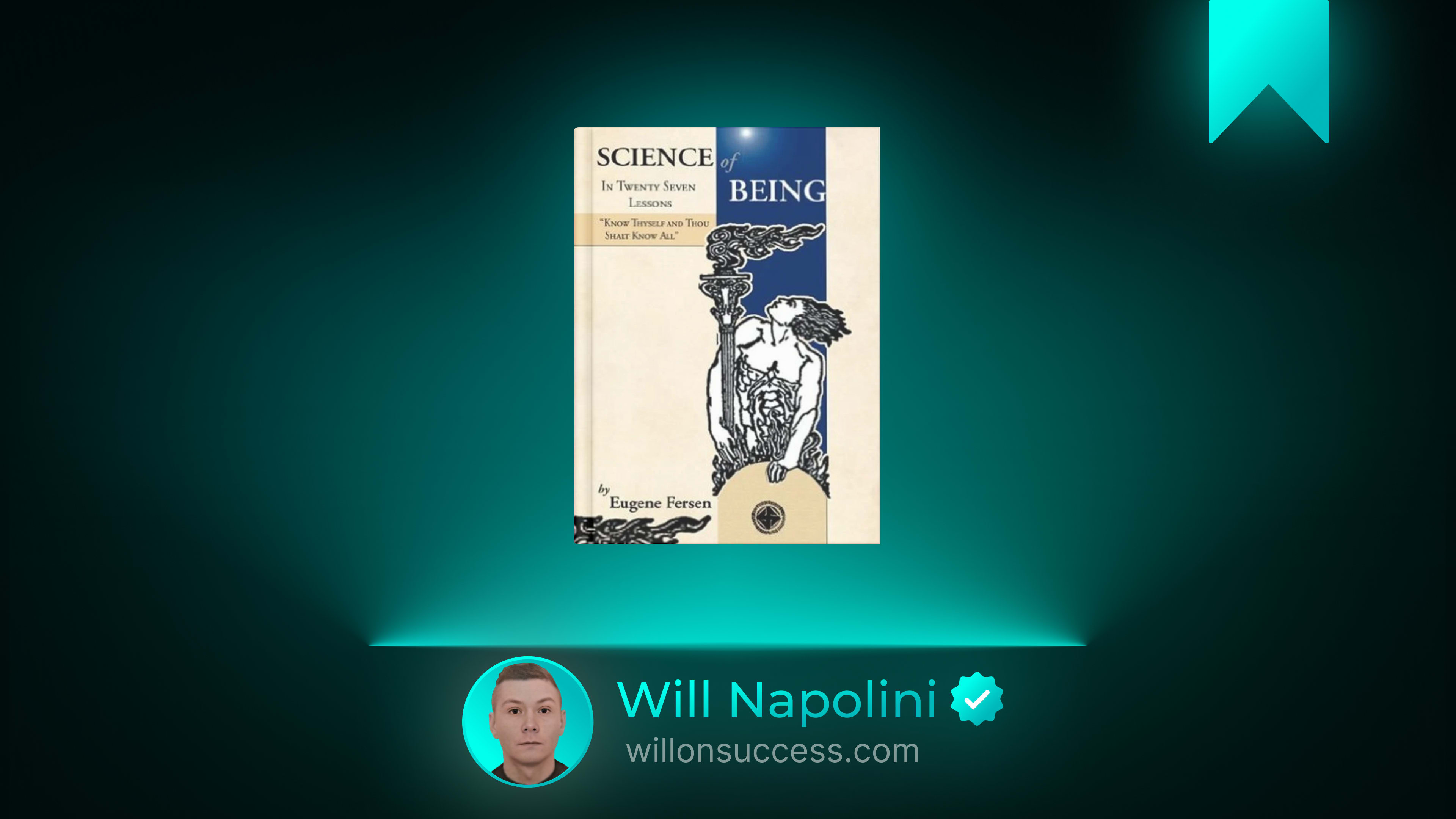
Eugene Fersen’s Science of Being is built around that pause. The book takes what might sound like an abstract metaphysical question — what is the nature of existence, of consciousness, of the self? — and treats it not as a puzzle for academics, but as the most practical inquiry a person can undertake. Because the answer you live inside, whether you realize it or not, shapes every decision you make, every relationship you enter, and every morning you wake up into.
If you have ever felt like you are performing your life rather than inhabiting it, this book is asking you to stop, look down, and notice that the ground you have been searching for has been under your feet the entire time.
The Big Idea: You Have Been Confusing the Map for the Territory
The central argument running through Science of Being is deceptively simple, though its implications are enormous: most of what we call “our life” is not life itself. It is a mental model of life. It is a running commentary, a simulation, a story we tell ourselves about our experience. And we have mistaken that story for the experience.
Think of it this way. You are sitting in a chair. You feel the weight of your body, the temperature of the air on your skin, the pressure of your feet against the floor. That is direct experience. That is being. But within a fraction of a second, your mind overlays that experience with language: I am sitting. This chair is uncomfortable. I need to finish this email. Did I lock the door? And suddenly, you are no longer sitting in a chair. You are sitting inside a thought about sitting in a chair. You have left the territory and entered the map.
Fersen’s work invites the reader to notice this shift — not to condemn it, because thinking is useful and necessary — but to recognize that you have a choice about whether you live entirely inside the map or whether you can return, again and again, to the ground of direct awareness beneath it.
The “science” in the title is important. This is not a book asking you to believe something on faith. It is asking you to look. To investigate your own experience with the same patience and honesty you would bring to any careful observation. The laboratory is your own attention. The experiment is noticing what is actually here, before thought adds its commentary.
The Story of the Endless Search
There is a pattern Fersen explores that I think most of us will recognize immediately, even if we have never named it. It is the pattern of the endless search.
We believe that if we just get the next thing — the promotion, the relationship, the house, the diagnosis, the resolution — then we will finally arrive. Then we will finally feel solid. Then the restless hum of not-enough will quiet down, and we will be able to rest inside our own lives.
So we chase. We optimize. We plan. We accumulate. And for a brief moment after each achievement, the hum does quiet. But then it starts again, quieter perhaps, but persistent. What’s next? What’s missing? What if I lose what I just gained?
The book does not frame this as a character flaw. It frames it as a structural misunderstanding. You are looking for a sense of completeness in objects, outcomes, and experiences. But the thing that is looking — the awareness itself — is not an object. It is not something you can acquire or achieve. It is what you already are, before the search begins.
Imagine a wave searching the ocean for water. It leaps from crest to crest, convinced that somewhere ahead there is a patch of ocean that will finally make it feel wet. It never occurs to the wave to stop leaping and notice that it is already, entirely, made of the thing it seeks.
That is the situation Fersen describes. Not in mystical language. Not as a riddle. But as a direct observation about the structure of your own attention.
Awareness Is Not the Same as Thinking
One of the most important distinctions the book draws — and the one I think will change the most for you if you let it — is the distinction between awareness and thought.
We tend to use these words interchangeably. I am thinking, therefore I am. But Fersen asks you to test that assumption. When you are thinking, there is the thought. But there is also something that notices the thought. Something that can watch a worry arise, observe it, and decide not to follow it. That watching presence is not itself the worry. It is prior to it. It is the space in which the worry appears.
This is not a minor philosophical point. It is the difference between being swept down a river and standing on the bank watching the water pass.
If you are the thought, then every anxious thought defines you. Every self-critical voice is the truth about who you are. Every fear is a command you must obey. You are at the mercy of whatever mental weather happens to blow through.
But if you are the awareness in which the thought appears — the sky rather than the clouds — then something shifts. The thought still comes. The anxiety still rises. The self-criticism still speaks. But it no longer has total authority. You can hear it without becoming it. You can let it pass without building your identity around it.
I have seen this distinction change people’s lives. Not because it makes the difficult feelings go away. They do not go away. But because it creates a small space between stimulus and response, between what happens to you and the story you build about what happens. And in that space, you find something you may not have felt in a very long time: choice.
The Body as the Anchor of Presence
The book does not leave you floating in abstract philosophy. It returns, repeatedly, to the physical. To the body. To the breath. To the felt sense of being alive in a specific place at a specific time.
This matters because the mind is a time machine. It is almost always somewhere else — replaying last Tuesday, rehearsing next Thursday, constructing elaborate futures that will never arrive. The body, by contrast, is always here. It cannot be in the past. It cannot be in the future. Your feet are on the floor now. Your lungs are filling now. The light is hitting your retina now.
When Fersen speaks of returning to being, a great deal of that return is simply returning to the body. Not as an object to be optimized, sculpted, or disciplined. But as the most immediate evidence that you exist, that you are here, that life is happening in this exact moment rather than in the story you are telling about it.
You start small. You feel your hands resting in your lap. You notice the temperature of the air entering your nostrils. You feel the weight of gravity holding you to the earth. None of this requires belief. None of it requires faith. It only requires that you point your attention toward what is already happening and let it register.
This is where consistency matters more than intensity. You do not need to meditate for two hours on a mountaintop. You need thirty seconds of genuine, undistracted attention to your own breathing, repeated until it becomes as natural as blinking. Small returns. Hundreds of them. Thousands. Until the habit of living inside the map loosens, and the habit of touching the ground strengthens.
The Self You Are Defending Is Smaller Than You Actually Are
There is a thread in the book that I find both challenging and deeply liberating, and I want to be honest with you about it because it is not a comfortable idea.
The self you spend most of your energy defending — the image you present to the world, the story of who you are, the reputation you protect, the identity you have built from your achievements and your wounds — that self is not the deepest layer of what you are. It is a construction. A useful one, in many ways. But a construction nonetheless.
And because it is a construction, it is fragile. It requires constant maintenance. It must be validated, defended, polished, protected from criticism. A tremendous amount of your daily energy goes into maintaining this image, and much of what we call stress, anxiety, and exhaustion is simply the fatigue of that endless maintenance.
The book does not ask you to destroy your identity or become a blank slate. You still need a name, a role, a story that allows you to function in the world. But it asks you to hold that story a little more lightly. To recognize that you are not identical to it. That beneath the name, the title, the history, and the personality, there is something quieter and more fundamental. Something that was here before the story began and will be here after it changes.
When you stop spending all your energy defending a small, constructed self, you free up an extraordinary amount of life. You become less reactive to criticism, because the criticism is hitting a character in a story, not the awareness reading the story. You become more generous, because you are no longer hoarding your energy for self-protection. You become more present in your relationships, because you are no longer performing. You are simply there.
Why This Matters on an Ordinary Tuesday
I want to bring this down from the philosophical and into the Tuesday afternoon, because if this idea does not change how you handle a difficult email or a tense dinner conversation, then it is just decoration.
Think about the last time someone criticized you at work. Notice what happened in your body. The tightening. The heat. The immediate mental cascade: They don’t understand. I need to defend myself. What if this affects my evaluation? You were no longer in the room. You were in the story about the room.
Now imagine a small gap. A half-second of awareness that notices the tightening before the story takes over. You feel the heat in your chest. You notice the thought I need to defend myself arising. And because you notice it, you are not entirely inside it. You can choose your response. You can say, “Tell me more about what concerns you,” instead of snapping back. You can let the feeling move through you without letting it drive the car.
That half-second is what Fersen is pointing toward. Not a permanent state of enlightenment. Not a life free of difficulty. Just the half-second of awareness that changes everything downstream.
Or think about your relationships. How often do you listen to someone while simultaneously composing your response? How often are you physically present with a person you love while your mind is three steps ahead, planning, judging, rehearsing? The book asks: what would it be like to actually be with someone? To let your attention rest on them without agenda, without the need to fix or impress or perform?
That kind of presence is rare. And because it is rare, it is one of the most generous gifts you can offer another human being. You do not need to be clever. You do not need to solve their problem. You just need to be there, fully, without the noise of your own mental narration drowning out the sound of their voice.
The Difference Between Knowing and Being
There is a distinction the book draws that I think is essential, and it is this: there is a vast difference between knowing about something and being it.
You can read every book on patience and still lose your temper in traffic. You can memorize every principle of compassion and still speak sharply to your child when you are tired. You can understand the theory of presence intellectually and still spend your entire dinner scrolling through your phone.
Knowledge is information. Being is embodiment. The gap between them is bridged only by practice, by repetition, by the slow and often humbling work of bringing what you understand down into how you actually move through a Tuesday.
This is why the book resists the temptation to become another intellectual framework to add to your collection. It keeps pointing you back to direct experience. Back to the breath. Back to the felt sense of being here. Back to the question: Right now, in this moment, can I feel that I am alive? Not think it. Feel it.
You do not need more information. You need more contact with what is already here.
Who Should Read This Book — and Who Might Find It Frustrating
I want to be honest about this, because not every book is for every reader, and pretending otherwise does no one a favor.
Who will benefit most: If you are someone who has achieved a measure of external success but still feels a persistent undercurrent of restlessness or disconnection, this book will speak directly to that feeling. If you are exhausted by the performance of maintaining an identity and are ready to explore what exists beneath the performance, you will find real sustenance here. If you are drawn to contemplative traditions but want an approach that feels investigative rather than dogmatic, Fersen’s work meets you in that space.
Who might find it less useful: If you are in a season of acute crisis — financial emergency, active grief, a situation requiring immediate external action — this is not the book to reach for first. It is a book for the person who has enough stability to sit still and look inward. It is also not a book that will give you a five-step action plan or a productivity system. If you need structure, metrics, and clear external benchmarks, you may find the book’s contemplative pace frustrating.
The book earns its place on your shelf not because it tells you what to do, but because it changes the quality of the attention you bring to whatever you are already doing.
Practical Application: Three Experiments for This Week
Understanding without practice is just entertainment. So let me offer you three small experiments. Not tasks to add to your already-full plate. Shifts in where you point your attention.
Experiment One: The Three-Breath Return
Three times a day — when you first sit down at your desk, before you open the car door, and just before you fall asleep — stop everything and take three breaths with your full attention. Feel the air enter. Feel it leave. Notice where you feel it in your body. Do not try to relax. Do not try to clear your mind. Just feel the breath. Three breaths. Ten seconds. That is all.
Experiment Two: The Listening Pause
In your next conversation with someone you care about, try this: when they finish speaking, wait two full seconds before you respond. In those two seconds, simply feel your feet on the ground. Let their words land in you before your mind starts constructing a reply. You will be amazed at how much more you hear when you are not busy preparing your own words.
Experiment Three: Name the Weather, Not the Climate
When a difficult emotion arises — anxiety, frustration, shame — try naming it as though you are reporting the weather. There is tightness in the chest. There is a thought saying I am not enough. There is heat in the face. Notice the language: there is, not I am. You are not the weather. You are the sky in which the weather moves. This small linguistic shift creates the half-second of space that changes everything downstream.
One Small Step
You do not need to overhaul your life tonight. You do not need to sign up for a retreat or restructure your entire morning routine. You need one moment of genuine contact with the fact that you exist.
Here is your step for right now, before you move on to anything else:
Put the screen down. Or look away from it. Feel the surface beneath your hands. Feel the weight of your body in the chair or against the bed. Take one breath — slow, unhurried — and feel it move through you from beginning to end. Notice that you are here. Not thinking about being here. Not narrating being here. Just being here.
That is the whole practice. Everything else is commentary.
The Door Is Already Open
I keep returning to one image after sitting with this book for a long time. It is the image of a tree in winter. The branches are bare. The leaves are gone. To someone passing by quickly, the tree might look dead. Empty. Stripped of everything that made it beautiful in summer.
But the life of the tree was never in the leaves. The leaves come and go. The life is in the trunk, in the roots, in the deep quiet wood that holds steady through every season. The tree does not panic when autumn comes. It does not scramble to replace what was lost. It simply stands in what it is, and trusts that spring is not something it must manufacture. Spring is something that arrives because the roots held.
You have been spending so much of your energy on the leaves. On the image, the performance, the next achievement, the story you tell the world about who you are. And the leaves matter. They are beautiful. They catch the light. But they are not the whole of you, and they were never meant to be permanent.
The question Fersen leaves you with is not What can I add to myself? It is What am I, underneath everything I have added?
And the invitation is not to answer that question with a thought. It is to sit quietly, breathe, and let the answer reveal itself in the silence between the thoughts. In the space where you stop trying to become someone and simply allow yourself to be what you already are.
The roots are already holding. You do not need to manufacture the ground. You only need to stop running long enough to feel it beneath you.
Put your feet flat on the floor. Breathe. And begin.