The 7 Day Startup Summary: How to Break the Cycle of Overthinking and Finally Launch
You may be spending months, or even years, preparing to start the thing you actually want to do.
You have the notebooks filled with ideas. You have researched the domain names. You have mentally mapped out the logo, the website structure, and the five-year growth trajectory. You tell yourself you are being thorough. You tell yourself you are mitigating risk.
But if I could sit across the table from you, I would gently point out a hard reality: you are not mitigating risk. You are hiding.
You are trying to draw a perfect map of a territory you have never visited. And in doing so, you are guaranteeing that you will never actually take the journey.
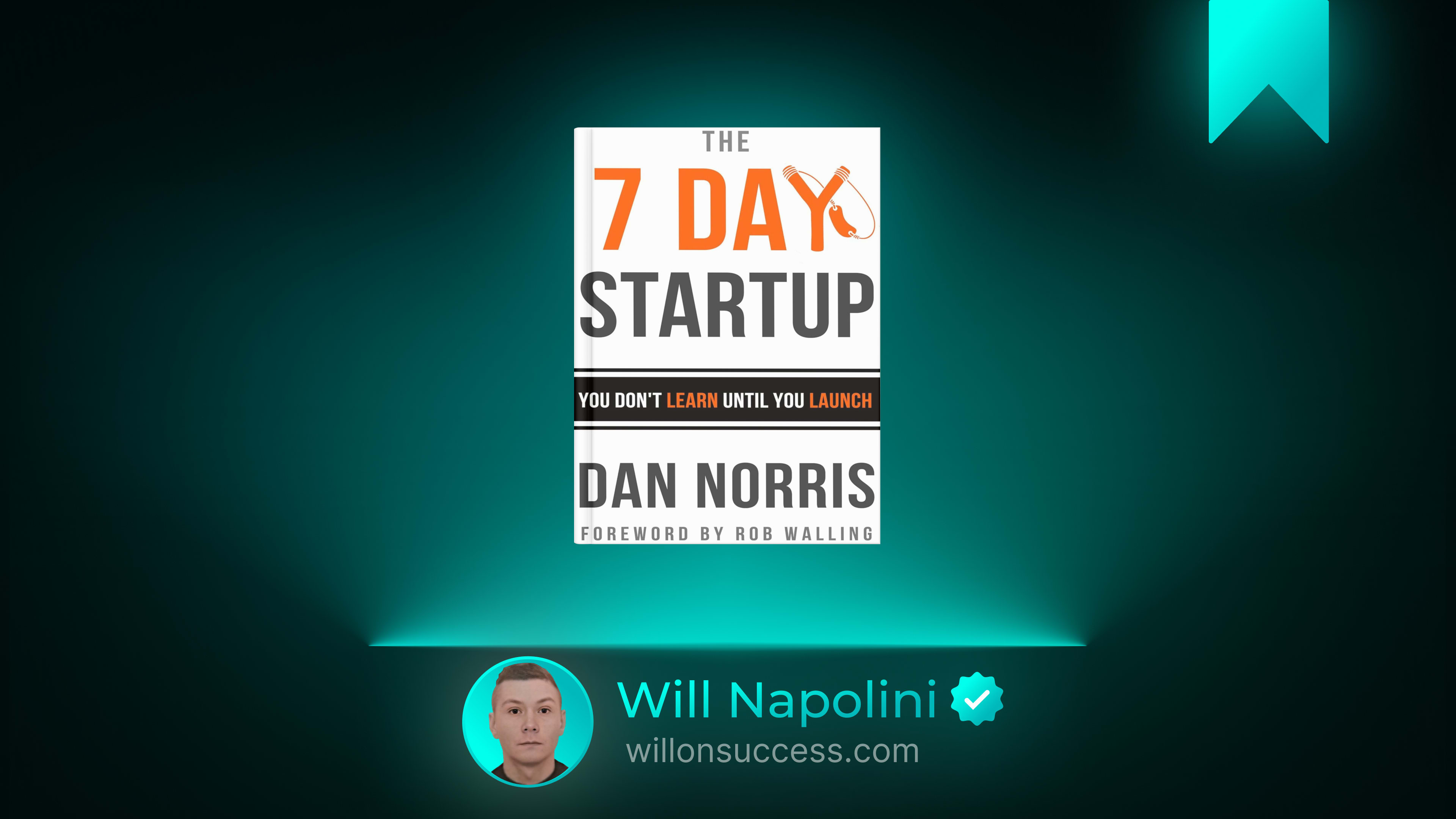
This is the exact trap Dan Norris exposes in his highly practical, no-nonsense book, The 7 Day Startup. While the book is aimed at aspiring entrepreneurs and side-hustlers, its core philosophy is a masterclass in overcoming the paralysis of perfectionism. It is a guide for anyone who has an idea but lacks the momentum to bring it into the real world.
Here is what I have learned from Norris’s framework, and how you can use it to stop planning in the shadows and start building in the light.

The Big Idea: Action Is the Only True Form of Research
The central thesis of The 7 Day Startup is a direct challenge to the traditional, academic approach to business building. Norris argues that you cannot think your way to a successful venture. You must build your way there.
The traditional model suggests you should spend months writing a business plan, perfecting a product in isolation, and then launching to the world with a grand reveal. Norris flips this entirely. He posits that the market is the only valid source of feedback, and the fastest way to get that feedback is to put something—anything—of value in front of real customers as quickly as possible.
The “7 Day” constraint is not a gimmick. It is a psychological tool. When you give yourself infinite time to prepare, your brain will find infinite reasons to delay. Fear of failure, fear of judgment, and the desire for perfection will quietly masquerade as “strategic planning.”
By forcing a seven-day deadline, you short-circuit the overthinking brain. You are forced to prioritize what actually matters: creating a basic, functional version of your idea and getting it into the hands of someone who might pay for it.
Ideas are cheap. Execution is everything. And execution requires momentum, which is only generated by motion.
The Story of WP Curve: Proof in the Trenches
To understand why this works, we must look at the author’s own documented experience. Dan Norris did not write this book from an academic distance; he wrote it from the trenches.
Before he was a bestselling author, Norris was struggling to find a viable business model. He had tried several ventures that failed. Then, he noticed a recurring problem: small business owners with WordPress websites constantly needed minor fixes, but hiring a developer for a ten-minute task was expensive and frustrating.
Instead of spending six months building a complex software platform to automate this, Norris applied the 7-day framework. He spent a week setting up a simple, almost crude subscription service called WP Curve. The initial offering was basic: unlimited minor WordPress fixes for a flat monthly fee.
He did not wait for a perfect website. He did not wait for a massive marketing budget. He launched, reached out to potential customers, and got his first paying subscribers within days.
More importantly, those early customers gave him real feedback. They told him what they actually needed, what was confusing, and what they valued. Norris used that feedback to iterate and improve the service week by week. That simple, seven-day experiment eventually grew into a multi-million dollar company, which he later sold.
He did not succeed because his initial idea was flawless. He succeeded because he started before he was ready, and he let the market guide his evolution.
Perfectionism Is Just Procrastination in a Suit
The Danger of the “Polished” Launch
One of the most insidious lies we tell ourselves is that we need to be fully ready before we begin. We believe that if we just tweak the offering one more time, read one more book, or take one more course, the launch will be effortless.
Norris dismantles this by highlighting a fundamental principle: your first version will be flawed, and that is exactly how it should be.
Perfectionism is not a standard of excellence; it is a defense mechanism. It protects you from the vulnerability of being judged. But in the real world, a flawed product that exists is infinitely more valuable than a perfect product that remains in your head.
When you embrace the 7-day constraint, you give yourself permission to be a beginner. You acknowledge that Day 1 is not about dominance; it is about discovery. You are not building a monument; you are laying a foundation. And foundations are meant to be built upon, not admired in isolation.
The Market Is the Only Judge That Matters
Escaping the Echo Chamber
When we finally do share our ideas, we usually make a critical mistake: we ask our friends and family for feedback.
This is a trap. Your friends and family love you. They want to protect your feelings. They will tell you your idea is “great” and “so innovative,” even if it is fundamentally flawed. This false validation is dangerous. It gives you the confidence to invest months of time and money into something the broader market does not actually want.
The 7 Day Startup framework demands that you seek validation from the only source that matters: strangers with wallets.
If a stranger is willing to exchange their hard-earned money for your product or service, you have validation. If they are not, you have valuable data. A “no” from the market on Day 7 saves you a “no” from the market after two years of wasted effort.
This requires a thick skin, but it also brings immense clarity. You stop guessing what people want and start observing what they actually do.
Constraints Create Momentum
The Power of the Seven-Day Clock
Why seven days? Why not thirty? Why not a year?
Because constraints breed creativity, and deadlines breed action. Parkinson’s Law states that work expands to fill the time allotted for its completion. If you give yourself a year to start a business, you will spend eleven months and twenty-nine days worrying about the font on your business cards.
A seven-day window forces ruthless prioritization. It forces you to ask: What is the absolute minimum I need to do to make this real?
It strips away the non-essentials. You do not have time to build a custom app; you have time to set up a simple landing page and a Stripe account. You do not have time to write a 50-page manual; you have time to record a quick video explaining how your service works.
This constraint shifts your focus from “building a company” to “solving a problem for one person.” That shift in perspective is where all sustainable growth begins.
Why This Matters on an Ordinary Tuesday
You might be thinking, “I am not trying to build the next tech unicorn. I am just trying to freelance, start a small creative project, or propose a new initiative at my job.”
The principles of The 7 Day Startup apply universally because they are principles of human psychology and action, not just corporate strategy.
If you are a freelancer, this framework stops you from spending weeks designing a portfolio website that no one visits. Instead, you spend seven days crafting a single, compelling outreach message and send it to ten potential clients.
If you are an employee, this framework stops you from writing a massive, 40-page proposal that your boss will never read. Instead, you spend a week building a small, functional prototype of your idea and present that.
When you adopt this mindset, your ordinary Tuesday changes. You stop asking, “Is this perfect?” and start asking, “Is this actionable?” You trade the anxiety of preparation for the momentum of progress.
Practical Application: Turning Concepts into Behavior
Understanding the theory is only the first step. Action before intention. Here is how you can apply this framework to your own ambitions starting today.
1. Define Your Minimum Viable Offer (MVO)
Take your grand, sprawling idea and shrink it. What is the smallest, simplest version of this idea that still provides genuine value? If you want to start a coaching business, your MVO is not a six-month comprehensive program with a custom app. Your MVO is a single, one-hour consultation offered to three people at a discounted rate in exchange for detailed feedback. Write down your MVO. It should feel slightly uncomfortable in its simplicity.
2. The Seven-Day Sprint
Open your calendar right now. Pick a date exactly seven days from today. This is your non-negotiable launch date. Work backward from that date. What must be true on Day 7? (e.g., A landing page is live, a payment link is active, and an email has been sent to 20 targeted prospects). Break those requirements into daily, manageable tasks. Protect this time fiercely.
3. Seek “Stranger Validation”
Do not show your Day 7 project to your spouse or your best friend for approval. Identify five people in your target audience who do not know you well. Reach out to them. Ask a specific, low-friction question: “I am building a simple service to help with [specific problem]. Would you be willing to look at it for two minutes and tell me if it solves that problem for you?” Listen to their response. If they hesitate, ask why. Their hesitation is your roadmap for iteration.
Who Should Read This Book
The 7 Day Startup is essential reading for aspiring entrepreneurs, side-hustlers, freelancers, and creators who are stuck in “idea mode.” If you have a history of starting projects with great enthusiasm only to abandon them when the planning phase gets overwhelming, this book is the antidote. It is also highly valuable for anyone who struggles with perfectionism or imposter syndrome.
Who might find it less useful? If you are building a product in a highly regulated industry (like medical devices, aerospace, or financial infrastructure) where a flawed minimum viable product could cause physical harm or legal catastrophe, this framework must be heavily adapted. Additionally, if you already have a thriving, optimized business and are looking for advanced scaling or enterprise management strategies, this book will be too foundational for your current needs. It is a book about starting, not scaling.
One Small Step
You do not need to quit your job or invest your life savings today. You just need to break the seal of inaction.
Here is your one small step: Identify one idea you have been “planning” for more than a month. Right now, define the absolute smallest version of that idea that you could realistically share with one real, potential user exactly seven days from today.
Write that definition on a piece of paper. Put it on your desk. And set a reminder on your phone for seven days from now that says: “Ship the imperfect version.”
The Courage to Begin Imperfectly
We are conditioned to believe that success is a straight line drawn by geniuses who knew exactly what they were doing from the very beginning. We look at established businesses and assume they launched fully formed, like Athena from the head of Zeus.
But the reality is far messier, and far more hopeful.
Every massive, successful venture began as a rough, imperfect, barely-functional experiment. The difference between those who succeed and those who dream is not the quality of their initial idea. It is their willingness to launch before they feel ready, to endure the awkwardness of the early days, and to let the market shape their path.
You do not need more time. You do not need more certainty. You need the courage to take a small, imperfect step into the unknown.
The world does not need more perfect plans. It needs your imperfect, courageous first action. Start your seven days today.