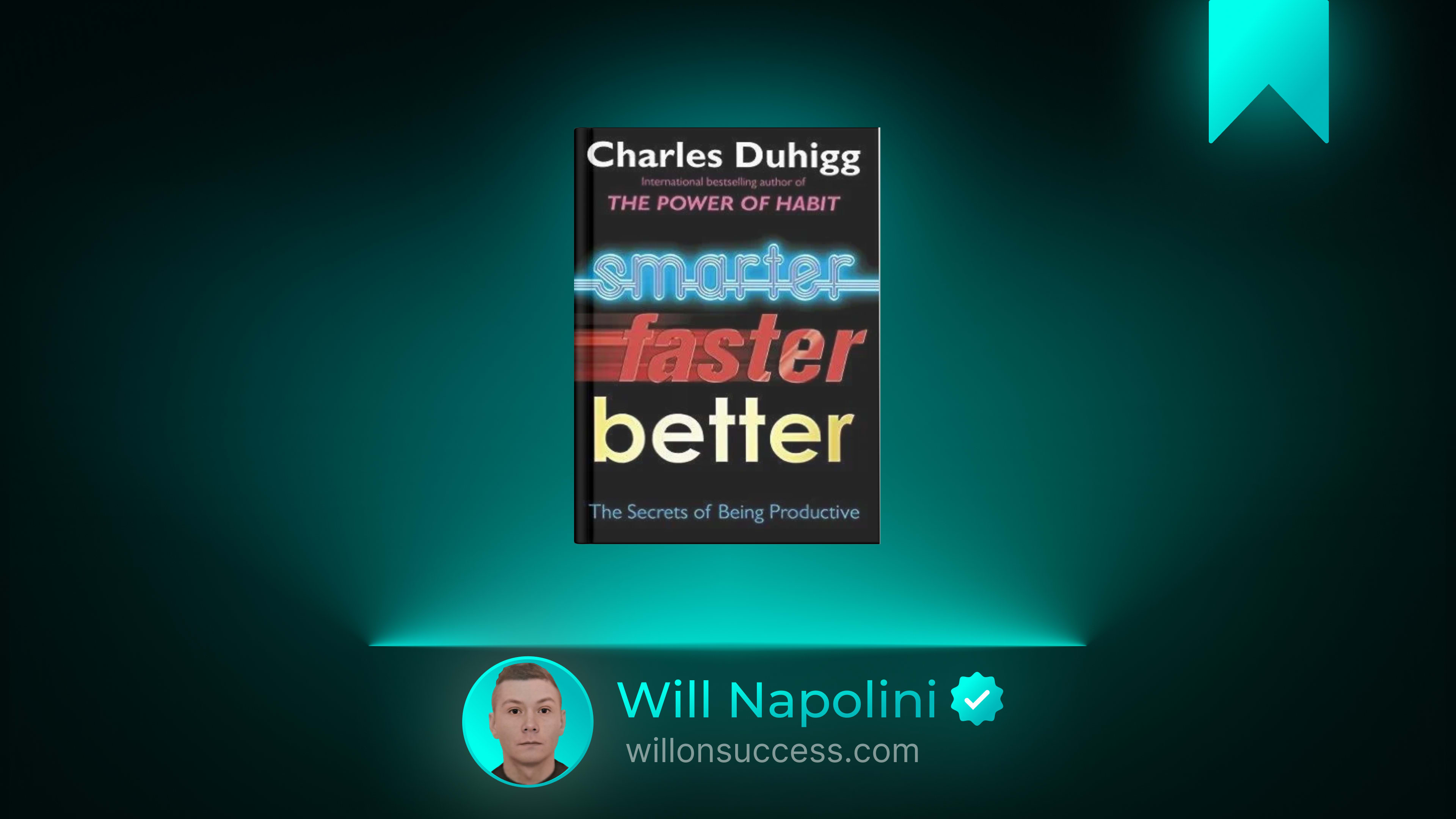
Stop Trying to Do More: What *Smarter Faster Better* Teaches Us About the Architecture of Real Focus
I want to ask you about the weight of your to-do list.
Not the physical weight of the paper, or the digital weight of the app notifications, but the psychological weight. The quiet, persistent hum of anxiety that sits in your chest when you realize it is 3:00 PM, you have been busy all day, and yet you have accomplished almost nothing that actually matters.
We live in a culture that worships the grind. We are told that if we are exhausted, we are doing it right. We buy planners, we download time-tracking apps, we wake up at 5:00 AM, and we try to squeeze every drop of efficiency out of our waking hours. We treat ourselves like machines that just need better software.
But if I could sit across the table from you right now, I would tell you something that might feel like a profound relief: You do not have a time-management problem. You have a meaning-management problem.
You are not lazy. You are not broken. You are simply trying to navigate a complex world using the wrong cognitive architecture.
Charles Duhigg, the Pulitzer Prize-winning journalist who previously mapped the science of habits, turned his investigative lens onto the science of productivity in his book Smarter Faster Better. He spent years interviewing neuroscientists, four-star generals, Broadway creators, and airline pilots to answer a single question: Why do some people and teams get the right things done with seemingly less effort, while others grind themselves into dust and still fall short?
What he discovered is that true productivity has almost nothing to do with willpower. It is not about forcing yourself to work harder. It is about making a specific set of choices regarding how you view your autonomy, how you direct your attention, and how you frame your goals.
Let me walk you through the mechanics of how the most effective people in the world actually think, and how you can borrow their architecture to stop spinning and start steering.

The Big Idea: Productivity Is the Art of Making Better Choices
The central thesis of Duhigg’s work is deeply counter-cultural: Productivity is not a personality trait. It is a set of learned choices.
Most of us view productivity as a measure of output. We think it means doing more things, faster. But Duhigg argues that true productivity is the art of getting the right things done with the least amount of wasted energy. It is the ability to bypass the busywork and strike directly at the lever that moves the needle.
When you understand this, the entire game changes. You stop asking, How can I get more done today? and you start asking, What is the most impactful choice I can make right now, and how do I clear the mental clutter to actually make it?
You stop being a passenger to your impulses and your inbox, and you become the author of your own attention.
The Story of the Marines and the Illusion of Control
To understand the foundation of this architecture, we have to look at a place where productivity and performance are matters of life and death: United States Marine Corps boot camp.
In the early 2000s, the Marines had a problem. Despite having the best physical training and the most rigorous discipline in the world, they were seeing a rise in recruits who simply shut down when faced with complex, unscripted challenges. They could follow orders perfectly, but when the script broke, they froze.
General Charles Flynn and his team realized that traditional boot camp was designed to strip away a recruit’s identity and replace it with blind obedience. But modern warfare—and modern life—does not reward blind obedience. It rewards adaptability.
So, they radically redesigned boot camp. Instead of just barking orders, drill instructors started forcing recruits to make choices. If a recruit made a mistake, instead of just making them do push-ups, the instructor would ask, Why did you make that choice? What were you trying to achieve? They started giving recruits small areas of autonomy. They asked them to lead, to plan, and to explain their reasoning.
What the Marines discovered is a profound psychological truth that Duhigg highlights: Motivation is not something you are born with; it is a muscle that is built by making choices that assert your autonomy.
When we feel like we are being forced to do something—when we feel like a cog in a machine, or a victim of our circumstances—our brains literally down-regulate. We experience a loss of agency, and with it, a loss of energy. But the moment we can link a task to a personal choice, the brain wakes up. Motivation is generated by the belief that we are in control of our own actions.
The Architecture of the Mind: Three Pillars of Real Focus
Duhigg breaks down the science of high performance into several distinct pillars. I want to focus on the three that will most immediately change the way you navigate your daily life.
1. The Locus of Control: Rewriting the “Have To” Narrative
The first pillar builds directly on the Marine Corps discovery. To generate motivation, you must cultivate an internal locus of control. This is the psychological belief that you are the author of your life, rather than a victim of external forces.
Think about how you talk to yourself about your work. I have to finish this report. I have to go to this meeting. I have to pay these bills.
The phrase “I have to” is a linguistic trap. It signals to your brain that you are under duress, that your autonomy has been stolen. And when the brain feels coerced, it rebels through procrastination, distraction, and fatigue.
The highly productive person does not magically enjoy doing taxes or writing tedious reports. Instead, they practice a subtle but powerful cognitive reframe. They find the choice inside the chore.
They say, I am choosing to finish this report because I value my reputation for reliability. Or, I am choosing to have this difficult conversation because I care about the long-term health of this relationship.
You do not need to love the task. You just need to connect it to a deeper value that you chose. When you assert your authorship, the friction disappears. You stop dragging the boulder and start pushing it.
2. Mental Models: The Antidote to Cognitive Tunneling
The second pillar is perhaps the most critical for anyone trying to maintain focus in a world of endless distraction. Duhigg explores the concept of “mental models” through the tragic story of Air France Flight 447.
In 2009, Flight 447 crashed into the Atlantic Ocean. When investigators analyzed the black box, they found something baffling. The plane’s sensors had iced over, causing the autopilot to disengage. The pilots were suddenly flying manually. But instead of executing the simple, standard recovery procedures they had been trained on, the lead pilot, Pierre-Cédric Bonin, pulled back on the stick, stalling the plane, and held it there until they crashed.
Why did a highly trained pilot do the exact opposite of what he was supposed to do?
Psychologists call it cognitive tunneling. When the brain is suddenly subjected to high stress and a lack of clear information, it panics. It narrows its focus entirely to the most immediate, obvious, and distracting stimulus in front of it. Bonin became obsessed with a single, irrelevant dial on his dashboard, entirely losing his mental model of what the plane was actually doing in the sky.
Duhigg points out that we experience cognitive tunneling every single day.
You sit down at your desk. Your phone buzzes. An email pops up. A colleague stops by. Because you do not have a clear “mental model” of what your day is supposed to look like, your brain panics and tunnels into the loudest, most immediate stimulus. You spend three hours putting out tiny fires, entirely losing the mental model of the major project you were supposed to be advancing.
The antidote to cognitive tunneling is to build a mental model before the stress hits. Highly productive people do not just react to their environment; they narrate it to themselves in advance. They visualize the day. They anticipate the friction. They build a story in their head of what success looks like, so that when the alarms start blaring, they do not freeze. They simply check their mental map and adjust their course.
3. The Trap of the SMART Goal and the Power of the Stretch Goal
The third pillar addresses how we set our targets. For decades, the corporate and personal development worlds have worshipped the SMART goal: Specific, Measurable, Achievable, Realistic, and Time-bound.
Duhigg does not say SMART goals are useless. They are excellent for ensuring you do not fail. But they are terrible for helping you grow.
The problem with “Achievable” and “Realistic” is that they encourage sandbagging. They encourage you to set the bar just low enough that you can comfortably step over it without breaking a sweat. They keep you safely inside the boundaries of what you already know how to do.
To achieve breakthroughs, Duhigg highlights the necessity of the Stretch Goal. A stretch goal is audacious. It is slightly terrifying. It is a target that you do not currently know how to hit.
When a company sets a realistic goal to improve manufacturing efficiency by 5%, they just ask the workers to work a little faster. When they set a stretch goal to improve it by 50%, the current system is rendered obsolete. They are forced to completely rethink the architecture of the factory.
Stretch goals force innovation because they strip away the illusion that your current habits are sufficient. They demand that you stop working in the system and start working on the system.
Why This Matters on an Ordinary Tuesday
It is easy to read about fighter pilots and corporate turnarounds and feel that these concepts belong to the extraordinary. But the architecture of Smarter Faster Better is designed for the quiet, ordinary moments of your life.
What does this look like on a Tuesday afternoon when you are exhausted, the house is messy, and you have a deadline looming?
It looks like catching yourself in the act of cognitive tunneling. You feel the urge to open a new browser tab and scroll through the news because the spreadsheet in front of you is difficult. You recognize the tunnel. You stop. You close your eyes for ten seconds and rebuild your mental model: I am sitting at my desk. My goal is to finish the financial projection. The next step is to fill in row 40. The distraction is just noise. You open your eyes and type the number.
It looks like looking at the pile of laundry you “have” to fold, and feeling the familiar wave of resentment. You pause and rewrite the narrative: I am choosing to fold this laundry because I want my home to feel like a sanctuary for my family tonight. The resentment softens. The task remains, but the friction vanishes.
It looks like sitting down to plan your year and refusing to write down a “realistic” goal of reading twelve books. Instead, you write down a stretch goal: I will write and publish one essay a month. You have no idea how you will find the time. The goal scares you a little. But in setting it, you force yourself to rethink your entire evening routine, rather than just reading a few pages before bed.
You stop trying to manage your time, and you start managing your mind.
Who Should Read This Book — and Who Might Need to Look Elsewhere
I believe in being honest about what a book can and cannot do, because no single framework is a universal cure.
Who it is for: If you are a knowledge worker, a manager, an entrepreneur, or a creative who feels like you are running on a hamster wheel of endless tasks without meaningful progress, this book is essential. Duhigg is a masterful storyteller, and he weaves deep psychological and neurological research into gripping narratives. It is for the person who wants to understand the why and the how of human performance, rather than just being handed a colorful daily planner.
Who might find it less useful: If you are looking for a quick, tactical guide on how to organize your inbox, or a rigid morning routine to copy and paste into your life, you will be frustrated by this book. Duhigg is not offering a list of life hacks. He is offering a deep dive into cognitive psychology and organizational behavior. Furthermore, if you are currently in a season of acute burnout or crisis, the idea of adding “stretch goals” to your life might feel overwhelming. Heal your nervous system first. Build a baseline of rest. Then, reach for the architecture of high performance.
Practical Application: Building the Architecture Today
Philosophy is useless if it does not change how you move through the world. If you want to stop grinding and start steering, you need to build systems that force you to think clearly. Here are three concrete ways to apply this today.
1. The “Choice” Audit (Rewiring Motivation)
Look at your calendar or your to-do list for tomorrow. Identify the one task you are dreading the most. The one that makes your chest tighten. Now, take out a piece of paper and write down three reasons why you are choosing to do it. Do not write “because my boss will fire me.” Dig deeper. I am choosing to do this because I value my financial independence. I am choosing to do this because I want to master this specific skill. I am choosing to do this because I refuse to let my team down. Find the autonomy inside the obligation. Write it down. Read it before you start the task.
2. The Morning Mental Model (Defeating Cognitive Tunneling)
Before you check your email, before you look at your phone, take two minutes every morning to build a mental model of your day. Ask yourself: What is the one thing that, if I get it done today, will make the day a success? What obstacles are likely to get in my way? How will I handle them when they appear? By narrating the day to yourself in advance, you build a cognitive map. When the inevitable distractions arise at 2:00 PM, your brain will not tunnel into them, because it already knows the route you are supposed to be traveling.
3. The 10% Stretch (Breaking the Realistic Trap)
Look at your primary goal for this quarter. Is it safe? Is it entirely “achievable” using your current methods? If it is, add 10% to it. Or add a constraint that makes it harder. If your goal is to make ten sales calls a day, make it twelve. If your goal is to lose five pounds, make it seven. You do not need to know exactly how you will achieve the extra 10% right now. The purpose of the stretch is not to guarantee you hit the number; the purpose is to force your brain to abandon its lazy, default routines and look for a smarter, faster, better way to operate.
One Small Step
You do not need to overhaul your entire life today. You do not need to map out a five-year strategic plan before dinner. You just need to reclaim your authorship in one small, specific moment.
Here is your one small step for right now:
Think of the very next thing you have to do. It might be washing the dishes, replying to an email, or driving to pick up your kids. Before you stand up, say out loud: “I am choosing to do this because…” and finish the sentence with a value that matters to you.
Feel the subtle shift in your posture. Feel the difference between being a victim of your schedule and being the author of your life. That tiny shift in agency is the spark that starts the engine.
The Door Is Already Open
We spend so much of our lives waiting for motivation to strike. We wait for the perfect mood, the perfect morning, the perfect burst of inspiration to finally tackle the things that matter. We treat our attention like a wild animal that we have to constantly chase, trap, and force into submission.
But Charles Duhigg’s work whispers a much quieter, much more empowering truth: You do not need to wait for motivation. You can manufacture it.
You manufacture it by taking back your choices. You manufacture it by drawing a clear map of the territory before you step into the woods. You manufacture it by refusing to settle for the safe, realistic goals that keep you small, and daring to set the targets that force you to grow.
You are not a machine designed to process tasks until you break down. You are a navigator. You are an architect. You are the author of your own attention.
The world will always demand more of you than you have time to give. The inbox will never be empty. The to-do list will never be finished.
But you do not need to do it all. You only need to do the right things, with a clear mind and a steady hand.
Stop trying to do more. Start choosing better. And watch how quickly the noise falls away.