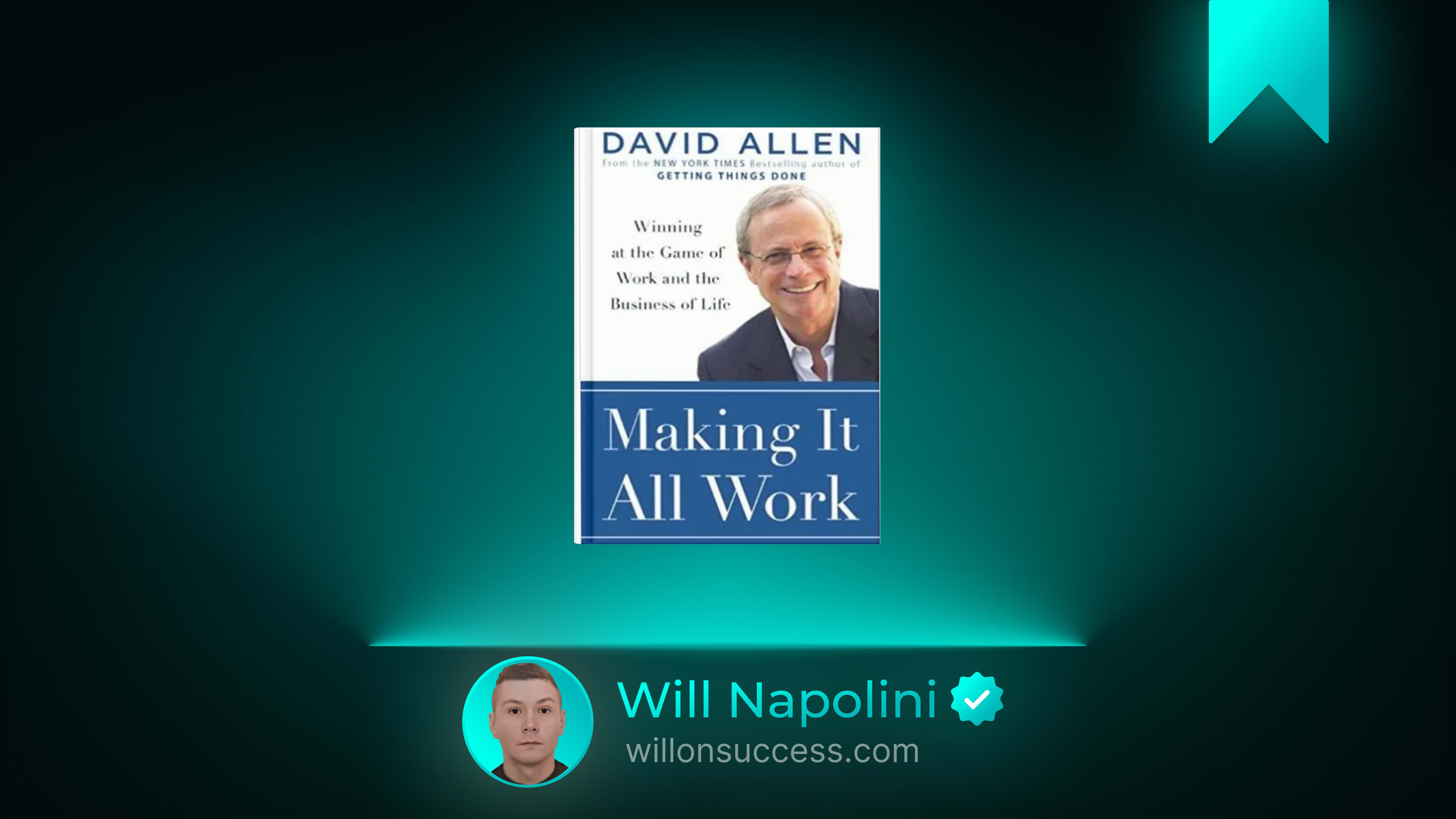
Making It All Work by David Allen: How to Stay Sane When Everything Demands Your Attention
You already know what to do. That is the frustrating part. You have read the books. You have tried the app. You have color-coded the calendar, written the list, set the reminder. And yet, on a random Wednesday afternoon, you still find yourself staring at a screen full of open tabs, feeling that familiar low hum of anxiety—the sense that no matter how fast you move, the wave is always one inch taller than you.
If that sounds familiar, I want you to hear something before we go further: the problem is not your discipline. The problem is not that you need a better system. The problem is that you are trying to solve an infinite problem with a finite toolkit and then blaming yourself when the math does not work out.
David Allen spent decades helping people organize their work, and in 2001 he gave the world Getting Things Done, a method for capturing, clarifying, and acting on the endless stream of tasks that land in your life. It helped millions. But seven years later, he sat down to write Making It All Work, and he addressed the question that haunts every productive person eventually: “I have the system. Why do I still feel like I am losing?”
The answer he offers is not another productivity hack. It is a shift in how you relate to the unfinishable nature of your life. And I think it might be the most honest and liberating idea in the entire genre of personal effectiveness.
The Big Idea: You Will Never Get It All Done—And That Is the Starting Point, Not the Failure
Here is the sentence I want you to sit with before anything else:
There will always be more to do than you can do. More emails than you can answer. More ideas than you can execute. More obligations than you can fulfill perfectly. More possibilities than you can pursue.
This is not a flaw in your life that better planning will fix. This is the nature of being alive in a complex world. Allen builds his entire philosophy on this acknowledgment rather than fighting it. And the shift is enormous. Because once you stop treating the overflowing inbox as evidence of your personal failure, you free up an extraordinary amount of energy. Energy you were spending on guilt, anxiety, and the desperate hope that if you just worked a little harder, you would reach the bottom of the pile.
You will not reach the bottom. No one does.
“Making it all work,” in Allen’s framing, does not mean completing everything. It means being appropriately present with whatever is in front of you, trusting that the rest is captured somewhere you can return to, and knowing that your choice in this moment is the best choice available given your current perspective.
That is not settling. That is sanity.
The Altitude Model: Why Your Overwhelm Might Be a Perspective Problem
One of the most useful frameworks Allen introduces in this book is what he calls the “horizons of focus”—a way of thinking about your commitments at different altitudes, like an airplane adjusting its elevation to see different amounts of terrain.
At ground level, you have the immediate actions: the email to answer, the call to make, the errand to run. One level up, you have current projects: the presentation due Friday, the kitchen renovation, the job search. Higher still, you have areas of responsibility: your health, your finances, your team, your family. Above that, one- to two-year goals. Above that, a vision for the kind of life you are building over three to five years. And at the highest altitude, purpose. Why you are here. What you are ultimately about.
Now, here is where it gets practical. Most of the time when you feel overwhelmed, it is not because you have too many tasks at ground level. It is because you are trying to solve a high-altitude problem at a low altitude. You are staring at a to-do list wondering why none of it feels meaningful, when the real question is whether these tasks connect to a project that connects to a life direction you actually chose.
Or the reverse: you are paralyzed by a big existential question—”Am I in the right career?”—when what you actually need is to complete one small action that will give you information. Send one email. Have one conversation. Attend one event. Ground-level movement that gradually clarifies the higher question.
Allen’s insight is that you need to be able to move fluidly between these altitudes. You need times when you zoom out and ask, “Does this project still matter to me? Am I honoring the commitments I actually care about?” And you need times when you zoom in and say, “I am not solving my life purpose right now. I am writing this paragraph. That is enough.”
The overwhelm comes from being stuck at one altitude while another one is screaming for attention.
Mind Like Water: Responding Appropriately Instead of Reacting Desperately
Allen borrows a phrase from martial arts: “mind like water.” Think about what water does when you toss a pebble into a still pond. It responds completely, proportionally, and then returns to calm. A pebble gets a small ripple. A boulder gets a big splash. But the water never overreacts. It never pretends the pebble is a boulder. It never ignores the boulder because it is busy ripplesizing the pebble.
Most of us, Allen observes, are not like water. We are like a pond that has been stirred into permanent turbulence. A small email gets an outsized emotional reaction because we are already depleted. A genuine crisis gets a muted response because we have nothing left to give. We overreact to the trivial and underreact to the important, not because we are careless, but because our baseline is already agitated.
The path back to “mind like water” is not suppression. It is not gritting your teeth and performing calm. It is having a trusted place for everything that is pulling at your attention, so that your mind is not spending its background processing power trying to remember, worry about, and rehearse seventeen unresolved commitments simultaneously.
When everything is captured—written down, filed, scheduled, delegated, or consciously deferred—your mind relaxes its grip. It stops juggling. And in that space, you can actually look at what is in front of you and respond proportionally. The pebble gets a ripple. The boulder gets a splash. And between them, there is stillness.
The Five Steps, Revisited for a Life You Cannot Control
Allen revisits the five stages of his method in this book, but he reframes them for a world that is messier and less predictable than a neat task list implies.
Capture. Get everything out of your head. Every commitment, idea, worry, half-formed thought. Not into your brain, where it will loop and distort. Into something external. A notebook. A file. An app. A voice memo. The point is not the tool. The point is that your mind is for generating ideas, not storing them.
Clarify. For each item you have captured, ask: What is this, actually? Is it actionable? If yes, what is the very next physical action? If no, is it trash, reference, or something you are incubating? This step is where most people skip, and it is where most of the fog lives. A vague item on your list—”deal with the house situation”—will generate anxiety every time you glance at it. A clarified one—”call the contractor Thursday at 9 a.m. to ask about the roof estimate”—generates nothing but a phone call.
Organize. Put the clarified items where they belong. Calendar for time-specific actions. A next-actions list for everything else. A project list for multi-step outcomes. A “waiting for” list for things you have delegated. A someday/maybe list for ideas you are not ready to act on. The organization is not the goal. The goal is being able to find the right thing at the right time without re-deciding everything from scratch.
Reflect. This is the step most people abandon, and it is the step that keeps the whole system alive. A weekly review. Thirty minutes. Look at your lists. Update them. Notice what has shifted. Ask yourself whether the projects still matter. Whether the priorities still hold. Whether something new has entered your world that you have not yet captured. Without reflection, even the best system decays into a guilt-inducing artifact you avoid opening.
Engage. Do the next thing. Not the perfect thing. Not the most impressive thing. The next thing, chosen with awareness of your time, energy, context, and priorities. Allen is clear: the point of all the previous steps is to make this step free of anxiety. You should be able to act without the nagging suspicion that you are doing the wrong thing, because you have already looked at the whole picture and chosen deliberately.
Why the Weekly Review Is Non-Negotiable
I want to linger on reflection for a moment, because I have watched so many people build a beautiful system and then let it starve.
You do not need a complicated review. You need a recurring appointment with your own life. Once a week—Allen suggests a consistent day and time—you sit down and look at the whole landscape. What came in this week that I have not processed? What projects moved? What stalled? What am I avoiding? Is there something I need to say yes or no to that I have been leaving ambiguous?
This is not busywork. This is navigation. Imagine sailing a boat and never once looking up from the rigging to check your heading. You could be working incredibly hard—pulling ropes, adjusting sails, sweating—and still drift miles off course. The weekly review is the moment you look up. You check the stars. You adjust the rudder a few degrees. And then you go back to the work, but now you are pointed somewhere.
Without it, you are always reacting. With it, you are steering.
Navigating Change Without a Five-Year Map
One of the most honest elements of this book is Allen’s acknowledgment that the world does not hold still long enough for rigid long-term planning to work reliably. Careers shift. Industries transform. Relationships evolve. The plan you made eighteen months ago might be irrelevant now, and that is not a failure of planning. It is the nature of a life lived in real time.
His counsel is not to abandon vision. It is to hold it lightly. To know your direction—north, broadly speaking—without insisting on the exact road. To make decisions based on the best information you have right now, while keeping your system flexible enough to absorb new information without collapsing.
This is especially relevant if you are in a season of transition. If you are between jobs, ending a relationship, moving, recovering from something, or simply in a phase where the old structure no longer fits and the new one has not yet formed. Allen gives you permission to operate at a lower altitude for a while. To focus on the next right action rather than the grand vision. To trust that clarity often emerges from movement, not the other way around.
You do not need to see the whole staircase. You need to see the next step, take it, and then look again.
Who Should Read This Book
If you have read Getting Things Done and implemented some version of it, but you still feel a low-grade hum of anxiety about whether you are doing the right things in the right order, this book addresses that specific ache. It moves from mechanics to meaning, from “how do I process my inbox” to “how do I stay oriented in a life that keeps changing?”
If you are a knowledge worker, a manager, a freelancer, a parent juggling multiple roles, or anyone whose primary challenge is not physical labor but decision fatigue and information overload, this book was written with you in mind.
If you have never encountered Allen’s work, you can read this one first, though some of the practical system will make more sense if you have at least a passing familiarity with the GTD framework. The book does explain the method, but it assumes you are past the “what is a next action?” stage and are now wrestling with “how do I keep all of this from consuming me?”
If you are looking for a quick, tactical list of productivity tips, this will feel too philosophical. Allen is not giving you ten apps to try. He is inviting you to rethink your relationship with the unfinishable.
A Practice for This Week
I am not going to ask you to overhaul your entire life by Friday. I am going to ask for thirty minutes.
Choose a day this week. A quiet one if possible. Set a timer for thirty minutes. Sit down with whatever capture system you use—a notebook, a notes app, scraps of paper, the mental loop you have been running for weeks—and do this:
Write down every single thing that currently has your attention. Every “I should,” every “I need to,” every vague worry, every half-formed idea, every commitment you have not yet honored. Do not organize. Do not judge. Do not solve. Just empty the contents of your mind onto the page.
When the thirty minutes are up, look at what you have written. You will likely feel two things at once: relief, because it is out of your head; and mild horror, because there is more than you realized. Both are normal. Both are useful.
Now pick three items. Just three. For each one, write the very next physical action. Not “figure out the insurance situation.” Instead: “Call the agent’s office and ask for the renewal quote.” Not “get healthier.” Instead: “Put running shoes by the door tonight so they are the first thing I see tomorrow morning.”
Do those three things this week. Not all three today. Not perfectly. Just do them. And notice what it feels like to act from clarity rather than from the fog of seventeen unresolved loops competing in your skull.
That small exercise is the whole philosophy in miniature. Capture. Clarify. Engage. Repeat.
One Small Step, Right Now
Before you close this article, before you open another tab or check another notification, take ten seconds. Think of the one thing that has been circling in the back of your mind the longest. The one you keep almost-remembering and then pushing down. The one that costs you a small amount of background energy every single day just by existing in the unresolved state.
Write it down. Right now. On whatever is nearest. A sticky note. Your phone. The back of an envelope. Get it out of your head and into a place you trust.
You do not have to solve it today. You do not have to figure out the next action this instant. You just have to stop carrying it in the fragile, unreliable space between your ears, where it will loop and distort and keep you up at 2 a.m.
Write it down. Let it go. Trust that you will come back to it.
And in that small act of release, you will feel something shift. Not everything. Not forever. But enough to breathe. Enough to turn back to whatever is in front of you and give it your full, undivided, proportional attention.
The wave will keep coming. It will always be taller than you. But you do not have to stop the ocean. You just have to stay in the boat, keep your heading, and row the next stroke.
And that, more than any system or method, is how you make it all work.