The Architecture of Inner Freedom: How Four Simple Agreements Can Rewire Your Life
There is an invisible script running your life, and you did not write it.
Most of us move through our days believing we are the authors of our own choices. We think our anxieties, our insecurities, and our reactions are simply the natural result of who we are. But if you look closely at the rules you live by, you will realize that most of them were handed to you before you were old enough to question them.
You were taught what it means to be “good.” You were taught what it means to be “successful.” You were taught how to interpret the looks, words, and actions of the people around you.
If I could sit across the table from you right now, I would ask you a simple question: How much of your daily mental energy is spent trying to meet the expectations of a script you never actually agreed to?
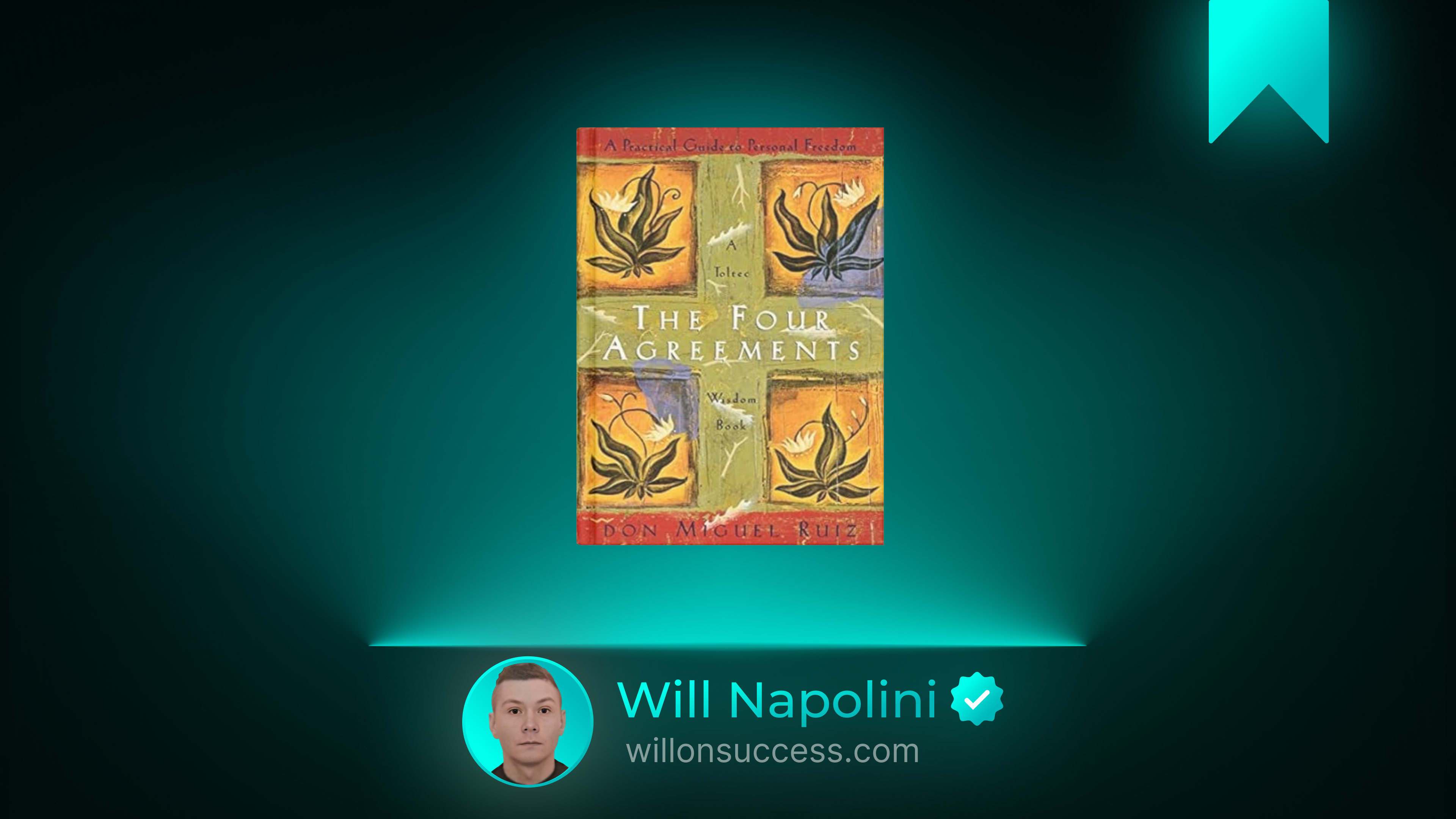
In The Four Agreements, Don Miguel Ruiz, a Mexican author and shaman from a lineage of Toltec knowledge keepers, offers a perspective that is as ancient as it is urgently relevant. His central thesis is that human suffering is not an unavoidable condition of life. It is the direct result of the false agreements we have made with ourselves, our society, and our environment.
You do not need to add more rules to your life to find peace. You do not need another complex productivity system or a new diet. You simply need to revoke the old agreements that are keeping you in the dark, and make four new ones.

The Fog of Domestication
To understand why these four agreements are so powerful, we first have to understand the mechanism of how we got trapped in the first place.
Ruiz uses the concept of “domestication.” It is not meant as an insult. It is simply the process of training. From the moment you are born, you are domesticated by your parents, your teachers, your religion, and your culture. They teach you how to behave, what to believe, and how to react.
Think of your mind as a fertile plot of soil. When you are a child, the soil is completely open. Every belief, every rule, and every expectation is planted as a seed. Because you have no critical filter, every seed takes root. You are told you are not smart enough, or that you must be quiet to be loved, or that your worth is tied to your output. These beliefs take root and grow into a dense, tangled forest.
Ruiz calls this the “fog.” The fog of beliefs is so thick that you cannot see past it. You cannot see your authentic self anymore. You only see the expectations of the fog.
When you break an agreement with the fog, you experience emotional pain. But when you live in alignment with the fog, you experience a slow, quiet suffocation. The way out is not to fight the fog with more fog. The way out is to make four new agreements that act as a compass, guiding you safely through the trees.
Speak Only Life Into Your World
The first agreement is the foundation for the other three: Be impeccable with your word.
The word “impeccable” comes from the Latin impeccabilis, which means “without sin.” Ruiz redefines sin not as a moral failing against a divine law, but as anything you do or say that goes against yourself. When you speak ill of yourself, when you label yourself as stupid or ugly or incapable, you are sinning against yourself.
Words are not just sounds. They are the code we use to program our reality. Ruiz explains that in the Toltec tradition, words are considered magic. They have the power to create the most beautiful dreams, or the power to destroy everything around you.
When you gossip, when you use your words to spread emotional poison, you are using black magic. But the most destructive black magic most of us practice is the way we speak to ourselves in the privacy of our own minds.
Why this matters for your daily life: You may be working hard to build a better life, but if your internal dialogue is constantly undermining your efforts, you are building a house while simultaneously tearing down the foundation. You cannot achieve external success if your internal vocabulary is rooted in self-sabotage. Your environment will always reflect the language you use to describe yourself.
Practical Application: Start a “Language Audit.” For the next 48 hours, pay strict attention to how you speak about yourself and others. Catch yourself every time you say, “I’m so stupid,” “I always mess this up,” or “I’m terrible at this.” When you hear it, stop and rephrase it. Say, “I am still learning this,” or “I made a mistake, but I can fix it.” Extend this to others: refuse to participate in gossip. If someone starts gossiping, simply change the subject or say, “I’d rather not talk about them when they aren’t here.” Protect the soil of your mind.
Build an Immune System for Your Mind
The second agreement is the shield that protects your energy: Don’t take anything personally.
This is perhaps the most difficult agreement to practice, but it is also the most liberating. We are conditioned to believe that everything other people do is about us. If our partner is distant, we assume we did something wrong. If our boss is critical, we assume we are failing. If a stranger snaps at us, we assume we are the target of their anger.
Ruiz offers a profound shift in perspective: Nothing others do is because of you. What others say and do is a projection of their own reality, their own dream, their own fog.
When you have a strong immune system, you can be exposed to a virus and not get sick. When you have a strong mental immune system, you can be exposed to the opinions, judgments, and bad moods of others without absorbing them. If someone insults you and you take it personally, it means you agree with them. You are letting their poison enter your system. But if you realize that their insult is just a reflection of their own internal suffering, it bounces off you.
Why this matters for your daily life: Taking things personally is the root of most human suffering. It keeps you in a state of constant reactivity. You become a leaf blown around by the wind of other people’s opinions. When you stop taking things personally, you stop needing the approval of others. You stop fearing their disapproval. You become the author of your own emotional state, rather than a victim of everyone else’s.
Practical Application: Implement the “Projection Pause.” The next time someone’s behavior triggers a feeling of hurt or defensiveness in you, take one deep breath and ask yourself: “What is this really about?” Recognize that their reaction is about their own stress, their own insecurities, or their own bad day. Say to yourself, “This is their weather, not mine.” You do not have to let their storm become your storm.
Replace the Fog with Clear Light
The third agreement clears the path forward: Don’t make assumptions.
The human mind hates uncertainty. When there is a gap in information, the mind will automatically fill it in. We assume we know what our spouse is thinking. We assume we know why our friend didn’t text back. We assume we know what the boss meant by that vague email.
And then, Ruiz points out, we do something even more destructive: we expect others to read our minds. We assume they know what we want, and when they don’t deliver, we feel resentful.
All the drama in our lives, all the unnecessary emotional pain, comes from making assumptions and taking things personally. We write fictional stories in our heads, we believe our own fiction, and then we react to the fiction as if it were reality.
Why this matters for your daily life: Assumptions destroy relationships and create anxiety. They are the opposite of clarity. When you make an assumption, you are choosing to operate in the dark, and then acting surprised when you trip over the furniture. Clear, direct communication is the light that allows you to navigate your relationships without fear.
Practical Application: Adopt the “Ask, Don’t Guess” rule. For one week, make it a strict policy to ask questions whenever you feel uncertainty. If you are unsure about a deadline, ask for clarification. If you feel hurt by a partner’s tone, ask, “I’m feeling a little disconnected right now, is everything okay between us?” Have the courage to express what you actually want, and the courage to ask for what you need to know. Replace the heavy fog of assumption with the clear light of curiosity.
Measure Success by Effort, Not Outcome
The final agreement makes the first three permanent: Always do your best.
This agreement is the engine of the other three. But it is easily misunderstood. “Doing your best” does not mean working yourself to the point of exhaustion. It does not mean perfection.
Ruiz emphasizes that your best is going to change from moment to moment. Your best when you are healthy and rested is different from your best when you are sick or grieving. Your best in the morning is different from your best late at night.
If you try to force yourself to give the same level of effort every single day, you will inevitably fail, and then you will judge yourself. The goal of this agreement is not to achieve a specific external outcome. The goal is to ensure that, in any given moment, you are doing everything you can with the energy and resources you currently have.
When you do your best, you take action because you love it, not because you expect a reward. You avoid the trap of self-judgment, self-abuse, and regret. If you do your best and still fail, you can rest knowing you left nothing on the table.
Why this matters for your daily life: We live in a culture that measures success purely by outcomes. If you didn’t get the promotion, you failed. If the project didn’t launch perfectly, you failed. This creates a life of constant anxiety and perpetual dissatisfaction. By shifting your focus to doing your best, you reclaim your power. You cannot always control the outcome, but you can always control your effort. This shift turns life from a high-stakes test into a continuous practice of craftsmanship.
Practical Application: Change your “End of Day Audit.” Tonight, when you review your day, do not measure it by what you accomplished. Measure it by your effort. Ask yourself: “Did I do my best today?” If the answer is yes, give yourself permission to rest completely. If the answer is no, do not punish yourself. Simply ask, “What got in the way?” and adjust for tomorrow. Let go of the outcome. Fall in love with the effort.
Who Should Read This Book
The Four Agreements is a profound read for anyone who feels trapped by the expectations of others, plagued by overthinking, or exhausted by the emotional drama of their own mind. If you struggle with people-pleasing, imposter syndrome, or taking criticism too hard, this book will offer a deeply liberating framework for your life. It is also an excellent tool for leaders and parents who want to create environments where people feel psychologically safe and emotionally free.
However, if you are looking for a highly structured, step-by-step business manual, or a purely scientific, academic text on psychology, this may not be the exact fit. Ruiz’s work is rooted in spiritual and shamanic philosophy. It is highly practical in its application, but its foundation is metaphysical. You must be open to exploring the deeper, unseen architecture of the mind to get the most out of it.
One Small Step
Understanding these agreements is only the beginning. The real work happens in the messy, unpredictable moments of your daily life.
Today, I want you to take one specific step. Choose just one of the four agreements to focus on for the next 24 hours.
If you choose the first, catch yourself every time you speak negatively about yourself. If you choose the second, pause and remind yourself “this is about them” when someone frustrates you. If you choose the third, ask a clarifying question instead of guessing someone’s motives. If you choose the fourth, give your absolute best to one ordinary task, like washing the dishes or writing an email, without worrying about the result.
Pick one. Commit to it for just one day.
The Pen Is in Your Hand
The fog of domestication did not roll in overnight, and it will not lift overnight. Breaking old agreements takes time, patience, and repetition. There will be days when you slip back into old habits, when you take things personally, when you make assumptions, when you judge yourself harshly.
When that happens, do not use the agreements as a new weapon to beat yourself up. That would just be creating a new fog. Instead, forgive yourself, recognize the slip, and gently guide your attention back to the path.
You have spent your whole life agreeing to a script that was written for you. You have carried the weight of expectations that were never yours to bear. But the pen is in your hand now.
Your freedom does not require you to conquer the world. It only requires you to stop agreeing with the lies it tells you about who you are.