The Power of the Right Soil: Finding Your True Potential in Totto-Chan
Have you ever felt like you were built for a world that simply was not constructed to hold you?
You know the feeling. It is the quiet, persistent friction of trying to force your natural shape into a rigid box. You might feel it at your desk on a Tuesday afternoon, staring at a spreadsheet while your mind screams for creative work. You might feel it in a relationship where your deepest passions are met with polite indifference. Or you might feel it when you look in the mirror and wonder why, despite trying so hard to be the person you think you should be, you still feel like an imposter in your own life.
When we experience this friction, our default reaction is almost always to blame ourselves. We assume we are broken. We assume we are lazy, undisciplined, or fundamentally flawed. We try to fix ourselves by working harder, pushing through the resistance, and conforming more strictly to the rules.
If I could sit across the table from you right now, I would tell you to stop.
You do not need to be fixed. You need to be planted in the right soil.
I want to share a book with you today that is ostensibly about a little girl in 1930s Japan, but which contains some of the most profound wisdom on human potential, environment design, and self-leadership I have ever encountered. It is a book that will change how you view your own perceived flaws, how you lead others, and how you design your daily life.
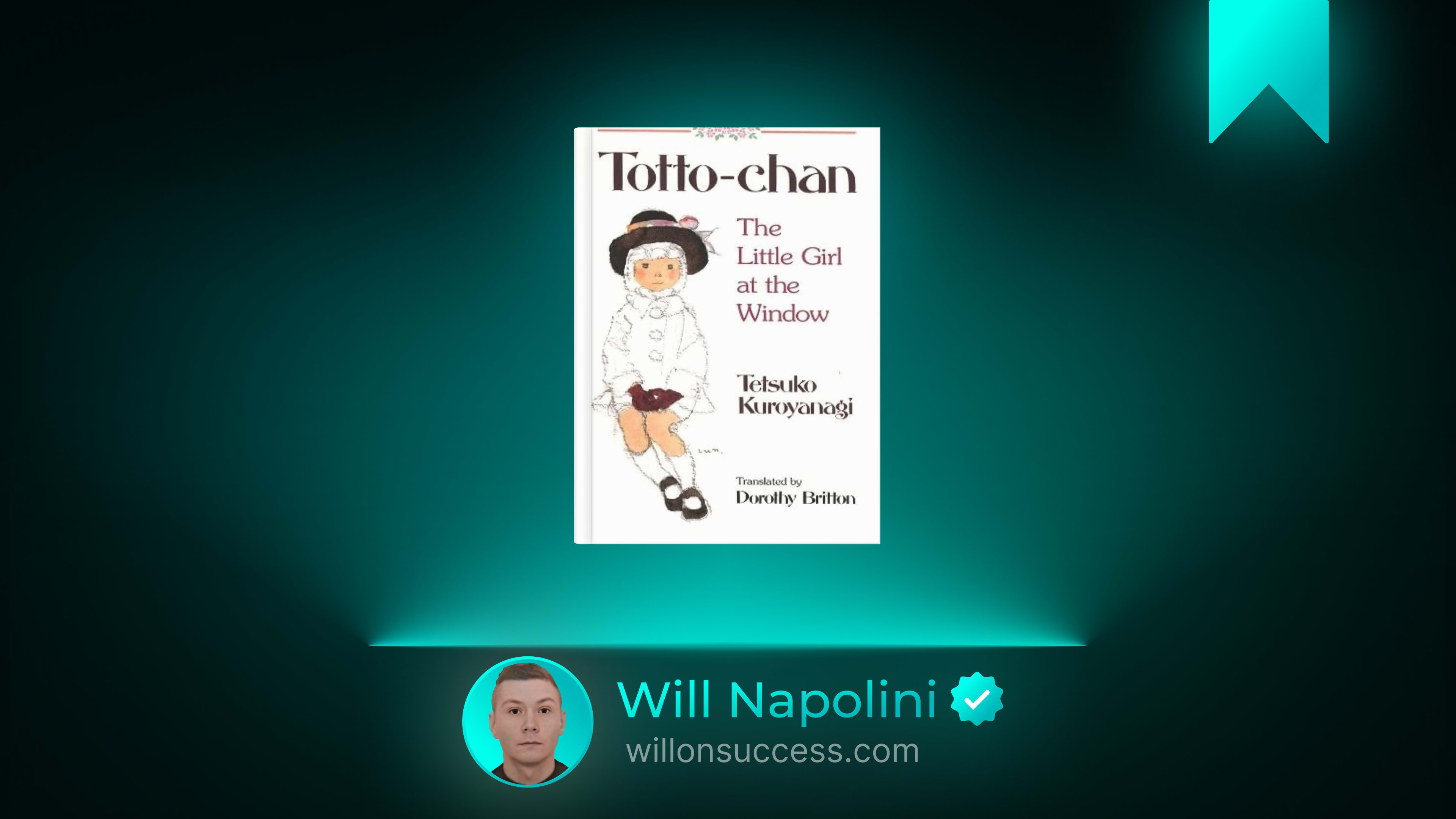
The book is Totto-Chan: The Little Girl at the Window by Tetsuko Kuroyanagi.
The Big Idea: Potential is Environmental, Not Just Internal
The central thesis of Totto-Chan is deceptively simple: Human potential is not a fixed trait hidden inside us; it is a seed that requires the exact right environment to germinate.
We are taught to believe that success is purely a matter of internal grit. If we just have enough discipline, we can thrive anywhere. But Kuroyanagi’s memoir demonstrates that when a person is in the wrong environment, their greatest strengths look like fatal flaws. When placed in the right environment, those exact same traits become the engines of their mastery.
Understanding this shifts everything. It moves us away from the exhausting cycle of self-criticism and toward the practical work of environment design. It teaches us that growth before achievement means we must first build the conditions where growth is actually possible.
The Story of the Girl at the Window
The story is autobiographical. Tetsuko Kuroyanagi, known as Totto-Chan, is a highly energetic, deeply curious, and wonderfully unconventional six-year-old girl.
On her very first day at a traditional public elementary school, she disrupts the class. She opens and closes her desk lid hundreds of times just to watch the mechanism. She leaves her seat to stand at the window and call out to a passing street musician. She is not acting out of malice; she is acting out of an insatiable curiosity about the world.
But the traditional school system does not have the bandwidth for her curiosity. The teacher is overwhelmed. After just one week, Totto-Chan is expelled.
Here is where the first miracle of the story occurs. Her mother, Miyoe, does not tell her daughter she was expelled. She simply absorbs the shock, hides her own anxiety, and begins looking for a new school. She refuses to let her bright, curious daughter internalize the label of a “failure.”
She finds Tomoe Gakuen, a tiny, unconventional school run by a visionary educator named Mr. Kobayashi. The school is literally made of abandoned railroad cars used as classrooms. There are no rigid schedules. The teachers write all the day’s subjects on the blackboard in the morning, and the students can choose to study them in any order they like. They spend their afternoons walking in nature, learning rhythm, and eating lunches that contain “something from the sea and something from the land.”
When Totto-Chan meets the headmaster, Mr. Kobayashi, on her first day, she talks his ear off for four straight hours. He does not interrupt her. He does not check his watch. He just listens with absolute, unwavering attention.
From that day forward, Mr. Kobayashi frequently tells her, “You are a good child.”
Those four words become the foundation of her entire life. In the environment of Tomoe Gakuen, Totto-Chan’s “disruptive” curiosity becomes a gift. She thrives. She learns to read, to love nature, to understand others, and to trust her own mind. The girl who was expelled after one week becomes a confident, capable, and deeply empathetic young woman.
The Major Principles
While this is a story about childhood education, the mechanics of what happens at Tomoe Gakuen apply directly to your life as an adult. Whether you are managing a team, building a business, or trying to establish healthy personal habits, these principles are universal.
The Labels We Accept Become the Lives We Lead
When Totto-Chan was at her first school, the environment implicitly labeled her as “bad” or “disruptive.” If her mother had repeated that label, or if she had stayed in that system, Totto-Chan would have internalized it. She would have grown up believing she was fundamentally defective.
Mr. Kobayashi’s genius was his understanding of psychological safety. By repeatedly telling her, “You are a good child,” he gave her a secure psychological base. When we feel safe and accepted for who we are, our nervous system relaxes. We stop spending our energy defending ourselves and start spending it on growing.
I have seen this happen in corporate environments constantly. I have seen brilliant employees labeled as “difficult” or “uncooperative” simply because their working style did not match the manager’s expectations. When those same individuals are moved to a team that values their specific cognitive style, they become top performers.
Character before circumstances. The circumstances of your environment will dictate which parts of your character are celebrated and which are penalized. You must be fiercely protective of the labels you accept. If the people around you are constantly telling you that you are not enough, you are in the wrong classroom.
Stop Forcing the Seed to Grow in Concrete
Tomoe Gakuen was built out of railroad cars. It was unconventional, unpolished, and entirely unique. But it was perfectly designed for the children who learned there.
In our own lives, we often try to force ourselves into pre-fabricated systems. We try to adopt the morning routine of a billionaire, the study habits of a straight-A student, or the productivity system of a tech CEO. When those systems fail us, we blame our lack of discipline.
But principles before hacks. A hack is a shortcut that ignores your underlying nature. A principle respects it.
If you are a night owl trying to force yourself to wake up at 5:00 AM to do deep work, you are forcing a seed to grow in concrete. You are not lacking discipline; you are lacking environmental alignment. True consistency before intensity means building a system that matches your natural rhythms so perfectly that the right action becomes the path of least resistance.
Curiosity is Not a Distraction; It is the Engine of Mastery
At Tomoe Gakuen, the children were allowed to follow their curiosity. If they wanted to study physics first and math second, they could. If they wanted to spend the afternoon observing bugs in the grass, they did.
In adulthood, we are taught that curiosity is a distraction from “real work.” We build rigid schedules and punish ourselves for wandering off-task. But Kuroyanagi shows us that curiosity is the actual engine of mastery.
When you are genuinely curious, learning feels like play. When learning feels like play, you can sustain effort for hours without burning out. If you are struggling to maintain consistency in a habit or a project, it is rarely a willpower problem. It is usually a curiosity problem. You have stripped the joy and exploration out of the process.
Why It Matters to You Right Now
You might be reading this and thinking, This is a beautiful story about a school, but I am an adult trying to pay a mortgage and manage a career. How does this help me?
It helps you because you are no longer just a student; you are the headmaster of your own life. You are the architect of your own Tomoe Gakuen.
Think about the areas where you feel the most friction.
- Are you in a career that demands you to be quiet, compliant, and repetitive, when your natural wiring is to question, create, and explore?
- Are you trying to build a fitness habit by punishing your body with workouts you hate, rather than finding movement that feels like play?
- Are you leading a team by enforcing rigid compliance, thereby crushing the very innovative curiosity you hired them for?
When you apply the lessons of Totto-Chan, you stop fighting your own nature. You stop trying to medicate your boredom with sheer willpower. You start designing your life so that your natural inclinations lead you directly to your goals.
A river does not fail when it hits a dam; it simply looks for a new channel. You do not need more force. You need a better channel.
Practical Application: Building Your Railroad Cars
Understanding the philosophy is only the beginning. Action before intention. How do we actually build a life that honors our true nature? Here are three concrete ways to apply this wisdom today.
1. Conduct a “Label Audit”
Take ten minutes to write down the negative labels you have accepted about yourself. (e.g., “I am disorganized,” “I am bad at networking,” “I am not a morning person,” “I lack follow-through.”) Next to each label, ask yourself: Is this a fundamental flaw in my character, or is this just a strength that is currently in the wrong environment? For example, “I am disorganized” might actually mean “I am highly creative and non-linear, and I am trying to work in a rigidly administrative role.” Reframe the label. Strip it of its moral weight. It is just data.
2. Design Your Environment for Your Actual Psychology
Stop trying to change your psychology to fit your environment, and start changing your environment to fit your psychology. If you want to read more, do not rely on willpower. Put a book on your pillow every morning. If you want to eat healthier, do not rely on discipline. Throw out the junk food so it requires a 20-minute drive to get it. Look at the one habit you are struggling with right now. What is the physical or social environment making it hard? Change one physical cue today to make the right choice easier.
3. Inject “Unstructured Curiosity” into Your Week
We kill our own momentum by over-scheduling every minute of our lives. Block out just two hours this week for “unstructured curiosity.” During this time, you are not allowed to work on your core tasks. You are only allowed to explore something you find genuinely interesting. Read a book outside your industry. Watch a documentary about a topic you know nothing about. Tinker with a new software tool. Let your mind wander. You will be shocked at how this “wasted” time revitalizes your focus and creativity for the rest of the week.
Who Should Read This Book
Totto-Chan is a gentle, narrative-driven memoir. It is not a dense, tactical business book. It is a story that unfolds through a series of charming, poignant, and sometimes heartbreaking vignettes.
You will benefit immensely from this book if:
- You are a parent, teacher, or leader who wants to understand how to nurture potential in others.
- You feel like a misfit in your current career or social circle and need permission to honor your own nature.
- You are feeling burned out by rigid, conventional approaches to productivity and success.
You may find it less useful if:
- You are looking for a highly structured, step-by-step tactical framework for business or finance.
- You prefer fast-paced, plot-heavy fiction over gentle, reflective memoirs.
It is a book that will soften your heart, but it will also sharpen your mind. It reminds us that the ultimate goal of personal development is not to become a perfectly optimized machine, but to become a fully realized human being.
One Small Step
Do not let this be just another inspiring story you read and forget. Let it be the catalyst for a shift in how you speak to yourself.
Here is your one small step for today: Identify the harshest, most critical voice in your head. The voice that tells you you are falling behind, that you are not doing enough, that you are fundamentally flawed.
For the rest of the day, whenever that voice speaks, consciously interrupt it. Replace it with the voice of Mr. Kobayashi. Tell yourself, out loud if you need to, “You are a good child.” Or, if that feels too foreign, “You are a capable person, and you are learning.”
It will feel silly at first. Do it anyway.
You have spent years listening to the critics who expelled you from your own potential. It is time to start listening to the headmaster who believes in you.
The Final Lesson
There is a tragic end to the physical story of Tomoe Gakuen. Near the end of World War II, the school is bombed and burned to the ground. The railroad cars are destroyed. The physical environment is gone.
But as the fire burns, Mr. Kobayashi looks at his students and says, “Now, let us see what kind of school we will build next time.”
He did not despair. He did not blame the children. He simply looked forward to the next iteration.
Totto-Chan grew up to be one of Japan’s most beloved television stars, authors, and UNICEF Goodwill Ambassadors. The physical school was destroyed, but the foundation Mr. Kobayashi built inside her mind was fireproof.
You cannot control the bombs that fall on your life. You cannot control the systems that fail you or the people who misunderstand you. But you can control the foundation you build inside yourself.
Build it on self-compassion. Build it on curiosity. Build it on the unshakable belief that you are exactly who you are supposed to be.
When you finally stop trying to be the person the world expects, and start cultivating the person you actually are, there is no limit to what you can grow.