Navigating the Crossroads of Ambivalence: Wisdom from Too Good to Leave, Too Bad to Stay
Are you standing at a crossroads, looking down two very different paths, feeling completely paralyzed?
You know the feeling. It is the exhausting, quiet agony of the pendulum. On Tuesday, you are absolutely certain you need to leave. You pack your bags in your mind. You rehearse the conversation. But by Wednesday morning, over a cup of coffee, you remember the good times, the history, the potential, and you swing back to staying.
You are caught in the space between “too good to leave” and “too bad to stay.”
If I could sit across the table from you right now, I would tell you that this pendulum swing is one of the most draining experiences a human being can endure. It steals your sleep. It clouds your focus. It makes you doubt your own intuition. You start to wonder if you are simply incapable of making a decision, or if you are just being selfish, or if you are being a coward.
I have learned that when we are stuck in this kind of emotional fog, the problem is rarely a lack of intelligence. The problem is that we are trying to solve a complex, deeply personal dilemma using the wrong tools. We are trying to think our way out of a feeling, or we are asking our friends for advice when we really need a structured framework.
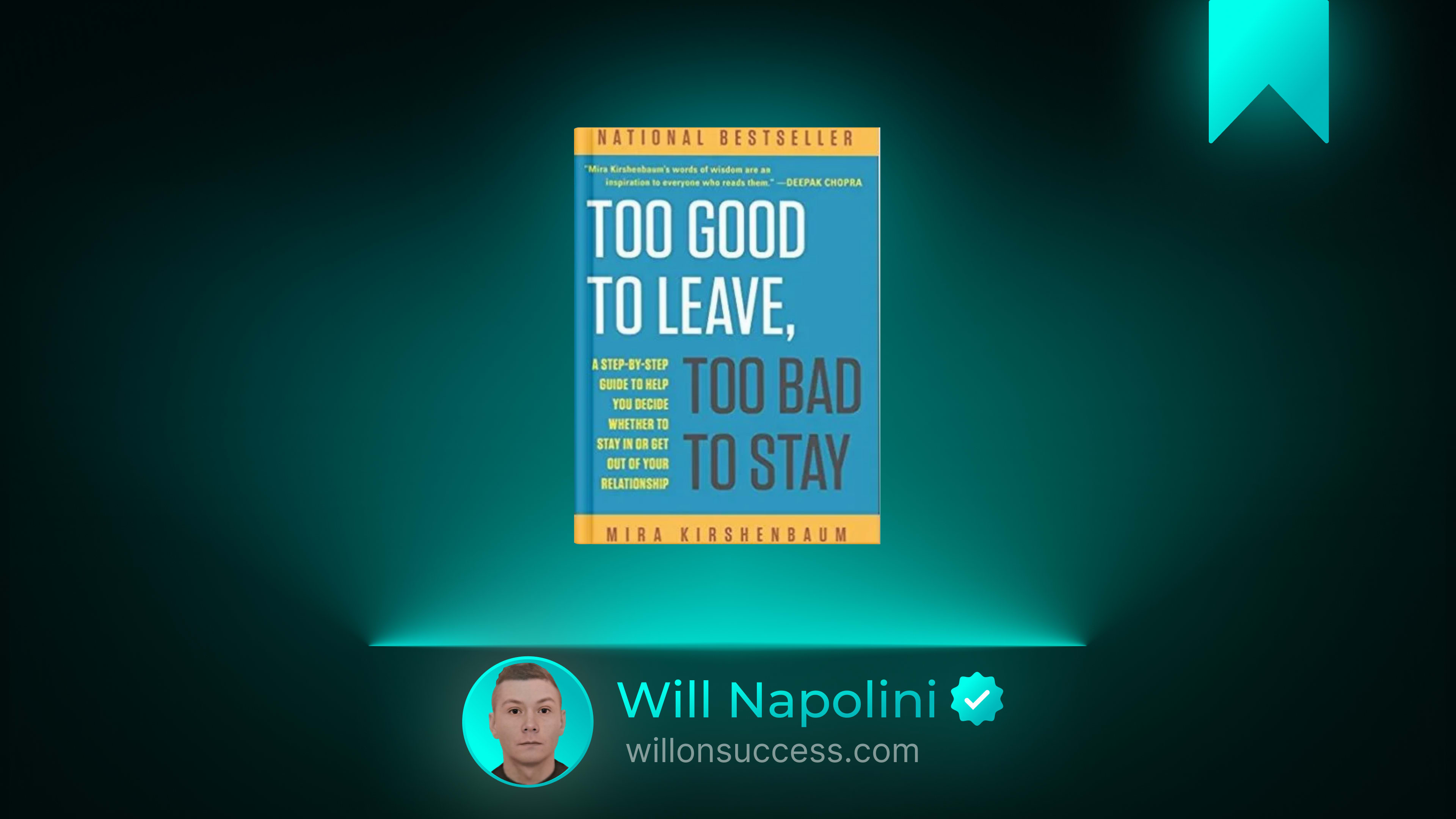
This is where Mira Kirshenbaum’s book, Too Good to Leave, Too Bad to Stay, becomes such a vital resource. It is not a book of poetic musings on love. It is a diagnostic tool. It is a clear, structured guide designed to help you cut through the noise and finally make a decision you can live with.
The Big Idea: Ambivalence is Data, Not a Life Sentence
The central thesis of Kirshenbaum’s work is surprisingly simple but profoundly shifting: Ambivalence is not a sign that you need more time; it is a sign that you are asking the wrong questions.
When you are stuck, you tend to ask vague, unanswerable questions. Do I love them enough? Are they the one? Is this as good as it gets? These questions are like trying to catch smoke with your bare hands. They only generate more anxiety.
Kirshenbaum argues that clarity does not come from thinking harder. It comes from asking better, more specific questions. By shifting your focus from abstract feelings to concrete realities, you can map out your situation logically. You do not need to magically “feel” the right answer. You need to systematically uncover the answer that is already there, hiding beneath the fear.
The Concept: The Diagnostic Decision Tree
Imagine trying to navigate a dense forest without a map. You just wander, hoping you stumble onto the right path. That is what making a relationship decision without a framework feels like.
Kirshenbaum provides the map. She uses a concept akin to a diagnostic decision tree—a series of specific, probing questions that act as signposts. Instead of looking at the relationship as one giant, overwhelming blob of “good” and “bad,” she breaks it down into distinct, manageable categories.
She asks you to evaluate specific dimensions of your relationship: Is there abuse? Are there fundamental dealbreakers? Are your core values aligned? Is your ambivalence driven by a fear of being alone, or a fear of commitment?
By answering these questions honestly, you eliminate the guesswork. You move from the emotional chaos of the heart to the grounded clarity of the mind. You start small. You answer one question. You let the answer guide you to the next. You let the structure do the heavy lifting.
The Major Principles
What can we extract from Kirshenbaum’s framework to apply to our own lives, whether in romance, business, or personal goals? The principles go far beyond relationship advice. They are about how we make high-stakes decisions when our emotions are compromised.
You Cannot Build a Future on the Foundation of Potential
One of the most powerful diagnostic questions Kirshenbaum introduces is what I call the “Never Change” test. She asks you to imagine that your partner will never change the specific traits that are causing you pain. If they never become more ambitious, never learn to communicate better, never stop leaving you feeling lonely—would you still stay?
This is a crucial principle of personal development: Character before circumstances. You must evaluate the reality of the present, not the promise of the future.
I have seen so many people stay in unfulfilling situations because they are in love with potential. They see what the person could be, or what the job could become. But potential is a ghost. It is not real. If your answer to the “Never Change” test is no, then you are not staying for the relationship you have; you are staying for a relationship that does not exist. And that is a very lonely place to live.
Separate Fear from Intuition
When we are ambivalent, fear is usually driving the car. But fear is a shapeshifter. It can look like love, and it can look like logic.
Kirshenbaum helps you distinguish between staying out of genuine alignment and staying out of fear. Are you staying because you truly value the partnership, or are you staying because you are terrified of starting over? Are you staying because you feel guilty about hurting them, or because you are afraid of being the “bad guy”?
Conversely, she helps you examine the fear of leaving. Are you wanting to leave because you are fundamentally incompatible, or are you wanting to leave because you are bored, or afraid of true intimacy?
Responsibility before excuses. You must take ownership of your motivations. If fear is the primary reason you are staying, you are not choosing your partner; you are choosing your comfort zone. Growth requires us to step out of the comfort zone, even when it is terrifying.
The Sunk-Cost Fallacy in the Heart
How much time have you invested in this relationship? Five years? Ten years? That is a massive amount of emotional, temporal, and financial capital. It is incredibly difficult to walk away when you have invested so much.
But Kirshenbaum gently but firmly points out that past investment is not a valid reason for future commitment. This is the sunk-cost fallacy. The time you have spent is gone. It cannot be recovered. The only question that matters is: Given who we are today, and what we want for tomorrow, does this path still make sense?
Your habits and your history are votes for the person you were. They do not have to be votes for the person you are becoming. Consistency before intensity means you must consistently align your daily choices with your current truth, not your past sacrifices.
Why It Matters to You Right Now
You might be thinking, I am not currently in a romantic relationship, so why does this matter to me?
Because the mechanics of ambivalence are universal. You may be facing this exact pendulum swing in your career. You might be running a business that is “too good to leave” because it pays the bills, but “too bad to stay” because it drains your soul. You might be clinging to a friendship, a living situation, or a personal habit that no longer serves you.
The mental loop of ambivalence degrades your self-trust. Every time you make a decision and then second-guess it, you weaken your internal compass. Every time you stay in a situation out of fear rather than choice, you teach yourself that your own needs are secondary.
When you apply Kirshenbaum’s principle of asking better questions, you stop leaking energy. You stop living in the waiting room of your own life. You reclaim your agency. You realize that making a hard choice is always better than making no choice at all, because even a wrong choice provides the data you need to course-correct. Stagnation provides nothing.
Practical Application: How to Clear the Fog
Understanding the trap of ambivalence is only the first step. Action before intention. You need a system to move from paralysis to clarity. Here is how you can apply the principles of this book to your own life today.
1. Implement a 48-Hour “Information Diet”
When we are ambivalent, we seek external validation. We ask our friends, we read articles, we look for a sign. This only adds to the noise. For the next 48 hours, stop asking for outside opinions. Stop discussing the dilemma with anyone who is not a licensed therapist or a deeply objective mentor. Sit in the quiet. The clarity you need is already inside you; you just need to stop drowning it out with other people’s voices.
2. Write the “Reality Ledger”
Take a piece of paper and draw a line down the middle. On the left side, write “The Reality of Today.” On the right side, write “The Fantasy of Tomorrow.” Under “Reality,” write down the concrete facts of your current situation, without judgment. (e.g., “We argue about money twice a week.” “I feel lonely when I come home.”) Under “Fantasy,” write down the hopes you have for how things could be. Look at the left side. That is what you are actually choosing if you stay. Are you willing to choose the left side for the next five years? If the answer is no, you have your clarity.
3. The “Magic Wand” Exercise
This is a variation of Kirshenbaum’s diagnostic questioning. Imagine you have a magic wand. You can wave it and instantly change the one thing that is frustrating you about your situation, but your partner (or boss, or friend) will have no memory of the change. If you wave the wand and they suddenly become perfectly attentive, would you stay? If yes, you are in love with a modified version of them, not the real them. If you wave the wand and you still feel a deep desire to leave, then the issue is not the specific behavior; the issue is the fundamental foundation of the relationship.
4. Make a “Micro-Decision”
Ambivalence thrives on massive, overwhelming choices. Break it down. If you are deciding whether to leave a job, do not decide to quit today. Just decide to update your resume this weekend. If you are deciding whether to end a relationship, do not decide to break up today. Just decide to sleep in the guest room for one night to see how your body feels. Action before intention. Small actions will reveal the truth that big thoughts cannot.
Who Should Read This Book
Too Good to Leave, Too Bad to Stay is a highly practical, almost clinical book. It is structured like a workbook.
You will benefit immensely from this book if:
- You are an analytical thinker who feels stuck in an emotional dilemma.
- You are prone to “analysis paralysis” and need a structured framework to make a decision.
- You have been in a state of relationship ambivalence for more than six months and need an objective guide to help you see clearly.
You may find it less useful if:
- You are looking for deep, poetic explorations of romantic love and emotional healing.
- You are currently in a crisis involving active abuse or severe mental health issues (in which case, please seek professional, immediate support rather than a self-help workbook).
- You prefer narrative-driven books over question-and-answer formats.
It is a tool, plain and simple. But when you are lost in the woods, a simple tool is exactly what you need to find your way out.
One Small Step
Do not let this article become just another piece of information you consume and forget. That is the trap of the ambivalent mind: consuming information to avoid making a decision.
Here is your one small step for today: Take out your phone or a piece of paper and write down the answer to the “Never Change” question.
Ask yourself: If the person, job, or situation I am agonizing over never changes a single thing about the traits that are causing me pain, do I want to stay?
Write down a simple “Yes” or “No.” Do not explain it. Do not justify it. Just answer it.
Look at that word. That is your truth, stripped of the fog.
You cannot control the past you have invested, and you cannot control the future that has not arrived. But you have absolute authority over the choice you make in this present moment.
A difficult decision made with clarity will always serve you better than a comfortable compromise made in fear. Choose yourself, ask the hard questions, and trust that you are strong enough to walk the path your answers reveal.