Why the Future is Unpredictable but Your Life Doesn't Have to Be: A Summary of Same as Ever
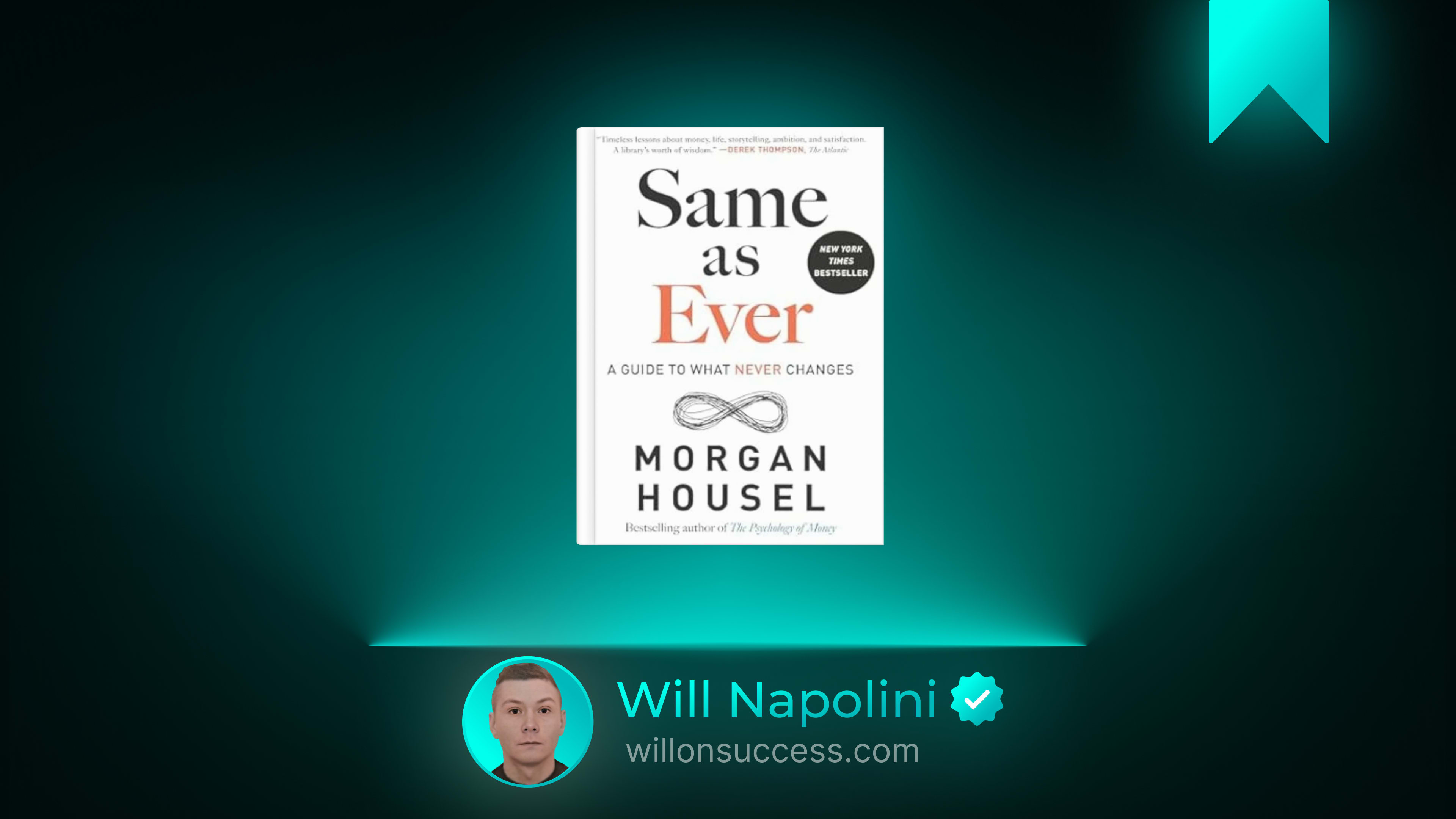
I want to show you an idea that might fundamentally change how you look at the uncertainty in your life.
We spend an enormous amount of energy trying to predict what will happen next. We forecast the economy, we guess what our competitors will do, and we try to map out the exact trajectory of our careers and relationships. We crave certainty. We want to know exactly where the ground will be tomorrow so we can position our feet safely today.
But what if the secret to navigating an unpredictable world has nothing to do with seeing the future, and everything to do with understanding what never changes?
If I could sit across the table from you right now, I would tell you to stop trying to read the crystal ball. The future is a fog of variables, entirely impossible to forecast with precision. But human nature? Human nature is carved in stone.

The Big Idea
This is the central thesis of Morgan Housel’s Same as Ever. The world changes constantly—technologies evolve, markets shift, and empires rise and fall. But the underlying software of humanity remains exactly the same.
We are still driven by the same fears, the same greed, the same need for belonging, and the same susceptibility to a good story that our ancestors were centuries ago. Housel argues that instead of exhausting yourself trying to predict the unpredictable events of tomorrow, you should master the timeless patterns of human behavior. When you base your decisions on what will always be true, you build a life that is resilient, grounded, and remarkably calm amidst the chaos.
You stop trying to force the external circumstances to be predictable, and you start building the internal character capable of handling whatever arrives.
The Story or Concept: The Climate and the Weather
Housel introduces a mental model that I have found indispensable: the difference between expiring information and permanent information.
Expiring information is the daily news. It is the stock market ticker, the political scandal of the week, the latest trending debate on social media. It feels incredibly urgent in the moment, but it rarely matters six months from now. It is the weather—constantly shifting, occasionally violent, and ultimately fleeting.
Permanent information, on the other hand, is the study of how people react to fear. It is the understanding of how incentives drive behavior, or why periods of prosperity inevitably breed arrogance. This is the climate.
Most of us spend our lives reacting to the weather, desperately trying to carry an umbrella for every possible storm. But the most resilient individuals are those who study the climate. They know that while they cannot predict the exact date of the next hurricane, they know with absolute certainty that hurricanes will come. Therefore, they build strong foundations. They invest in preparedness, not prediction.
The Major Principles
Happiness Is the Gap Between Reality and Expectations
You may be working hard, achieving your goals, and still wondering why you don’t feel fulfilled. We tend to believe that happiness is the result of objective conditions. We think that if we just reach a certain income, buy the right house, or get the promotion, the satisfaction will arrive automatically.
But Housel points out a much simpler, albeit harsher, equation: Happiness equals reality minus expectations.
Imagine a highly successful celebrity who possesses wealth, status, and adulation. By all objective measures, their reality is extraordinary. Yet, if their expectations demand constant validation, endless fame, and absolute perfection, they can be profoundly miserable. Now consider someone living a modest, quiet life who expects very little and deeply appreciates what they have. They can experience a profound sense of joy.
The mistake we make is assuming that to be happier, we must endlessly upgrade our reality. But reality is difficult to change quickly. Expectations, however, can be adjusted today. When you learn to manage your expectations, you reclaim your peace of mind. You stop letting the highlight reels of other people’s lives dictate your internal sense of worth.
Calm Plants the Seeds of Crazy
Have you ever noticed how periods of unprecedented stability almost always end in sudden chaos?
Housel observes a timeless pendulum in human behavior: calm plants the seeds of crazy. When times are good, when the markets are rising and life feels secure, we do not just feel comfortable; we become over-optimistic. We start to believe that the good times are our new baseline. This complacency leads us to take on too much debt, assume too much risk, and stretch ourselves too thin.
Eventually, the reckoning arrives. The calm transitions into fear, and the optimism shatters into panic. This is not an anomaly of modern economics; it is a permanent feature of human psychology.
The antidote to this destructive cycle is not to live in constant paranoia. The antidote is to deeply understand the concept of “enough.” When you know what is enough for you, you stop playing a game where the only way to win is to risk what you have and need, in order to gain what you don’t have and don’t need. Recognizing when you have crossed the threshold of “enough” is one of the most powerful financial and emotional decisions you will ever make.
The Invisible Price Tag of Success
There is a dangerous assumption hiding inside the way most of us think about achievement. We look at a thriving business, a beautiful marriage, or a robust investment portfolio, and we see the reward. What we fail to see is the price tag.
Everything worth pursuing in life has a cost. But as Housel notes, the price is rarely paid in cash. You do not buy a great career with a credit card. You pay for it with stress, uncertainty, long hours, bureaucracy, and constant doubt. You pay for a deep, lasting marriage with the friction of compromise, the pain of difficult conversations, and the sacrifice of your own ego.
When you encounter hardship on the path to a meaningful goal, the default human reaction is to feel like something has gone wrong. We treat the difficulty as a fine—a penalty for making a mistake. But the difficulty is not a fine. It is a fee. It is the admission price for the experience you are trying to build.
Once you reframe volatility, stress, and fear as the standard fees of success rather than punishments for failure, they lose their power to paralyze you. You take responsibility for the fee, rather than making excuses about the unfairness of the hardship. You become willing to pay the price because you finally understand what you are buying.
Progress Is Invisible; Destruction Is Loud
If you watch the daily news, it is easy to conclude that the world is falling apart. We are bombarded with images of tragedy, conflict, and disaster. But this is an illusion created by the asymmetry of time.
Destruction happens quickly. A building can be demolished in an afternoon. A market can crash in a single week. A reputation can be ruined in a moment. Because destruction is sudden, it is highly visible and deeply emotional.
Progress, however, is a slow, quiet compounding. It is the diseases that were cured over decades, the gradual reduction in global poverty, the small daily improvements in technology that make life infinitesimally easier. Good news is essentially the tragedy that didn’t happen. And because it didn’t happen, there is nothing to film, nothing to broadcast, and nothing to measure in the moment.
You do not need more motivation to stay optimistic; you need a better understanding of time. The goal is not merely to achieve a sudden spike of success, but to become someone capable of sustaining long-term growth. When you realize that we measure destruction by the second, but we measure progress by the decade, you can maintain a quiet, grounded hope even when the headlines scream despair.
Stories Move Markets and Minds
We like to think of ourselves as rational creatures who make decisions based on data, logic, and spreadsheets. But Housel reminds us of a much older truth: humans are storytelling creatures.
When an anecdote and a statistic disagree, the anecdote almost always wins. A compelling story about a single person’s triumph will always move markets, minds, and money far more effectively than a chart showing a slow, statistical average.
Why does this matter in your life? Because you are constantly telling yourself a story about who you are and what you are capable of. If your internal narrative is one of defeat, no amount of external data will convince you to take a risk. But if you can craft a compelling, honest story about your own resilience and potential, you will find the courage to act. Furthermore, understanding this principle makes you immune to the manipulative stories sold to you by marketers and politicians. You learn to look past the emotional narrative and ask for the underlying data.
Wounds Heal, but Scars Endure
You have likely been in an argument where you and another person are looking at the exact same facts, yet you arrive at completely opposite conclusions. It is tempting to assume the other person is either uninformed or irrational.
But Housel offers a more compassionate and accurate explanation: people do not make decisions based on a shared spreadsheet of facts; they make decisions based on their unique history of scars.
Minor setbacks in life are like wounds. They hurt, they bleed, but eventually, they heal and fade from memory. But massive, traumatic events—surviving a brutal recession, losing a loved one, experiencing a profound failure—leave psychological scars. These scars permanently reset your baseline for risk, fear, and expectation.
The person who grew up in poverty will view the stock market entirely differently than the person who grew up in wealth. Neither is inherently wrong; they are simply operating from different scarring experiences. When you recognize this, your relationships change. You become less quick to judge, and far more curious about the invisible history that shaped the person sitting across from you.
What Changes When You See the World This Way
When you internalize these principles, a profound shift occurs in how you navigate your life.
You stop feeling like a victim of circumstance. When the market turns against you, you do not panic, because you know that fear and greed are simply taking their turn on the pendulum. When your career hits a wall of frustration, you do not quit, because you recognize that you are simply paying the invisible fee of admission.
You become a more empathetic partner, a more patient leader, and a more resilient individual.
In your work, you stop obsessing over quarterly downturns and start focusing on long-term compounding. In your relationships, you understand that your partner’s fears are often rooted in their scars, making you a more patient listener. In your daily habits, you realize that small, daily improvements are invisible in the moment, so you stop quitting when you don’t see immediate results.
Practical Application
Understanding timeless principles is valuable, but understanding without action changes nothing. Here is how you can translate these ideas into your daily life.
Define Your “Enough” Sit down with a piece of paper and write down what “enough” looks like for you in three areas: your finances, your career status, and your lifestyle. Be specific. Is it a certain savings rate? Is it a specific title? Is it a certain amount of free time on the weekends? Once you define it, make a pact with yourself to protect it. When you reach that threshold, stop moving the goalposts.
Reframe Your Current Struggle Think of the biggest challenge you are facing right now at work or in a relationship. Write down the word “FEE” at the top of the page. Below it, list the frustrations, the stress, and the doubts you are experiencing. Remind yourself that this is not a penalty for doing something wrong; it is the exact cost of the outcome you desire.
Audit Your Information Diet Look at the last ten articles, videos, or posts you consumed. How many of them will matter in five years? Challenge yourself to replace 20% of your daily news intake with “permanent information.” Read a biography, study the history of your industry, or learn about human psychology. Feed your mind the climate, not just the weather.
Who Should Read This Book
Same as Ever is essential reading for anyone who feels overwhelmed by the pace of modern change. It is profoundly useful for investors, entrepreneurs, and leaders who need to make decisions in uncertain environments, as well as anyone seeking a more grounded approach to personal happiness.
However, if you are looking for a step-by-step tactical manual on how to day-trade stocks, optimize your morning routine to the second, or build a viral marketing campaign, this book will frustrate you. Housel is not interested in life hacks. He is interested in life wisdom. If you are willing to slow down and think deeply about the enduring nature of humanity, this book will reward you for the rest of your life.
One Small Step
You do not need to overhaul your entire life today. You just need to shift your perspective.
Tonight, before you go to sleep, think of one expectation you currently hold that is causing you unnecessary stress or envy. Perhaps it is an expectation about how fast your career should be advancing, or how your home should compare to your peers. Consciously choose to lower that expectation by ten percent. Give yourself permission to be satisfied with a little less perfection.
The world will always be noisy, unpredictable, and entirely out of your control. But your mind is a fortress you can defend.
You cannot command the changing tides of the world, but you can always choose the depth of your anchor.