The Wealth Illusion: Why Working Harder Will Never Make You Rich
You work hard. You follow the rules. You get the degree, you take the job, you get the promotion. Yet, at the end of the month, you look at your bank account and wonder where it all went.
If I could sit across the table from you right now, I would tell you something that might feel like a heavy truth: You are not struggling because you lack work ethic. You are struggling because you were handed the wrong map.
From the time we are old enough to sit at a desk, we are taught a very specific formula for life. Study hard, get good grades, find a secure job with benefits, save a little money, and eventually, you will be comfortable. It is the advice our parents gave us, driven by their deep love and their desire to see us safe.
But the world has changed, and that old map no longer leads to the destination it promises. It leads to a treadmill. You run faster, you earn more, but the treadmill speeds up to match your pace.
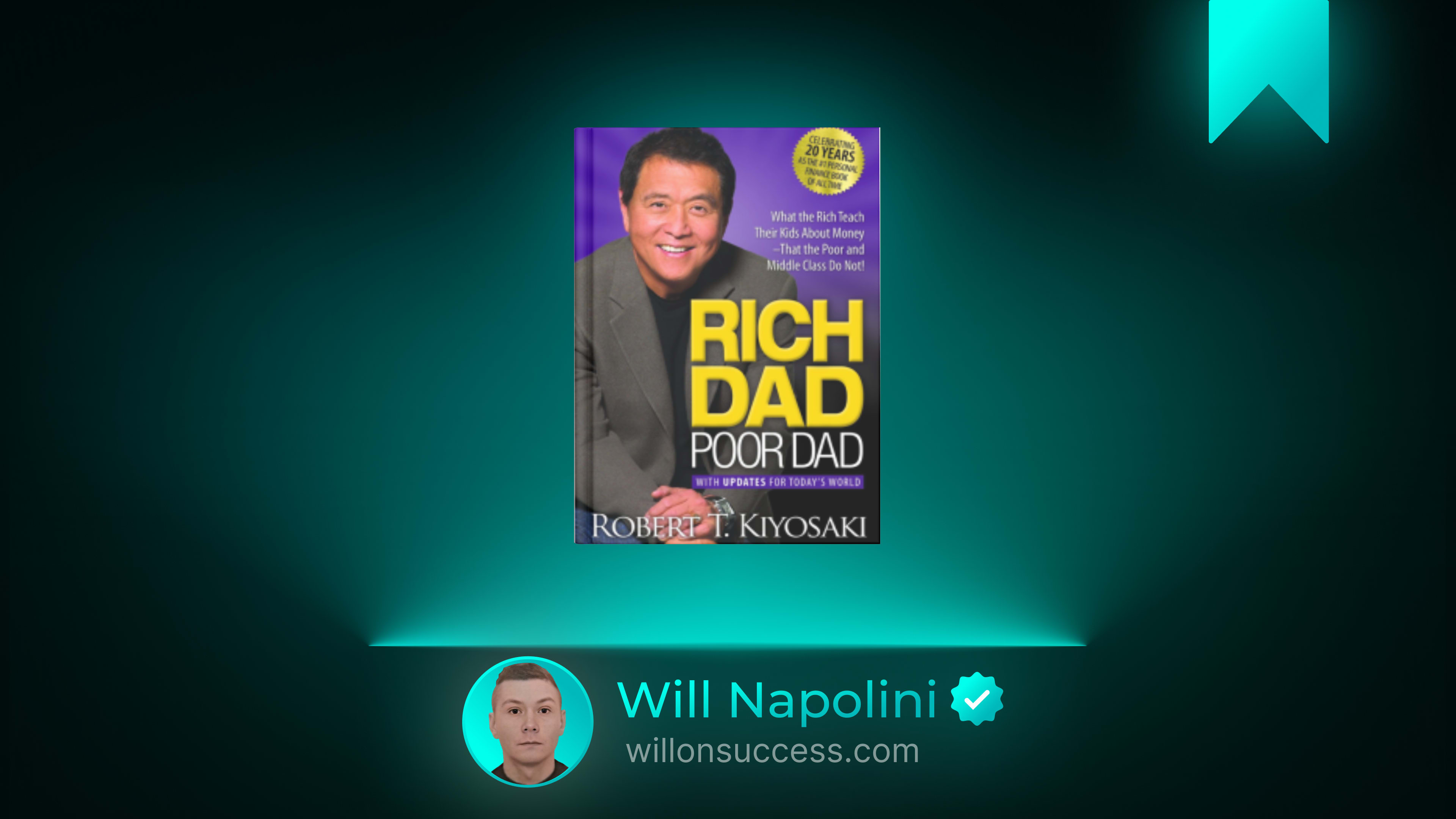
In his paradigm-shifting book Rich Dad Poor Dad, Robert Kiyosaki dismantles the mythology of the “safe” path. He reveals that the primary difference between the wealthy and the middle class is not the size of their income, but the architecture of their minds. The rich do not work for money. They build systems that make money work for them.

The Tale of Two Maps
The foundation of the book rests on a powerful, true story from Kiyosaki’s childhood in Hawaii. He grew up observing two highly influential men who shaped his worldview—two fathers who offered entirely contradictory advice.
His biological father—whom he calls his “Poor Dad”—was a brilliant, highly educated man with a PhD. He held a prestigious government job and earned a high income. Yet, he constantly struggled with bills, lived paycheck to paycheck, and believed that financial success was a matter of earning a larger salary. His mantra was, “The love of money is the root of all evil,” and “I can’t afford it.”
His best friend’s father—his “Rich Dad”—never finished the eighth grade. He was an entrepreneur and an investor who eventually became one of the wealthiest men in Hawaii. He believed that financial security came from owning assets, not from climbing a corporate ladder. His mantra was, “The lack of money is the root of all evil,” and “How can I afford it?”
One man believed the system would take care of him if he was a loyal employee. The other man believed that relying on an employer was the riskiest thing a person could do.
Kiyosaki chose to listen to the Rich Dad. And in doing so, he discovered that wealth is not a number on a W-2 form. Wealth is a measure of how much time you can survive without physically working.
The Engine of the Rat Race
To understand how to build wealth, we first have to understand why we feel so trapped. Kiyosaki identifies the “Rat Race”—that exhausting cycle of working, paying bills, and running out of money—as an emotional trap, not just a mathematical one.
The Rat Race is driven by two primary emotions: Fear and Desire.
Fear keeps you in the job you dislike. It is the fear of not having enough money to pay the mortgage, the fear of starting over, the fear of what people will think if you fail. So, you wake up, go to work, and trade your time for a paycheck to soothe that fear.
But then the paycheck arrives, and Desire takes over. You see a new car, a larger house, a better vacation. You convince yourself that you deserve it because you work so hard. So, you spend it.
When the money is gone, the fear returns. You go back to work. You get a raise, but you immediately upgrade your lifestyle to match it. This is known as lifestyle creep. You are earning more than ever, yet you feel just as broke as you did at your entry-level job.
If I were mentoring you through this, I would ask you to look honestly at your own life. Are you managing your money, or are your emotions managing your money? Breaking out of the Rat Race does not begin with a stock tip. It begins with the discipline to pause between the impulse to earn and the impulse to spend.
Redefining the Building Blocks of Wealth
If you take only one concept away from this book, let it be this: You must know the difference between an asset and a liability, and you must buy assets.
It sounds incredibly simple, yet millions of highly educated people get this wrong every single day. Traditional accounting definitions can be complex and muddy. Kiyosaki strips it down to its purest, most actionable form:
- An asset puts money in your pocket.
- A liability takes money out of your pocket.
This is where the book challenges conventional wisdom most aggressively. Most people believe their home is their greatest asset. But look at it through the lens of cash flow. Your home requires a mortgage, property taxes, insurance, maintenance, and repairs. Unless it is generating rental income, it is taking money out of your pocket every single month. Therefore, in the strictest sense of cash flow, your primary residence is a liability.
The middle class buys liabilities that they think are assets (big houses, new cars, financed luxuries) and wonders why they cannot get ahead.
The rich acquire true assets. These are things that generate income whether you are physically present or not. Rental real estate, dividend-paying stocks, intellectual property, and businesses that do not require your daily presence.
Think of your financial life like an orchard. Your income from your job is the water you carry in buckets. It is exhausting, heavy work. But an asset is a fruit tree. It takes time, patience, and care to plant the seed and nurture the roots. But once the tree matures, it bears fruit season after season, whether you are carrying buckets or not. Your goal is to stop carrying buckets and start planting trees.
Minding Your Own Business
There is a profound difference between your profession and your business.
Your profession is what you do to pay the bills. You might be a nurse, a software engineer, a teacher, or a mechanic. You work hard at your profession, and you make your employer or your clients wealthy.
Your business, however, is your asset column.
Kiyosaki shares a brilliant story about Ray Kroc, the founder of McDonald’s. Kroc once asked a group of elite MBA students, “What business am I in?” The students laughed and said, “You’re in the hamburger business.” Kroc replied, “No. My profession is selling hamburgers. But my business is real estate.” McDonald’s primary financial engine was buying the land and the buildings, and then leasing them to the franchisees.
You do not need to quit your day job today. In fact, Kiyosaki advises against quitting your job prematurely. Instead, keep your day job, but start minding your own business on the side.
Use the income from your profession to acquire assets for your business. Every time you get a bonus, do not buy a luxury watch. Buy a dividend stock. Every time you get a tax refund, do not book a lavish vacation. Put a down payment on a small rental property or invest in a side enterprise. Keep your day job to cover your living expenses, but let your asset column build your wealth.
The Power of Financial Literacy
It is not how much money you make. It is how much money you keep, and how many generations you can keep it for.
Making a high income without financial literacy is like pouring water into a bucket with a hole in the bottom. You might fill it up quickly, but it will eventually drain away. We see this all the time with lottery winners and professional athletes who make millions in their twenties and declare bankruptcy in their thirties.
Financial literacy is built on four pillars:
- Accounting: The ability to read the numbers and understand the actual health of a situation, rather than just trusting the surface-level pitch.
- Investing: The science of money making money. Understanding risk, reward, and strategy.
- Understanding Markets: The science of supply and demand, and knowing how to read the emotional and technical conditions of the economy.
- The Law: Understanding tax advantages and corporate protections.
Kiyosaki points out a massive structural advantage the rich utilize: corporations. An employee’s financial flow looks like this: Earn → Pay Taxes → Spend what is left. A corporation’s financial flow looks like this: Earn → Spend everything it can (expenses) → Pay Taxes on what is left.
Understanding the legal and tax frameworks of your country is not just for accountants. It is a vital survival skill for anyone who wants to build and protect wealth. Ignorance of the law is incredibly expensive.
Working to Learn, Not Just to Earn
When we are young, we are often advised to specialize. Pick a niche, get highly trained, and become an expert. While specialization is great for a profession, it can be a trap for an entrepreneur.
Kiyosaki recommends that, especially early in your career, you should seek jobs for what you will learn, not what you will earn.
He famously suggests that talented people should spend at least a few years in network marketing or direct sales. Why? Because the ability to sell, to communicate, to handle rejection, and to understand human psychology are the most critical skills in business. You can have the greatest product in the world, but if you cannot communicate its value, you will not succeed.
If you want to build your asset column, you must become a generalist. Learn a little bit about a lot of things. Study marketing, leadership, negotiation, and public speaking. The broader your skill set, the more opportunities you will see that specialists are entirely blind to.
Why This Matters Now More Than Ever
Why should you care about shifting your paradigm today? Because the safety net your parents relied on is largely gone.
Pensions are disappearing. The cost of healthcare and education is outpacing wage growth. Relying entirely on an employer to fund your retirement is a gamble with stakes that are far too high.
When you take responsibility for your own financial education, you reclaim your agency. You stop being a victim of economic downturns, corporate layoffs, and inflation. You realize that a recession is not a disaster; it is simply a time when assets go on sale.
You trade the fragile illusion of job security for the unshakeable reality of self-reliance. You stop worrying about the economy and start focusing on your own financial architecture.
Practical Application: Building Your Orchard
Understanding the philosophy of the rich is valuable, but philosophy without execution is just entertainment. If you want to escape the Rat Race, you must change your daily behaviors.
Perform a Brutal Asset Audit Take out a piece of paper. Draw a line down the middle. On the left side, write “Assets.” On the right side, write “Liabilities.” List every single thing you own. Be honest. If it does not generate income or appreciate reliably without requiring constant cash infusions, it belongs on the right side. Your car, your boat, your clothes, and your primary mortgage go on the right. Once you see the stark reality on paper, make a vow: For the next twelve months, you will not add a single item to the right column. You will only direct your surplus capital to the left column.
Pay Yourself First (The Pressure Cooker) Most people earn their money, pay their bills, and then try to save or invest what is left over. There is never anything left over. Instead, adopt the “Pay Yourself First” principle. The moment your paycheck hits your account, automatically route a set percentage directly into your asset column (an investment account, a business fund). Then, pay your bills with what is left. This will create immediate financial pressure. Let it. Use that pressure to force your mind to get creative. The pressure will push you to find side gigs, ask for a raise, or sell things you no longer need. You are using the fear of falling behind to motivate your hustle, rather than using your hustle to buy luxuries.
Invest in Your Financial IQ Stop reading the daily financial news and start studying the foundational principles of wealth. Dedicate one hour a week to learning. Read a book on real estate investing. Take a course on reading corporate balance sheets. Listen to a podcast about tax strategy. You cannot outsource your financial education to a financial advisor. You must know enough to know if your advisor is giving you good advice.
Who Needs to Read This Book
Rich Dad Poor Dad is essential reading for the beginner who feels paralyzed by the jargon of the financial world. It is for the high-income earner who is secretly drowning in debt, and for the young adult who wants to avoid the mistakes their parents made. It is a masterclass in mindset, designed to shatter your limiting beliefs about money.
However, it is important to be honest about what this book is not. It is not a step-by-step tactical manual. It will not give you the exact formula for analyzing a commercial real estate deal, nor will it tell you which specific index funds to buy on a Tuesday afternoon.
If you are looking for a granular, technical textbook on portfolio management, this book will leave you frustrated. But if you need a complete rewiring of your psychological relationship with money, work, and wealth, this is the foundation you must build upon.
Your First Step Toward Financial Freedom
You do not need a million dollars to start thinking like the rich. You only need a shift in perspective and a commitment to action.
So here is what I want you to do today.
I want you to change your vocabulary. For the next 24 hours, catch yourself every time you say, “I can’t afford it.” Notice how that statement shuts down your brain. It is a period at the end of a sentence. It allows you to go back to sleep.
Instead, force yourself to ask, “How can I afford it?”
This simple shift turns a period into a question mark. It forces your brain to wake up and start searching for solutions.
Your paycheck pays for your today, but your assets pay for your tomorrow. Stop running on the treadmill, step off the machine, and go plant your first tree.