How to Own the World: A Plain English Guide to Taking Control of Your Financial Future
There is a dangerous myth hiding in plain sight. It is the idea that investing is an exclusive club, reserved for geniuses in tailored suits staring at six glowing monitors, speaking a language of acronyms deliberately designed to make you feel foolish.
Because we feel foolish, we outsource our financial survival to “experts.” And because we outsource it, we remain dependent.
I have watched brilliant, hardworking people labor for forty years, only to arrive at retirement with nothing but a tired body and a reliance on a fragile pension. They worked hard, but they never learned the craft of ownership. They spent their lives trading their time for money, never realizing that money itself can be taught to work.
If I could sit across the table from you right now, looking at your bank statements and your quiet anxieties about the future, here is what I would tell you: The financial industry profits from your intimidation. Your greatest rebellion is simply learning the rules of the game.
The Big Idea: Redefining What Wealth Actually Is
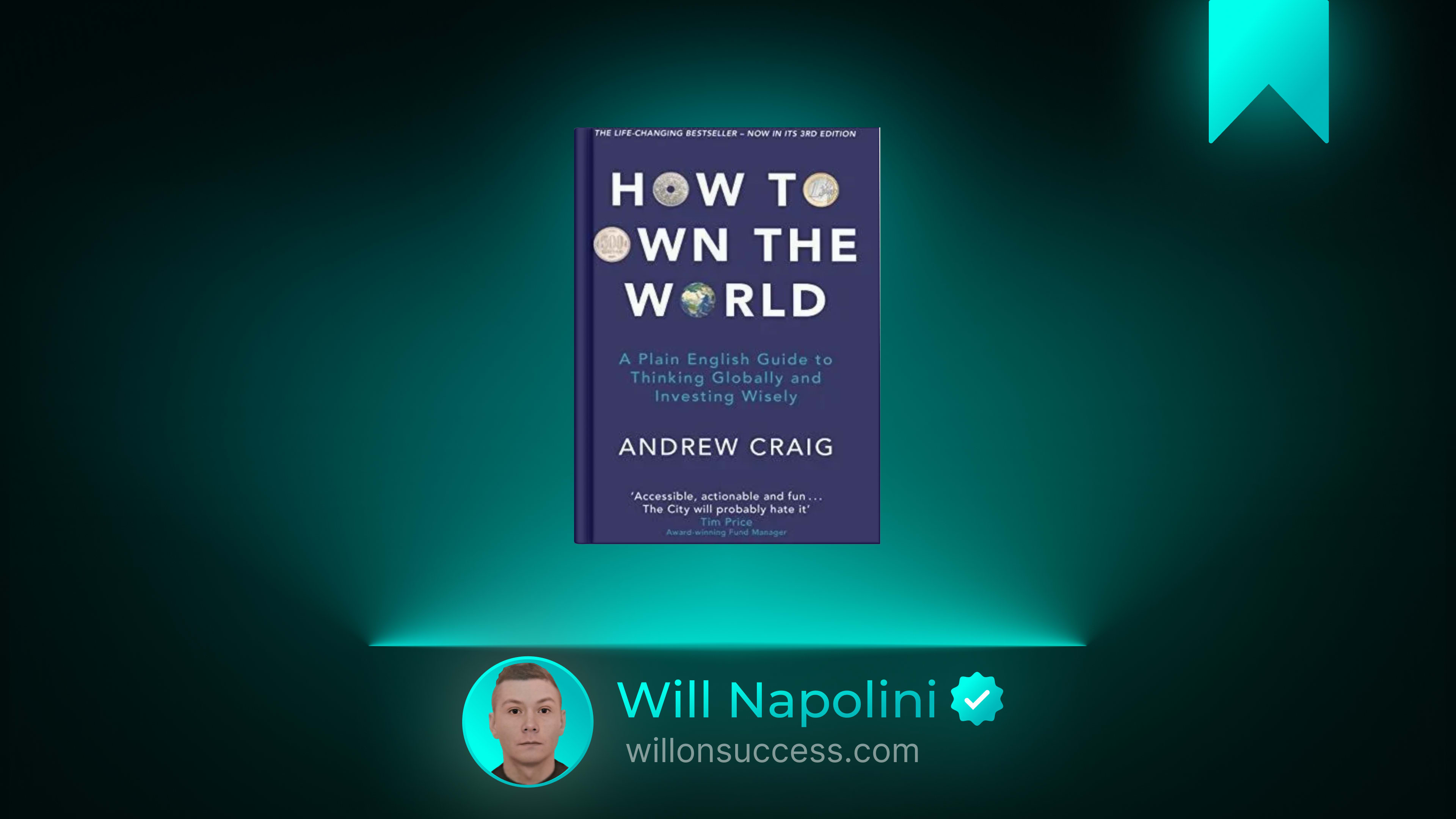
In his remarkably accessible book How to Own the World: A Plain English Guide to Thinking Globally and Investing Wisely, Andrew Craig strips away the jargon and reveals a profound truth. He argues that we fundamentally misunderstand what wealth is.
Most of us believe wealth is the size of our paycheck. But a high salary just means you have a high capacity to consume. True wealth is silent. It is an engine running in the background.
Craig defines wealth as the ability to live on the money your money makes, rather than the money you make from your labor.
The central thesis of this book is both radical and deeply comforting: you do not need to be a financial wizard to build lasting wealth. In fact, as an everyday, self-directed investor, you possess massive, structural advantages over the very Wall Street professionals you’ve been taught to revere. Investing is not a dark art; it is a learnable craft, much like carpentry or gardening. And once you understand the mechanics, you can take direct control of your future.
The Tale of Two Farmers: Why You Hold the Advantage
To understand why the everyday investor has the edge, we have to look at the psychology of the market.
Imagine two farmers. The first farmer plants a seed, digs it up every three days to check the roots, panics when it doesn’t rain on a Tuesday, and ultimately tramples his own crop in a fit of anxiety. This is the professional fund manager. They are constantly pressured by quarterly performance reviews, terrified of losing clients, and forced to react to the daily noise of the news cycle. They suffer from “career risk.” If they underperform the market for two years, they are fired. Therefore, they herd together—buying what is popular and selling in a panic just to protect their jobs.
The second farmer plants a diverse selection of seeds across different types of soil. He waters them, steps back, and lets the sun and the seasons do the heavy lifting. He knows that a storm might hit the eastern field, but the western field will thrive. He doesn’t dig up the seeds. This is the everyday investor.
You answer to no one but yourself. You do not have a boss demanding a 10% return by December 31st. You can buy a wonderful asset when the world is panicking and simply hold it for twenty years.
Your patience is a weapon that no hedge fund can replicate.
The Core Principles of Global Ownership
How do you transition from a consumer to an owner? How do you move from working for money to building a fortress of capital? Here are the core principles that will change your financial trajectory.
1. The Power of the Long Game
Most people fail at investing because they treat the stock market like a casino. They look for the hot tip, the next big thing, the shortcut. But Craig reminds us that the market is not a casino; it is a mechanism for transferring wealth from the impatient to the patient.
When you invest in the global economy, you are not gambling. You are betting on human ingenuity. You are betting that ten years from now, people will still need energy, healthcare, technology, and food. By adopting a long-term horizon, you detach yourself from the emotional rollercoaster of daily price fluctuations. You stop checking your portfolio every morning and start checking it every year.
2. The Quiet Miracle of Compound Growth
We all know the phrase “compound interest,” but the human brain struggles to comprehend exponential growth. We think linearly. We think that if we save a little, we will have a little.
But money makes money, and then that money makes more money. Craig illustrates how turning hundreds into millions is rarely about hitting a lucky stock pick; it is about the relentless, mathematical certainty of time. When you start small and stay consistent, you are buying your future freedom, one fraction of a share at a time.
A small decision becomes a direction, and a direction repeated long enough becomes a life. The magic of compounding does not happen in the first five years. It happens in the last five. But you only get to the last five if you start today.
3. The Art of Owning the World
One of the most common traps I see people fall into is “home bias”—investing only in the companies they know, in the country they live in. But tying your financial survival to the economy of a single nation is a fool’s game.
Craig advocates for thinking globally. The global economy is a vast, interconnected engine. By diversifying across asset classes (shares, property, bonds, commodities) and across geographies, you protect yourself from the ruin of any single disaster.
You do not need to guess which single seed will grow the tallest. You just need to plant the entire forest. By owning a slice of the global market through low-cost index funds, you ensure that wherever human innovation and progress are happening, you are participating in it. You are not trying to beat the market; you are becoming the market.
Why This Matters on an Ordinary Tuesday
Why does this matter when you are just trying to get through the work week? Because understanding these principles fundamentally shifts your relationship with your life.
When you know how to own the world, you no longer look at your job as your only lifeline. Your job becomes the funding mechanism for your freedom engine. This realization replaces the low-level anxiety of “Will I have enough when I retire?” with the quiet confidence of “My capital is working while I sleep.”
When the news screams about a recession, you do not panic. You realize that human beings have survived and thrived through wars, pandemics, and depressions, and the global market has always, eventually, marched upward. You stop reacting to the weather and start trusting the seasons.
Practical Application: Building Your Freedom Engine
Understanding is valuable, but understanding without action changes nothing. You do not need a complex spreadsheet to begin. You need a simple system that removes willpower from the equation.
- Stop Paying for Underperformance: Look at your current retirement accounts or mutual funds. What are the fees? If you are paying 1% or 2% to an active manager who is just hugging the index, you are bleeding your future wealth. Shift your focus toward low-cost, globally diversified index funds.
- Automate Your Harvest: Do not rely on your motivation to invest “whatever is left over” at the end of the month. There is never anything left over. Set up an automatic, recurring transfer from your checking account to your investment account on the day you get paid. Pay your future self first.
- Define Your Wealth Metric: Stop looking at your salary as your primary measure of success. Start tracking your investment base and the yield it produces. Watch the engine grow.
Who Should Read This Book
How to Own the World is a masterclass for anyone who feels paralyzed by financial jargon. It is essential reading for young professionals who want to harness the power of time, and for mid-career earners who realize they have been saving, but not investing. It is deeply valuable for anyone tired of paying high fees to financial advisors for mediocre results.
However, if you are looking for a get-rich-quick scheme, a guide to day-trading cryptocurrency, or a way to beat the market by next Thursday, this book will deeply frustrate you. Craig is not interested in gambling. He is interested in the slow, steady, and inevitable creation of wealth. He requires you to be boringly consistent, and for many, that is the hardest discipline of all.
One Small Step to Take Today
You do not need to overhaul your entire financial life today. You just need to lay the first brick.
Your one small step today is this: Log into your bank’s portal or a reputable brokerage, and set up an automated, recurring transfer of just $50 (or your local equivalent) a month into a low-cost, globally diversified index fund.
Do not look at it tomorrow. Do not check it when the news is bad. Let time do its work.
You cannot control the market, but you can control your participation in it, and the seed you plant in silence today will be the shade you rest in tomorrow.