You Are Not Lazy—You Are Drowning: What KC Davis Teaches About Cleaning When You Can Barely Function
You are staring at the dishes in the sink. They have been there for three days. Maybe four. You know because you have walked past them every morning, felt the familiar clench of shame in your stomach, and kept walking. You told yourself you would do them after coffee. Then after work. Then tomorrow. And tomorrow became another today, and the dishes became another layer in the growing evidence that something is wrong with you.
You are not wrong. You are not lazy. You are not a slob. You are not broken.
You are drowning. And the dishes are not the problem. The shame about the dishes is the problem.
I want you to hear me clearly before we go further: if you have spent months or years feeling like a failure because your living space does not match some internal standard of what it “should” look like, if you have cleaned in frantic bursts and then collapsed into exhaustion, if you have hidden your home from visitors because you cannot bear to be seen in the mess—this book was written for you. Specifically for you. By someone who has been exactly where you are sitting.
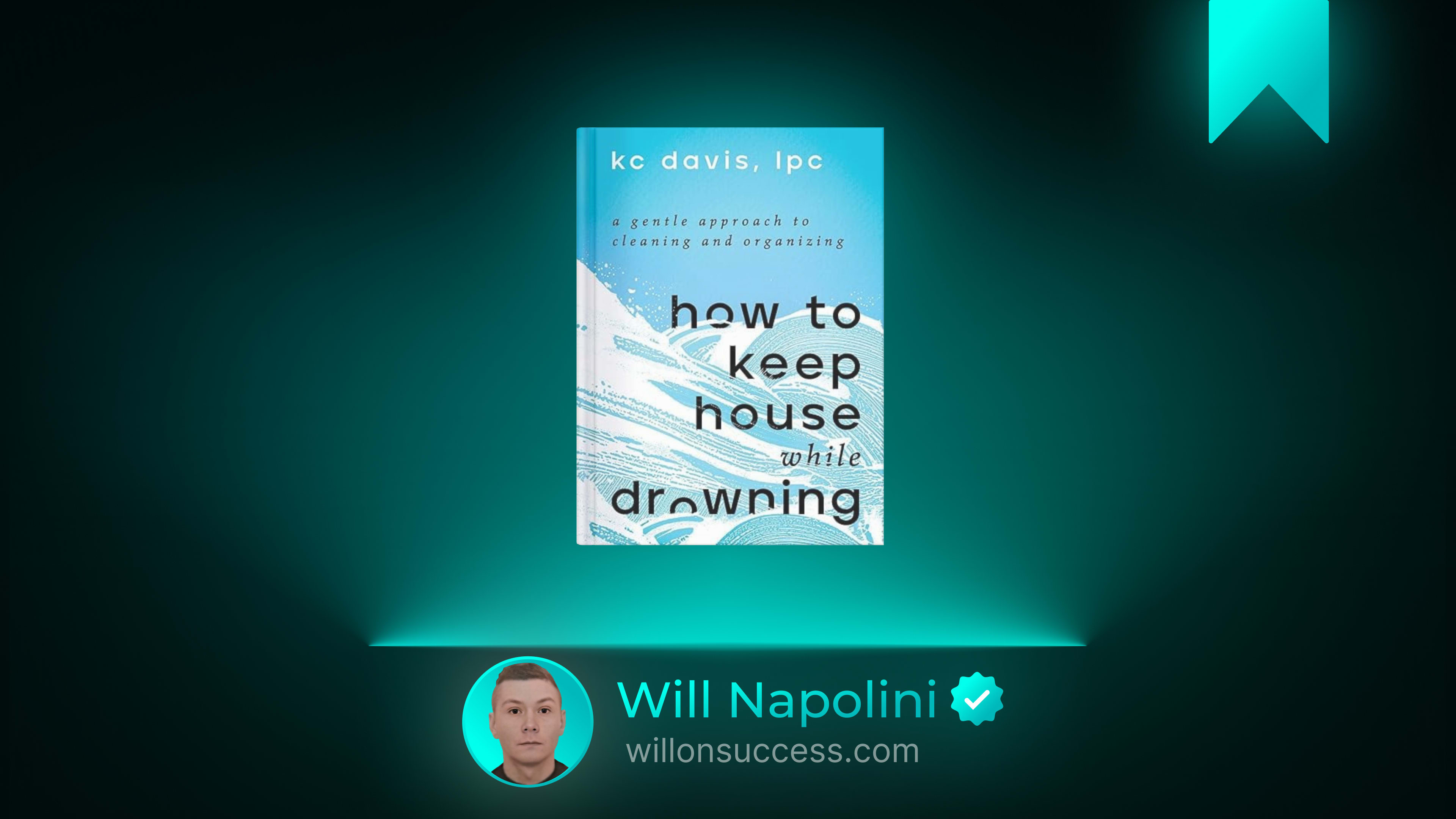
KC Davis is a licensed therapist who wrote How to Keep House While Drowning after her own experience of postpartum depression left her unable to manage basic household tasks. She was not writing from theory. She was writing from the kitchen floor, metaphorically and sometimes literally. The book is short—deliberately, radically short—because she knew that the person who needs it most cannot manage three hundred pages. She knew that the person reading it might be holding a baby, or lying in bed at two in the afternoon, or paralyzed by the executive dysfunction that makes even the thought of sorting laundry feel like climbing a mountain.
And her message, the one that threads through every page, is this: care tasks are morally neutral. You are not a better person because you vacuumed. You are not a worse person because you didn’t. Your worth is not tied to your countertops.
If no one has ever told you that before, let it land. Let it settle into the place where the shame lives. You are not behind. You are not failing. You are a human being doing your best inside a body and a mind that are, right now, asking for rest.
The Big Idea: Your Home Exists to Serve You—Not the Other Way Around
Davis’s foundational reframe is so simple it sounds almost obvious, and yet it dismantles a lifetime of conditioning in a single sentence: your home is not a performance. It is a tool. It exists to shelter you, feed you, and let you rest. That is its function. Everything beyond that—decoration, organization, aesthetic perfection—is optional.
This matters because most of us were taught, explicitly or implicitly, that a clean home is evidence of good character. That a messy home means you are undisciplined, disrespectful, or fundamentally failing at adulthood. Those messages came from somewhere—a parent, a culture, a social media feed, a childhood where order was enforced through criticism—and they lodged deep.
Davis pulls them out gently. She does not argue with them. She simply replaces them with a different framework: functionality over aesthetics. The question is not “Does my home look good?” The question is “Does my home meet my basic needs right now?”
And here is where she introduces what I think is the most practically useful concept in the entire book.
The Five Things: The Minimum Viable Home
Davis identifies five categories of care tasks that, if managed to even a basic degree, make a space functional and livable:
Laundry. You need clean clothes to wear. Clean sheets to sleep in. You do not need them folded. You do not need them put away. You need them clean.
Dishes. You need a way to eat and drink without running out of clean plates, cups, and utensils. You do not need a spotless kitchen. You need enough clean surfaces to function.
Trash. You need waste to leave the space before it becomes a health hazard or an overwhelming visual burden. You do not need to sort it perfectly. You need it gone.
Food. You need something to eat. It does not need to be a home-cooked meal. It does not need to be nutritious in the way a dietitian would define. You need calories that are accessible and require minimal preparation.
Surfaces. You need flat spaces—counters, tables, desks—clear enough to use. Not spotless. Not styled. Just clear enough that you can set down a plate, open a laptop, or place a glass of water.
That is it. Five things. If those five things are at a baseline level of managed, your home is functional. You are not failing. You are maintaining. And maintaining, when you are depressed, grieving, disabled, exhausted, or newly postpartum, is an act of profound self-care.
Everything else—the dust on the shelves, the clutter in the closet, the streaks on the mirror, the pile of mail on the counter—is optional. It can wait. It can wait indefinitely. And waiting does not make you a bad person. It makes you a person who is prioritizing survival over presentation. And that is the correct hierarchy.
Shame Is the Real Enemy—Not the Mess
Davis is a therapist, and she understands something that most cleaning advice ignores: the mess is rarely the actual problem. The shame about the mess is the problem. The shame creates avoidance. The avoidance lets the mess grow. The grown mess creates more shame. And the cycle tightens until you cannot walk into your own kitchen without feeling a physical wave of dread.
She names this cycle clearly and without judgment. She does not say “just push through the shame.” She says: the shame is not accurate information. It is a feeling, and feelings are not facts. The fact is that you are struggling. The fact is that you are doing your best with the energy you have. The fact is that a pile of laundry does not make you less worthy of love, respect, or a comfortable home.
I have seen this shame cycle destroy people’s relationship with their own space. I have watched someone avoid their bedroom for weeks because the clutter felt like a judgment on their character. I have watched someone scrub their kitchen at midnight in a panic before a friend visits, then collapse afterward, exhausted and resentful. The cleaning was not self-care. It was penance. And penance is not sustainable.
Davis offers a different path. Not perfection. Not punishment. Just function. Just enough. Just the next small thing.
Permission to Do It Wrong, Do It Halfway, or Not Do It at All
One of the most liberating sections of the book is Davis’s insistence that you are allowed to lower your standards to what is actually achievable right now. Not what you think you “should” be able to do. Not what your mother did, or what Instagram suggests, or what you managed before the depression, before the baby, before the diagnosis, before the burnout.
She gives explicit permission for things that many of us were taught to feel guilty about:
Using paper plates so there are no dishes to wash. Eating cereal for dinner because it requires no cooking and no cleanup. Letting the laundry sit in the basket unfolded because folded laundry is a luxury, and clean laundry is the actual need. Hiring help if you can afford it, or asking a friend, or trading tasks with a neighbor. Doing only one thing instead of the whole list. Doing it badly instead of not doing it at all.
This is not laziness. This is triage. When you are in survival mode, you do not aim for excellence. You aim for function. You aim for “the dishes are clean enough to eat off” and “there is food in the fridge” and “the trash is out.” And if that is all you manage today, that is enough. You are not failing. You are adapting.
Davis also addresses the paralysis of task initiation—the ADHD experience, the depression experience, the grief experience—where you know what needs to be done, you want to do it, and your body simply will not start. She does not shame you for this. She offers workarounds. Break the task into steps so small they feel almost absurd. Do not “clean the kitchen.” Wash three forks. Then stop. That counts. Put one bag of trash by the door. Then stop. That counts. Start the laundry and walk away. Let the machine do the work. You do not need to stand there and watch it.
The bar is not “complete the task.” The bar is “engage with the task in any way that moves it forward by even one percent.” And one percent, accumulated over days, becomes ten percent. Ten percent becomes functional. Functional becomes livable. Livable becomes a place where you can rest. And rest is what you need to heal.
You Are Worth the Effort—Even When You Do Not Feel Like It
Here is the emotional heart of the book, and the place where Davis’s voice becomes most tender. She says, in essence: you deserve a functional space. Not because you earned it by being productive. Not because you cleaned well enough or often enough. Because you exist. Because you are a person who deserves to eat off a clean plate, sleep in fresh sheets, and walk through a room where the floor is visible.
This is not a reward system. You do not clean your home to prove you deserve to live in it. You clean your home because you deserve to live in a space that does not cause you additional suffering. The effort is not punishment. It is care. And care does not require you to feel deserving first. You can care for yourself even while the voice in your head insists you do not matter. You can wash the plate even while the shame tells you it is pointless. You can do the small thing not because you feel worthy, but as an act of defiance against the unworthiness.
I have learned that self-compassion is not always warm and soft. Sometimes it is gritty. Sometimes it is standing in front of a sink full of dishes, feeling absolutely nothing but exhaustion and resentment, and washing them anyway—not because you want to, not because you feel inspired, but because future-you deserves a clean glass in the morning. And that counts. That is love. Ugly, tired, reluctant love. But love.
Why This Matters Beyond the Kitchen
You might think this is “just” a book about cleaning. It is not. It is a book about how we treat ourselves when we are at our least functional. It is a book about whether we believe our worth is conditional on our productivity. It is a book about whether we can extend to ourselves the same grace we would extend to a friend who said, “I haven’t done laundry in two weeks and I can’t get off the couch.”
You would not call that friend lazy. You would not tell them they should be ashamed. You would say, “You are going through something. Let me help. Let’s start small. You don’t have to do it all.”
Davis is asking you to say that to yourself. And then to actually believe it.
On an ordinary Tuesday, this means you walk into your kitchen and do not flinch. You look at the counter and do not hear the inner critic narrate your failure. You pick up one wrapper, one cup, one plate, and you put it where it goes. And you do not punish yourself for not doing the rest. You let the rest wait. You let yourself be a person who did one small thing and is allowed to rest now.
That is not giving up. That is giving yourself permission to be human.
Practical Application: One Small Thing, Done Imperfectly
Davis’s book is already intensely practical, but here is how to translate its principles into your next twenty-four hours.
Identify Your Five Things and Pick One Look at the list: laundry, dishes, trash, food, surfaces. Which one is causing you the most immediate discomfort or dysfunction right now? Not which one is the biggest mess. Which one is making your daily life hardest? Pick that one. Ignore the others for now. You are not doing everything. You are doing one thing.
Break That One Thing Into the Smallest Possible Step Do not “do the dishes.” Wash three items. Put them in the drying rack. Turn off the water. Walk away. Do not “do the laundry.” Put one load in the machine. Press start. Walk away. Do not “clean the kitchen.” Pick up five items from the counter and put them where they belong. Five. Not fifty. Five. Then stop. You have done something. That is enough for now.
Remove One Source of Unnecessary Difficulty If washing dishes is the thing that breaks you, buy paper plates. Not as a permanent solution if you do not want it to be, but as a bridge. If cooking is the barrier, stock shelf-stable meals that require only a microwave. If taking out the trash is overwhelming because it requires walking to the bin outside, keep a smaller bag by the door that you can grab on your way out. Reduce the friction. Give yourself the easiest possible path to the functional outcome.
Practice Saying “Good Enough” Out Loud The next time you finish a task—any task, even a tiny one—say out loud: “That is good enough.” Do not qualify it. Do not add “but I should have also…” Just say it. Let your nervous system hear the permission. Let it register that you are allowed to stop. That the task does not require perfection to be complete. That you are allowed to set the bar at “functional” and walk away.
Tell One Person the Truth If you have been hiding your struggle—keeping your home closed off, declining visits, feeling too ashamed to let anyone see—tell one person. A friend. A family member. A therapist. A stranger on the internet. Say: “I am struggling to keep up, and I feel ashamed about it.” You do not need to fix it before you say it. You just need to say it. Shame loses power in the light. And you are allowed to be seen in your mess. You are allowed to be a person who is struggling. You are not less lovable for it.
Who Should Read This Book
How to Keep House While Drowning is essential reading if you are managing depression, anxiety, ADHD, chronic illness, physical disability, postpartum recovery, grief, or any season of life where basic functioning feels like an uphill battle. It is for the person who has read every organizing blog and watched every cleaning video and still cannot make themselves start. It is for the person who feels like a fraud because their external life looks “fine” but their kitchen is a disaster and they are too ashamed to invite anyone over.
It is also profoundly useful for partners, family members, and friends of people in these seasons. If you love someone who is struggling, this book will help you understand why “just clean up” is not helpful advice, and what actually supports someone who is drowning.
Readers who are already in a stable, functional rhythm with their home and are looking for advanced organization systems, aesthetic inspiration, or productivity optimization will not find much here. This is not a book about doing more. It is a book about doing less, with less shame, and calling it enough. And that is precisely its gift.
The book is also intentionally short—roughly 150 pages, with generous spacing and short chapters. You can read it in an afternoon. You can read it in fragments over a week. You can skip around. Davis designed it for the exact reader who cannot manage a long, dense text. The form matches the message: lower the bar. Meet yourself where you are. You do not need to earn the right to rest.
One Small Step
Do not clean your whole house tonight. Do not make a list of everything that needs to be done. Do not schedule a “deep clean” for the weekend that you will dread all week.
Do one thing. Right now. Today.
Pick up one item from the surface nearest to you. A wrapper. A cup. A piece of mail. Put it where it goes—or put it in a pile to deal with later. Then stop. Look at what you did. Say to yourself, quietly or out loud: “I did that. And that is enough.”
You do not need to fix everything. You do not need to fix it today. You only need to break the paralysis with one small motion, and then give yourself permission to rest.
The dishes will still be there tomorrow. The laundry will still be there. The trash will still be there. And you will still be worthy of a clean plate, a fresh shirt, and a clear surface. You do not need to earn those things. You only need to reach for them, one small imperfect reach at a time.
You are not behind. You are not failing. You are here, and you are trying, and that is not nothing. That is everything.
And it is enough.