You Are Not Broken—You Are Running Old Software: What Nicole LePera Teaches About Healing Yourself
There is a version of you that has been running your life without your permission.
Not a dramatic, cinematic villain. Not a saboteur lurking in the shadows. Just a set of old instructions—written in childhood, reinforced through repetition, never updated—that quietly determines how you respond to stress, how you handle intimacy, how you speak to yourself when you fail, and what you believe you deserve.
You did not choose those instructions. You inherited them. You absorbed them from your family, your culture, your earliest experiences of safety and danger. And for years, maybe decades, you mistook them for who you actually are.
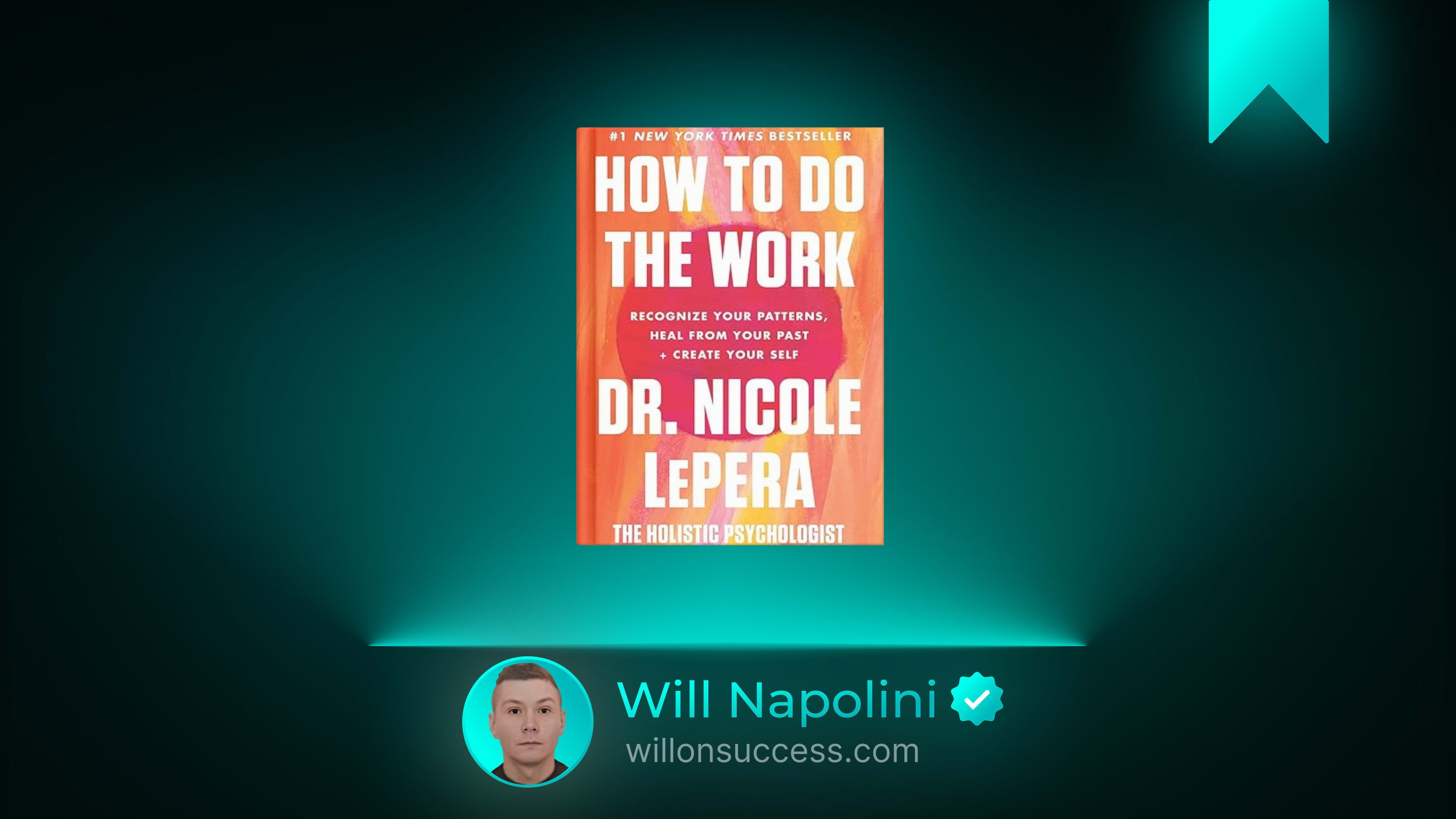
Nicole LePera, known to millions as The Holistic Psychologist, wrote How to Do the Work around one liberating insight: you are not your conditioning. You are the awareness that can observe it, question it, and gradually replace it. Healing is not about becoming someone new. It is about returning to who you were before the world taught you to shrink, perform, or disappear.
If I could sit across the table from you and say one thing, it would be this: you do not need to be fixed. You need to be understood. And the person best positioned to understand you is you.
The Big Idea: You Were Built for Survival, Not for Living
LePera’s central argument is deceptively straightforward. Every human being develops a set of adaptive strategies in childhood to navigate their environment. If your household was chaotic, you learned hypervigilance. If your caregivers were emotionally unavailable, you learned to suppress your needs. If love was conditional on performance, you learned to earn your place through achievement.
These strategies were brilliant adaptations at the time. They kept you safe. They helped you belong. They allowed a small, dependent child to navigate an imperfect world with the tools available.
The problem is that the program never got updated.
You are now an adult, living in a fundamentally different context, but your nervous system still reacts as though you are in that original environment. The boss’s critical email triggers the same dread your father’s silence once produced. Your partner’s request for space activates the same terror your mother’s inconsistency created. The friend who cancels plans drops you into the same abandonment panic you felt at seven.
LePera calls this the difference between your authentic Self—the awareness beneath the conditioning—and the constructed ego, the protective personality that formed around your wounds. Most of us spend our entire lives identified with the construction. We think we are our anxiety, our people-pleasing, our avoidance, our perfectionism. We are not. Those are costumes we wore so long we forgot we could take them off.
The work—the actual, unglamorous, daily work—is to see the costume clearly, thank it for its service, and choose something more aligned with who you actually are beneath it.
The Body Keeps the Score You Cannot Think Your Way Out Of
One of the most important contributions LePera makes in this book is her insistence that healing is not purely cognitive. You cannot journal your way out of trauma stored in your tissues. You cannot affirm your way out of a nervous system locked in chronic fight-or-flight. You cannot intellectualize your way into feeling safe.
This matters because so many of us are highly intelligent, deeply analytical people who have read every book, listened to every podcast, and understood every concept—and still feel stuck. We know why we react the way we do. We can trace the pattern back to its origin. And yet the pattern persists.
LePera explains why: trauma and chronic stress are not just memories. They are physiological states held in the body. Your nervous system learned, through repetition, to default into certain survival modes. And those modes operate below conscious thought.
She outlines the primary stress responses most readers will recognize:
Fight—the urge to control, dominate, or attack when threatened. In everyday life, this shows up as irritability, defensiveness, or the need to be right.
Flight—the urge to escape, avoid, or stay endlessly busy. This manifests as workaholism, avoidance of difficult conversations, or constant distraction.
Freeze—the urge to shut down, numb, or dissociate. This looks like procrastination, emotional flatness, scrolling for hours, or the feeling of being “stuck” without knowing why.
Fawn—the urge to please, appease, or lose yourself in another person’s needs to avoid conflict or abandonment. This is the people-pleaser who cannot say no, who absorbs others’ emotions, who feels guilty for having their own preferences.
Most of us have a dominant response and a secondary one. And most of us never consciously notice which mode we are in because the transition happens so fast, so automatically, that it feels like “just who I am.”
It is not who you are. It is what your body learned to do. And what was learned can be gently, patiently, unlearned.
Inner Child Work: The Conversation You Never Had
If there is one practice LePera returns to throughout the book with the most conviction, it is inner child work. The concept is this: the wounded parts of you—the parts that still carry the fear, shame, or unmet needs of childhood—do not simply vanish because you grew up. They remain active in your psyche, influencing your reactions, your beliefs, and your relationships.
Inner child work is the practice of consciously connecting with those younger parts of yourself and offering them what they did not receive. Not from another person. From you. From the adult you have become who now has the resources, the awareness, and the compassion that were unavailable then.
This sounds simple. In practice, it is one of the most confronting things a person can do. Because it requires you to feel the feelings you spent years avoiding. It requires you to sit with the grief of what you needed and did not get. It requires you to stop blaming your adult self for the wounds you received as a child.
LePera guides readers through this process with specific exercises: visualization, letter-writing, dialogue, and somatic awareness. The goal is not to stay in the pain. The goal is to witness it, validate it, and then offer the reassurance that was missing.
“You were not too much.” “You did not deserve what happened.” “You are safe now. I am here.”
These sentences, spoken to the child within you, are not magical. But repeated with sincerity and patience, they begin to rewire the neural pathways that once screamed “you are not enough” or “you are not safe” or “you must earn your place.”
I have seen this work transform people. Not overnight. Not dramatically. But steadily. The person who could not stop apologizing for existing begins to occupy space without flinching. The person who could not tolerate being alone begins to find their own company bearable, even nourishing. The shift is quiet. But it is seismic.
Generational Cycles: What You Inherited Is Not What You Must Pass On
LePera dedicates meaningful space to the concept of generational trauma—the idea that unhealed pain, unprocessed grief, and unconscious patterns are transmitted from one generation to the next, often without anyone realizing it is happening.
The mother who could not offer emotional warmth because she was never offered it herself. The father who equated love with financial provision because vulnerability was punished in his childhood. The grandmother who controlled every detail because chaos once threatened her survival.
These are not villains. They are people doing their best with what they were given. And recognizing that does not minimize the impact on you. You are allowed to grieve what you did not receive while also understanding why it was not given. Both truths coexist.
But here is where LePera places the responsibility squarely in the present: awareness creates choice. Once you can see the pattern, you can interrupt it. Once you can name the cycle, you can choose not to pass it forward.
This is not a burden. It is the most powerful thing a person can do. To say: “This ends with me. The criticism, the silence, the emotional unavailability, the addiction, the perfectionism, the fear—I will feel it, I will heal it, and I will not hand it to the next person as though it were an inheritance.”
Breaking a cycle does not mean you never struggle again. It means you struggle consciously instead of unconsciously. It means you catch yourself before the old script plays out. It means you repair instead of repeating. And that, over time, changes everything.
The Work Is Not an Event—It Is a Practice
Here is where LePera earns her title. The work is not something you do once in a therapist’s office and then graduate from. It is not a workshop, a retreat, or a breakthrough moment. It is the small, daily, often invisible practice of choosing awareness over autopilot.
She offers a toolkit that readers can build into their lives gradually:
Somatic practices—breathwork, body scans, gentle movement—to help the nervous system discharge stored tension and return to a state of safety. You cannot heal in a body that feels perpetually threatened.
Mindfulness and meditation—not as spiritual performance, but as the simple act of observing your thoughts without being hijacked by them. Learning that a thought is not a fact. That a feeling is not a command.
Journaling prompts and self-inquiry—structured questions that help you trace your reactions to their roots. “When did I first feel this way?” “Whose voice is this?” “What would I say to a child in this situation?”
Boundary-setting as a healing practice—not as aggression, but as the quiet declaration that your needs, your energy, and your peace matter. Learning to say no without explanation. Learning to say yes only when you mean it.
Community and connection—healing does not happen in isolation. LePera emphasizes the importance of safe relationships, even one, where you can be seen without performing. Where you can be witnessed in your process without having to be polished.
None of these tools work as a one-time intervention. They work through repetition. Through showing up on the days you do not feel like it. Through choosing the breath, the pause, the honest sentence, even when the old pattern screams louder.
You start small. You stay consistent. You let time compound the effort.
Why This Matters on an Ordinary Morning
Let me make this concrete.
It is Tuesday. You wake up and immediately feel the familiar tightness in your chest—the low-grade dread that has become so constant you barely register it anymore. Your mind begins cataloguing the day’s obligations, the people you need to please, the tasks you need to complete perfectly or else.
In the old pattern, you would barrel through. Ignore the body. Override the signal. Perform. And by Thursday, you would be running on fumes, snapping at someone you love, or numbing out in front of a screen because you have nothing left to give.
In the new practice—the one LePera is building toward—you stop. You place your feet on the floor. You take three breaths that extend the exhale longer than the inhale, signaling safety to your nervous system. You ask: “What do I actually need right now?” Not what is expected of you. What do you need?
Maybe the answer is five more minutes of stillness. Maybe it is a glass of water and a walk outside. Maybe it is calling in sick because your body is asking for rest you have been denying it for weeks.
Whatever the answer is, you honor it. Not because you are lazy. Because you are no longer willing to abandon yourself in the way you were once abandoned.
That small act, repeated daily, rebuilds trust between you and yourself. And that trust is the foundation everything else is built on.
Practical Application: Beginning the Work Today
You do not need to overhaul your life by tomorrow. You need one entry point. Here are several, drawn from LePera’s framework, that you can begin this week.
Identify Your Dominant Stress Response For the next three days, simply notice what your body does when you feel stressed, criticized, or overwhelmed. Do you tense and want to fight? Do you flee into busyness or distraction? Do you shut down and go blank? Do you immediately start managing everyone else’s emotions? Name it without judgment. “I notice I am in flight mode.” “I notice I am freezing.” Awareness is the first intervention. You cannot change what you cannot see.
Write a Letter to Your Younger Self Set aside twenty minutes in a quiet space. Close your eyes and picture yourself at the age where you first felt the wound you still carry—perhaps seven, perhaps twelve, perhaps younger. Write a letter to that child. Tell them what you see. Tell them they are not to blame. Tell them what they needed to hear and never did. Tell them you are here now. You will not leave them.
Do not rush this. If tears come, let them. If anger comes, let that too. This is not performance. This is excavation.
Practice One Somatic Reset Daily Choose one simple body-based practice and do it at the same time each day for seven days. It can be: five rounds of extended-exhale breathing (inhale for four counts, exhale for seven). A two-minute body scan from head to toe, simply noticing sensation without changing it. Placing both hands on your chest and belly, feeling the warmth, and saying silently, “I am here. I am safe.” The specific technique matters less than the consistency. You are teaching your nervous system a new default.
Set One Boundary You Have Been Avoiding Identify one area of your life where you consistently say yes when you mean no, where you over-give to avoid disapproval, where you suppress a need to keep the peace. This week, make one small change. Decline one invitation you do not want to accept. Ask for one thing you need without over-explaining. Say “I need to think about that” instead of an immediate yes. Notice the discomfort. Do it anyway. You are rewiring the belief that your needs are unacceptable.
Create a Daily Check-In Ritual Set a gentle alarm for the same time each day—perhaps morning before the rush, perhaps evening before bed. Take two minutes. Ask yourself three questions: “What am I feeling right now?” “Where do I feel it in my body?” “What do I need?” Write down the answers, even if they are one word. Even if they are “I don’t know.” The practice is not about getting the right answer. It is about building the habit of turning toward yourself instead of away.
Who Should Read This Book
How to Do the Work will resonate most deeply if you sense that your reactions are disproportionate to the present moment, if you find yourself repeating patterns you consciously want to break, or if you have spent years understanding your history intellectually but still feel stuck emotionally. It is especially valuable for people in their twenties and thirties who are beginning to separate their authentic identity from their family’s conditioning and want practical guidance for that process.
Readers seeking a purely clinical, research-heavy text may find LePera’s tone too warm, too personal, too accessible for their preference. The book prioritizes emotional connection and practical application over academic rigor. It is written as a guide, not a textbook. If you want peer-reviewed citations and theoretical debates, this is not that book. If you want a compassionate hand on your shoulder saying “I see you, and here is what might help,” it is exactly that book.
It is also important to say: this book is a complement to professional support, not a replacement. If you are navigating complex trauma, active addiction, or severe mental health challenges, LePera’s framework can illuminate your path, but skilled therapeutic support remains essential. The book does not claim otherwise.
One Small Step
Before you close this page, do one thing.
Place both feet flat on the ground. Feel the floor beneath you. Take one breath where your exhale is longer than your inhale. And finish this sentence aloud or in writing:
“The story I have been telling myself about who I am is __. And I am ready to question whether it is still true.”
You do not need to solve it today. You do not need to heal it tonight. You only need to begin the honest looking.
Because the work was never about becoming someone else. It was about remembering who you were before the world taught you to forget. And that remembering starts with a single breath, a single pause, a single choice to turn inward instead of away.
You have been running old software long enough. The update is available. And it begins now, in this breath, in this small and ordinary moment.
You are not behind. You are not too late. You are here. And here is where the work begins.