Stop Searching for Love in the Wrong Place: What Nicole LePera Teaches About Becoming What You Seek
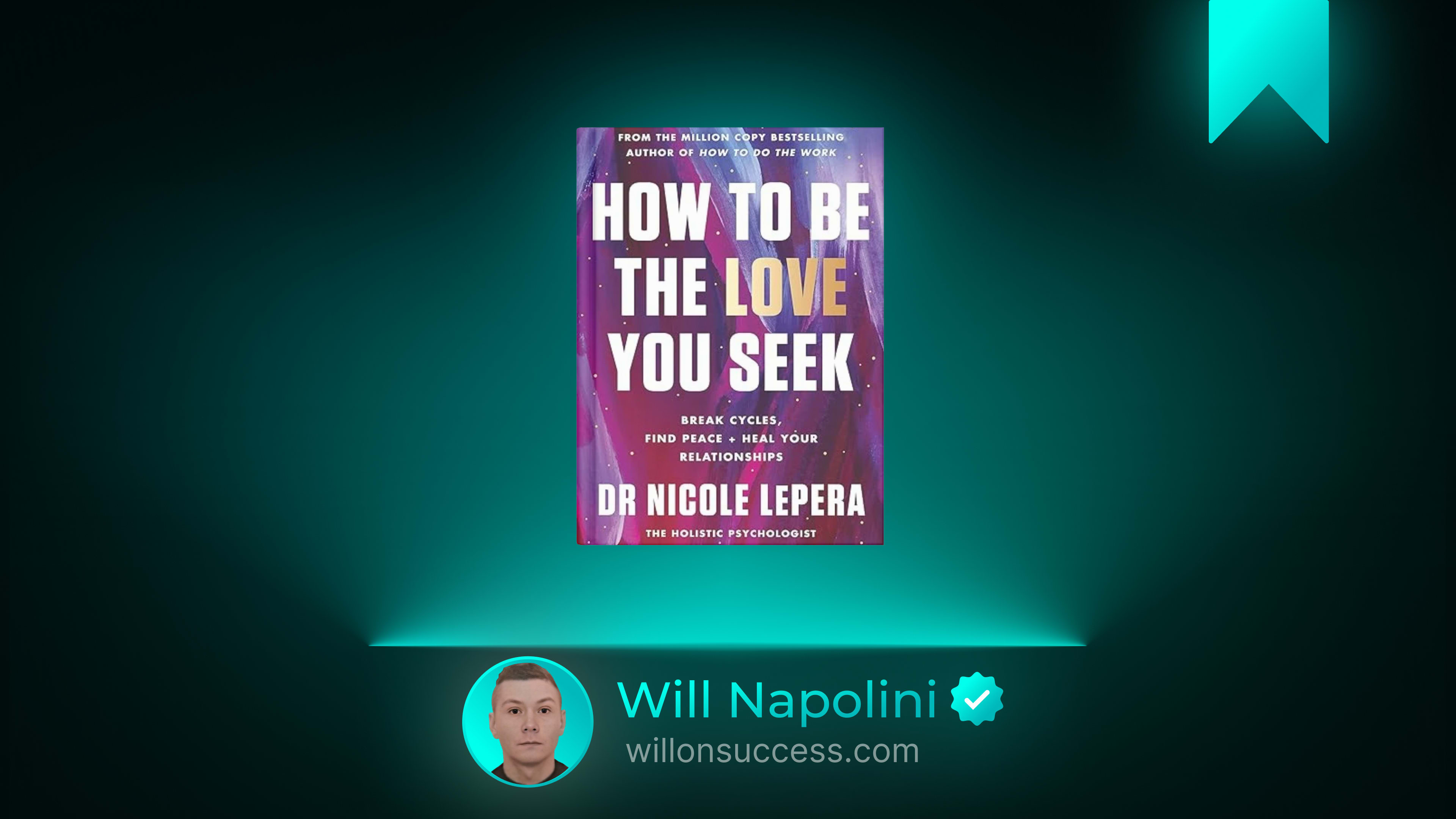
What if every relationship you have struggled with was not bad luck, but a pattern? What if the love you keep searching for in other people was never meant to be found there—not because others are unworthy of giving it, but because the wound asking for it was never theirs to heal?
I have watched people cycle through relationship after relationship, convinced the problem is selection. Wrong person. Wrong timing. Wrong circumstances. And sometimes, yes, that is true. But more often than I would like to admit, the common thread is not the partner. It is the unhealed part of us that keeps choosing, attracting, and recreating the same emotional landscape we grew up inside.
Nicole LePera, known to millions as The Holistic Psychologist, wrote How to Be the Love You Seek around one deceptively simple premise: you cannot give what you have not cultivated within yourself, and you cannot receive what you do not believe you deserve. The love you are looking for is not hiding in another person. It is waiting for you to become it.
This is not a platitude. It is a diagnosis. And like all honest diagnoses, it stings before it heals.
The Central Idea: You Were Taught to Look Outside
LePera’s foundational argument is this: most of us learned what love looks like before we had any capacity to evaluate it. We learned it from caregivers who were inconsistent, critical, absent, or overwhelmed. We learned it from households where affection was conditional, where safety was unpredictable, where emotional needs were treated as inconveniences.
Those early experiences did not just pass through us. They wrote a script. And that script now runs beneath every romantic relationship, every friendship, every moment of vulnerability we attempt.
The child who learned “I must perform to be worthy of attention” becomes the adult who over-gives and then resents the imbalance. The child who learned “my needs are too much” becomes the adult who suppresses their desires until they erupt. The child who learned “love leaves” becomes the adult who pushes people away before they can be abandoned.
LePera draws heavily on attachment theory here—the well-established framework showing that our earliest bonds with caregivers create blueprints for how we relate to intimacy throughout life. These blueprints are not life sentences. But they are default settings. And until you consciously reprogram them, they run the show.
The title of the book is the thesis. You do not find love. You become it. And becoming it means confronting the parts of yourself that were taught love was scarce, conditional, or dangerous.
Your Attachment Style Is Not Your Identity—But It Is Your Starting Point
One of the most practically useful frameworks LePera presents is the mapping of attachment styles. If you have never encountered this language, it can feel like someone finally handed you the instruction manual for your own emotional reactions.
Broadly, the styles look like this:
The anxiously attached person craves closeness but lives in fear of abandonment. They monitor their partner’s moods, read into silences, and often feel they must earn love through vigilance and effort.
The avoidantly attached person equates intimacy with loss of freedom. They pull away when things get deep, intellectualize their feelings, and often feel suffocated by others’ needs.
The fearfully attached person—sometimes called disorganized—wants closeness desperately but is terrified of it simultaneously. They oscillate between reaching out and shutting down, often within the same hour.
The securely attached person can give and receive love without losing themselves. They tolerate discomfort, communicate needs directly, and do not catastrophize conflict.
Here is what LePera emphasizes and what I think matters most: these styles are not character flaws. They are survival strategies. A child who learned to suppress their needs in a chaotic household was not broken. They were adapting. The problem is that the adaptation outlived its usefulness. What kept you safe at seven is sabotaging you at thirty-seven.
You do not need to shame yourself for your pattern. You need to see it clearly. Naming the pattern is the first act of loosening its grip.
The Inner Child Is Not a Metaphor—It Is an Operating System
LePera’s work consistently returns to what she calls inner child work, and this book is no exception. The idea is not mystical. It is practical. The part of you that still reacts with a child’s terror, a child’s neediness, or a child’s rage is not a metaphorical construct. It is a neural pathway forged in early experience and reinforced through repetition.
When your partner takes three hours to text back and you spiral into imagining they are losing interest, that is not your adult self responding proportionally. That is a younger part of you—the part who once waited for a parent who never came—reacting to the present as though it were the past.
LePera guides readers through the process of recognizing these moments, pausing before reacting, and offering that younger part of yourself the reassurance it never received. This is not indulgent. It is not self-pity. It is reparenting. It is giving yourself what was not given so that you stop demanding it from people who cannot possibly deliver it in the way your wound requires.
I have seen this shift happen in real time. A person who spent years punishing partners for not soothing them perfectly begins, slowly, to soothe themselves. Not because the partner becomes better. Because the internal void stops screaming for external rescue.
That is the moment love becomes possible. Not because someone finally fills the hole. Because you stopped asking another human to be your salvation.
Generational Patterns Are Inherited, Not Chosen
One of the most compassionate angles LePera brings to this work is the recognition that our caregivers were also wounded children who grew up without tools. The mother who could not offer consistent warmth was likely raised by someone who could not offer it to her. The father who equated love with provision rather than presence was likely taught that emotions were weakness.
This does not excuse harm. LePera is not asking you to minimize what you endured or to pretend it did not shape you. But she is inviting you to see the lineage of pain so that you can make a conscious choice: this pattern ends with me.
Breaking a generational cycle is not a single dramatic decision. It is a thousand small ones. It is pausing before you repeat the criticism you grew up hearing. It is choosing to say “I need space” instead of disappearing. It is tolerating the discomfort of vulnerability instead of numbing. It is apologizing to your child, your partner, your friend in ways no one ever apologized to you.
You are not responsible for what was done to you. You are responsible for what you do with it now. And that responsibility is not a burden. It is the only real freedom available to you.
Love Is a Practice, Not a Destination
Perhaps the most quietly radical idea in this book is that love is not something you arrive at. It is not a state you achieve once and then maintain passively. Love is a daily practice. It is something you do, repeatedly, in small and unglamorous ways.
LePera frames self-love not as bubble baths and affirmations, though those are not inherently wrong. She frames it as the disciplined work of showing up for yourself the way you wish someone else would. It is setting a boundary when it would be easier to people-please. It is resting when productivity culture screams at you to push through. It is speaking to yourself in the tone you would use with a frightened child, rather than the tone your harshest critic once used with you.
And here is where this connects to relationships with others: you cannot pour from an empty vessel. This is not a cliché. It is physics. If your inner world is depleted, resentful, and unattended, every relationship becomes a withdrawal you cannot sustain. You will eventually overdraw. You will eventually collapse into bitterness or numbness.
The practice is simple in concept and difficult in execution: tend to yourself before you tend to others. Not selfishly. Sustainably. The way a gardener tends the soil before expecting the bloom.
Why This Matters on an Ordinary Evening
Let me bring this down from the conceptual to the concrete.
It is Thursday night. Your partner says something mildly critical about how you handled a situation at work. In the old pattern—the anxious pattern, the avoidant pattern, the fearful pattern—you would react from the wound. You would defend, withdraw, or attack. You would hear “you are not enough” in what was actually “I wish you had handled that differently.” You would escalate or shut down, and the evening would be lost.
In the new practice—the one LePera is building toward—you notice the reaction rising. You feel the heat in your chest, the tightening in your throat. You do not act on it immediately. You name it: “That landed on an old wound. This is not just about tonight.” You breathe. You choose a response rather than a reaction. You say, “That hurt to hear. I need a moment.”
This is not dramatic. It will not make a good story. But it is the actual architecture of a different life. One small pause, repeated over months and years, becomes a different marriage, a different friendship, a different relationship with yourself.
You start small. You stay consistent. You let the nervous system learn that safety is possible.
Practical Application: Becoming the Love You Seek
Understanding attachment theory is illuminating. But illumination without action is just entertainment. Here is how to move this into your body and your days.
Identify Your Default Pattern This week, pay attention to your next moment of relational stress. When you feel triggered by someone you love, pause and ask: “How old do I feel right now?” If the answer is seven, or twelve, or sixteen, you have found the wound speaking. Journal about what that younger version of you needed to hear. Write the words down. Read them back to yourself slowly.
Practice One Boundary You Have Been Avoiding Choose one relationship where you consistently over-give, over-explain, or suppress a need. This week, make one small request or state one honest limit. It does not need to be confrontational. It can be as simple as: “I need an hour to myself tonight,” or “I would appreciate it if you could ask me before making plans that include me.” Notice what arises in your body when you do this. That discomfort is the old pattern resisting the new one. Let it be uncomfortable. Do it anyway.
Create a Daily Self-Check-In Set a timer for the same time each day. Take three breaths. Ask yourself: “What do I need right now that I have not given myself?” It might be rest. It might be honesty. It might be permission to grieve something small. Whatever the answer is, honor it in some way, even if only by naming it. This is reparenting in its simplest form.
Trace One Generational Pattern Think of a relational behavior that runs in your family. Maybe it is silence during conflict. Maybe it is criticism disguised as concern. Maybe it is disappearing when things get emotionally intense. Write down where you first witnessed it. Then write down one specific way you will respond differently the next time that pattern shows up in your own life. You are not fixing your family. You are interrupting the relay race before the baton reaches the next runner.
Replace One Self-Abandoning Habit Identify one way you routinely override your own needs to maintain peace or approval. Perhaps you say “I’m fine” when you are not. Perhaps you agree to plans you dread. Perhaps you minimize your accomplishments to make others comfortable. Choose one of these patterns and practice a different response this week. Even a small one. Even a quiet “Actually, I’d prefer not to.” You are teaching your nervous system that your needs do not require permission.
Who Should Read This Book
How to Be the Love You Seek will resonate most powerfully if you find yourself in recurring relational patterns you cannot seem to break, if you struggle with people-pleasing or emotional avoidance, or if you sense that your reactions in love are disproportionate to the present moment. It is especially valuable for those in their twenties and thirties who are beginning to see how their family of origin shaped their relational instincts and want to do something about it before the patterns calcify further.
Readers who prefer rigorous academic psychology or who are skeptical of “inner child” language may find LePera’s tone too warm or too accessible for their taste. The book is written for a general audience and prioritizes emotional resonance over clinical precision. If you want a textbook on attachment theory, this is not it. If you want a compassionate guide that meets you where you are and walks you toward change, it is.
The book is also not a substitute for therapy. LePera herself would likely say this. Deep relational trauma, complex PTSD, and entrenched patterns often require professional support beyond what a book can provide. But as a companion to that work—or as a first step toward recognizing that something needs to shift—it is genuinely useful.
One Small Step
Tonight, before you sleep, place one hand on your chest. Feel the rhythm of your breath. And say one sentence to yourself—the sentence you most needed to hear as a child but never did.
It might be: “You are enough exactly as you are.” It might be: “You do not have to earn love.” It might be: “You are safe now.”
Say it slowly. Mean it as much as you can, even if it feels foreign. Even if part of you resists it. Say it anyway.
You are not searching for love. You are learning to become it. And that learning begins with the smallest, most radical act available to you: offering yourself the tenderness you spent years waiting for someone else to provide.
The door was never locked from the outside. It was locked from within. And you have always held the key.