The Goal: Why Working Harder Is the Wrong Answer When You Feel Stuck
I want to ask you a question that might make you slightly uncomfortable: How much of your hard work this week actually moved you closer to what you truly want?
If you are like most people I talk to, the answer is complicated. You are busy. You are checking off tasks. You are answering emails, attending meetings, managing households, and keeping the plates spinning. You are putting in the hours. And yet, when you look at the major goals in your life—the business you want to build, the health you want to reclaim, the relationship you want to deepen—the needle barely seems to move.
There is a specific kind of exhaustion that comes not from doing too little, but from doing too much of the wrong things. We have been taught that if we just work harder, optimize our routines, and push through the fatigue, we will eventually arrive.
But what if the reason you feel stuck has nothing to do with your effort, and everything to do with your system?
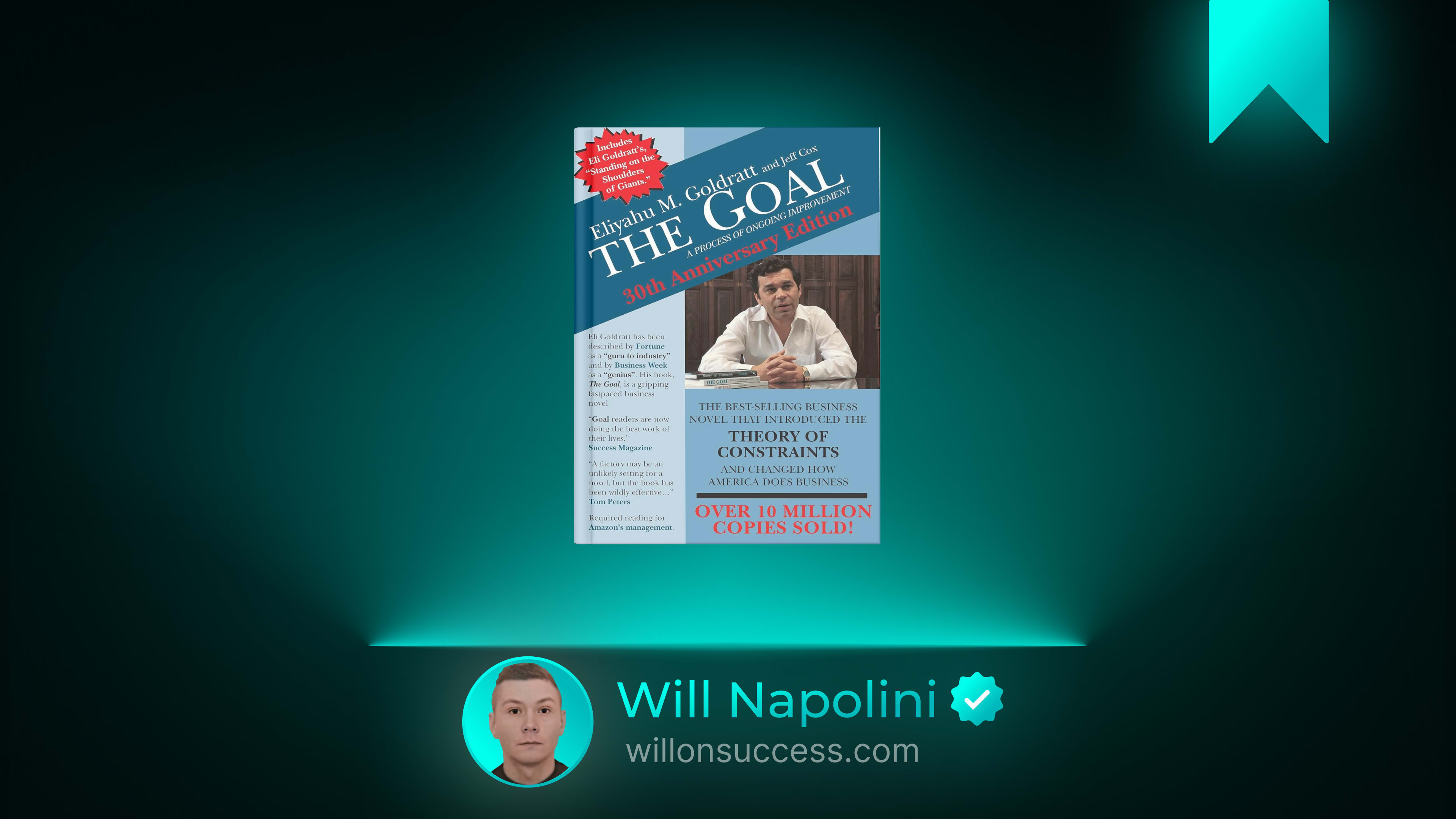
Eliyahu M. Goldratt wrote The Goal as a novel about a struggling manufacturing plant. But underneath the hard hats, the conveyor belts, and the corporate politics, he wrote one of the most profound manuals for human effectiveness ever published. He introduced the world to the Theory of Constraints. And while it was designed for factories, its principles apply to your career, your relationships, your creative work, and your life.
If you have ever felt like you are running at full speed on a treadmill, this book will show you how to step off and actually start walking toward your destination.

The Big Idea: You Cannot Optimize a System That Is Pulling in the Wrong Direction
The central premise of The Goal is deceptively simple: A chain is only as strong as its weakest link, and a system is only as fast as its slowest part.
Goldratt argues that in any system—whether it is a manufacturing plant, a software development team, or your own daily routine—there is always at least one constraint. A bottleneck. A point of friction that dictates the maximum output of the entire enterprise.
Here is the radical truth that changes everything: Optimizing any part of the system that is not the bottleneck is an illusion of progress.
If you speed up a machine that feeds into a bottleneck, you do not get more finished products. You just get a larger pile of unfinished inventory sitting in front of the bottleneck. In life, this looks like reading ten more books on leadership when your actual constraint is that you are terrified of having a difficult conversation with your employee. It looks like buying a more expensive camera when your constraint is that you never actually schedule time to shoot.
Goldratt’s core argument is that true productivity is not about doing more things efficiently. It is about identifying the single constraint that governs your goal, and ruthlessly subordinating everything else to it.
The Plant, The Physicist, and The Socratic Method
To understand how this works, you have to understand the story.
The protagonist is Alex Rogo, a plant manager whose factory is failing. His boss gives him an ultimatum: turn the plant around in three months, or it closes. To make matters worse, the stress is destroying his marriage. Alex is doing everything he was taught to do. He is pushing his people to work harder. He is keeping his machines running at 100% capacity. He is obsessed with “efficiency.” And yet, the plant is bleeding money and missing shipping deadlines.
Then, by chance, he runs into a man named Jonah, a physicist he knew years ago. Jonah does not give Alex a list of management hacks. Instead, Jonah acts as a mentor. He asks Alex a series of piercing, Socratic questions.
The most important question Jonah asks is: “What is the goal of your manufacturing plant?”
Alex fumbles. He suggests the goal is to produce high-quality goods, or to keep people employed, or to capture market share. Jonah gently dismantles every answer until Alex arrives at the only one that matters: The goal is to make money. Everything else—efficiency, technology, busy workers—is only valuable if it directly contributes to making money. If an action does not serve the goal, it does not matter how “efficiently” you do it.
Once Alex understands the goal, he can finally look at his plant and see the constraints. And that is when the real transformation begins.
The Boy Scout Hike: A Metaphor for Your Life
The most brilliant and memorable concept in The Goal happens away from the factory floor. Alex is leading a troop of Boy Scouts on a hike. The troop is strung out over a mile of trail. The fast kids are way up ahead, the slow kids are lagging behind, and the group is not arriving at the campsite on time.
Alex realizes that the hike is a system of dependent events combined with statistical fluctuations. The speed of the entire troop is not determined by the fastest hiker. It is determined entirely by the slowest hiker—a boy named Herbie, who is carrying a heavy backpack and walking at a leisurely pace.
Alex tries everything. He yells at the kids in the back to hurry up. He tells the kids in the front to slow down. Nothing works to close the gap. The troop remains strung out, and they are still going to be late.
Finally, Alex has an epiphany. He stops the troop. He takes the heavy items out of Herbie’s backpack and distributes them among the faster, stronger kids. He puts Herbie at the very front of the line.
Suddenly, the troop moves as a single, cohesive unit. The gap closes. And because the bottleneck (Herbie) is now unburdened and leading, the overall speed of the entire troop increases.
Herbie is the constraint. And until Alex addressed Herbie, all the effort of the faster kids was meaningless.
Find Your Herbie: The Courage to Identify the Constraint
In your life, your career, or your current project, there is a Herbie. There is a bottleneck.
If you are trying to write a book, your constraint might not be your typing speed or your vocabulary. It might be the thirty minutes of quiet, uninterrupted thinking time you need every morning before the house wakes up.
If you are trying to grow a business, your constraint might not be your marketing budget. It might be the fact that you are still personally fulfilling every order, meaning you can never sell more than what your own two hands can pack in a day.
If you are trying to improve your health, your constraint might not be your gym routine. It might be your sleep, or your relationship with sugar late at night.
Finding your constraint requires honesty. It is often easier to optimize the things we are already good at. It feels good to type faster. It feels good to design a beautiful new logo for your website. It feels like work. But if those things are not the bottleneck, you are just rearranging the deck chairs.
You have to look at the system and ask: What is the one thing that, if it moved faster, would allow everything else to move faster?
Subordinate Everything Else (The Hardest Step)
Once you identify the constraint, Goldratt outlines a five-step process for managing it. The first two are straightforward: Identify the constraint, and exploit it (make sure the bottleneck is never idle).
But the third step is where most people fail. Goldratt calls it Subordinate everything else to the constraint.
This means you must willingly allow the non-bottlenecks in your life to be “inefficient.”
In the factory, this meant turning off machines that were running perfectly fine, because they were producing parts that the bottleneck couldn’t process yet. To the factory workers, this felt like heresy. They were being paid to work, and the manager was telling them to sit and do nothing.
In your life, subordination is deeply uncomfortable. It means saying no to good opportunities because they will distract you from the critical constraint. It means letting the laundry pile up for a day so you can protect your morning writing time. It means leaving some emails unanswered so you can spend two hours training the employee who is struggling to take tasks off your plate.
We hate subordination because we have been conditioned to believe that all idle time is wasted time. But in a system governed by constraints, an hour saved at a non-bottleneck is a mirage. An hour saved at the bottleneck is a miracle.
You must be willing to look busy to no one, not even yourself, in order to protect the one thing that actually moves the needle.
Elevate the Constraint, and Beware of Inertia
Once you have subordinated everything to the bottleneck, the next step is to elevate it. If the constraint is still holding you back, you bring in more resources. You hire the assistant. You buy the software. You wake up thirty minutes earlier. You invest the money to remove the friction.
But Goldratt offers one final, crucial warning in his fifth step: If in the previous steps a constraint has been broken, go back to step one, but do not let inertia become the system’s constraint.
When you fix Herbie, he is no longer the slowest hiker. But the moment he speeds up, someone else in the troop becomes the new Herbie. The constraint shifts.
This is why personal growth and business growth are not destinations; they are practices. You solve the bottleneck in your marketing, and suddenly the constraint moves to your customer service. You solve the constraint in your fitness, and suddenly the constraint moves to your stress management.
The danger is that once we fix a problem, we become attached to the solution. We keep doing what worked yesterday, even though the bottleneck has moved down the line. You must remain fluid. You must be willing to continually ask, Where is the friction now?
Why This Matters on an Ordinary Tuesday
I want to bring this out of the realm of theory and into your week.
Most of us suffer from a surplus of effort and a deficit of focus. We treat our lives like a collection of independent tasks, trying to check every box on our to-do list, believing that if we just clear the list, we will achieve our goals.
But a to-do list is not a system. It is just a pile of demands.
When you apply the Theory of Constraints to your life, you stop asking, How can I get more done today? and you start asking, What is the one thing that must happen today to move the actual goal forward?
Imagine you are trying to transition into a new career. You spend your evenings tweaking your resume formatting, updating your LinkedIn banner, and reading industry news. Those are good things. But if your constraint is that you have not actually reached out to a single human being who works in that industry, all the resume tweaking in the world is just inventory piling up in front of a bottleneck.
Subordinating means you close the resume template. You accept that it is not perfect. And you spend your hour sending three messages to people in your desired field. You feed the bottleneck.
This shifts your identity. You stop being someone who is “busy” and you become someone who is “effective.” The emotional relief of this shift is profound. When you know you are feeding the constraint, you can finally rest without guilt, because you know the rest of the system can wait.
Who Should Read This Book
The Goal is a business novel, which means it is written as a story. This makes it highly readable, but it also means you have to be willing to engage with a narrative about manufacturing plants, union disputes, and 1980s corporate dynamics.
If you are an entrepreneur, a manager, a project leader, or someone who works in operations, this book is mandatory reading. It will permanently change how you view workflows and team dynamics.
If you are someone who feels overwhelmed by the modern “productivity” industry—tired of life hacks, complex planner systems, and the pressure to optimize every minute of your day—this book will be a breath of fresh air. It offers a unifying, logical framework that cuts through the noise.
It may not be the right book for you if you are looking for deep emotional healing, or if you are in a highly abstract, purely creative field where “throughput” is difficult to define. Goldratt’s mind is highly analytical, and the book rewards analytical thinking. But if you are willing to translate his factory metaphors into your own life, the wisdom is universally applicable.
One Small Step
Here is what I would ask you to do today.
Take out a piece of paper. At the top, write down your single, most important goal for this current season of your life. Not five goals. One. (e.g., “Launch my consulting practice,” “Reconnect with my spouse,” “Write the first draft of my manuscript.”)
Below that, write down the primary constraint. Ask yourself: If I could magically wave a wand and remove one point of friction, what would make this goal happen almost automatically?
Identify your Herbie.
Once you have identified it, I want you to do one thing today to lighten that backpack. If the constraint is time, cancel one meeting. If the constraint is energy, go to bed an hour early tonight. If the constraint is knowledge, send one email asking for help.
Do not try to fix the whole system today. Do not try to optimize the fast hikers at the front of the line.
Just find your Herbie. Lighten his pack. And start walking.