The 7 Habits of Highly Effective People Summary: How to Build a Life of Purpose and True Effectiveness
You have probably tried the productivity hacks.
You have downloaded the task managers, color-coded your calendar, and experimented with waking up at 5:00 AM. You have read the articles on how to optimize your morning routine and streamline your workflow. And yet, you may still find yourself at the end of a long week feeling exhausted, scattered, and quietly wondering if you are actually moving in the right direction.
If I could sit across the table from you, I would tell you that this exhaustion is not a failure of discipline. It is a failure of foundation.
For decades, the self-help industry has sold us the “Personality Ethic”—the idea that success is a matter of technique, public image, and positive thinking. It is the belief that if you just learn the right communication tricks or time-management shortcuts, you will unlock a frictionless life.
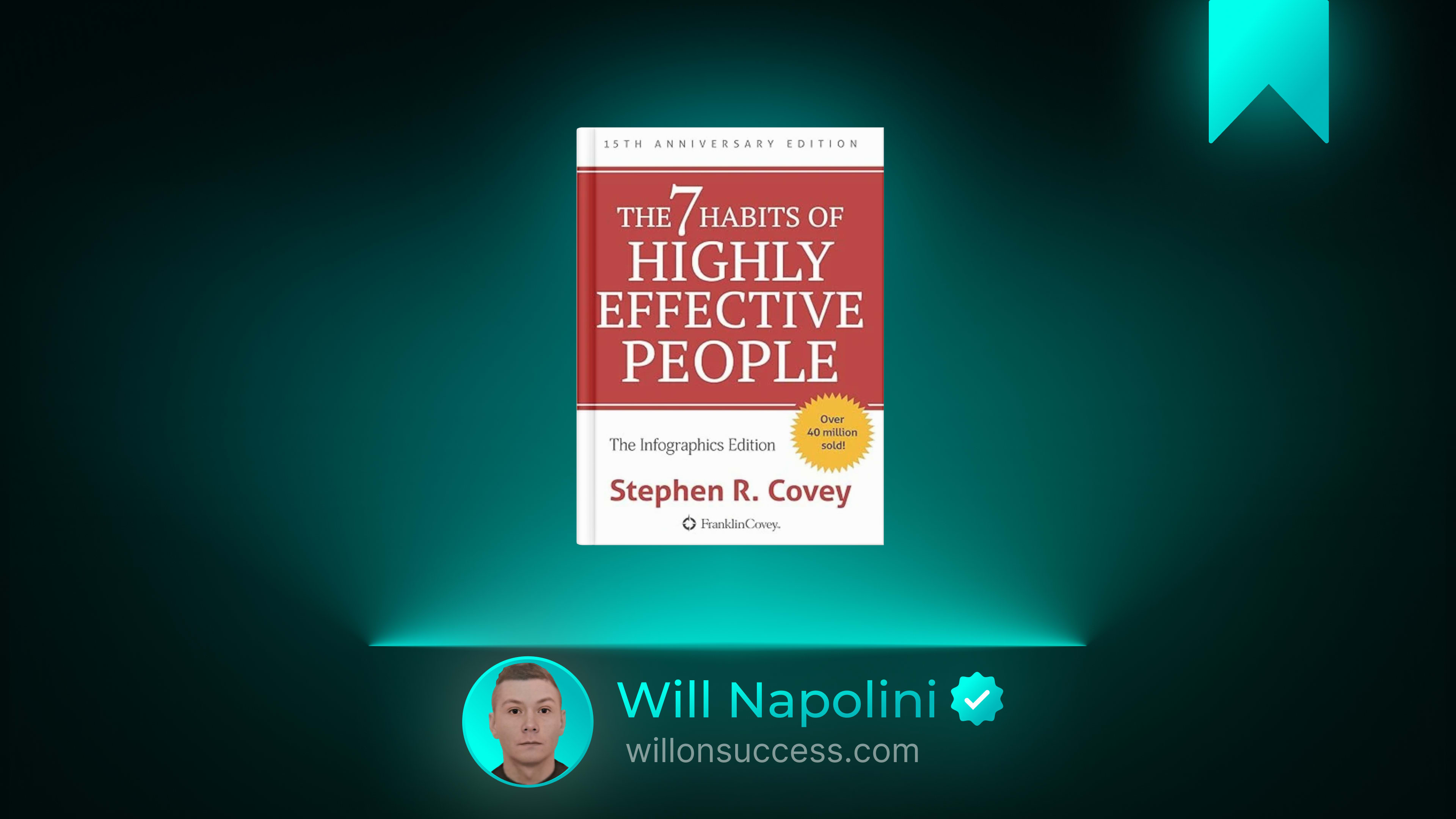
But Stephen R. Covey’s masterpiece, The 7 Habits of Highly Effective People, dismantles this illusion with gentle, unshakeable conviction. Covey argues that true effectiveness does not come from tweaking your external behavior. It comes from aligning your internal character with universal, timeless principles.
This is not a book about how to get more done in less time. It is a book about how to become the kind of person who naturally attracts trust, creates meaningful results, and lives with profound integrity.
Here is what I have learned from this framework, and how you can use it to stop managing your symptoms and start transforming your life from the inside out.

The Big Idea: The Inside-Out Approach
The central thesis of The 7 Habits is that private victories must precede public victories. You cannot have a healthy marriage if you do not have personal integrity. You cannot lead a team effectively if you cannot manage yourself.
Covey calls this the “Inside-Out” approach. It is the understanding that your external reality is largely a reflection of your internal paradigms—the mental maps through which you see the world. If your map is flawed, no amount of positive thinking or hard work will get you to the right destination.
True change does not happen by manipulating your circumstances. It happens by changing the lens through which you view those circumstances, and then aligning your daily habits with timeless principles like fairness, integrity, honesty, and human dignity.
Effectiveness, Covey reminds us, lies in the balance. He illustrates this with the ancient fable of the goose that laid the golden eggs. If you focus only on the golden eggs (the results, the output, the productivity), you will eventually neglect or destroy the goose (your health, your relationships, your capacity). True effectiveness is maintaining the balance between Production (P) and Production Capability (PC).
The Paradigm Shift: The Map Is Not the Territory
Before we can build new habits, we must understand how we see the world. Covey shares a powerful story to illustrate the concept of a “paradigm shift.”
He describes riding a subway in New York City on a quiet Sunday morning. People were reading peacefully. Then, a man and his children boarded the train. The children were immediately loud, rambunctious, and disruptive. The man sat down, closed his eyes, and completely ignored their behavior. The atmosphere on the train grew tense. Annoyed, Covey finally turned to the man and said, “Sir, your children are really disturbing a lot of people. I wonder if you couldn’t control them a little more?”
The man lifted his gaze as if coming out of a trance and said softly, “Oh, you’re right. I guess I should do something about it. We just came from the hospital where their mother died about an hour ago. I don’t know what to think, and I guess they don’t know how to handle it either.”
In an instant, Covey’s paradigm shifted. His irritation vanished, replaced by deep compassion. “Your wife just died? Oh, I’m so sorry. Can I help you in any way?”
The man’s behavior did not change. But Covey’s perception of it changed entirely, and therefore, his own behavior changed.
This is the core of the book. We all walk around with mental maps. When we encounter friction in our lives—whether with a spouse, a boss, or our own goals—we usually try to change the other person or the situation. Covey challenges us to do the harder, more rewarding work: examining and shifting our own map.
You Are the Programmer, Not the Program
The Power of Proactive Choice (Habit 1)
The foundation of all growth is the realization that you are not a victim of your circumstances. Between what happens to you (the stimulus) and what you do about it (the response), there is a space. In that space lies your freedom to choose.
Covey calls this being “proactive.” It does not mean being aggressive or taking initiative at work. It means recognizing that you are “response-able”—you have the ability to choose your response.
Reactive people are driven by their environment, their moods, or the actions of others. If the weather is bad, their day is ruined. If their boss is critical, their self-worth plummets. Their behavior is a product of their conditions.
Proactive people, however, are driven by carefully chosen values. They carry their own weather. When I first internalized this, it was both terrifying and liberating. It meant I could no longer blame my past, my economy, or my upbringing for my current trajectory. But it also meant I held the pen.
Covey illustrates this with two circles: the Circle of Concern (things you care about but cannot control, like the economy, the past, or other people’s opinions) and the Circle of Influence (things you can actually do something about, like your attitude, your skills, and your daily habits).
Reactive people focus on the Circle of Concern, which causes their Circle of Influence to shrink. Proactive people focus their energy on the Circle of Influence, which causes it to expand.
Build the House Before You Hang the Pictures
The Discipline of Vision (Habit 2)
Habit 2 is to “Begin with the End in Mind.” This is the principle of personal leadership. It is based on the imagination—the ability to envision what is not yet visible.
Covey asks you to imagine attending your own funeral. Four speakers are scheduled: a family member, a friend, a colleague, and a member of your community. What would you want each of them to say about you? Not what you did for a living, but who you were as a person.
This exercise is not morbid; it is clarifying. It forces you to define your ultimate values. Most people climb the ladder of success with great efficiency, only to reach the top and realize it is leaning against the wrong wall.
Beginning with the end in mind means writing a personal mission statement. It is your personal constitution. When you have a clear compass, you do not need to constantly check the clock. You know which opportunities to say “no” to, because they do not align with your destination.
Protect Your Most Valuable Asset
The P/PC Balance and Prioritization (Habit 3)
Habit 3 is “Put First Things First.” This is the practical execution of Habits 1 and 2. It is the discipline of organizing and executing around your priorities.
Covey introduces the Time Management Matrix, dividing activities into four quadrants based on urgency and importance.
- Quadrant I: Urgent and Important (crises, deadlines).
- Quadrant II: Not Urgent but Important (planning, relationship building, exercise, personal growth).
- Quadrant III: Urgent but Not Important (interruptions, some emails, other people’s priorities).
- Quadrant IV: Not Urgent and Not Important (mindless scrolling, excessive entertainment).
Most of us live our lives bouncing between Quadrant I (putting out fires) and Quadrant III (responding to the urgent demands of others). We feel busy, but we are not effective.
The secret of highly effective people is that they live in Quadrant II. They invest time in activities that are not urgent, but that prevent crises and build long-term capacity. They schedule the “big rocks” first. If you fill a jar with sand (the trivial, urgent things) first, there is no room for the big rocks (your core values and goals). But if you put the big rocks in first, the sand will naturally fill the spaces around them.
This is where the P/PC balance becomes real. Working 80-hour weeks to hit a quarterly target (P) while neglecting your health and family (PC) is a recipe for eventual collapse. Effectiveness requires protecting the goose.
True Influence Begins with Empathy
The Foundation of Interdependence (Habits 4, 5, and 6)
The first three habits are about “Private Victory”—achieving independence and self-mastery. But we do not live in a vacuum. The next three habits are about “Public Victory”—working effectively with others.
Covey introduces the metaphor of the “Emotional Bank Account.” Every relationship has an account. You make deposits through kindness, keeping promises, clarifying expectations, and personal integrity. You make withdrawals through broken promises, disrespect, or arrogance. If your balance is low, your communication will be met with defensiveness. If your balance is high, you have a reserve of trust to draw upon during difficult times.
To build this balance, you must master Habit 5: “Seek First to Understand, Then to Be Understood.”
Most of us do not listen with the intent to understand. We listen with the intent to reply. We are either speaking or preparing to speak. Covey champions “empathic listening”—listening not just with your ears, but with your eyes and your heart, to understand the other person’s frame of reference.
When you genuinely understand someone, you earn the right to be understood. This naturally leads to Habit 4 (Think Win-Win, an abundance mentality rather than a scarcity mentality) and Habit 6 (Synergize, where the whole becomes greater than the sum of its parts because differences are valued, not merely tolerated).
You Cannot Pour from an Empty Vessel
The Discipline of Renewal (Habit 7)
Habit 7 is “Sharpen the Saw.” It is the habit of self-renewal, and it surrounds and sustains all the other habits.
Imagine a man in the woods, furiously sawing down a tree. He is exhausted, sweating, and making slow progress. You ask him, “Why don’t you take a break and sharpen the saw?” He replies, “I don’t have time to sharpen the saw. I’m too busy sawing.”
We do this constantly. We are too busy working to invest in our health. We are too busy managing our families to invest in our marriages. We are too busy consuming information to invest in deep thinking.
Covey argues that we must regularly renew ourselves in four dimensions:
- Physical: Exercise, nutrition, stress management.
- Spiritual: Meditation, nature, art, connecting to your core values.
- Mental: Reading, writing, planning, learning new skills.
- Social/Emotional: Service, empathy, synergy, building meaningful connections.
This is not a luxury. It is the maintenance of your greatest asset: you.
Why This Matters on an Ordinary Tuesday
It is easy to read about these habits and relegate them to a “someday” when you have more time. But the power of this framework is in its daily application.
When you embrace the Circle of Influence, a frustrating email from a client no longer ruins your morning. You recognize their tone is outside your control, but your professional, calm response is entirely within it.
When you live in Quadrant II, you protect your Tuesday evening for a long walk or reading a book, knowing that this renewal makes you a better leader, parent, and thinker on Wednesday.
When you seek first to understand, a tense conversation with your partner transforms from a battle of wills into a collaborative effort to solve a problem. You stop defending your position and start exploring theirs.
These habits do not make life easy. They make life meaningful. They replace the anxiety of reactivity with the quiet confidence of principle-centered living.
Practical Application: Turning Concepts into Behavior
Understanding is valuable, but understanding without action changes nothing. Here is how you can apply these principles to your life starting today.
1. The Circle of Influence Audit
Take a piece of paper and draw two concentric circles. In the outer circle (Circle of Concern), write down everything that is currently stressing you out (the news, your boss’s mood, the economy). In the inner circle (Circle of Influence), write down the specific actions you can take regarding those issues. Now, cross out the outer circle. Choose one item from the inner circle and take a concrete step toward it today. Reclaim your agency.
2. The Quadrant II Commitment
Look at your calendar for the upcoming week. Identify one important, non-urgent activity that you have been neglecting (e.g., a strategic planning session, a date night, a workout, a difficult but necessary conversation). Schedule it as a non-negotiable appointment. Treat it with the same respect you would give a meeting with your most important client.
3. The Empathic Listening Challenge
In your next significant conversation, make a pact with yourself: you will not offer advice, judge, or share your own story until the other person has fully expressed their thoughts and feelings, and you can accurately summarize their point of view to their satisfaction. Simply say, “What I hear you saying is…” and let them correct you until they feel truly heard. Notice how the dynamic shifts.
Who Should Read This Book
The 7 Habits of Highly Effective People is essential reading for anyone who feels overwhelmed by the superficiality of modern productivity culture. It is for leaders who want to build trust-based teams, parents who want to raise responsible children, and individuals who sense a disconnect between their daily actions and their deepest values.
Who might find it less useful? If you are looking for a rapid, tactical guide to “hacking” your way to a million dollars in thirty days, or if you believe that success is purely a matter of manipulating external circumstances, this book will frustrate you. It requires patience, introspection, and a willingness to do the hard, internal work of character development. It is a philosophy of life, not a quick fix.
One Small Step
You do not need to rewrite your personal mission statement or overhaul your entire life today. You just need to practice the fundamental muscle of effectiveness.
Here is your one small step: The next time you feel a surge of irritation, frustration, or the urge to react defensively today, I want you to pause.
Take one deep breath. In that brief space between the stimulus and your response, remind yourself: I am the programmer. I choose my response.
Then, choose the response that aligns with the person you are becoming, not the person you used to be.
The Courage to Build from the Inside Out
We live in a world that rewards the appearance of success over the substance of character. We are tempted to polish the exterior while ignoring the rotting foundation.
But the deepest lesson of The 7 Habits of Highly Effective People is that true, lasting effectiveness cannot be faked. It must be grown. It requires the quiet courage to tend to your roots, to sharpen your saw, and to keep your promises to yourself when no one is watching.
Your character is not built in the grand, dramatic moments of crisis. It is forged in the quiet, unobserved choices of an ordinary Tuesday.
Stop trying to manage the symptoms of a misaligned life. Start building from the inside out. The world is waiting for the person you are capable of becoming.