The Alchemist Summary: How to Find Your Purpose and Trust the Journey
There is a quiet tragedy that happens to most of us. It isn’t that we fail at our goals. It is that we slowly forget what our goals were supposed to be in the first place.
We trade our deepest desires for comfort. We compromise our curiosity for security. And then we spend the rest of our lives wondering why we feel a persistent, unexplainable emptiness. I have sat across the table from countless people who have achieved everything they thought they wanted, only to realize they were climbing a ladder leaned against the wrong wall.
If you are feeling that quiet pull toward something more, something truer, I want to share a story with you that changed the way I think about purpose.
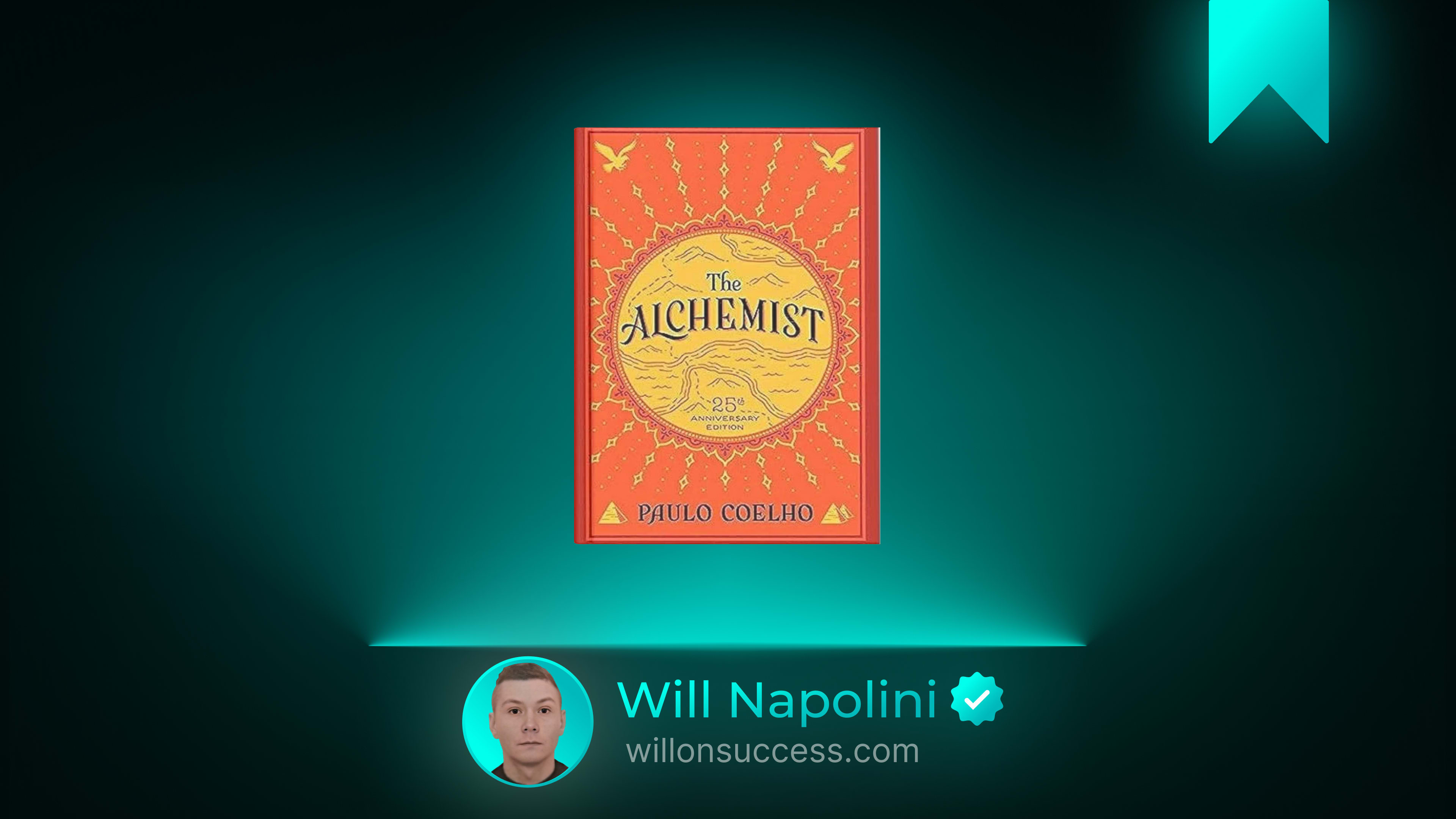
Paulo Coelho’s The Alchemist is often dismissed as a simple fairy tale. But if you look closely, it is actually a profound manual for human potential. It is a book about the courage it takes to listen to your own heart, the danger of settling for a comfortable mediocrity, and the hidden mechanics of how a life of meaning is actually built.

The Big Idea: The Personal Legend
The central thesis of The Alchemist revolves around a concept Coelho calls your “Personal Legend.”
Your Personal Legend is the unique purpose you were put on this earth to fulfill. It is the thing you were meant to do. It is the intersection of your deepest curiosity, your natural talents, and the needs of the world around you.
Coelho’s most famous and frequently quoted idea is this: “When you want something, all the universe conspires in helping you to achieve it.”
This sounds like magic, but it is not. It is a statement about alignment. When you genuinely commit to your true path, your focus sharpens. You stop wasting energy on distractions. You begin to notice opportunities you previously ignored. The universe does not hand you a map; it hands you a compass, and it expects you to walk. The obstacle to your Personal Legend is never a lack of resources or a lack of time. The obstacle is your fear of taking the first step.
The Story of the Shepherd and the Desert
To understand how this works, we have to look at the journey of the book’s protagonist, a young Andalusian shepherd named Santiago.
Santiago is content. He has his sheep, his books, his wine, and the freedom of the open road. But he has a recurring dream about a hidden treasure located at the Egyptian Pyramids.
When he finally asks a wise woman to interpret the dream, and later meets a mysterious old king named Melchizedek, he is told that this dream is a call to his Personal Legend. The old king warns him that the journey will be difficult, but tells him that the fear of suffering is worse than the suffering itself.
Santiago makes a radical choice. He sells his sheep, crosses the Strait of Gibraltar, and enters the harsh, unforgiving Sahara Desert. Almost immediately, he is robbed. He loses everything. He is forced to work for a crystal merchant for a year just to survive. He joins a caravan, falls in love with a desert woman named Fatima, and eventually meets the titular Alchemist, who teaches him how to listen to the “Soul of the World.”
After years of hardship, near-death experiences, and profound spiritual growth, Santiago finally reaches the Pyramids. There, he is beaten by refugees who mock his dream. One of the attackers tells Santiago about his own recurring dream of a treasure buried under a sycamore tree in an abandoned church in Spain—the exact spot where Santiago used to sleep with his sheep.
Santiago walks back home. He digs beneath the sycamore tree. He finds the treasure.
But here is the secret of the story: The physical gold was always there. The real treasure was the wisdom, the resilience, the love, and the profound self-knowledge Santiago had to acquire in the desert before he was capable of recognizing and handling the gold.
The Fear of Suffering Is Worse Than the Suffering Itself
The most heartbreaking and relatable character in the book is not the hero, but the crystal merchant.
Santiago works for this man for nearly a year. The merchant is a good man, but he is deeply afraid of change. He has always dreamed of making a pilgrimage to Mecca, but he refuses to go.
Why? Because the hope of going to Mecca is what keeps him alive. He is terrified that if he actually goes, he will be disappointed. He is even more terrified that if he achieves his dream, he will have no reason left to live. So, he chooses the safety of his unfulfilled dream over the risk of reality.
I have seen this happen so many times in real life. You may be staying in a career that drains you because the familiar misery is easier to bear than the unknown terror of starting over. You may be staying in a relationship out of habit, convincing yourself that the comfort of the known is better than the risk of the unknown.
We do not avoid our destiny because it is too hard; we avoid it because it requires us to become someone new. The crystal merchant chose to be a man who wanted to go to Mecca, rather than a man who went to Mecca. He chose the identity of the dreamer over the reality of the achiever.
When you recognize this trap, you realize that comfort is a beautiful garden, but it is a terrible place to plant a legacy.
The World Speaks to Those Who Are Paying Attention
Throughout his journey, Santiago is guided by “omens.” Coelho writes about the “Language of the World,” suggesting that the universe is constantly communicating with us, pointing us toward our Personal Legend.
In a practical, modern sense, an omen is simply a signal. It is a sudden flash of intuition, a book that falls off the shelf, a conversation that sparks an idea, a persistent curiosity that refuses to go away.
Most of us ignore these signals because we are too distracted, or because the signal points in a direction that feels inconvenient. We want the universe to give us a neon sign, but it usually speaks in whispers.
When Santiago commits to his journey, he begins to see the world differently. He learns to read the flight of birds, the patterns in the sand, the shifting of the wind. He is not performing magic; he is simply paying deep, undivided attention to his environment.
When you align yourself with your true purpose, your mind begins to filter out the noise and tune into the signal. You start to notice the resources, the people, and the opportunities that were always there, but which you were previously blind to. The universe is not necessarily moving mountains for you; rather, you are finally awake enough to see the path that was already cleared.
The Treasure Is Not the Destination; It Is the Transformation
The ending of The Alchemist is often misunderstood. People get frustrated that Santiago had to travel all the way to Egypt just to find out the treasure was buried in his own backyard. They think it is a trick.
But it is not a trick. It is the deepest truth of the book.
If the treasure had been buried under the sycamore tree on day one, the shepherd boy would have dug it up, spent it foolishly, and been ruined by it. He did not have the character to sustain the wealth. He did not have the wisdom to protect it. He did not have the emotional maturity to understand its value.
He had to cross the desert. He had to be robbed. He had to learn the language of the crystals. He had to face the sands of the Sahara and the alchemy of his own soul.
The journey was not an obstacle to the treasure; the journey was the mechanism that forged the man capable of claiming it.
This is the principle of growth before achievement. External results must be matched by internal development. If you achieve a massive goal without undergoing the personal transformation required to sustain it, the achievement will eventually crush you. You do not just want the gold. You want to become the kind of person who can hold the gold.
Why This Matters on an Ordinary Tuesday
You might be thinking that this is a beautiful story, but you are just trying to get through a normal workweek. You are not a shepherd, and you are not looking for buried treasure in the desert.
But the desert is everywhere. The desert is the difficult project at work. The desert is the awkward conversation you need to have with your partner. The desert is the early mornings and the late nights required to build a business, learn a new skill, or raise a child with intention.
The mistake we make is assuming that our current circumstances are permanent. We look at our bank accounts, our job titles, and our daily routines, and we accept them as the final draft of our lives.
The Alchemist challenges you to look at your life and ask a different question. Instead of asking, “What is the safest choice?” you must ask, “What is the choice that aligns with my Personal Legend?”
When you apply this philosophy, you stop viewing setbacks as proof that you are on the wrong path. When Santiago was robbed in Tangier, he didn’t turn back. He realized that every setback is simply the universe teaching you a lesson you needed to learn before you could move forward. You begin to trust the process. You begin to trust yourself.
Practical Application: Turning Principles into Behavior
Wisdom without action is just entertainment. Here is how you can integrate the lessons of The Alchemist into your daily life.
1. Audit Your “Crystal Shop” Take a hard look at the areas of your life where you are choosing comfort over growth. Where are you acting like the crystal merchant? Identify one area where you are holding onto a dream but refusing to take the first step because you are afraid of the outcome. Write it down. Acknowledge that the fear of the journey is the only thing keeping you stuck.
2. Track the Thread of Curiosity For the next seven days, pay attention to what genuinely captures your interest. Not what you think you should be interested in, but what actually pulls your attention. What books do you read? What topics do you research? What problems do you naturally want to solve? Your Personal Legend is rarely announced with a trumpet; it is whispered through your persistent curiosities. Follow the thread.
3. Expect the “Tangier” Moment When you finally commit to a new goal, you will experience “beginner’s luck.” Things will go well at first. And then, almost inevitably, things will go wrong. You will face a setback. You will feel like quitting. Coelho calls this the universe testing your resolve. When the setback happens, do not panic. Do not assume you are on the wrong path. Expect it. Treat the setback as the price of admission for the next level of your growth.
Who Should Read This Book
The Alchemist is a global phenomenon for a reason, but it is not for everyone.
If you are looking for a rigid, step-by-step business framework, or a highly scientific breakdown of habit formation, this book will frustrate you. It is a fable. It is allegorical, deeply spiritual, and heavily reliant on metaphor. If you are deeply allergic to mystical language or prefer hard realism, the tone may not resonate with you.
However, if you are feeling lost, if you are standing at a crossroads in your life, or if you simply feel that there must be more to your existence than paying bills and waiting for the weekend, this book is a masterpiece. It is for the reader who needs permission to trust their intuition. It is for anyone who needs a gentle reminder that their dreams are valid, and that the journey, no matter how difficult, is entirely worth it.
One Small Step
You do not need to sell your sheep and move to the desert today. You just need to reclaim a small piece of your own history.
Take five minutes right now. Open a notebook or a blank document on your computer.
Write down one dream, idea, or goal that you gave up on years ago because it seemed too impractical, too risky, or too foolish. Do not try to figure out how to achieve it today. Do not make a plan. Just write it down, look at it, and acknowledge that it still lives inside you.
The Path Forward
We spend so much of our lives looking for the treasure at the end of the road, believing that once we find it, we will finally be allowed to rest. But the true magic of life is not in the destination. It is in the alchemy of the journey itself.
Every difficult conversation, every late night of study, every moment of doubt you push through—these are not delays. They are the fire that burns away your impurities. They are the process of turning the lead of your potential into the gold of your character.
You were not built to simply survive the desert. You were built to discover what lies on the other side of it.