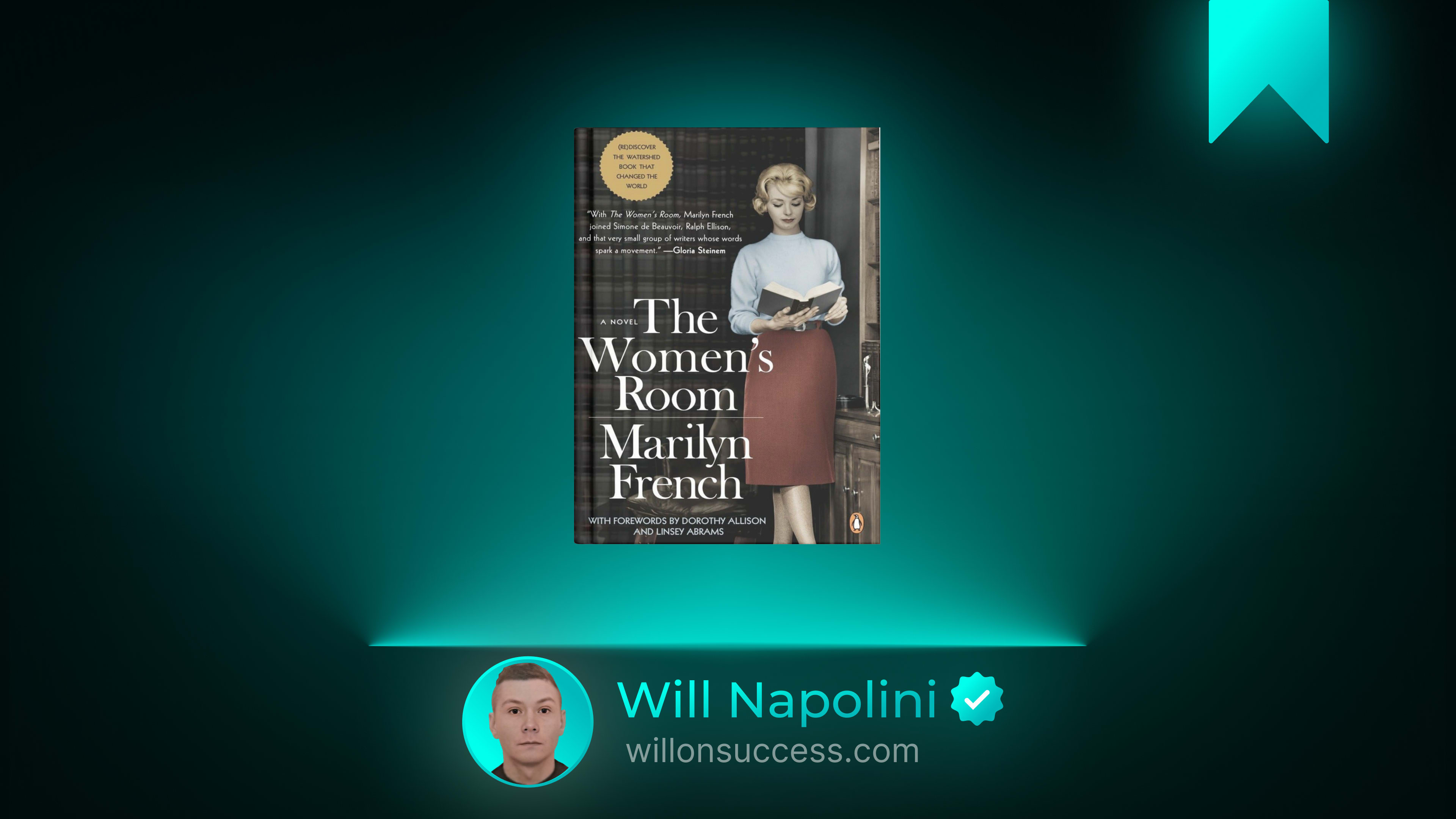
The Women's Room by Marilyn French: The Courage to Claim a Life That Is Actually Yours
Have you ever looked up in the middle of an ordinary afternoon—dishes drying, emails answered, someone else’s schedule organized down to the last appointment—and felt a quiet, almost wordless question rise in your chest: Is this the life I chose, or the life I was handed?
Not a dramatic crisis. Not a collapse. Just a small, persistent ache. A sense that somewhere between who you were at twenty and who you are now, a version of you went quiet. Not gone. Quiet. Waiting.
If you have felt that, even once, Marilyn French’s The Women’s Room will find you. Not because it is gentle. It is not. But because it tells the truth about what it costs to bury your own desires, and what it costs, eventually, to dig them back up.
The Big Idea: You Cannot Build a Self on Someone Else’s Foundation
Published in 1977, The Women’s Room is a novel, not a guidebook. It does not hand you numbered steps. What it does is something rarer and more unsettling: it makes you witness a life being slowly constructed around another person’s expectations, and then watches that construction crack, collapse, and—painfully, imperfectly—begin again.
The book follows Mira Ward from the late 1940s through the 1970s. She is bright, curious, hungry for ideas as a young woman. She marries. She moves to the suburbs. She raises two sons. She keeps a house. She becomes, by every external measure of her era, a success. And she disappears. Not all at once. In small surrenders. In swallowed opinions. In afternoons where the only adult conversation she has is with another wife over coffee, both of them performing contentment.
What French understood, and what gives this novel its enduring force, is that the loss of self rarely announces itself with thunder. It comes through a thousand small accommodations. You stop mentioning the book you want to read because no one asks. You stop voicing the opinion that might cause friction. You build your identity around a role—spouse, parent, provider, keeper of peace—until the role becomes so tightly fitted that you forget there is a person underneath it.
The central argument of the novel, if a novel can be said to argue, is this: a life built entirely in service of an assigned role will eventually demand a reckoning. And the longer you postpone that reckoning, the more it will cost.
Mira’s Long Walk Toward Herself
The novel spans roughly three decades. Mira’s first act of self-assertion is small: she insists on finishing college, even when the culture around her suggests that education for a woman is a pleasant garnish before marriage. It is a modest victory, but French treats it as significant. A direction chosen. A seed planted in soil that was not meant to hold it.
Then comes the marriage to Norm. Norm is not a monster. This is important. French does not write a simple villain. Norm is a decent man who has absorbed, without examination, the assumption that his wife’s purpose is to orbit his life. He expects dinner. He expects a managed home. He expects Mira to be pleased with the life he is building because he is building it. And Mira, who has learned that love means accommodation, gives him what he expects.
The suburban years are rendered with an almost unbearable domestic precision. The routines. The small humiliations of being unseen. The friendships with other women—Val, Adele, Martha—who are living parallel lives, each one performing a version of contentment while privately unraveling. French makes you feel the texture of those afternoons, the way the silence in a well-kept house can become its own kind of violence.
The marriage ends. Not in a single explosion, but in the slow recognition that Mira has been absent from her own life for years. Divorce, in French’s telling, is not liberation dressed in bright colors. It is disorientation. It is poverty. It is the terror of being forty-something and having to ask, for the first time as an adult, What do I actually want?
And then—slowly, imperfectly—she begins again. Graduate school. New friendships. A lover named Ben who challenges and wounds and complicates. A community of women who speak honestly to one another. A self that is no longer defined by who she is to a man, but by what she thinks, what she creates, what she refuses to swallow.
It is not a triumphant arc. French does not write triumph. She writes survival, and the slow accumulation of self-knowledge that survival makes possible.
The Roles We Wear Are Not the Skin Beneath Them
One of the novel’s most quietly devastating observations is that the roles we inhabit can become so familiar that we mistake them for identity. Mira does not simply play the wife. She becomes the wife, in the way that a river carves a canyon so gradually that the stone forgets it was ever anything else.
This is not exclusively a woman’s experience, though French writes it from the inside of womanhood in a particular era. Anyone who has built their sense of worth around a job title, a relationship, a family role, or a community’s expectation knows this erosion. You become the function. And the function does not ask what you need.
What I have learned, watching people navigate seasons of reinvention, is that the question “Who am I without this role?” is one of the most frightening questions a person can ask. It is also one of the most necessary. Not because the role is wrong. You can be a devoted parent, a committed partner, a dedicated worker, and still be you underneath those commitments. The danger is not the role itself. The danger is when the role becomes the only room you are allowed to occupy.
French shows you what happens when a woman finally walks out of that single room and discovers there is a whole house she never entered. And that the doors were never locked. She simply was never told she could open them.
Female Friendship as a Mirror You Did Not Know You Needed
One of the novel’s great gifts is its honest, unglamorous portrayal of women’s friendships. Mira’s friends are not cheerleaders. They are not always kind. Some of them make choices that horrify her. One of them breaks in a way that cannot be repaired. But they are witnesses to one another. They say the things that the culture will not say. They name the loneliness. They name the anger. They sit in a kitchen at eleven p.m. and say, “This is not enough,” and in saying it, make it real.
If you have ever had a friend who simply saw you—who looked past the performance and said, “You are allowed to want more than this”—you know what French is writing about. These friendships are not decorative. They are structural. They are the scaffolding that holds you upright while you are rebuilding.
What you repeat in private eventually becomes visible in your life. And sometimes, what you need to repeat first is the truth, spoken aloud to one other person who will not flinch.
Education as an Act of Self-Rescue
When Mira returns to academic life, French does not write it as a simple victory. It is messy. She is older than her peers. She is uncertain. The confidence she faked in her twenties is gone, and what replaces it is something more fragile but more real: the willingness to be a beginner again.
But there is a transformation in it. Not because a degree changes your circumstances overnight. Because the act of engaging your own mind—of reading, arguing, writing, thinking rigorously about ideas—restores a part of you that silence has been slowly dissolving. Education, in this novel, is not a credential. It is a reclamation. A way of saying, My thoughts matter. My questions matter. I exist in the world of ideas, not only in the world of service.
You do not need to enroll in a university to reclaim this. But you do need to give your own mind something to chew on. A book that challenges you. A conversation that goes deeper than logistics. A question you pursue for no reason other than that it interests you. The mind, like a garden, does not thrive on neglect. It grows toward whatever you feed it.
The Cost of Waking Up Is Real, and French Does Not Pretend Otherwise
I want to be honest with you about this book, because I think honesty serves you better than comfort. The Women’s Room is not a pleasant read. There are passages that are bleak. One of Mira’s closest friends reaches a breaking point from which she does not recover. The novel does not look away from depression, from the suffocation of a life with no exit, from the particular cruelty of a world that tells you to be grateful for your own erasure.
French does not resolve these threads neatly. Not every character finds her way out. Not every awakening leads to freedom. Some women in this novel remain trapped, and French lets that tragedy stand without softening it.
This matters. Because if you are in the middle of your own difficult season—if the awakening you are experiencing feels less like liberation and more like grief—this book will not insult you by pretending everything works out. It will sit beside you in the difficulty and say, Yes. This is what it feels like. And you are not wrong to feel it.
But it will also show you that the woman on the other side of that grief is not the same woman who entered it. She is not unscathed. But she is more fully herself. And that, French suggests, is worth the terrible price.
What This Looks Like on an Ordinary Tuesday
You may be reading this and thinking, That was the 1950s. That was a specific generation. My life is different. And in many ways, it is. The legal and social constraints French describes have shifted enormously.
But the internal architecture she maps—the slow accommodation, the silencing of desire, the construction of identity around role rather than self—has not disappeared. It has changed shape. It lives in the person who chose a career to please a parent and cannot remember what they wanted. It lives in the parent who has not made a decision based on their own desire in a decade. It lives in anyone who has made themselves so useful to others that they have become invisible to themselves.
The question French asks is not “Are you a 1960s housewife?” The question is: Where in your life are you performing a role instead of living a self? Where have you confused being needed with being seen?
Who Should Read This Book
The Women’s Room will resonate most powerfully with readers who have felt the slow drift of self-erasure—who sense that they have been living a life shaped more by expectation than by desire. It speaks to anyone in the middle of a transition, anyone rebuilding after a relationship ends, anyone wondering whether it is too late to ask what they actually want.
It is particularly valuable for readers interested in women’s history, feminist literature, and the social landscape of mid-century America. It is a novel that changed the conversation for millions of readers when it was published, and its emotional truth has not aged.
A word of honesty: this is a long novel, and it is emotionally demanding. It is not a quick, uplifting read. If you are in a fragile place and need lightness, this may not be the right season for it. But if you are ready to sit with difficult truths and emerge with a clearer sense of what you owe yourself, it is worth the time.
One Small Step You Can Take Today
I am not going to tell you to overhaul your life by Friday. That is not how change works, and French’s novel is a testament to the fact that awakening happens in layers, over years, through small acts of honesty that accumulate like sediment until they become stone.
But I will ask you for one thing. One small, honest act.
Tonight, or tomorrow morning, take ten minutes. Sit somewhere quiet. And write down the answer to this question:
What is one thing I want that I have not said aloud to anyone?
Not what you should want. Not what would be practical or easy or pleasing to the people around you. What do you want?
You do not have to act on it today. You do not have to announce it. You just have to name it. To yourself. In writing. Because a desire that is never named is a desire that can be indefinitely postponed. And you have postponed enough.
Mira Ward spent years in a well-kept house, waiting for permission to want something for herself. Permission never came. It was never going to come. It never comes for any of us. The permission was always ours to give.
Your life is not a role to be performed well. It is a self to be discovered, slowly, honestly, in your own time. And the first act of discovery is the simplest one: admitting what you actually want.
Name it. Write it down. Then close the notebook and carry it with you tomorrow like a seed in your pocket—small, quiet, alive. Waiting for the season when you are ready to plant it.
That season will come. But the seed has to exist first.