The Young Guard by Alexander Fadeyev: What It Means to Say No When Saying No Could Kill You
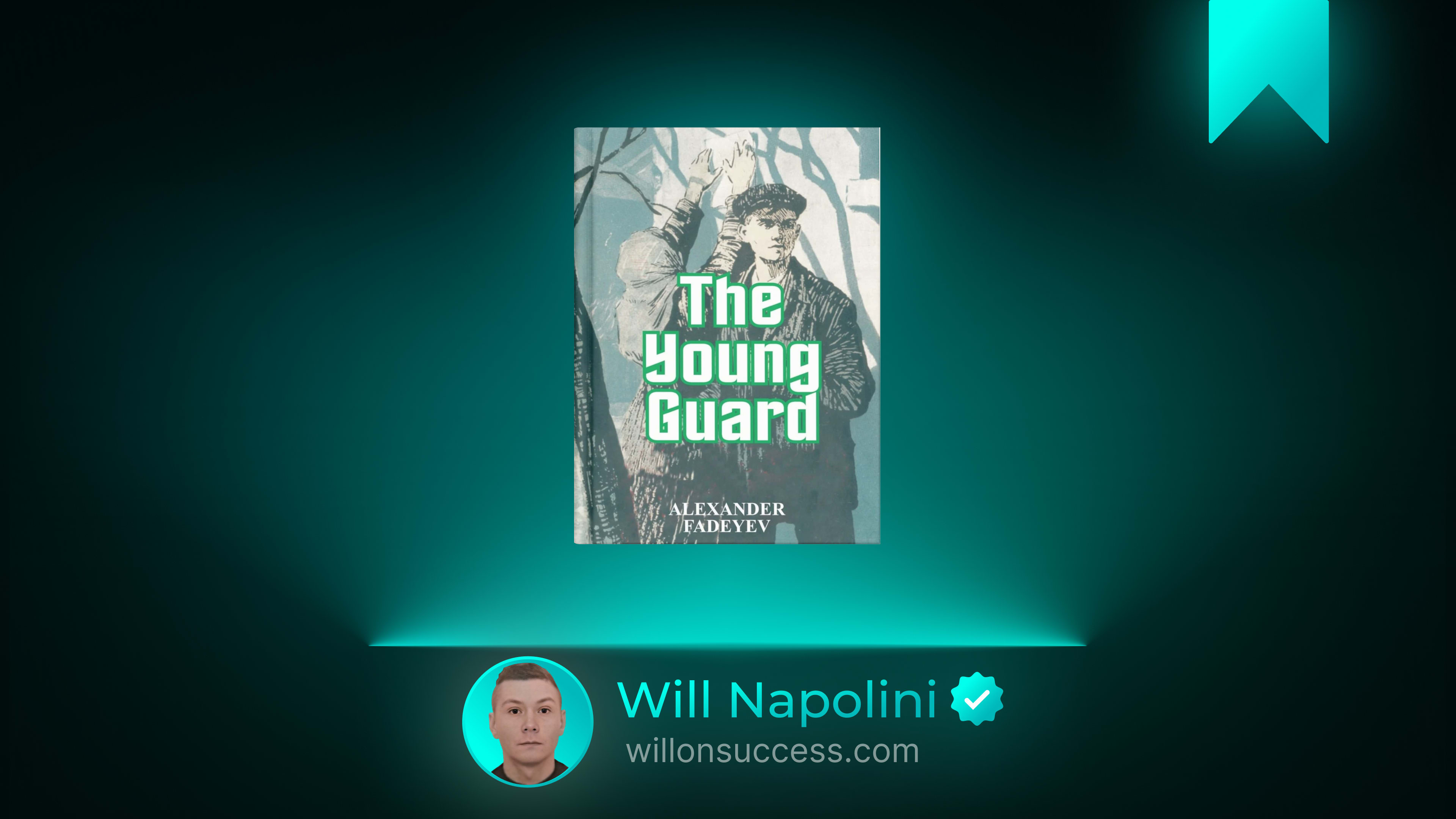
I want you to imagine something, and I want you to sit with it for a moment before you move past it.
You are seventeen. The war has swallowed your town. The people in charge now speak a language you half-understand and answer to no one you elected. Your neighbors have learned to look at the ground when soldiers pass. Your parents have learned to say yes when they mean no, because saying no has a price measured in bodies. And you understand, with the quiet clarity that sometimes belongs to the young, that you could do the same. You could look at the ground. You could survive. No one would blame you.
And then something in you refuses.
Not loudly. Not heroically, at first. Just a small, stubborn voice that says: I will not be the person who looks away.
That voice is where Alexander Fadeyev’s The Young Guard begins. Not in a battle. Not in a speech. In the quiet interior of a young person deciding that endurance without resistance is not living. It is only not-yet-dying.
The Big Idea: Character Is Forged in the Moment You Decide What You Will Not Tolerate
Published in 1945 and revised in 1951, The Young Guard is a novel built on a true story, and I think it is important to say that plainly, because the truth of it is what gives the book its weight. In the winter of 1942–1943, in the mining town of Krasnodon in the Donbas region, a group of teenagers and young adults—many of them seventeen, eighteen, nineteen years old—formed an underground anti-fascist organization. They called themselves the Young Guard. They distributed leaflets. They sabotaged German operations. They freed prisoners. They planned for a day of liberation they would not live to see.
They were betrayed. Most of them were arrested, tortured, and killed in January 1943. They were young. They were real. They are the people in this book.
Fadeyev wrote the novel in the immediate aftermath of the war, when the stories of Krasnodon were still raw, still bleeding into the living memory of survivors. What he understood, and what gives the novel its enduring human force beneath its political framework, is a principle as old as moral philosophy itself: you do not discover your character in comfort. You discover it in the moment when doing the right thing becomes dangerous and doing nothing becomes safe.
The novel is not really about war. It is about what war reveals. It is about the question every person carries but hopes never to answer: What am I actually made of?
The Story: Young People Who Chose to Be Difficult
Fadeyev structures the novel around a small constellation of young people. Oleg Koshevoy, Ulyana Gromova, Lyubov Shevtsova, Sergei Tyulenin, Ivan Zemnukhov—these are the names at the center, drawn from the real members of the Young Guard. They are not saints in Fadeyev’s telling. They are teenagers. They fall in love. They argue. They are sometimes reckless, sometimes uncertain. They recite poetry and make plans and feel the particular electric aliveness of being young.
And then the occupation comes, and the novel asks: what does aliveness mean when the world is trying to extinguish it?
What happens next is not a single heroic gesture. It is a slow, deliberate building. The young people find one another. They test each other. They begin with small acts—a torn poster, a whispered conversation, a refusal to attend a forced gathering. These small acts become larger ones. Leaflets. Sabotage. Planning. The work of resistance is shown as work: tedious, frightening, requiring trust built one conversation at a time.
Fadeyev is careful to show the ordinariness of courage before it becomes extraordinary. Oleg does not wake up one morning a hero. He becomes one decision at a time, each decision making the next one possible, each refusal to comply building a momentum that eventually cannot be stopped.
And then the betrayal. The arrests. The interrogations. The novel does not look away from what follows. The young people are tortured. They are killed. Some are thrown into mine shafts. The brutality is rendered without ornament, and Fadeyev does not ask you to find meaning in the cruelty itself. He asks you to find meaning in the choice that preceded it.
Courage Is Not the Absence of Fear. It Is the Decision That Fear Does Not Get the Final Word.
I have thought for a long time about what makes the courage in this book different from the courage in action films or adventure stories. And I believe the difference is this: the characters in The Young Guard are afraid. Fadeyev does not write them as fearless. They lie awake at night. They worry about their mothers. They understand, with terrible clarity, what will happen to them if they are caught.
And they act anyway.
This is the distinction that matters. Courage is not a personality trait you are born with. It is not the absence of trembling. It is the decision, made in full knowledge of the cost, that some things matter more than your own safety. That there is a line you will not cross, even if crossing it would keep you alive. That silence, purchased at the price of your own moral surrender, is a kind of death that happens while you are still breathing.
You may never face an occupying army. Most of us will not. But the smaller version of this question visits every life. The moment when speaking up costs you social comfort. The moment when going along is easier than standing apart. The moment when you must decide whether your values are decoration or architecture—whether they are something you display when it is safe, or something you build your choices on when it is not.
The young people of Krasnodon answered that question in the most extreme circumstances imaginable. But the question itself is universal. And the answer, Fadeyev suggests, is not something you are born knowing. It is something you decide, in the moment, under pressure, with your hands shaking.
Solidarity Is the Architecture That Makes Courage Possible
One of the novel’s deepest insights, and one that I think applies far beyond the context of wartime resistance, is that no one sustains moral courage alone. The Young Guard is not a single hero. It is a group. A web of trust. A network of young people who found each other, tested each other, and built something together that none of them could have built in isolation.
Fadeyev spends considerable time showing how this trust is constructed. It is not instant. It is cautious. One person speaks carefully to another. A leaflet is passed. A conversation deepens. Someone reveals a belief they have been hiding. And in the revealing, they become vulnerable. And in the vulnerability, they become bonded.
This is how all meaningful resistance works, whether against tyranny or against the smaller tyrannies of everyday life—the tyranny of conformity, of silence, of the expectation that you will simply endure what you know is wrong. You cannot carry that alone. You need one other person who will say, Yes. I see it too. And I will not pretend otherwise.
A small decision becomes a direction, and a direction shared with others becomes a force. The Young Guard members were brave individually. But they were sustained collectively. The friendship was not incidental to the resistance. It was the resistance.
The Cost Is Real, and Honoring It Means Not Looking Away
I owe you honesty here, because I think you deserve it.
The Young Guard is a difficult book to read in its final sections. The torture, the executions, the youth of the people who die—Fadeyev renders these with a restraint that somehow makes them more devastating, not less. He does not sensationalize. He does not turn the suffering into spectacle. But he does not spare you either. These were real people. They were in their teens. They died.
The novel asks you to sit with that. Not to consume it and move on. Not to file it under “history” and close the book. But to let the weight of it press on you. To understand that moral courage is not an abstraction. It is made of flesh. It has a mother who will never see her child again. It has a body that feels pain. The cost is not metaphorical.
And yet—and this is where Fadeyev’s achievement is most complex—the novel does not end in despair. It ends in witness. The act of telling the story is itself an act of defiance against the silence that the occupiers intended. The young people are dead. But they are not erased. Their names are spoken. Their choices are recorded. The novel itself becomes the monument that the mine shafts were meant to prevent.
There is a principle here that I think reaches beyond the book: what you refuse to name, you allow to disappear. What you speak, even at great cost, you preserve. This applies to truth in every era, in every context. The act of honest witness is never small.
What This Means When You Are Not Under Occupation
You are, most likely, not in Krasnodon in 1942. You are reading this on an ordinary day, in the middle of a life that is probably complicated but probably safe. And I want to be careful not to flatten the enormity of what those young people endured into a tidy lesson for your Tuesday afternoon.
But I do think the novel asks a question that transcends its setting, and I think it is fair to let that question reach you.
Where in your life are you looking at the ground?
Not in a war zone. But in the smaller spaces where you know something is wrong and have decided it is easier not to say so. In the workplace where a line is being crossed and everyone is pretending it is not. In the relationship where you have been shrinking yourself to keep the peace. In the quiet private space where you know what you believe but have stopped saying it aloud because saying it would require you to act on it.
The Young Guard members did not begin by storming a fortress. They began by refusing to look at the ground. By saying, to one another, in whispers, This is wrong, and I will not pretend it is not.
Your version of that refusal will be smaller. It will not cost you your life. But it may cost you comfort. It may cost you approval. It may cost you the easy silence you have been using as shelter. And the novel asks, gently but firmly: is that silence actually shelter, or is it a smaller room you have built around yourself and called safety?
Who Should Read This Book
The Young Guard will speak most powerfully to readers interested in the moral dimensions of war, the history of resistance movements, and the literature of courage under extremity. It is a significant work of twentieth-century Russian literature and a document of its time, and it carries the particular weight of a story that actually happened.
A note of honest context: the novel is a product of Soviet literary culture, and its 1951 revision was shaped by political pressures to emphasize the Communist Party’s guiding role in the organization. The 1945 original is, in many readers’ experience, the more humanly immediate text. The political framework is present throughout. If you are looking for a politically neutral account, this is not that. But beneath the framework, the human story—the teenagers, the fear, the friendship, the choice—remains genuinely powerful.
The book is long. It is emotionally demanding. The final sections are harrowing. If you are in a season where you need gentleness, this may not be the right time. But if you are ready to be shaken, and if you want to understand what moral courage looks like when it is not theoretical but physical, immediate, and young, this book will stay with you.
One Small Step You Can Take Today
I am not going to ask you to form a resistance cell. That is not what this moment requires.
But I am going to ask you for one act of honest naming.
Think of one thing in your life—one situation, one relationship, one expectation—that you have been quietly enduring while telling yourself it is fine. One thing where you have been looking at the ground because looking up would require you to speak, and speaking would require you to act.
You do not have to fix it today. You do not have to announce anything. But I want you to name it. To yourself. Clearly. Without softening it. Write it down if that helps. This is the thing I have been pretending is acceptable. This is the ground I have been staring at.
Name it, and then ask yourself one question: What would I do if I were not afraid of the cost of speaking?
You do not have to answer it yet. You do not have to act on it this week. But you have to let the question exist. You have to stop pretending the answer is nothing.
Because the deepest lesson of Krasnodon, the one that reaches past the war and the politics and the decades, is this: the moment you decide that your silence is no longer survivable—that is the moment your actual life begins. Not the safe life. Not the comfortable life. The actual one. The one where you are finally present in your own choices.
Those young people in the Donbas winter had almost no time. They were seventeen, eighteen, nineteen, and the world gave them weeks, not years, to decide who they were. You have more time than they did. That is a gift. But it is also a responsibility, because time given is not time guaranteed.
You do not have to be fearless. You only have to stop looking at the ground.
And then, when you are ready, find one person you trust and say, out loud, the thing you have been carrying alone. That is how every guard, every resistance, every reclamation begins. Not with an army. With a whisper between two people who have decided that silence is no longer the price they are willing to pay for safety.
Begin there. The rest follows.