Watership Down: The Quiet Lesson About Leadership, Belonging, and Building Something That Lasts
Have you ever felt the quiet, stubborn pull to leave something that looks perfectly fine on the outside but feels deeply wrong on the inside?
Not a dramatic crisis. No alarm bells. Just a small, persistent whisper telling you that where you are is not where you are meant to be. And alongside that whisper, a fear so large it almost drowns it out: If I leave what I know, what will I become?
I want to talk to you about a book that answers that question with more honesty and tenderness than almost anything I have encountered. It was written in 1972 by a man named Richard Adams, who first told it as a story to his two young daughters during long car rides through the English countryside. It was rejected by several publishers before it finally found its way into print. And it became one of the most beloved novels of the twentieth century.
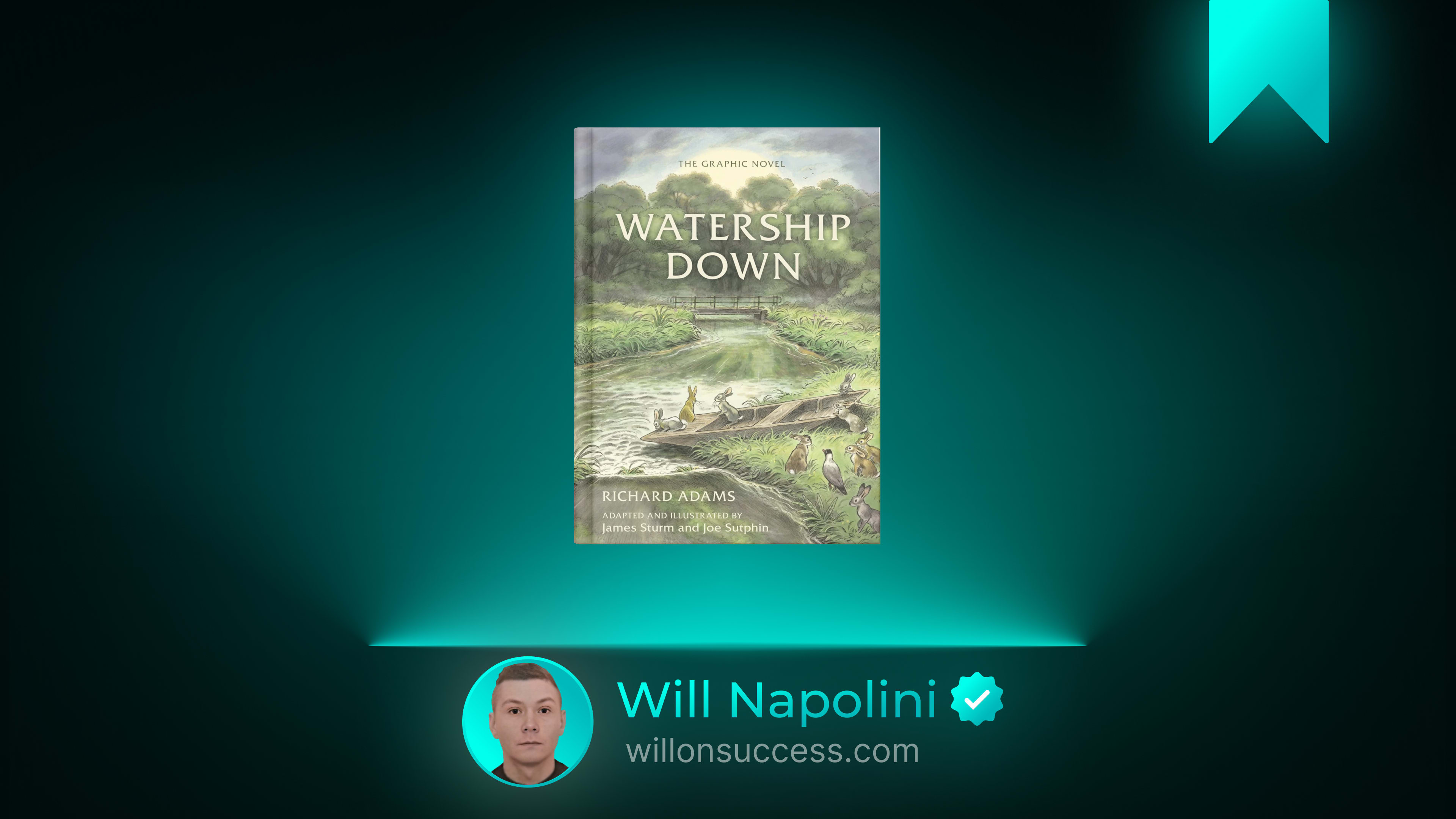
The book is Watership Down. On the surface, it is a story about rabbits. Beneath that surface, it is one of the most complete pictures of leadership, courage, community, and the long hard work of building a life that I have ever read.
And I think you need it more than you realize.
The Big Idea: Home Is Not a Place You Find. It Is a Place You Build, Together.
The central movement of Watership Down is deceptively simple. A small rabbit named Fiver senses that his warren, Sandleford, is about to be destroyed. Most of the other rabbits dismiss him. But his brother Hazel trusts him. Together, they gather a small, ragged group of rabbits—none of them particularly impressive by the standards of their society—and they leave.
What follows is not a triumphant march. It is a stumbling, frightened, often desperate journey through open country full of predators, hunger, and uncertainty. These rabbits are not heroes in the traditional sense. They are small. They are afraid. They bicker. They nearly die, repeatedly.
But they keep moving. And slowly, painfully, they become something more than a collection of frightened individuals. They become a community. And eventually, on a hill called Watership Down, they build a home.
Here is what Adams is really teaching you: the life you are meant to live will not hand itself to you fully formed. You will have to leave something comfortable, travel through something terrifying, and build it alongside people who are just as scared as you are. And the building will change you far more than the destination.
The Story: A Band of Misfits Crosses Open Ground
Let me sketch the journey for you, because the specific moments carry the lessons.
Hazel is not the biggest rabbit. He is not the strongest or the fastest. In the warren’s hierarchy, he is unremarkable. But when Fiver’s warning goes unheeded, Hazel makes a choice: he will not wait for permission. He gathers who will come. Bigwig, a tough former enforcer. Blackberry, a clever thinker. Pipkin, small and anxious. A handful of others. They cross the river. They cross the open fields where hawks circle. They are exposed, vulnerable, and utterly without the structure they have always known.
Along the way, they discover Cowslip’s warren—a place that looks like paradise. Plenty of food. Soft burrows. No visible predators. The rabbits there are well-fed and strangely passive. It takes the near-death of Bigwig, caught in a snare, for the group to understand the truth: a farmer is feeding them in exchange for a steady supply of rabbits to kill. The comfort is a transaction. The safety is an illusion.
They leave. And later, they face Efrafa, a warren ruled by General Woundwort, a rabbit who has built an empire through surveillance, rigid control, and brutality. Every rabbit in Efrafa is marked, tracked, assigned. There is order. There is no freedom.
Hazel’s group is neither of these things. They are messy, improvising, occasionally terrified. But they are free, and they belong to one another.
That contrast—between the comfortable cage, the controlled prison, and the difficult freedom—is the spine of everything Adams wants you to understand.
Your “Small Voice” Deserves a Hearing
Fiver is the smallest rabbit in the group. He is nervous. He has visions that others find unsettling or absurd. In the opening chapters, the larger, more “important” rabbits ignore him entirely.
I have watched people do this to themselves. You feel something is off in your career, your relationship, your daily rhythm. But the feeling is small, and the people around you seem fine, and so you talk yourself out of it. It’s probably nothing. I’m probably overreacting. Who am I to say something needs to change?
Adams is not telling you to act on every anxious impulse. But he is telling you something important: the quiet signal you keep dismissing might be the most accurate information you have. Fiver’s visions are not loud. They are not dramatic. They are a small, persistent knowing.
Hazel’s first act of real leadership is simply this: he listens to his brother. He does not fully understand the warning. But he trusts the source. And that trust saves their lives.
If there is a whisper in your life right now—a sense that a situation is not sustainable, that a path is closing, that something needs to shift before it breaks—I would gently ask you: are you listening? Or are you waiting for the warning to become a catastrophe before you take it seriously?
You do not need a crisis to justify a change. Sometimes the small knowing is enough.
Leadership Is Not Authority. It Is Attention.
Hazel is one of the most quietly remarkable leaders in all of literature, and what makes him remarkable is almost entirely what he does not do.
He does not command. He does not posture. He does not pretend to have answers he does not have. When the group faces a problem—crossing a river, escaping a dog, dealing with an injury—Hazel’s first instinct is to ask: Who among us is best suited to handle this? Then he steps back and lets them.
When Blackberry figures out how to float across water, Hazel lets Blackberry lead that moment. When Bigwig’s strength is needed, Hazel sends Bigwig forward and trusts him. When Pipkin is frightened, Hazel does not mock him. He stays close. He says, in effect, You are not a burden. You are part of this.
Contrast that with Woundwort, who rules Efrafa through fear, who sees every rabbit as a resource to be managed, who cannot tolerate dissent or weakness. Woundwort’s warren is orderly. It is also joyless, brittle, and ultimately unsustainable, because it is built on the suppression of every individual’s spirit.
Here is what I have learned, and what I would tell you if we were sitting across from each other right now: the people around you do not need you to be the strongest voice in the room. They need you to notice them. To ask what they need. To make space for the gift they carry, even when that gift looks small.
This applies whether you are leading a team at work, raising children, building a small business, or simply trying to be the kind of friend who holds a group together. Leadership is not a title. It is the daily practice of paying attention to the people in front of you and asking, What do you need from me right now?
Hazel does that. Over and over. Quietly. Without fanfare. And it is enough.
The Danger of the Comfortable Cage
I keep coming back to Cowslip’s warren. It haunts me.
The rabbits there have everything they need on the surface. Food appears daily. The burrows are warm. No predator comes near. And the rabbits have stopped asking why. They have stopped telling stories. They have stopped being curious. They have traded their alertness, their culture, their very aliveness, for the guarantee of another easy meal.
And then the snare tightens.
You do not have to look far to find Cowslip’s warren in your own life. It might be a job that pays well but slowly hollows you out. A routine that is comfortable but has quietly killed every part of you that once felt curious or alive. A relationship where no one fights anymore because no one is really present anymore.
The danger is not that these situations are obviously bad. The danger is that they are fine. They are pleasant. They ask nothing of you. And by the time you realize what you have traded, the snare is already around your neck.
Adams does not condemn the rabbits in Cowslip’s warren. He pities them. And I think that is the right response. If you recognize your own comfortable cage in that description, you do not need to feel ashamed. You need to feel seen. And then you need to decide whether the safety is worth the slow disappearing.
Difficult freedom will always cost more than comfortable captivity in the short term. But it is the only arrangement in which you remain fully yourself.
Every Member Carries Something Essential
One of the things that moves me most about this novel is how Adams treats the small ones. Pipkin is timid. He worries constantly. In a story about survival, he seems like a liability. But Adams never treats him as one. Pipkin’s sensitivity, his careful attention, his loyalty—these matter. They hold the group together in ways that strength alone cannot.
Blackberry thinks differently from the others. She solves problems no one else can see. Bigwig is fierce and blunt and occasionally reckless, but his courage in the moment of greatest danger is what saves them all. Kehaar, the seagull who befriends them, brings a perspective literally from above that no rabbit could generate alone.
No single rabbit in this story has everything needed for the journey. And no single rabbit is without something needed.
I think about this when I meet people who feel they have nothing to offer. Who look at their own anxiety, their own quietness, their own odd skills, and think, Surely this is not enough. Surely I need to be someone else to matter.
You do not. The group needs your particular gift, even if that gift is simply the willingness to stay, to pay attention, to be steady when others are frantic. You do not need to be Bigwig. You do not need to be Fiver. You need to be exactly who you are, offered honestly to the people walking beside you.
A community is not built from a collection of heroes. It is built from a collection of willing, imperfect creatures who decide to face the open ground together.
The Stories You Tell Yourself Keep You Alive
Scattered through the novel are the tales of El-ahrairah, the trickster rabbit-hero of rabbit mythology. The rabbits tell these stories around each other in moments of rest, fear, and uncertainty. They are funny. They are irreverent. They are also a kind of glue.
Adams understood something that personal-development culture often forgets: you cannot sustain a long, hard journey on strategy alone. You need narrative. You need meaning. You need stories that remind you who you are and where you come from.
When the rabbits are exhausted and frightened, a story about El-ahrairah outwitting a predator reminds them: We are clever. We are resourceful. We have survived before. The story is not a solution. It is a reminder of identity. And identity, in the middle of a difficult crossing, can be the thing that keeps you from lying down and giving up.
Think about the stories you tell yourself. Not the grand narratives you share publicly, but the quiet ones you repeat internally. I am the kind of person who… This always happens to me because… I will never be able to…
Those stories are doing the same work El-ahrairah’s tales do for the rabbits. They are either sustaining you or slowly convincing you to stay in the snare. You have more authorship over them than you think.
Who Should Read This Book
If you are in a season of transition—leaving a job, ending a relationship, moving to a new city, starting something from almost nothing—this book will feel like it was written directly for you. If you lead people in any capacity and find yourself defaulting to control rather than trust, Hazel’s quiet example will challenge you. If you have ever felt too small, too anxious, too unremarkable to matter in the work you are doing, Pipkin and Fiver will quietly change how you see yourself.
This is not a fast read. Adams takes his time with the landscape, the rabbit language, the slow rhythm of a journey on four small legs. If you want a plot-driven thriller, this may test your patience in the middle chapters. But the patience is rewarded. The book earns its ending.
It is also worth knowing: this is a novel, not a self-help book. Adams is not lecturing you. He is telling you a story and trusting you to find the meaning. That trust is part of the gift.
One Small Step You Can Take Today
I do not want to leave you with a vague feeling of inspiration. I want to leave you with something you can do before the day ends.
Here is what I would ask of you.
Think of one “small voice” you have been ignoring. A sense that something in your life—a habit, a situation, a relationship pattern, a project you have been avoiding—needs to shift. You have felt it for a while. You have talked yourself out of it repeatedly because the warning is quiet and the disruption would be uncomfortable.
Do not overhaul your life tonight. That is not what I am asking.
Instead, take one small step that acknowledges the voice. Write down what it is telling you. Tell one trusted person about it. Block out thirty minutes this week to sit with the question honestly. If it is a job that is hollowing you out, spend twenty minutes looking at what else exists. If it is a relationship that has gone quiet, send one honest message. If it is a creative project you have been postponing, open the document. Write one paragraph. Sketch one line.
You do not need to cross the whole river tonight. You need to step toward the bank.
Hazel did not start with a plan for Watership Down. He started by listening to his brother and deciding to walk out of the burrow. One step. Into the open. With no guarantee.
That is all you need right now. One honest step in the direction of the life you are actually meant to be building.
The down is waiting. And you do not have to cross it alone. But you do have to leave the warren.
And the first step out is always the hardest, and always the most important, and always, always enough.