The Dip by Seth Godin: Why the Hardest Part of Any Journey Is the Exact Part That Makes You Valuable
Somewhere in your childhood, someone handed you a rule that has been quietly costing you ever since.
Winners never quit.
You heard it from a coach. From a parent. From a teacher who meant well. From a poster on a classroom wall. And you believed it, because it sounded noble, and because you were young, and because no one told you the second half of the sentence.
The second half is this: Winners never quit the wrong thing. And they never quit at the wrong time.
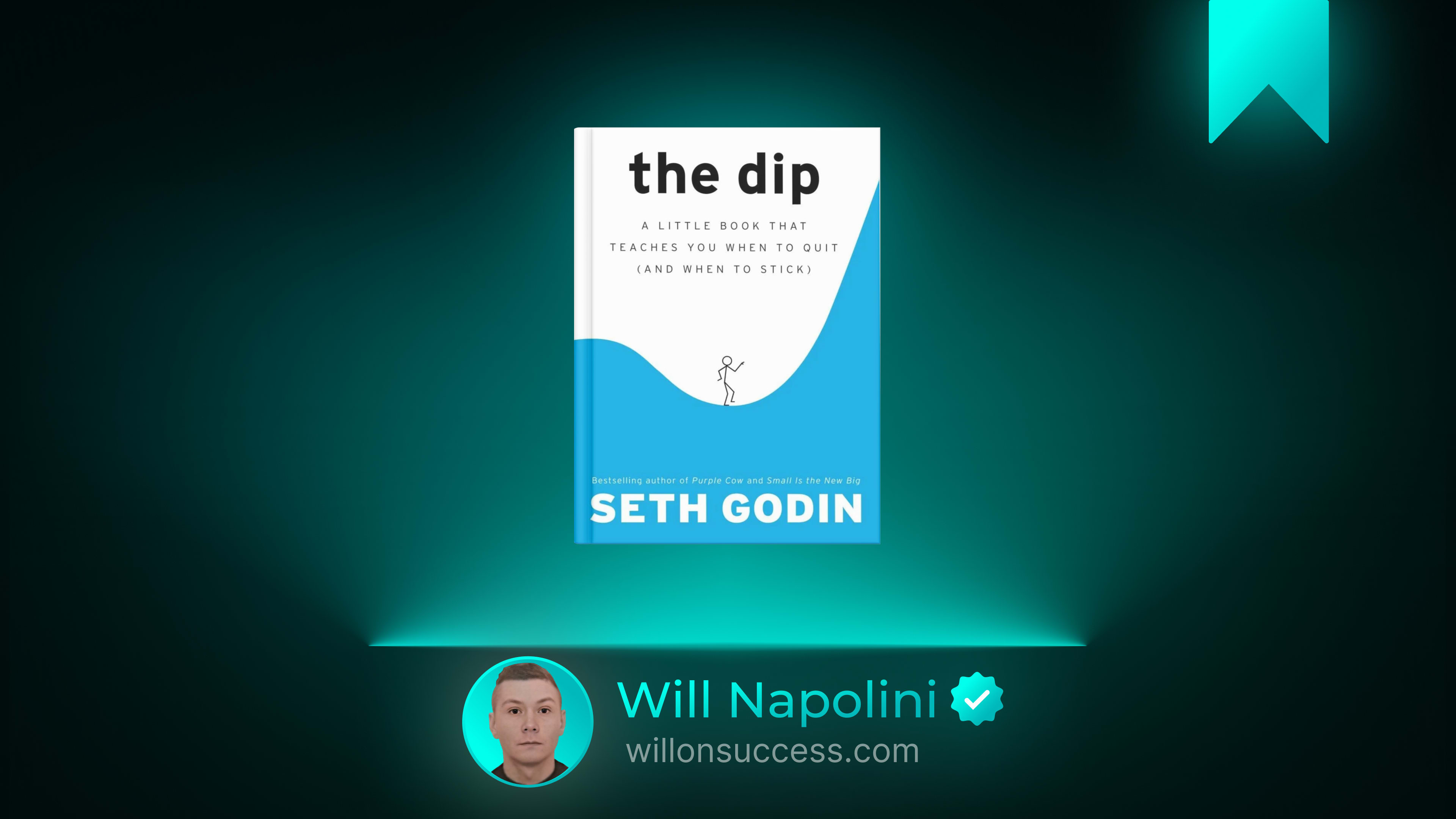
Seth Godin published a very short book in 2007 called The Dip. It is roughly the length of a long afternoon. You can read it in two hours. And it will change the way you think about every commitment you have ever made, every project you have ever abandoned, and every voice in your head that has ever whispered, Maybe I should just stop.
This is not a book about grit. It is not a book about hustle. It is not a pep talk dressed up in a business jacket. It is a book about discernment. About the difference between the pain that builds you and the pain that wastes you. About the radical, unfashionable idea that quitting is not the opposite of success. Sometimes, quitting is the prerequisite.
Let me walk you through what Godin built, and what I have learned from living inside it.

The Big Idea: The Long Grind in the Middle Is Not a Problem. It Is the Point.
Every new endeavor follows a similar emotional arc. You start, and it is exciting. The novelty carries you. You see quick progress. You tell your friends. You feel the thrill of beginning.
Then the novelty fades. The quick progress stops. You hit a long, grinding stretch where the work is hard, the results are invisible, and the excitement you felt at the beginning seems like a memory belonging to someone else. You are no longer a beginner, which means you no longer get the beginner’s grace. But you are not yet skilled, which means you do not get the skilled person’s reward. You are in between. In the middle. In the long, unglamorous, thankless middle.
Godin calls this the Dip. And here is the insight that changed the way I think about my own life: the Dip is not a sign that you made the wrong choice. The Dip is the mechanism that makes the choice valuable.
Think about it. If becoming a skilled surgeon were easy—if the training were short, the learning curve gentle, the middle stretch pleasant—then everyone would do it. The skill would be common. The value would collapse. The reason a skilled surgeon is valuable is precisely because the path to becoming one is long, brutal, and full of moments where a reasonable person would walk away.
The Dip creates scarcity. Scarcity creates value. And the people who make it through the Dip are not smarter or more talented than the people who quit. They simply made a different decision about what the pain meant. They understood that the pain was not a detour. It was the road.
The valley is not the interruption of the journey. The valley is the journey.
Three Landscapes: Knowing Which One You Are In
Before you can decide whether to quit or stay, you have to understand the terrain. Godin describes three distinct landscapes, and confusing them is the source of enormous wasted effort and unnecessary suffering.
The Dip
The Dip is the long slog between starting and mastery. It is the stretch where effort is high and visible reward is low. It is the middle of the medical residency. The third year of building a business that has not yet turned a profit. The hundredth hour of practicing an instrument where you still sound mediocre. The fiftieth draft of a manuscript that is not yet good.
The Dip is painful. But it is productive. Every hour you spend in the Dip is an hour that builds skill, deepens understanding, and separates you from the people who walked away. The Dip is where value is forged. And if you are in a Dip, the right move is almost always to keep going.
The Cul-de-Sac
A cul-de-sac is a dead end. You walk into it, and you realize there is nowhere to go. You can turn around. You can stand still. But you cannot move forward. No amount of effort, persistence, or positive thinking will change the geometry of the road.
Godin’s point is that most people spend years in cul-de-sacs, mistaking them for Dips. They stay in a job where the ceiling is fixed, where no amount of excellence will lead to advancement, where the structure itself prevents growth. They stay in a relationship where the fundamental incompatibility is not going to change no matter how many conversations they have. They stay in a market that is shrinking, a skill that is being automated, a strategy that has reached its natural limit.
And they stay because quitting feels like failure. Because they have already invested three years, five years, a decade. Because the voice from childhood says, Winners never quit.
But staying in a cul-de-sac is not perseverance. It is a slow, comfortable form of giving up. You are not pushing through a valley toward a peak. You are walking in circles in a parking lot, calling it a journey.
The hardest thing to quit is the thing that is merely bad enough to make you miserable, but not bad enough to make you leave.
The Cliff
The Cliff is rare, but Godin names it because it matters. The Cliff is the situation where you cannot quit until you fall off. Where the consequences of continuing are invisible until they are catastrophic, and by the time you see them, it is too late.
The classic example is addiction. A person can smoke for twenty years and feel fine. The damage is silent, cumulative, invisible. And then one day, the diagnosis arrives, and the cliff is there, and the years of “quitting” that should have happened decades ago are no longer available.
The Cliff reminds you that some costs do not announce themselves in advance. And it argues for paying attention to the slow, quiet signals—the ones that do not scream, that do not create a crisis, that simply accumulate in the background while you tell yourself everything is manageable.
Quitting Is a Skill, Not a Character Flaw
Here is the cultural lie Godin dismantles most effectively: the idea that quitting is a moral failure. That people who quit are weak, undisciplined, commitment-phobic. That if you just had more grit, more discipline, more toughness, you would push through.
Godin does not agree. He argues that quitting is one of the most important strategic decisions a person can make. And that the ability to quit well—to quit the right things, at the right time, for the right reasons—is a sign of clarity, not weakness.
The key distinction is this: you should quit a tactic. You should not quit a direction.
A tactic is a specific approach to a goal. A job. A marketing strategy. A particular relationship. A method of studying. A business model. Tactics are replaceable. If one is not working, walking away from it is not failure. It is intelligence. It is the willingness to say, This specific path is not leading where I need to go, and I will find another.
A direction is the deeper aim. The kind of life you want to build. The kind of person you want to become. The field you want to master. The values you want to embody. Directions are not replaceable. And quitting a direction in the middle of the Dip—walking away from the thing you actually care about because the middle is hard and the results are slow—is the one kind of quitting that genuinely costs you.
I have watched people confuse these two constantly. The writer who quits writing because one novel did not sell, when the direction was never “sell a novel” but “become a person who writes.” The entrepreneur who quits entrepreneurship because one business failed, when the direction was never “build this specific company” but “learn to create value.” The person who quits a career because one job was miserable, when the direction was never “stay at this company” but “do work that matters.”
They quit the direction because the tactic hurt. And they carry the grief of that quitting for years, wondering why they feel hollow, wondering why nothing else fits, wondering why the excitement of new beginnings never lasts.
Be the Best in the World (Your World)
Godin makes an argument that sounds arrogant until you understand what he actually means. He says you should strive to be the best in the world at what you do. And then he immediately clarifies: “the world” does not mean the entire planet. It means your world. Your niche. Your community. Your specific intersection of skill, audience, and context.
You do not need to be the best guitarist alive. You need to be the best guitarist for the specific kind of music, in the specific community, serving the specific audience, that you are uniquely positioned to serve. You do not need to be the best accountant in the country. You need to be the best accountant for small creative businesses in your city. The best teacher for the specific kind of student who learns the way you teach. The best friend for the specific people in your life who need the specific kind of presence you offer.
This is not a lowering of standards. It is a sharpening of focus. And it matters because of the Dip. If your goal is vague—if you are trying to be “good at business” or “a decent writer” or “a competent parent”—then the Dip has no endpoint. There is no clear summit. You will grind forever in the middle, never sure whether you are progressing, because you never defined what progress looks like.
But if your goal is specific—if you know exactly who you are serving, exactly what you are building, exactly what mastery looks like in your particular domain—then the Dip has a far side. You can see it. You can measure your progress toward it. You can endure the middle because you know what the other side looks like.
A vague goal makes the Dip infinite. A specific goal makes the Dip finite. And finite pain is bearable.
Decide Before the Fog, Not Inside It
One of the most practical ideas in the book is this: the decision to quit or stay should not be made in the middle of the Dip. It should be made before you enter it.
When you start a new project, a new career, a new commitment, you are in the honeymoon phase. The energy is high. The novelty is fresh. You can see the summit clearly. You feel capable, excited, optimistic. This is the moment to decide, honestly and soberly, what you are committing to. How long are you willing to stay? What would have to be true for you to walk away? What does the far side of the Dip look like, and is it worth the price?
Write it down. Make the decision in the clear air, before the fog rolls in.
Because when you are in the Dip—when the work is grinding, the results are invisible, the excitement is gone, and every rational voice in your head is saying, This is a waste of time, you should stop, you are not cut out for this—you are in the worst possible state of mind to make a strategic decision. You are exhausted. You are demoralized. You are reacting to pain, not evaluating evidence. And the decision you make in that state will be a pain decision, not a strategy decision.
Godin’s counsel is clear: if you are going to quit, quit before the Dip. Quit in the planning stage. Quit when you see the cul-de-sac clearly. But do not quit in the middle of the valley, when your judgment is clouded by fatigue and the only thing you can feel is the ache in your legs.
The worst time to choose your direction is when you are too tired to see the road.
What This Looks Like on an Ordinary Tuesday
You are not starting a company today. You are not quitting your career today. You are probably going to do the same things you did yesterday, and the day before, and the day before that. The laundry. The emails. The commute. The dinner. The slow, unglamorous accumulation of hours that make up a life.
But here is what I would invite you to notice, drawn straight from what Godin put on the page:
Where in your life are you in a Dip, and calling it a cul-de-sac? Where are you grinding through the hard middle of something that actually matters, and telling yourself it is pointless because the results are not visible yet? The project that is half-finished. The skill that is half-learned. The relationship that is in its hard, unromantic, workaday middle. The body you are trying to rebuild, slowly, without the dramatic transformation you were promised.
And where in your life are you in a cul-de-sac, and calling it a Dip? Where are you staying because leaving feels like failure, when the honest truth is that the road ended two years ago and you have been walking in circles ever since? The job with no growth. The strategy that is not working. The commitment you made to someone else’s vision that has slowly replaced your own.
You do not have to solve either of those today. You just have to name them. You just have to look at the landscape honestly and say, This is a valley. I will keep walking. Or, This is a dead end. I will turn around.
The naming is the work. The action will follow.
Who Should Read This Book
Read this book if you are in the middle of something hard and you are not sure whether the hardness means you are growing or whether you are wasting your time. This book will not answer that question for you. But it will give you the framework to answer it yourself.
Read it if you are a chronic starter—someone who begins projects with enormous excitement, rides the wave of novelty for a few weeks, and then abandons them when the middle arrives. Godin will not shame you for this. But he will show you what you are actually doing, and what it is costing you.
Read it if you are a chronic stayer—someone who remains in situations long past their usefulness because leaving feels like admitting defeat. Godin will give you permission to walk away. Not reckless permission. Strategic permission. The permission of a person who understands that the years you spend in a cul-de-sac are years you cannot spend on a road that actually goes somewhere.
I will be honest about the book’s limitations. It is very short, and some readers may feel the core idea is delivered in the first thirty pages, with the remaining pages reinforcing rather than deepening. Godin’s style is punchy, repetitive, and deliberately provocative. He writes in short bursts, with the rhythm of a marketer making a pitch. If you prefer long, narrative, deeply developed arguments, you may find the style thin. The book also focuses primarily on professional and creative contexts—business, career, projects. If you are looking for a framework that applies equally to relationships, parenting, or spiritual life, you will need to do some of the translation yourself.
But the core idea is genuine. And it is one that the culture badly needs. Not more hustle. Not more grit. Not more “never give up” posters on office walls. More discernment. More honesty. More willingness to look at the road and say, This is a valley, and I will walk through it. Or, This is a dead end, and I will not pretend otherwise.
One Small Step
Here is what I would ask of you today. One thing. Small. Specific. Achievable before the day is over.
Think of one commitment in your life that you have been quietly, persistently miserable about. One project, one role, one obligation, one path. The one you have been white-knuckling. The one where the thought of continuing makes your chest tighten, and the thought of quitting makes your stomach drop, and so you do neither. You just endure. You just keep walking, hoping the feeling will change, hoping the road will improve, hoping that someday the effort will finally pay off.
Take ten minutes tonight. Sit in a quiet room. Take a piece of paper. And write down two things.
First: If I were starting this today, with no prior investment, no sunk cost, no fear of what people would think—would I choose it? Answer honestly. Not strategically. Not bravely. Honestly.
Second: If the answer is no, what is the smallest, most honest step I could take toward letting it go? Not a dramatic exit. Not a bridge-burning confrontation. Just the first small step. The conversation. The email. The decision to stop adding new energy to something that has been dead for a while.
You do not have to act tonight. You just have to write it down. You just have to look at the landscape without the fog of fatigue and obligation clouding your eyes. You just have to name what you see.
The valley is real. The dead end is real. And you are allowed to know the difference. You are allowed to walk through the valley with your eyes open, knowing why you are there, knowing what the far side looks like, knowing that the pain is the price of the thing you actually want. And you are allowed to turn around in the cul-de-sac, without shame, without apology, without the childhood voice telling you that quitting makes you less.
It does not. Quitting the wrong thing is how you make room for the right thing. And the right thing, whatever it is, has a Dip of its own waiting for you. A long, hard, unglamorous middle that will test you and tire you and ask you, over and over, whether you really want this.
You will want to be in that Dip. You will want to be in the valley that leads somewhere, not the one that circles back to where you started.
So choose. Choose in the clear air. Choose before the fog. Choose the valley that has a far side, and walk into it with your eyes open.
The middle is long. The middle is hard. The middle is where almost everyone turns back.
That is exactly why the other side is worth reaching. That is exactly why you, if you keep walking, will be rare. And rare things are valuable. Not because they are perfect. Because they are scarce. Because they endured. Because they did not quit in the fog.
Keep walking. Or turn around. But do not stand still in the middle, calling it a journey.
You deserve a road that goes somewhere.