The Courage to Be Disliked: How to Stop Carrying the Weight of Other People's Expectations and Finally Live Your Own Life
What if the reason you feel stuck has absolutely nothing to do with what happened to you ten years ago, and everything to do with a hidden goal you are unconsciously pursuing right now?
What if the heavy, exhausting weight you feel when you walk into a room is not the burden of your own inadequacy, but the impossible, crushing weight of trying to manage other people’s emotions?
We live in a culture that tells us we are the sum of our pasts. We are told that to move forward, we must first dig up our childhoods, analyze our traumas, and heal our wounds. We are also told that to be successful, we must be liked, respected, and validated by the people around us.
But what if both of those premises are traps? What if they are the very chains keeping you small?
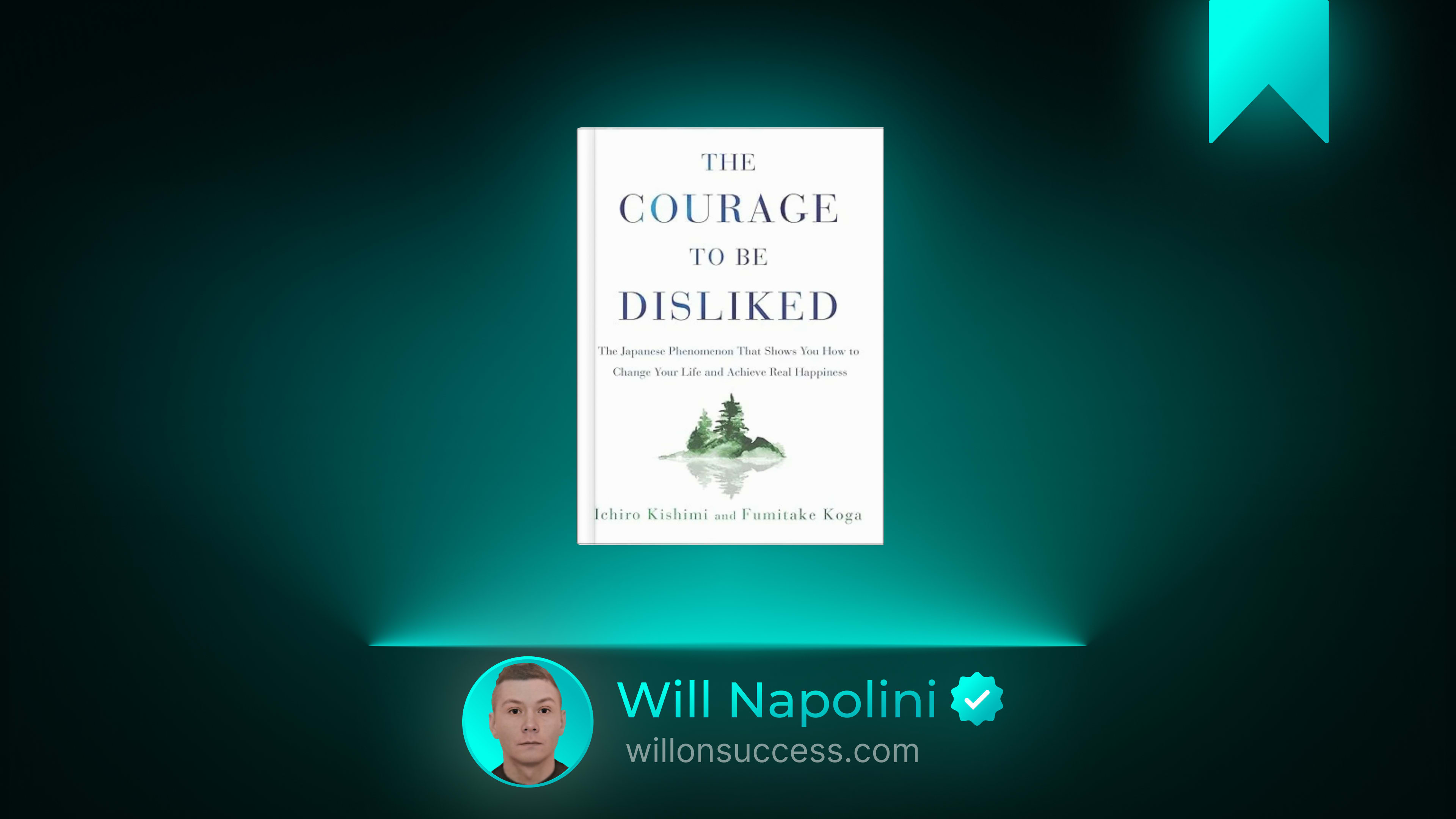
In 2013, two Japanese authors—Ichiro Kishimi and Fumitake Koga—published a book that quietly set the publishing world on fire. The Courage to Be Disliked is not a standard self-help book. It is structured as a Socratic dialogue over five nights between a cynical, frustrated Young Man and a calm, uncompromising Philosopher. The Young Man represents all of us: defensive, carrying baggage, convinced the world is unfair and that our pasts dictate our futures. The Philosopher represents the teachings of Alfred Adler, one of the three giants of 19th-century psychology alongside Freud and Jung.
Over the course of those five nights, the Philosopher systematically dismantles the Young Man’s worldview. And if you let it, he will dismantle yours, too. Not to break you, but to set you free.
Let us sit down and look at what this book is actually trying to tell you.

The Big Idea: You Are Not a Prisoner of Your Past; You Are the Architect of Your Present
The most radical, and initially most uncomfortable, idea in this book is the rejection of “etiology” (the study of causation) in favor of “teleology” (the study of purpose).
Freud taught us etiology: you are anxious today because something terrible happened to you yesterday. Your present is determined by your past.
Adler teaches teleology: you are experiencing anxiety today because anxiety serves a purpose for you right now. Your present is determined by your current goals.
The Philosopher illustrates this with a story about a shut-in who refuses to leave his room. The moment he steps outside, he experiences heart palpitations and panic. The Freudian view says: He was traumatized in the past, and therefore he cannot go outside.
The Adlerian view flips it entirely: He has a goal of not going outside—perhaps to keep his parents worried about him, or to avoid the risk of being judged by the world. To achieve this goal, he manufactures the anxiety and panic.
Now, I need to be very careful here, because this is where people often misunderstand Adler. He is not saying that terrible things did not happen to you. He is not denying your pain, your grief, or your trauma. He is saying that the meaning you assign to those events, and the way you use them to justify your current inaction, is a choice you are making in this exact moment.
If your past determines your future, you are helpless. You are a victim of a timeline you cannot change. But if your present behavior is driven by a present goal, you have absolute power. You can simply choose a new goal.
You are not a prisoner of your past. You are a customer who keeps ordering the same painful dish from the menu of your life, and then complaining about the taste. You can close the menu. You can order something else.
The Separation of Tasks: Dropping the Rope
If the rejection of trauma is the philosophical foundation of the book, the “Separation of Tasks” is its most practical, life-changing tool.
The Philosopher makes a sweeping, almost arrogant claim: All problems are interpersonal relationship problems. Every piece of friction, every ounce of resentment, every sleepless night of worry can be traced back to our entanglement with other people.
Why do we get entangled? Because we do not know where our responsibilities end and someone else’s begin. We constantly intrude on other people’s tasks, and we allow them to intrude on ours.
How do you separate them? You ask one simple question: Who ultimately bears the consequences of the decision made?
Let us say you are choosing a career path. You want to be a writer. Your parents want you to be an accountant. You are agonizing, fighting with them, losing sleep, trying to convince them.
Whose task is it to choose your career? Yours. You bear the consequences of the daily work. Whose task is it to feel disappointed, worried, or angry about your choice? Your parents’. They bear the consequences of their own emotions.
When you try to manage your parents’ disappointment, you are intruding on their task. When they try to force you into accounting, they are intruding on yours. This intrusion is the root of all interpersonal conflict.
The cure is to draw a boundary. You do your task with integrity. You let them do theirs. You do not try to control their reaction, and you do not let their reaction control your action.
I think about this whenever I see people exhausted by a tug-of-war they never agreed to enter. Someone hands you the rope—maybe it is a demanding boss, a guilt-tripping family member, or a judgmental friend. They pull. Your instinct is to grab the rope and pull back, or to brace yourself and suffer the strain.
The Separation of Tasks teaches you a third option: Just drop the rope.
You do not have to win the tug-of-war. You do not have to convince them. You simply let the rope fall to the dirt and walk away. They may yell. They may call you selfish. But the tension is gone. You are free.
True Freedom Is the Courage to Be Disliked
This brings us to the title of the book, and the hardest pill to swallow.
If you separate your tasks from everyone else’s, some people are going to be upset. Your parents might be disappointed. Your boss might be frustrated. Your friends might think you have changed.
The Young Man in the book argues that this is a terrible outcome. He wants to be liked by everyone. He believes that being liked is the ultimate proof of a good life.
The Philosopher responds with devastating clarity: To be disliked is the proof that you are living freely.
If you go through life and no one dislikes you, it means you are constantly monitoring everyone else’s moods, adjusting your behavior, swallowing your truth, and compromising your values to avoid friction. You are living their lives, not yours. Seeking recognition is a trap. It is a lifelong sentence of servitude to the expectations of others.
Freedom is not the absence of responsibility. Freedom is the willingness to bear the cost of your own choices, including the cost of being misunderstood.
I have spent years watching incredibly talented, deeply good people paralyze themselves because they were terrified of a hypothetical frown from a hypothetical observer. They do not launch the business. They do not publish the essay. They do not set the boundary. They wait for universal permission that will never come.
You do not need a consensus to exist. You do not need applause to be valid. The courage to be disliked is not about becoming a jerk. It is not about going out of your way to offend people. It is simply the quiet, internal acceptance that if living your truth causes someone else to dislike you, that is their task to manage, not yours to fix.
Happiness Is the Feeling of Contribution (Not Praise)
If we stop seeking recognition, what are we left with? If we do not live for the applause, what is the point of the work?
Adler’s answer is “Community Feeling.” It is the sense that you belong, that you have a place, and that you are of use to others. But—and this is crucial—this feeling does not come from being praised.
The book makes a fascinating distinction between “vertical” and “horizontal” relationships.
A vertical relationship is based on hierarchy. One person is above, the other is below. When you praise someone (“Good job! You are so smart!”), you are operating from a vertical position. You are a judge handing down a verdict to a subordinate. Praise is actually a form of manipulation; it is a way to control behavior from above.
A horizontal relationship is based on equality. You may have different roles, different skills, or different ages, but as human beings, you are on the same plane. In a horizontal relationship, you do not praise. You express gratitude. You say, “Thank you.” You say, “That helped me.”
When you are praised, your worth is conditional. It depends on the judgment of the person above you. When you are thanked, you experience the pure feeling of contribution. You realize that your existence, your action, your presence was of use to another human being.
Adler defines happiness simply as the feeling of contribution. You do not need to be famous. You do not need to be wealthy. You do not need to be the best. You just need to feel that you are useful to your community, however small that community is.
When you wash the dishes and your partner says, “Thank you, that made my evening so much easier,” you experience happiness. When you mentor a junior colleague and see them succeed, you experience happiness. You do not need them to tell you that you are a “good person.” You just need to know that you contributed.
Why This Matters on an Ordinary Tuesday
You are not going to read this book and instantly become an enlightened being who never feels insecure again. You are going to wake up on Tuesday, and someone is going to send you a passive-aggressive email, and your heart rate is going to spike. You are going to feel the old urge to people-please rising in your chest.
But you will have a new vocabulary for what is happening.
When your mother calls and tries to guilt you into coming home for a holiday you cannot afford to take, you will hear the Philosopher’s voice. Whose task is this? Her task is to manage her disappointment. Your task is to manage your schedule and your finances. You drop the rope. You say, “I love you, but I won’t be able to make it.” You let her be upset. You survive.
When you are sitting at your desk, paralyzed by the fear that your new project isn’t “good enough” and that people will criticize it, you will remember the teleology. You will realize you are using the fear of criticism as an excuse to avoid the risk of failure. You will recognize the goal. And you will choose a new one.
When your child brings home a mediocre report card, instead of scolding them (vertical) or falsely praising them (manipulation), you will sit beside them (horizontal) and ask, “How do you feel about this? What do you think you need?” You will separate your task (loving and supporting them) from their task (doing their schoolwork).
This philosophy does not make life frictionless. It makes life yours. It takes the steering wheel out of the hands of your past, your parents, your boss, and your critics, and puts it firmly back in your hands.
Who Should Read This Book
You should read this book if you are a chronic people-pleaser. If you feel exhausted by the constant, invisible labor of managing everyone else’s emotional state, this book will hand you a machete to cut through the vines.
You should read it if you feel stuck in a “trauma narrative”—if you find yourself constantly saying, “I can’t do X because of what happened to me in my childhood.” Adler’s uncompromising belief in your present agency will feel like a bucket of cold water. It will shock you, but it will wake you up.
You should read it if you appreciate philosophy delivered through dialogue. The back-and-forth between the Youth and the Philosopher is engaging, and the Youth asks all the exact objections you will be thinking of.
I will offer one honest caveat. The format can feel slightly repetitive, and the Philosopher can sometimes come across as incredibly blunt, almost lacking in empathy for the raw pain of the human experience. If you are in the midst of acute, severe psychological distress or active trauma processing, Adler’s total dismissal of past causes might feel invalidating rather than liberating. Read it with the understanding that it is a philosophical framework for empowerment, not a substitute for clinical psychiatric care.
But if you are ready to take radical responsibility for your life, it is a masterpiece.
One Small Step
I want you to do something today that requires a quiet, internal kind of bravery.
Identify one rope you are currently holding, and drop it.
Think of one relationship in your life where you are constantly trying to manage the other person’s reaction to you. Maybe it is a partner whose mood dictates the weather of your entire evening. Maybe it is a friend who makes you feel guilty for not texting back fast enough. Maybe it is a parent whose approval you are still trying to earn.
Today, make one small decision based entirely on what is true and right for you, without attempting to soften the blow, manage their reaction, or preemptively apologize.
Send the email. Say the “no.” Take the hour for yourself.
When the other person reacts—when they frown, when they sigh, when they express their disappointment—do not rush in to fix it. Do not grab the rope. Stand still. Let them feel their feelings. Let them do their task.
Take a deep breath. Notice that the sky did not fall. Notice that you are still standing. Notice the sudden, vast, terrifying, beautiful space that opens up when you stop carrying the weight of someone else’s expectations.
Life is not a mountain you are hiking up, struggling to reach a peak where you will finally be deemed “good enough” by the people watching you.
Life is a dance floor. The music is playing right now. The steps do not matter as much as the willingness to move. You do not need the permission of the crowd to step onto the floor. You just need the courage to dance, even if they don’t like your style.
The music is playing. Step out.