You Were Never Meant to Earn Your Own Worth: What the Self-Love Workbook for Women Teaches About Coming Home to Yourself
I want to tell you something that might feel strange, even uncomfortable, and I want you to sit with it for a moment before you rush to the next thing on your list.
You do not have to earn the right to rest. You do not have to earn the right to take up space. You do not have to earn the right to say no, to be tired, to be imperfect, or to be loved exactly as you are in this moment, before you fix a single thing about yourself.
If reading that sentence made your chest tighten, if some part of you whispered but that’s not how it works, I have to do more first — then I think you and I need to have a conversation.
Because that voice, the one that insists you must perform before you are permitted to exist comfortably, is not the truth. It is a pattern. And patterns can be changed.
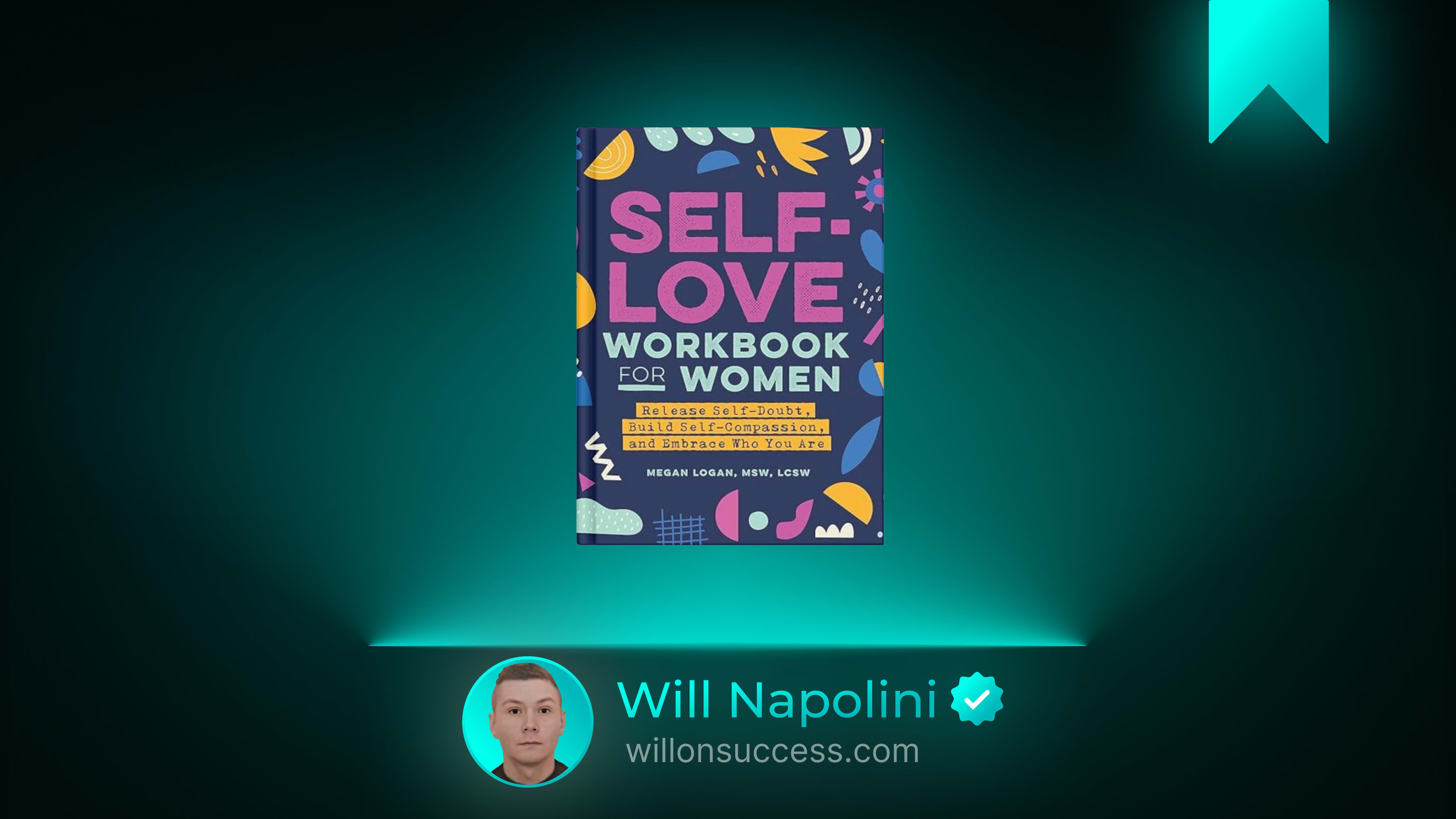
Megan Logan’s The Self-Love Workbook for Women is built for the woman who has spent years pouring from an empty cup. The woman who says yes when she means no. The woman who apologizes for having needs. The woman who has become so skilled at reading the emotions of everyone in the room that she has forgotten what she herself is feeling.
Logan is a licensed clinical social worker, and this book carries the steady, practical energy of someone who has sat across from hundreds of women and heard the same quiet confession: I take care of everyone else, and I do not know how to take care of myself without feeling guilty.
This is not a book of affirmations to tape to your mirror. It is a workbook. It asks you to write, to reflect, to notice, and to practice. It treats self-love not as a feeling you wait for, but as a skill you build, one small repetition at a time.
Let me walk you through what it teaches, and how you can begin applying it tonight.
The Big Idea: Self-Worth Is Not a Reward for Good Behavior
The foundational premise of Logan’s work is one that sounds simple but runs against almost everything many women have been taught: Your worth is not something you produce. It is something you already are.
This is not a platitude. It is a structural claim about how you relate to your own life.
Most of us have been quietly trained, from childhood, to treat our worth as conditional. You are worthy if you are helpful. You are worthy if you are pleasant. You are worthy if you do not cause trouble. You are worthy if you make everyone else comfortable first.
Over years, this training becomes invisible. You stop noticing that you are performing. You simply believe, at a deep, pre-verbal level, that your value must be demonstrated before it can be felt. You become an employee of your own life, constantly justifying your existence through output.
Logan’s workbook asks you to step out of that employment. To recognize that the worth you keep trying to earn through exhaustion and compliance was never on the table to begin with. You came into the world already holding it. The work is not to acquire it. The work is to stop giving it away.
The Story of the Empty Cup
There is an image I think about often when I consider the patterns Logan describes. Imagine a woman holding a large pitcher of water. Every person who comes to her — her children, her partner, her parents, her coworkers, her friends — holds out a cup. And she pours. She pours and pours, smiling, because this is what she was taught love looks like. Service. Availability. The absence of inconvenience.
But no one ever asks her to sit down. No one ever fills her pitcher. And slowly, without drama, without a single dramatic collapse, she runs dry.
She does not announce it. She simply begins to feel hollow. Resentful in ways she cannot explain. Tired in ways that sleep does not fix. She snaps at small things. She withdraws. And then, because the pattern runs deep, she feels guilty for being empty, as though her emptiness is a moral failure rather than the natural consequence of never being refilled.
Logan’s workbook is, at its core, a guide to setting the pitcher down. To saying: I will pour, but I will not pour until I am hollow. I matter too. My needs are not an inconvenience. My rest is not a luxury I must justify.
And the most radical part? The book teaches you to do this without waiting for permission. Because permission is not coming from the people who have benefited from your endless pouring. You must give it to yourself.
The Inner Critic: The Voice That Keeps You Small
One of the most useful sections of the workbook deals with what Logan calls the inner critic — that relentless internal narrator that comments on everything you do and finds it lacking.
You know this voice. It is the one that whispers after you speak up in a meeting: That was stupid. Why did you say that? Everyone noticed. It is the one that scans your body in the mirror and catalogues flaws. It is the one that reviews your day before sleep and produces a list of everything you did wrong.
The workbook does not ask you to silence this voice overnight. That is neither realistic nor necessary. Instead, it asks you to do something more fundamental: notice it, name it, and stop obeying it.
The inner critic is not you. It is a compilation. It is built from the voices of critical parents, perfectionist teachers, cultural expectations, and old wounds that never healed properly. It speaks in the language of the people who shaped you, but it is not speaking the truth. It is speaking a script.
Logan provides exercises to help you externalize this voice — to write it down, to give it a name, to observe it the way you would observe a loud neighbor through a thin wall. You can hear it. You do not have to open the door. You do not have to let it rearrange your furniture.
What I have learned from my own experience with this practice is that the inner critic loses a tremendous amount of power the moment you stop treating it as the final authority on your worth. It can shout. You can let it shout. And then you can go make yourself a cup of tea and continue with your evening.
Boundaries Are Not Walls — They Are Gates
If there is one practical skill that the workbook returns to again and again, it is the skill of setting boundaries. And Logan is careful to frame this in a way that I think is essential for women who have been conditioned to see themselves as caretakers.
A boundary is not a punishment you inflict on other people. It is not a wall you build to keep love out. A boundary is a gate. It is the simple, clear statement of what you will and will not carry, what you will and will not tolerate, what you will and will not pour from when your pitcher is already low.
The workbook walks you through the mechanics of this: how to say no without over-explaining. How to tolerate the discomfort of someone being disappointed with you. How to recognize that other people’s feelings about your boundary are not your responsibility to manage.
This is where the book gets genuinely challenging, because setting boundaries when you are a people-pleaser feels like betrayal. It feels like you are being cruel. It feels like you are failing a test you did not know you were taking.
But here is what I would tell you, gently and firmly: the discomfort you feel when you set a boundary is not evidence that you are doing something wrong. It is evidence that you are doing something new. Your nervous system is used to the old pattern — the pattern of saying yes, of absorbing, of disappearing. The new pattern will feel unsafe at first, the way any unfamiliar road feels unsafe when you are driving it for the first time in the dark.
You drive it anyway. You drive it slowly. You drive it with your hands tight on the wheel. And eventually, the road becomes familiar, and the fear loosens its grip.
Self-Care Is Not the Same as Self-Love
Logan draws a distinction that I think many of us need to hear: self-care and self-love are not the same thing.
Self-care is the bath. The walk. The candle. The early bedtime. These things are good, and they matter. But they can also become another performance, another item on the list of things you should do to prove you are taking care of yourself.
Self-love goes deeper. Self-love is the decision to stop abandoning yourself in your own life. It is the choice to speak to yourself the way you would speak to a dear friend who came to you exhausted and ashamed. It is the refusal to keep making yourself small so that other people can feel comfortable.
You can take a bath every night and still hate yourself in the morning. Self-love is not the bath. Self-love is the quiet, stubborn decision that you are allowed to exist without apology.
The workbook provides journaling exercises and reflection prompts designed to help you locate the places where you abandon yourself — in conversations where you go silent, in relationships where you shrink, in decisions where you choose everyone else’s preference over your own. And then it asks you, gently, to practice choosing yourself. Not dramatically. Not all at once. But consistently.
Why This Matters on an Ordinary Wednesday
Let me bring this down to the ground, because philosophy without application is just decoration.
What does this look like on a Wednesday afternoon when your mother calls and makes a comment about your weight? What does this look like when your boss asks you to take on another project and your body screams no but your mouth says of course? What does this look like when your partner sighs and you immediately scan the room for what you did wrong?
It looks like a pause. A single, deliberate pause before you react.
In that pause, you notice the old pattern rising. The urge to fix, to smooth, to shrink. And instead of following the urge, you simply name it. There is the people-pleasing reflex. There is the guilt. There is the fear that if I say no, I will be unlovable.
And then you choose differently. You say, “I can’t take that on right now.” You let the silence sit. You let your mother’s comment hang in the air without defending yourself. You do not scan the room. You simply breathe and let your partner have their feeling.
This is not dramatic. No one will applaud. You will not feel triumphant in the moment. You will probably feel shaky, guilty, and uncertain. That is normal. That is the feeling of a new muscle being used for the first time.
But the next Wednesday, it will be slightly easier. And the Wednesday after that, slightly easier still. And one day, you will realize that the old reflex no longer fires automatically. You will realize that you have built something quiet and sturdy in the place where the old pattern used to run the show.
The Wound and the Work
I want to be honest about something the workbook acknowledges, because I think honesty matters more than comfort.
The patterns of self-neglect and people-pleasing do not appear from nowhere. They are often learned in childhood, in families where love was conditional, where a child’s needs were treated as burdens, where a girl learned early that the safest way to belong was to be useful, quiet, and undemanding.
If that resonates with you, I want you to hear me clearly: you are not broken because you learned to survive in the only way available to you. You adapted. You did what a child does when the environment requires it. That was not weakness. That was intelligence.
But you are not that child anymore. The survival strategy that kept you safe then is the same strategy that keeps you exhausted now. And you are allowed to set it down. You are allowed to say, with compassion for the girl you were and honesty about the woman you are becoming: That was then. I do not need to earn my place in the room anymore. I am already in it.
The workbook does not promise that this realization will heal everything in a weekend. It offers a process. A slow, patient, often nonlinear process of noticing, naming, grieving, and rebuilding. And that is okay. You did not build these patterns in a day, and you will not dismantle them in a day. But you can begin. And beginning is the only thing that has ever mattered.
Who Should Read This Book — and Who Might Not Need It
Who it is for: If you are a woman who feels chronically guilty, who struggles to say no, who puts her own needs last and then resents the people she is serving, this workbook will feel like a hand reaching into the dark to find yours. If you are tired of performing wellness and want practical, structured exercises to actually build self-worth rather than just read about it, this is your book. It is especially valuable for women in caretaking roles — mothers, daughters caring for aging parents, partners, helpers — who have lost track of where they end and other people’s needs begin.
Who might find it less useful: If you are looking for a quick, inspirational read that will make you feel better by Friday, this is not it. It is a workbook. It requires you to write, to sit with discomfort, to do the exercises. If you are not willing to engage with the material actively, you will get very little from it. It is also specifically written for women navigating gendered expectations of caregiving and compliance, so if that framing does not apply to your life, some of the examples may feel less relevant.
Practical Application: Three Exercises to Begin Tonight
You do not need to complete the entire workbook in one sitting. You need one honest conversation with yourself, and then another tomorrow. But here are three places to start.
Exercise One: The Needs Inventory
Tonight, before you go to sleep, take out a piece of paper and write down five things you need right now. Not things you want to buy. Not things you need to do for other people. Things you need. Rest. Quiet. A conversation with a friend. A walk outside. Permission to be tired. Write them down. Do not judge them. Do not minimize them. Just let yourself admit, on paper, that you have needs and that they matter.
Exercise Two: The Boundary Sentence
Think of one situation in your life right now where you are saying yes when you mean no. It can be small. A recurring favor. An obligation you dread. A conversation you keep agreeing to have that drains you. Write down one sentence you could say to set a boundary in that situation. You do not have to say it today. Just write it down. Let yourself see the words. I need to step back from this. Or I can’t do that anymore. Or simply No, thank you. Seeing the sentence on paper makes it less terrifying to speak it aloud.
Exercise Three: The Compassionate Rewrite
Think of the last thing you criticized yourself for today. The mistake, the awkward moment, the thing you wish you had done differently. Now write down what you would say to a close friend who came to you with that exact same situation. Would you call her stupid? Would you tell her she always ruins things? Or would you say, That sounds really hard. You did your best. You’re allowed to be imperfect? Write that compassionate response down, and then say it to yourself. Out loud. Even if it feels strange. Especially if it feels strange.
One Small Step
You do not need to fix your entire relationship with yourself tonight. You do not need to become a different person by morning. You just need to interrupt one old pattern and replace it with one small act of self-respect.
Here is your step for today:
The next time you catch yourself about to apologize for something that is not your fault — for taking up space, for having a need, for saying no, for being tired — stop. Close your mouth. Do not say the word sorry. Instead, say thank you or simply say nothing. Let the silence exist. Let yourself exist in it without rushing to smooth it over.
One small interruption. One tiny act of refusing to shrink. That is where the new pattern begins.
The Door Is Already Open
I want to leave you with something I believe deeply, something I have seen proven true in my own life and in the lives of the people I care about most.
You are not a project to be completed. You are not a rough draft waiting for someone else’s edits. You are not a house that must be renovated before it is allowed to be a home.
You are already the home. You have always been the home. The work is not to build it. The work is to stop leaving it. The work is to stop handing the keys to everyone who walks by and then wondering why you feel locked out of your own life.
The woman who pours endlessly, who apologizes for existing, who shrinks to make others comfortable — she is not who you have to be. She is who you learned to be in a world that rewarded her. And you can thank her for getting you here, for keeping you safe when you were small, and then you can gently, firmly, lovingly ask her to rest.
You do not owe the world your exhaustion. You do not owe anyone your silence. You do not owe your body another year of neglect while you tend to everyone else’s garden and let your own go dry.
The workbook is not the destination. It is the map. But the walking is yours. The slow, imperfect, sometimes backtracking, always-brave walking is yours. And you do not have to walk it perfectly. You just have to walk it honestly.
Turn the key. Step inside. And let yourself be home.