Why Men Love Bitches – The Quiet Power of Refusing to Abandon Yourself in Love
Have you ever caught yourself shrinking?
Modulating your voice, canceling your friends, swallowing your opinions, or hiding your needs, all to make sure the person across the table feels comfortable? I have watched incredibly brilliant, vibrant women do this. They turn themselves into origami, folding and refolding until they are small enough to fit into someone else’s pocket. They do it out of love. They do it out of a desire to be chosen. And then they wonder why they feel so exhausted, and why the relationship eventually feels hollow.
If that image stirs a quiet ache in you, I want to talk about a book with a title that makes some people wince.
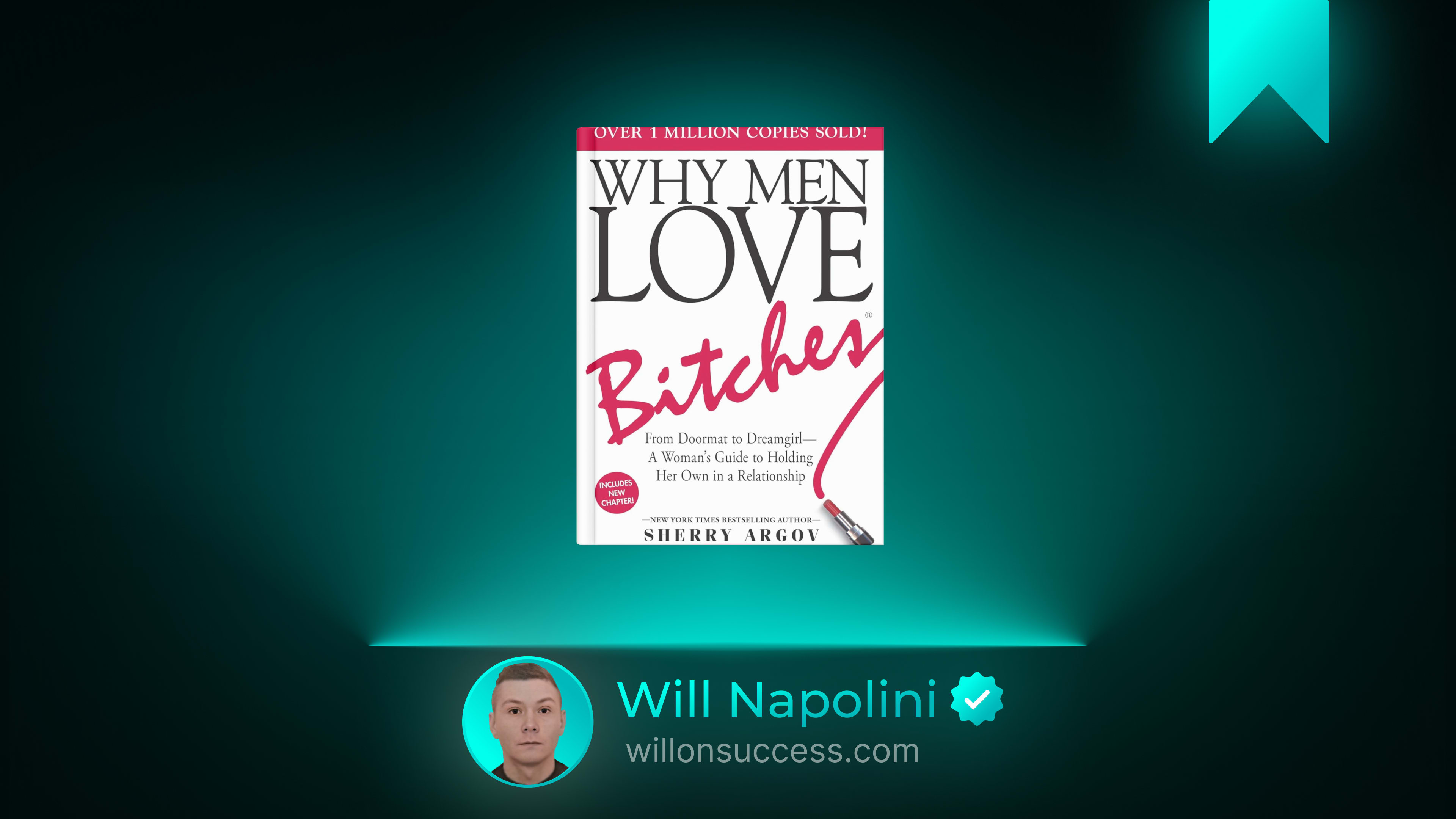
Why Men Love Bitches: From Doormat to Dreamgirl by Sherry Argov.
Before we go any further, let us clear the air. Argov is not advocating for cruelty. She is not telling you to be cold, abrasive, or manipulative. In her framework, the word in the title simply describes a woman who holds her own. A woman who refuses to be a doormat. A woman who does not abandon herself to keep someone else.
The book is not actually about how to trap a man. It is about how to stop abandoning yourself. And when you stop abandoning yourself, a remarkable shift happens in how the world—and the people in it—responds to you.

The Big Idea: Love Is Not a Reward for Self-Erasure
Here is the principle at the center of the book, and I want you to sit with it before we unpack the mechanics:
You cannot negotiate genuine desire through endless accommodation. Attraction and lasting respect are not born from how much you sacrifice, but from how firmly you maintain your own center.
We are often taught, implicitly or explicitly, that being “nice” is the pathway to being loved. We are taught that if we give enough, accommodate enough, and make ourselves easy enough to love, the other person will eventually realize our value and commit.
Argov’s central insight is that this strategy almost always backfires. When you make someone else the absolute center of your universe, you do not become more lovable. You become a satellite. You orbit their moods, their schedule, and their preferences. And while people enjoy having satellites, they do not build deep, enduring partnerships with them. They build partnerships with other centers of gravity.
The goal is not to become hard. The goal is to become solid.
The “Nice Girl” Trap and the Illusion of Control
To understand why holding your own is so powerful, we have to look honestly at the alternative. Argov calls it the “doormat” or the “nice girl” syndrome.
The nice girl believes that love is fragile, and that it is her job to hold it together through sheer effort. If he is pulling away, she leans in closer. If he is busy, she clears her schedule. If he crosses a boundary, she writes him a long, emotional text explaining how his actions made her feel, hoping he will finally understand and change.
I want to speak directly to the part of you that does this. You are not foolish for loving deeply. You are not broken for wanting connection. You are simply using a map that leads to a dead end.
The nice girl’s over-functioning is actually a subtle form of control. By doing everything, giving everything, and anticipating every need, she is trying to manage the outcome. She is trying to guarantee that he will not leave. But in doing so, she strips the relationship of its natural tension, its natural rhythm, and its natural growth. She leaves no space for the other person to step up, to pursue, or to miss her.
When you do all the work in a relationship, you are not building a partnership. You are building a dependency. And dependency, over time, breeds resentment on your side and suffocation on theirs.
The Architecture of Holding Your Own
Argov breaks down the behaviors of a woman who holds her own into a series of practical shifts. These are not mind games. They are the natural byproducts of a woman who respects her own time and energy. Let us look at the most vital ones.
Your Life Is Not a Waiting Room
One of the most common mistakes I see in early dating—and even in long-term relationships—is the suspension of one’s own life. He calls on a Tuesday afternoon and asks to see you that evening. You had planned to go to the gym, call your sister, and read a book. But you cancel all of it, because he is available now.
The woman who holds her own does not do this. She says, “I would love to see you, but I am busy tonight. Let us do Thursday.”
Notice what she does not do. She does not offer a three-paragraph apology. She does not invent a fake emergency. She simply has a life, and she honors her prior commitments to herself.
This communicates something profound without you having to say a word. It communicates that your time has value. It communicates that you are a complete person outside of this relationship. And paradoxically, it makes the time you do spend together much more valuable, because it is time you are choosing to give, not time you are surrendering by default.
Action Speaks; Nagging Echoes
How do you handle it when someone disappoints you? When they cancel last minute, or say something thoughtless, or fail to meet a standard you have set?
The instinct is to explain. To talk it out. To send the long message detailing why their behavior was unacceptable and how it made you feel. We do this because we want to be understood. We believe that if they just understood our pain, they would change.
Argov points out a hard truth: over-explaining a boundary actually weakens it. When you give a long speech about why a behavior is not okay, you are not enforcing a boundary; you are negotiating one. You are handing them the power to debate your feelings.
The woman who holds her own uses action, not words. If he cancels last minute without a valid reason, she does not send an angry essay. She simply becomes less available. She steps back. She invests her energy elsewhere. She lets the natural consequence of his action be the loss of her immediate presence.
You do not need to teach people how to treat you through lectures. You teach them through the quiet, consistent enforcement of what you will and will not accept.
Let the Space Between You Do Its Work
There is a deep anxiety that drives us to fill every silence. If he hasn’t texted in four hours, we send a meme. If the conversation lulls on a date, we rush to fill it with chatter. We are terrified of the space between us.
But attraction requires space. A fire needs air to burn. If you smother a fire with constant attention, constant availability, and constant reassurance, it goes out.
Holding your own means becoming comfortable with the pause. It means letting him wonder what you are doing. It means allowing him the dignity of pursuing you, of figuring out how he feels, of stepping across the space to reach you. When you lean back, you give the other person the room they need to lean forward.
Why This Matters on an Ordinary Tuesday
Let us bring this down from the realm of dating strategy into the reality of your daily life.
Why should you care about this? Because the cost of being the “nice girl” is not just a bad relationship. The cost is your own identity.
When you spend years molding yourself to fit the contours of whoever you are dating, you eventually wake up and realize you do not know who you are anymore. You do not know what music you like when no one is in the car. You do not know what you want to do on a Sunday morning. You have outsourced your preferences to keep the peace.
Applying Argov’s principles is not about manipulating a partner into proposing. It is about reclaiming your own architecture.
When you stop over-giving, you suddenly have energy again. You have the energy to pursue your career, to deepen your friendships, to cultivate your hobbies. And as you build a life that is rich and fulfilling on its own, you stop looking at a partner as the sole source of your happiness. You stop looking at them to rescue you from your own boredom or insecurity.
That shift is palpable. People can feel it when they walk into a room with you. You are no longer scanning their face to see if you are doing it right. You are simply present, grounded, and entirely yourself. That is the “dreamgirl” Argov writes about. Not a woman who is perfect, but a woman who is whole.
What This Book Is, and What It Is Not
I want to be honest with you about the limits of this book, because taking it as absolute gospel can sometimes cause more harm than good.
Why Men Love Bitches is highly tactical. It is excellent for behavioral shifts. If you are a chronic people-pleaser, if you text too much, if you abandon your friends the moment a new romance starts, this book will be a splash of cold, necessary water. It will give you the permission you have been waiting for to say “no.”
However, it is not a deep psychological exploration of attachment trauma. If your over-giving stems from a deep, unhealed wound of abandonment—if you literally feel like you will die if someone pulls away—then simply “acting” like you do not care will feel like wearing a straitjacket. The tactics will make you anxious. In those cases, the behavioral shifts in this book need to be paired with deeper therapeutic work to heal the root of the anxiety.
Furthermore, the book is heavily focused on heterosexual dating dynamics and uses language that some may find dated or overly focused on “keeping a man.” If you can look past the specific gendered framing and extract the universal principles of self-respect, boundary-setting, and maintaining independence, the core wisdom holds up beautifully across any relationship dynamic.
It is also important to note that holding your own is different from building a wall. If you use these principles to avoid vulnerability, to keep people at a safe distance so you never get hurt, you are not being empowered. You are being defensive. True strength is having solid boundaries and a soft heart. It is the ability to say, “I love you deeply, and I will still not tolerate disrespect.”
A Question Worth Sitting With
If you are willing to look honestly at your current relationship, or your patterns in past ones, I would offer you this question:
Where in my life am I currently over-functioning to compensate for someone else’s under-functioning?
Are you doing all the planning? Are you initiating all the deep conversations? Are you managing the emotional temperature of the relationship so that they never have to feel uncomfortable?
Notice where you are carrying the weight. And then, gently, ask yourself what would happen if you simply set the weight down. Not in anger. Not as a punishment. Just setting it down to see if the other person picks it up.
You might be surprised by what they are capable of carrying when you finally give them the space to do it.
One Small Step for Today
Here is what I want you to do before this day ends. It is small, it is specific, and it will immediately begin to shift your internal posture.
Look at your calendar for the next seven days. Find one commitment you have made to yourself—a workout, a reading hour, a coffee with a friend, or simply an evening to rest—and decide, right now, that it is non-negotiable.
If a romantic interest, or even a long-term partner, asks for your time during that exact window, you are going to practice the art of the warm refusal.
You will say: “I would love to, but I have a prior commitment then. Let’s look at another time.”
You will not explain what the commitment is. (Reading a book on the couch is a valid commitment to yourself). You will not apologize profusely. You will simply hold the boundary of your own time.
When you do this, you might feel a spike of anxiety. Your mind will tell you that they will be annoyed, that they will lose interest, that you are being “difficult.” Let the anxiety be there. Do it anyway.
You are teaching yourself that your life exists outside of their desires. You are teaching them that your time is a privilege, not a given. And you are stepping out of the waiting room and back into the center of your own life.
Love is not a reward for making yourself small enough to be easily kept. It is the beautiful, chaotic, profound collision of two people who are already entirely whole.
Hold your ground. Keep your heart open. And watch how the right people rise to meet you there.