Stop Being Nice, Start Being Real: How to Reclaim Your Life Without Losing Your Heart
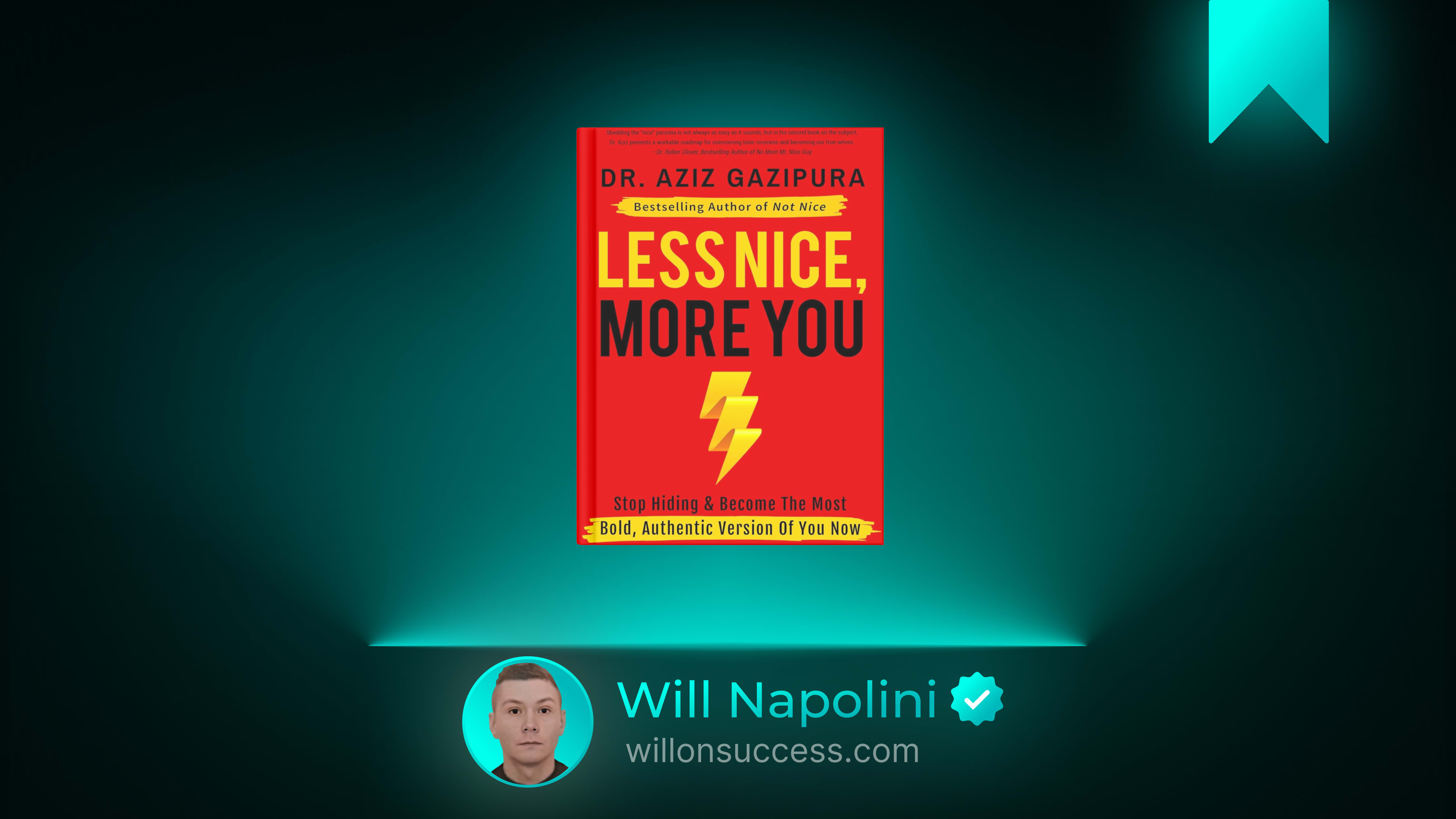
I used to believe that being good meant being agreeable.
For years, I mistook silence for peace, compliance for kindness, and exhaustion for virtue. I thought that if I just accommodated everyone else’s needs perfectly enough, I would eventually earn the right to have my own. I was wrong. What I earned instead was resentment, invisibility, and a slow erosion of the very self I was trying to protect.
You may know this ache. The feeling of saying “yes” while your body screams “no.” The rehearsed smiles that hide genuine discomfort. The relationships that feel stable on the surface but hollow underneath. The nagging sense that you are performing a version of yourself rather than living one.
Aziz Gazipura wrote Less Nice, More You for anyone who has confused niceness with goodness. His central message is both liberating and terrifying: Being nice is often a defense mechanism disguised as virtue, and reclaiming your authentic self requires unlearning behaviors you were praised for developing.
This is not a call to become harsh, selfish, or indifferent. It is an invitation to become real. And reality, Gazipura argues, is the only foundation upon which genuine connection, sustainable success, and inner peace can be built.

The Big Idea: Niceness Is a Strategy, Not a Virtue
Gazipura distinguishes between two fundamentally different orientations: niceness and authenticity.
Niceness is fear-based. It prioritizes others’ comfort over your truth. It avoids conflict at the cost of integrity. It seeks approval rather than connection. It is a performance designed to keep you safe from rejection, criticism, or abandonment.
Authenticity is love-based. It honors both your needs and others’. It speaks truth with compassion. It accepts that disagreement is inevitable in honest relationships. It seeks mutual respect rather than universal approval. It is a practice rooted in self-trust.
The critical insight is this: You were taught to be nice because it worked. As children, many of us learned that compliance brought safety, praise, or affection. Authenticity brought punishment, withdrawal, or chaos. Niceness became a brilliant survival strategy. The problem is that strategies designed for childhood environments become prisons in adult life.
What protected you then is suffocating you now.
I have sat across from accomplished professionals, devoted parents, and generous friends who are utterly depleted—not because they give too much, but because they give from a place of obligation rather than choice. Their generosity lacks joy because it lacks freedom. They are nice, but they are not present.
Gazipura does not shame this pattern. He honors its origins. Then he gently insists that healing requires updating your operating system. Safety no longer comes from accommodation. It comes from self-trust.
The Cost of Chronic Niceness
Before exploring what authenticity looks like, we must honestly name what niceness costs. Gazipura identifies several hidden prices:
Resentment Accumulates in Silence
Every unspoken “no” becomes a stored debt. Every suppressed preference becomes a quiet grievance. Over time, these accumulate into bitterness that leaks out passively—through sarcasm, withdrawal, passive aggression, or sudden explosions that confuse everyone, including you.
Unexpressed boundaries do not disappear. They metastasize.
Relationships Lack Depth
When you present a curated version of yourself, others connect with the performance, not the person. You may be liked, but you are not known. Intimacy requires vulnerability, and vulnerability requires risk. Niceness eliminates risk—and with it, the possibility of being truly seen.
Decision-Making Becomes Paralyzing
When your primary compass is external approval, every choice becomes a calculation of others’ potential reactions. Simple decisions exhaust you because you’re running simulations of everyone’s feelings instead of consulting your own values.
Self-Trust Erodes
Each time you override your instincts to maintain harmony, you send a message to yourself: Your perceptions are unreliable. Your needs are secondary. Your voice doesn’t matter. Over decades, this creates a profound disconnection from your own inner wisdom.
Health Suffers
Chronic suppression activates stress responses. Headaches, digestive issues, fatigue, anxiety—these are often the body’s way of speaking when the voice has been silenced. Your physiology keeps score even when your personality refuses to.
I want to be clear: Recognizing these costs is not self-flagellation. It is diagnosis. You cannot heal what you refuse to name. And naming these patterns is itself an act of emerging authenticity.
Boundaries Are Acts of Love, Not Rejection
Perhaps the most transformative reframe in Less Nice, More You is this: Boundaries are not walls against others. They are containers for genuine relationship.
Nice people often view boundaries as selfish. Authentic people understand that boundaries make generosity sustainable. When you give from overflow rather than depletion, your giving carries warmth instead of obligation. When you say “no” clearly, your “yes” becomes trustworthy.
Gazipura teaches that boundary-setting is a skill, not a character flaw. Like any skill, it requires practice, tolerates imperfection, and improves with feedback.
The Anatomy of a Healthy Boundary
A genuine boundary includes three elements:
- Clarity about your limit. Not vague hints or hopeful silences. Direct, kind communication about what you can and cannot offer.
- Ownership without blame. “I need to leave by seven” rather than “You always make me stay too late.” Your limit is about your capacity, not their failure.
- Tolerance for others’ reactions. People accustomed to your niceness may resist your authenticity. Their disappointment is not evidence that you’re wrong. It’s evidence that the dynamic is shifting.
I have watched people transform relationships by implementing this framework. A mother who stopped pretending to enjoy family gatherings she found draining discovered that her honest presence—even when limited—was more valued than her exhausted performance. A professional who began declining misaligned projects found that his focused contributions carried more weight than his scattered compliance.
Your limits do not diminish your value. They define your shape.
Without shape, you are merely available. With shape, you become someone others can actually relate to.
Emotional Honesty as Relational Infrastructure
Niceness treats difficult emotions as problems to be managed or hidden. Authenticity treats them as information to be honored and communicated.
Gazipura emphasizes that emotional honesty is not emotional dumping. It is the disciplined practice of naming your experience without demanding that others fix it, absorb it, or agree with it.
This distinction matters enormously.
“I’m feeling overwhelmed and need to renegotiate our timeline” is emotional honesty. “You’re killing me with these deadlines!” is emotional reactivity. Both express distress. Only the first invites collaboration.
Why This Feels Terrifying
If you grew up in an environment where emotions were punished, dismissed, or weaponized, expressing them feels dangerous. Your nervous system associates vulnerability with threat. This is not weakness. It is adaptive learning.
Healing involves creating new associations. Small risks, safely taken, rebuild trust in your own emotional expression. Start with low-stakes situations. Name a preference to a trusted friend. Express mild discomfort before it becomes major resentment. Notice when the world does not end.
Courage is not the absence of fear. Courage is the accumulation of evidence that you can survive being real.
Over time, emotional honesty becomes less like cliff-diving and more like breathing—natural, necessary, and sustaining.
The Myth of the Perfect Transition
One of Gazipura’s most compassionate contributions is his acknowledgment that becoming authentic is messy. You will overcorrect. You will swing from silent compliance to blunt reactivity before finding balanced expression. You will lose some relationships. You will grieve the loss of approval. You will doubt whether authenticity is worth the cost.
This is not failure. This is recalibration.
I have mentored people through this transition, and I can tell you: the middle phase is uncomfortable for everyone involved. Old patterns resist change. New patterns feel clumsy. People who benefited from your niceness may accuse you of selfishness. Your own guilt may flare intensely.
Stay steady.
Growth is not linear. Integration takes time. Trust the process even when the progress feels invisible.
What helps during this phase:
- Self-compassion over self-criticism. Berating yourself for imperfect authenticity recreates the same punitive dynamic you’re trying to escape. Speak to yourself as you would to a beloved friend navigating the same terrain.
- Community over isolation. Find others practicing similar growth. Shared vulnerability normalizes the struggle and provides mirrors for blind spots.
- Patience with others’ adjustment periods. People need time to recalibrate to your new frequency. Some will adapt. Some won’t. Both outcomes contain gifts.
- Celebration of small wins. Did you express a preference? Honor it. Did you tolerate someone’s disappointment without collapsing? Acknowledge it. Progress deserves recognition.
Practical Application: From Insight to Embodiment
Understanding these concepts intellectually changes nothing. Lived practice changes everything. Here is how to begin:
Conduct a Niceness Audit
For one week, notice moments when you prioritize others’ comfort over your truth. Don’t judge. Just observe. Journal briefly: What triggered the nice response? What did you suppress? What did you fear would happen if you were authentic? Patterns will emerge. Awareness precedes choice.
Practice Micro-Honesties Daily
Choose one small, low-risk moment each day to express something true. A food preference. A scheduling constraint. A feeling about a minor situation. Keep it simple, kind, and direct. Build the muscle gradually. Consistency matters more than intensity.
Create a Boundary Script Library
Prepare phrases for common situations before you’re in them. “I appreciate the invitation, and I won’t be able to attend.” “I’d like to finish my thought before responding.” “I need some time to consider this; I’ll get back to you by Friday.” Having language ready reduces the cognitive load of real-time authenticity.
Schedule Regular Self-Check-ins
Set a recurring calendar reminder to ask: “What do I actually want right now?” “Where am I overriding my instincts?” “What needs expression?” Make self-inquiry as routine as checking email. Your inner voice strengthens with attention.
Grieve What Authenticity Costs
Acknowledge losses honestly. Some relationships will change. Some approvals will vanish. Some identities will dissolve. Allow sadness without interpreting it as evidence that you’re on the wrong path. Transformation requires mourning. Honor what served you while releasing what constrains you.
Who Should Read This Book
Less Nice, More You will resonate deeply if:
- You frequently feel resentful, exhausted, or invisible despite appearing successful or well-adjusted
- You struggle to identify or express your own needs and preferences
- You fear conflict so intensely that you avoid necessary conversations
- You suspect your “kindness” is partly a trauma response
- You want to build relationships based on mutual authenticity rather than performed harmony
It may be less helpful if:
- You are currently in an abusive situation where authenticity could endanger you (prioritize safety; seek specialized support)
- You expect quick fixes or formulaic scripts for complex relational dynamics
- You are unwilling to examine your own role in dysfunctional patterns
- You prefer theoretical frameworks over experiential, embodied practices
Gazipura writes with rare combination of clinical precision and human tenderness. He understands that unlearning niceness is not merely behavioral adjustment—it is identity reconstruction. The book meets you exactly where you are, without judgment or false promises.
One Small Step Today
Before today ends, identify one thing you’ve been withholding to keep peace.
Then express it to one safe person in one sentence.
Not perfectly. Not comprehensively. Just honestly.
“I felt hurt when…”
“I actually prefer…”
“I need…”
“I disagree because…”
Say it. Breathe through the discomfort. Notice what happens—or doesn’t.
This single act is a vote for your own existence. It tells your nervous system that your truth can survive daylight. It begins rewiring decades of conditioned silence.
You were never meant to shrink so others could feel comfortable. You were meant to expand so others could meet you in truth.
Your authenticity is not a threat to love. It is the only ground where real love can stand.
Begin there. The rest follows.