The Courage to Be Disliked: Breaking Free from the Trap of Being 'Not Nice'
Have you ever caught yourself nodding in agreement, smiling politely, and saying “yes” to a request, while a quiet voice inside you was screaming “no”?
You say you will help a colleague with a project you have no time for. You agree to attend a social event you are dreading. You swallow your true opinion to keep the peace at the dinner table. You monitor the mood of the room, adjusting your behavior to ensure no one is displeased with you.
If I could sit across the table from you right now, I would tell you something that might surprise you: You are not doing this because you are a good person. You are doing this because you are afraid.
And that fear is quietly erasing the person you were meant to be.
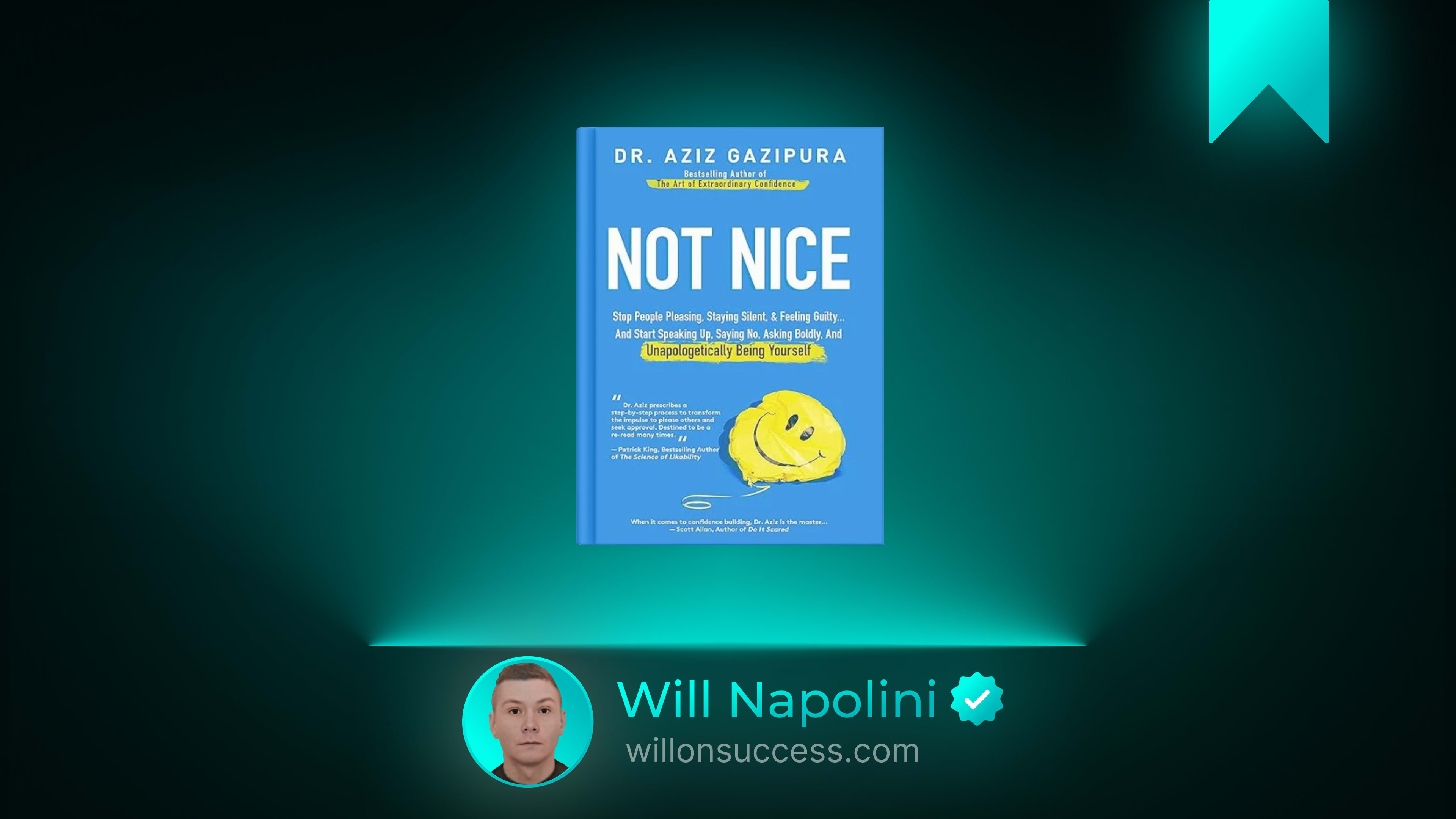
In his groundbreaking book Not Nice: Stop People Pleasing, Staying Silent, & Feeling Guilty… And Start Speaking Up, Saying No, Asking Boldly, And Unapologetically Being Yourself, clinical psychologist Dr. Aziz Gazipura dismantles one of our most cherished cultural assumptions. We are taught from a young age that being “nice” is the highest social virtue. But Gazipura reveals a profound and uncomfortable truth: chronic niceness is not a moral achievement. It is a fear-based survival mechanism.
The central idea of this book is that the opposite of being “nice” is not being cruel, aggressive, or selfish. The opposite of being nice is being authentic. When you stop performing niceness to manage other people’s emotions, you finally create the space to discover who you actually are.
The Origin of the Mask
To understand why this matters, we have to look at where the “nice” mask comes from.
When you were a child, you were entirely dependent on the adults around you. You quickly learned that certain behaviors—agreeing, complying, staying quiet, not causing a fuss—resulted in love, praise, and safety. Other behaviors—asserting your needs, expressing anger, disagreeing—risked withdrawal of love, disapproval, or conflict.
Your brain, brilliant and adaptive, created a strategy: I will be nice. If I am nice, I will be safe.
This strategy worked beautifully when you were seven. But you are not seven anymore.
Gazipura points out that many of us are still walking through our adult lives wearing an emotional survival suit designed for a child. We outsource our self-worth to the opinions of others. We operate under the silent, exhausting assumption that everyone else’s comfort is more important than our own truth.
This constant state of hyper-vigilance takes a profound toll. It is not just an emotional burden; it becomes a physical one. The tension of holding back your true thoughts, the tightness in your chest when you anticipate a disagreement, the chronic fatigue of performing a version of yourself that isn’t real—this is the hidden tax of niceness. You may succeed in keeping everyone else comfortable, but the price you pay is your own identity. You slowly disappear into the background of your own life, becoming a supporting character in everyone else’s story.
Niceness Is a Performance, Kindness Is a Choice
There is a vast difference between being kind and being nice. This distinction changes everything.
Kindness flows from a place of internal abundance. You help someone because you genuinely want to, and you have the energy to give. It is a free gift.
Niceness, on the other hand, is a transaction driven by anxiety. You help someone because you are terrified of what they will think of you if you don’t. You are managing their perception of you. It is a subtle form of control, disguised as generosity.
When you realize that your “niceness” is actually a shield to protect yourself from rejection, you stop judging yourself for being a people-pleaser. You recognize it for what it is: an outdated defense mechanism. And once you see the shield for what it is, you can finally choose to put it down. You can stop asking, “What do they want me to do?” and start asking, “What is true for me right now?”
Clean Boundaries Require No Courtroom Speeches
One of the most paralyzing aspects of breaking free from people-pleasing is the fear of setting boundaries. When a chronic people-pleaser finally tries to say “no,” they often deliver what Gazipura calls a “courtroom speech.”
Imagine you are invited to a dinner party you have absolutely no energy to attend. A “nice” person doesn’t just say no. They say: “Oh my gosh, I am so incredibly sorry, I would love to come, but my car is making a weird noise, and my cousin is visiting, and I have this massive headache, and I feel just terrible about it, please forgive me.”
They offer a ten-minute explanation, complete with apologies, excuses, and elaborate justifications, hoping the other person will act as a judge and declare their “no” legally valid. They are begging for permission to have a boundary.
But true boundaries do not require a defense attorney. A clean boundary is simple, direct, and respectful. “Thank you so much for thinking of me, but I won’t be able to make it.”
When you stop over-explaining, you signal to yourself and the world that your needs do not require a committee’s approval to be valid. You take responsibility for your own limits without demanding that others manage your guilt.
Confidence Is a Receipt, Not a Prerequisite
Perhaps the most liberating concept in the book is how Gazipura reframes confidence. Most of us wait until we feel confident before we speak up, ask for the raise, or set the boundary. We treat confidence as a prerequisite for action. We tell ourselves, “Once I feel ready, I will do it.”
But confidence does not work that way. Confidence is a receipt. It is the emotional proof you get after you take action despite your fear.
You will never feel entirely ready to have the difficult conversation. You will never feel completely comfortable disappointing someone who relies on you. The goal is not to eliminate the fear; the goal is to take the action while the fear is sitting right there in the passenger seat.
Every time you do something “not nice”—every time you speak your truth instead of swallowing it, every time you honor your exhaustion instead of pushing through to please a boss—you print a new receipt of confidence. Action precedes belief. You do not think your way into a new way of acting; you act your way into a new way of thinking.
The Quiet Power of Taking Up Space
Why should you care about shifting from nice to authentic? Because the trajectory of chronic niceness leads to a life of quiet desperation.
Imagine what changes in your daily life when you stop outsourcing your worth.
At work, you stop volunteering for the extra committee that drains your weekends just to look like a “team player.” Instead, you protect your time and deliver exceptional work on the projects that actually matter, earning genuine respect rather than superficial appreciation.
In your relationships, you stop smiling through your resentment. You start communicating your actual needs and desires. This might feel terrifying at first, but it is the only path to genuine intimacy. People cannot truly love you if they are only interacting with the mask you wear to keep them happy. When you show up as your real, messy, opinionated self, you give the people around you permission to do the same.
In your own mind, the constant, exhausting chatter of the inner critic begins to quiet down. The inner critic thrives on the gap between who you are and who you are pretending to be. When you align your actions with your truth, the internal war ends.
You trade the fragile, conditional safety of approval for the unshakeable ground of self-respect.
How to Reclaim Your Voice Today
Understanding these concepts is valuable, but understanding without action changes nothing. If you want to begin dismantling the trap of niceness, you must start small. You must build the muscle of authenticity in low-stakes environments before you can use it in high-stakes ones.
Practice the Sacred Pause The next time someone asks you for a favor, an invitation, or a commitment, do not answer immediately. Your default setting will be to say “yes” to avoid awkwardness. Instead, say: “Let me check my schedule and get back to you.” This buys you the time to step out of your fear response and ask yourself what you actually want to do, rather than what you feel obligated to do.
Drop the Excuses The next time you have to decline an invitation, practice giving a “clean no.” Say, “I appreciate the offer, but I’m going to pass this time.” Notice the intense, almost physical urge to add a justification. Resist it. Let the “no” stand on its own two feet. Watch how the world does not end when you fail to provide an alibi for your own life.
Tolerate the Guilt Hangover When you first start setting boundaries, you will feel guilty. This is crucial to understand: the guilt does not mean you did something wrong. The guilt is simply the feeling of an old neural pathway being disrupted. It is an emotional hangover from breaking a lifelong habit of self-abandonment. Expect it, allow it to wash over you, and do not let it dictate your behavior. The guilt will fade; the self-respect will remain.
Who Needs to Read This Book
Not Nice is essential reading for the chronic over-giver, the conflict-avoider, and the person who feels a deep, unnamable resentment bubbling beneath their pleasant exterior. If you frequently feel exhausted by the effort of managing other people’s emotions, this book will hand you the tools to reclaim your energy. It is for anyone who has ever looked in the mirror and realized they have no idea what they actually want, because they have spent a lifetime figuring out what everyone else wants.
However, if you are someone who already struggles with being overly aggressive, blunt to the point of cruelty, or entirely unconcerned with the feelings of others, this book is not for you. Gazipura is not teaching people to be jerks; he is teaching anxious people to be brave. He is not advocating for selfishness; he is advocating for self-honesty.
Your First Step Toward Being Real
You do not need to overhaul your entire personality by tomorrow morning. Change happens in the quiet, seemingly insignificant moments where you choose truth over comfort.
So here is what I want you to do today.
Identify one incredibly small situation where you would normally defer to someone else out of sheer habit. Maybe it is choosing the restaurant for lunch when you actually have a strong preference. Maybe it is telling a friend you prefer a different movie. Maybe it is simply saying, “I actually see it differently,” in a low-stakes conversation.
Do it. Feel the slight spike of anxiety in your chest. Do it anyway.
You do not owe the world a performance. You only owe yourself the truth. Take a breath, feel the fear, and speak anyway.