Choosing the Living World: What Norwegian Wood Teaches Us About Grief, Love, and Moving Forward
There is a particular kind of sadness that arrives not when you lose someone, but when you realize you are beginning to forget the sound of their voice.
You try to hold on. You replay old conversations. You visit the places you used to go together. You press your memory against the shape of them the way a tongue presses against a missing tooth, searching for something that is no longer there. And slowly, terribly, the details begin to soften. The edges blur. The voice grows faint.
And then you wonder: if I let go of the grief, am I letting go of them?
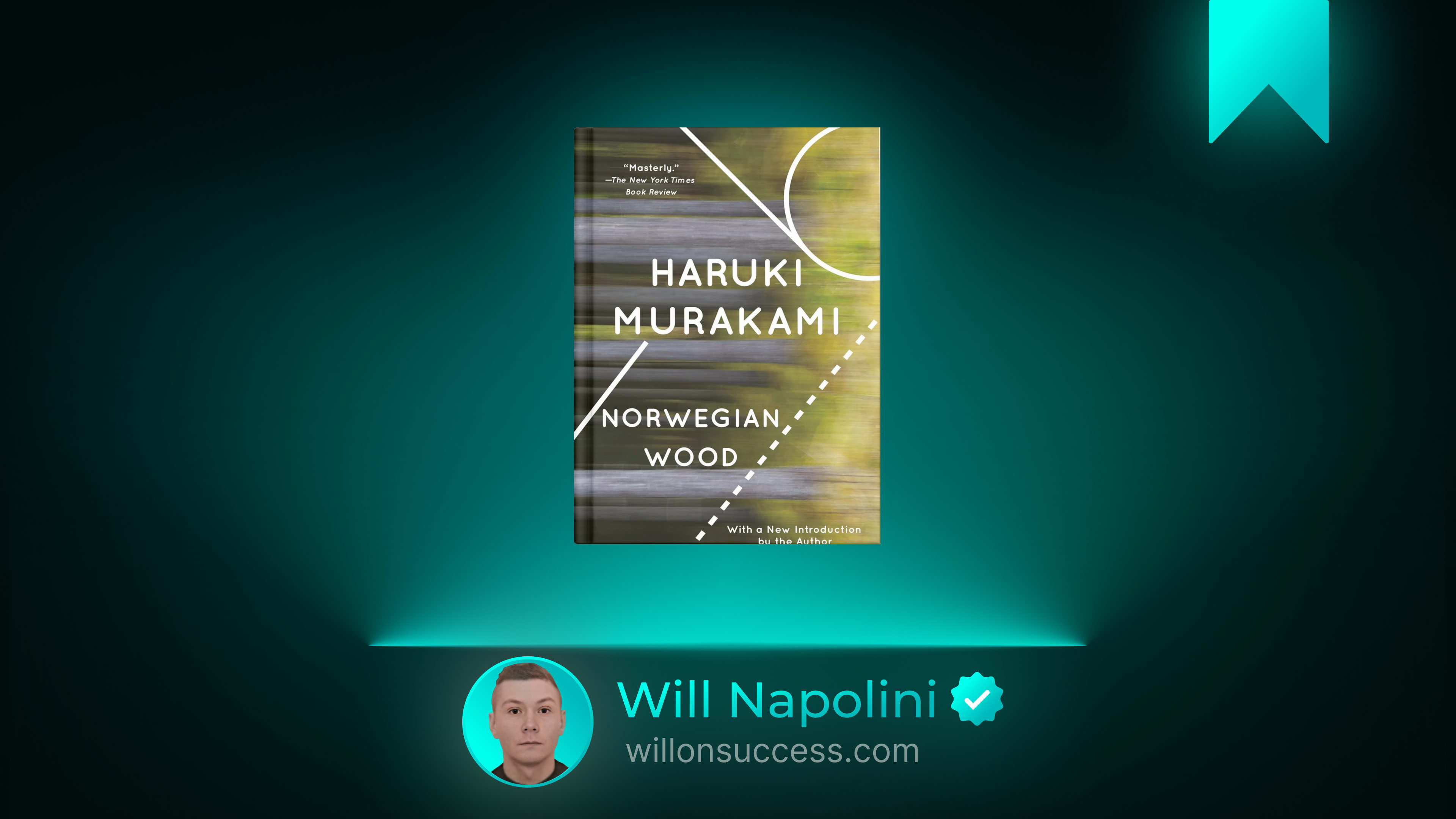
If you have ever asked yourself that question, I want to walk you through a novel that sits with it honestly, tenderly, and without flinching. The book is Norwegian Wood by Haruki Murakami, published in 1987. It is a love story, a grief story, and ultimately a story about the most difficult choice a person can face: whether to remain in the quiet, still world of the dead, or to turn back toward the messy, imperfect, painfully alive world of the living.
I have read this book more than once, and each time it has asked something different of me. The first time, I wept. The second time, I understood. I want to share what I understood, because I believe it may help you navigate whatever loss you are carrying right now.
The Big Idea
At its heart, Norwegian Wood is about a young man named Toru Watanabe who is caught between two gravitational fields. One pulls him toward the past, toward grief, toward the people he has lost. The other pulls him toward the present, toward vitality, toward the people who are still here.
The novel does not pretend this is a simple choice. It does not tell you that grief is a stage you pass through neatly, like a season changing. It shows you that grief is more like a forest. You can wander inside it for years. You can learn every tree, every shadow, every silence. You can make a home there. But eventually, if you want to live, you have to find the path that leads out.
And here is the hardest part: walking out does not mean you stop loving the ones you left behind.
The Story: A Song, a Death, and Two Women
The novel opens with Toru, years later, hearing an orchestral version of the Beatles song “Norwegian Wood” on an airplane. The melody unlocks a flood of memory, and he is pulled back to his college days in late-1960s Tokyo.
When Toru was seventeen, his closest friend, Kizuki, died by suicide. No note. No warning. Just an absence where a person used to be. Kizuki had been the center of Toru’s small world, and his girlfriend, Naoko, had been part of that world too. After Kizuki’s death, Toru and Naoko are drawn together by the gravity of their shared loss. They walk for hours through the streets of Tokyo, saying very little, trying to make sense of a silence that has swallowed the person they both loved.
But Naoko is fragile. The grief has opened something inside her that cannot easily close. She eventually withdraws to a sanatorium in the mountains, a quiet, secluded place removed from the noise and demands of ordinary life. Toru visits her there. He loves her. He wants to save her. He believes that if he is patient enough, faithful enough, present enough, he can pull her back.
Meanwhile, back in Tokyo, Toru meets Midori. Midori is everything Naoko is not. Where Naoko is stillness, Midori is motion. Where Naoko lives in the past, Midori is fiercely, unapologetically in the present. She is honest in a way that startles people. She laughs loudly. She gets angry. She cooks meals, watches fires burn, and asks Toru directly what he wants. She is alive in the most unguarded, unperformed sense of the word.
And so Toru stands at the crossroads. Naoko, and the world of the dead. Midori, and the world of the living. The stillness of memory, or the chaos of now.
I will not tell you how the story ends, because the ending is not the point. The point is the choice. And the choice is one that every person who has ever loved and lost must eventually make.
Grief Is Not a Door You Walk Through Once
One of the most honest things Murakami shows us in this novel is that grief is not linear. Toru does not grieve Kizuki and then move on. The loss seeps into everything. It colors his friendships, his studies, his relationships, his sense of who he is. Years pass, and the grief is still there, quieter perhaps, but woven into the fabric of his days.
I have seen this in my own life, and I have seen it in the lives of everyone I have mentored through loss. We are often told to “move on,” as if grief were a room you walk through and then close the door behind. But that is not how it works. Grief is not a room. It is weather. Some days the sky is clear and you can almost forget. Other days the clouds roll in without warning, and you are standing in the middle of a Tuesday afternoon, crying in a parking lot because a stranger laughed in a way that reminded you of someone who is gone.
Grief does not shrink. You grow around it, the way a tree grows around a fence post driven into its trunk. The post is still there. The tree has simply become large enough to hold it.
Murakami gives us permission to grieve slowly. He does not rush Toru. He does not punish him for still being tangled in Kizuki’s memory years later. And I think that matters. If you are carrying a loss right now, you do not owe anyone a timeline. You do not owe the world a neat recovery. You are allowed to grieve for as long as the grief needs to be grieved.
But—and this is the part the novel insists on gently, firmly—you are not meant to build your permanent home inside the grief. You are meant to carry it and keep walking.
You Cannot Love Someone Back to Life
This may be the hardest lesson in the book, and I want to handle it with the care it deserves.
Toru loves Naoko. He loves her with a patience and devotion that is genuinely beautiful. He writes her letters. He visits the sanatorium. He sits with her in silence. He tells himself that his love is the rope that will pull her back to the world.
And it is not enough.
I need you to hear me clearly when I say this, because I have watched so many good people destroy themselves trying to be the exception to this rule. You can love someone with every fiber of your being, and that love may not be enough to fix what is broken inside them. You cannot pour your devotion into a wound and expect it to become a scar. Some wounds need more than one person can give. Some wounds need help that goes beyond what love, however fierce and faithful, can provide.
Toru’s tragedy is not that he loved Naoko. His tragedy is that he believed his love was the missing ingredient, the one thing that would tip the balance. He made himself responsible for her survival. And in doing so, he postponed his own.
If you are caring for someone who is suffering—whether from grief, illness, addiction, or depression—you already know how exhausting and sacred that work is. And I want to honor that. But I also want to remind you of something you may have forgotten in the middle of all that giving: you are allowed to set the rope down. You are allowed to love someone and admit, at the same time, that you cannot save them. Those two truths can coexist. In fact, they must.
The dead do not ask us to join them. They ask us to live.
The Living World Is Messy, Imperfect, and Worth Choosing
Midori is one of the most vital characters I have ever encountered in literature. She is not perfect. She is not serene. She is sometimes crude, sometimes impatient, sometimes selfish. She talks about things that make people uncomfortable. She refuses to perform a version of herself that is easier for others to digest.
And that is precisely why she represents life.
Naoko’s world—the sanatorium in the mountains—is beautiful, quiet, and removed from the demands of the ordinary. It is a place where time slows down, where the noise of the city cannot reach you, where you can grieve without being asked to show up for anything. It is, in many ways, a place of peace.
But it is not a place where you can grow.
Midori’s world is Tokyo. It is noisy, crowded, complicated. It requires you to cook dinner, catch trains, argue with your landlord, get your heart broken, laugh at inappropriate moments, and show up the next morning and do it all again. It is not peaceful. It is not still. But it is alive.
And Toru must choose.
I think about this choice more often than you might expect. Not just in the context of grief, but in every area of life where we are tempted to withdraw into something safe, controlled, and small rather than step into something uncertain, vulnerable, and real.
You can stay in the job that is comfortable but has stopped teaching you anything. Or you can walk into the room where you might fail. You can keep rehearsing the conversation in your head for the tenth time. Or you can pick up the phone and say the thing you are afraid to say. You can stay inside the forest of your grief, where the silence is familiar and no one asks anything of you. Or you can walk back into the city, where the noise will hurt at first, but where someone might look at you and say, “I’m glad you’re here.”
Choosing life is not a grand declaration. It is the quiet decision to answer the phone, to eat breakfast, to walk outside when every part of you wants to stay in the dark. It is small, and it is repeated, and it is enough.
Memory Is Both a Wound and a Compass
The entire novel is narrated from the perspective of an older Toru looking back. He is not living these events in real time. He is remembering them. And the act of remembering is not neutral. Memory softens some things and sharpens others. It edits. It romanticizes. It mourns.
Murakami is showing us something important about how we relate to our own pasts. The past is not a fixed record. It is a living conversation between who we were and who we have become. When Toru remembers Naoko, he is not just remembering her. He is remembering the version of himself who loved her, who believed he could save her, who stood at the crossroads and did not yet know which way to walk.
I have learned that the stories we tell ourselves about our past shape the choices we make in our present. If you carry a memory as nothing but a wound, it will keep bleeding into every new relationship, every new beginning. But if you can learn to carry that same memory as a compass—as something that taught you what matters, what you are capable of, what you never want to take for granted—then the past becomes a guide rather than a cage.
You do not have to forget. You do not have to pretend the loss did not happen. You simply have to decide what the memory is for. Is it an anchor that holds you in place? Or is it a lantern that lights the next few steps forward?
Isolation Feels Safe but Slowly Erases You
The sanatorium in Norwegian Wood is a fascinating place. It is not a prison. The residents are free to leave. But many of them stay because the outside world feels too loud, too demanding, too full of expectations they are not ready to meet. Inside the sanatorium, life is gentle. Structured. Quiet. No one asks you to be anyone other than who you are in your most fragile state.
I understand the appeal. I have felt it myself in smaller ways. The desire to withdraw. To stop performing. To find a place where the world will simply let me be still for a while.
And sometimes that withdrawal is necessary. Rest is not weakness. Retreat is not failure. There are seasons when the sanatorium is exactly where you need to be.
But Murakami shows us the danger of staying too long. The longer you remain removed from the living world, the harder it becomes to return. The quiet that was healing at first slowly becomes a kind of erasure. You stop practicing the skills of connection. You stop testing yourself against the friction of real life. You become comfortable in your fragility, and comfort, paradoxically, becomes its own kind of trap.
One of the most quietly courageous characters in the novel is Reiko, Naoko’s roommate at the sanatorium. Reiko has been there for years. She has built a life within its walls. And eventually, she makes the terrifying decision to leave. To go back to the city. To play her guitar for strangers. To risk being seen, being judged, being imperfect in public.
Her choice is small in the context of the novel, but it is enormous in its meaning. She chooses the uncertain, vulnerable, messy world over the safe, still, familiar one. And in doing so, she chooses herself.
Why This Matters Beyond the Pages
You may not be navigating the specific griefs that Toru navigates. But I suspect you know what it feels like to be caught between two versions of your life. The version you had before something broke, and the version you are trying to build now. The person you were before the loss, the failure, the diagnosis, the ending—and the person you are becoming on the other side.
Murakami’s novel speaks to anyone who has ever wondered whether it is possible to honor what was lost while still walking forward. Whether loving someone who is gone means you must also stay gone, in some sense. Whether choosing happiness is a kind of betrayal.
It is not. It never was.
If you are in a relationship and you find yourself holding your partner at arm’s length because you are afraid of losing them the way you lost someone before, this book will show you the cost of that distance. If you are in your career and you are playing it safe because failure once broke something open in you, this book will gently ask whether safety is actually serving you or slowly erasing you. If you are in a season of grief and you feel guilty for laughing, for enjoying a meal, for noticing the way the light looks in the late afternoon—this book will tell you that you are allowed to notice. You are allowed to enjoy. You are allowed to be alive.
Practical Application: Honoring the Past Without Living in It
Understanding these themes is one thing. Living them is another. Here are a few ways to begin.
Write the Letter You Will Never Send
If there is someone you have lost—whether to death, to distance, to the slow erosion of time—write them a letter. Tell them what you have been carrying. Tell them what you wish you had said. Tell them what you are afraid of forgetting. You do not need to send it. The act of writing it is the point. It moves the grief from a silent, shapeless weight inside your chest into words that can be held, read, and eventually set down.
Name One Small Way You Are Choosing Stillness Over Life
Be honest with yourself. Is there an area of your life where you have withdrawn into the sanatorium? A friendship you have let go quiet because reaching out feels too risky? A creative project you abandoned because the first attempt was painful? A conversation you keep postponing because you are afraid of what it might open? Name it. You do not have to fix it today. Just name it. Awareness is the first step back toward the living world.
Let Yourself Be Midori for One Afternoon
Midori’s gift is her willingness to be fully, unapologetically present. She does not perform. She does not curate. She simply shows up, hungry and honest and a little bit loud. Try it. Spend one afternoon this week doing something that makes you feel vividly, uncomfortably alive. Cook a meal from scratch. Walk somewhere you have never been. Call a friend and talk about nothing important for twenty minutes. Say the thing you actually think instead of the thing you think people want to hear. Let yourself be messy. Let yourself be in the middle of life rather than observing it from a safe distance.
Give Yourself Permission to Grieve and Live Simultaneously
This is perhaps the most important practice. You do not have to finish grieving before you start living. The two are not sequential. They are concurrent. You can miss someone terribly and still laugh at a terrible joke. You can carry a wound and still plant a garden. You can honor the dead by being fully, stubbornly, imperfectly alive. Give yourself permission to do both at once.
Who Should Read This Book
Norwegian Wood will speak most powerfully to anyone who has experienced a significant loss and is trying to figure out how to keep going. If you are in your twenties or thirties and trying to make sense of how the idealism of youth collides with the complexity of adult love, this novel will feel like it was written specifically for you. If you have ever loved someone you could not save, or if you have ever felt guilty for wanting to move forward, Murakami’s quiet, aching prose will make you feel profoundly understood.
It is also a beautiful book for anyone who appreciates slow, atmospheric storytelling. Murakami writes with a patience that is rare. He lets scenes breathe. He lets silence sit on the page. The novel is unhurried, sensory, and deeply intimate.
That said, I want to be straightforward: this book is heavy. It deals openly with suicide, depression, grief, and sexuality. There are passages of genuine darkness, and the novel does not offer easy comfort or tidy resolution. If you are in a fragile place emotionally, or if you are looking for something uplifting and light, this may not be the right book for this season of your life. Give yourself grace, and come back to it when you are ready.
It is also worth noting that this is the most realistic of Murakami’s novels. If you come to it expecting the surreal, dreamlike quality of his other work, you may be surprised. Here, the magic is in the emotional honesty, not in talking cats or parallel worlds.
One Small Step
Today, I want you to do one thing that connects you to the living world in a way that feels slightly vulnerable.
Send the text you have been drafting in your head but not sending. Make the phone call. Step outside and walk somewhere without your headphones, just listening to the sounds of the world around you. Cook something with your hands. Knock on a neighbor’s door. Say “I miss you” to someone you miss.
It does not have to be large. It just has to be real. It just has to be a single step out of the quiet forest and back into the noisy, imperfect, beautiful city of the living.
The Final Word
Murakami titled this novel after a Beatles song about a fleeting encounter, a moment that was already gone before the singer could hold it. “This bird has flown,” the lyric says. The thing you thought you had is already in the air, already beyond your reach.
And yet the song remains. The memory remains. The feeling of having been in that room, in that moment, with that person—it remains. Not as a chain. As a melody. Something you can hum quietly while you walk somewhere new.
Toru Watanabe spends the entire novel trying to hold on to what has already flown. And slowly, painfully, beautifully, he learns that letting go is not the same as letting lose. You can release the bird and still carry the song.
The people we have loved and lost are not asking us to stay in the forest. They are not asking us to keep their chair empty forever. If they could speak to us now, I believe they would say the simplest, bravest thing anyone can say to someone