The Wild Heart of Growing Up: What Ronia the Robber's Daughter Teaches Us About Choosing Our Own Path
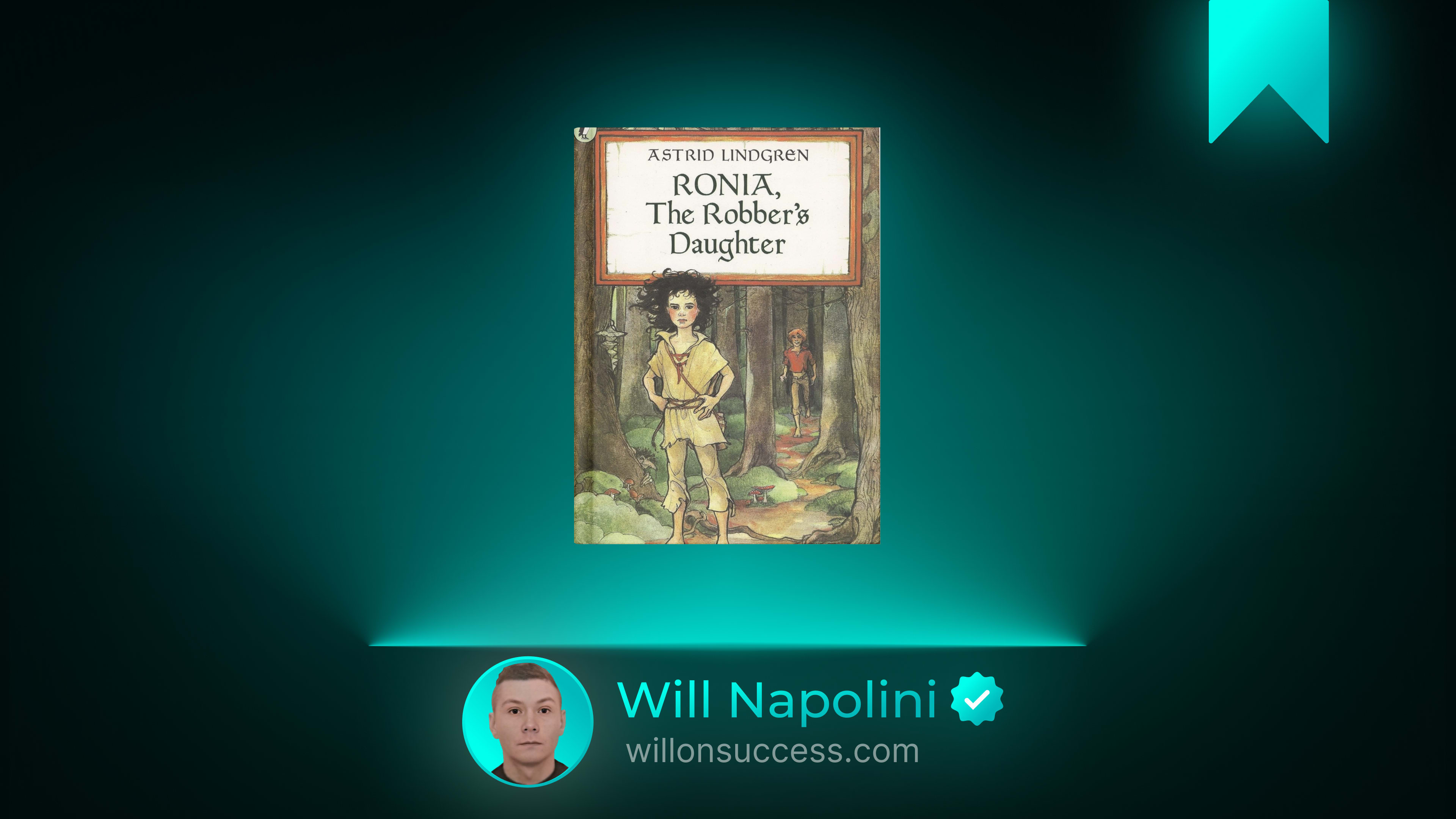
There is a moment in every life when the person you were raised to become and the person you are meant to become stand on opposite sides of a ravine, staring at each other. And you must choose which side to walk toward.
Most stories about growing up treat this moment as a single, dramatic decision. You leave home. You quit the job. You say the thing you have been swallowing for years. But Astrid Lindgren understood something deeper. In her luminous novel Ronia the Robber’s Daughter, she shows us that choosing your own path is not a single leap. It is a season. It is a long, cold winter of uncertainty followed by the slow, stubborn green of spring pushing through the frost.
This is a children’s book. But if I could sit across the table from you and press it into your hands, I would tell you: read it as an adult. Read it slowly. Because beneath the story of a wild girl and a rival robber’s son lives one of the truest maps of independence I have ever encountered.
The Night the World Split Open
The story begins with a storm.
On the night Ronia is born, lightning strikes the great Mattis Fortress and splits it cleanly in two. Her father, Mattis, is the chief of a rough, loud, fiercely loyal band of robbers. He is a man of enormous appetites and enormous feelings, and the moment he sees his daughter, he loves her with a ferocity that terrifies him.
The split in the fortress is not just a plot device. It is a metaphor that Lindgren plants in the very first pages and lets grow across the entire book. Something in the world has been divided. The old order has cracked. And through that crack, something new will eventually grow.
Ronia grows up wild. She runs barefoot through the deep forests surrounding the fortress. She swims in icy rivers, climbs cliffs, and talks to the strange, dangerous creatures of the woods. She is not raised to be delicate. She is raised to be free. And for the first part of her life, that freedom is uncomplicated. The forest is her kingdom, and her father’s love is the warm fire she returns to each evening.
Then she meets Birk.
Birk Borkason is the son of Borka, the chief of a rival robber clan who has secretly moved into the split-off half of the fortress. He is Ronia’s opposite and her mirror. Where she is fire, he is water. Where she is impulsive, he is steady. They meet at the edge of the great crack in the stone—the hell gap—and they look at each other across the divide that their fathers have drawn in blood and pride.
And they become friends.
Not because it is safe. Not because it is wise. But because something in them recognizes something in the other, and that recognition is stronger than the loyalty they owe to their tribes.
The Courage to Cross the Hell Gap
If I were to ask you what the most difficult part of growing up is, you might say leaving home. You might say making your own decisions. But I have learned that the most difficult part is something quieter and more painful than either of those.
The most difficult part is disappointing someone who loves you.
When Mattis discovers that Ronia has befriended the enemy, his rage is volcanic. He cannot comprehend it. To him, the Borka clan is not a group of people. They are a threat, an insult, an existential danger. And his daughter—his wild, beloved Ronia—has crossed the line he drew in the earth.
Lindgren does not make Mattis a villain. This is important. She makes him a father who loves so fiercely that he cannot imagine a world where his daughter’s love might extend beyond the walls he has built around her. His pain is real. His fear is real. And Ronia must look at that pain and choose to walk away from it anyway.
This is the moment that breaks my heart every time I read it. Not because Ronia is cruel. But because she is kind. She loves her father. She does not want to hurt him. And she must hurt him in order to become herself.
There is a line of wisdom buried deep in this story, one that I have carried for years: You cannot become who you are meant to be while remaining exactly who your family needs you to be. Sometimes those two things are the same. But sometimes they are not. And when they are not, you must choose. And the choosing will cost you something real.
The Winter in the Cave
After Ronia leaves the fortress, she and Birk find a cave in the forest. They decide to survive the winter together, alone, without the protection of their fathers’ clans.
This is the heart of the book. This is where Lindgren earns her place among the great storytellers of growing up.
The winter is brutal. The children nearly starve. They freeze. They argue. They fall ill. There are nights when Ronia lies in the dark and wonders if she has made a terrible mistake. There are mornings when Birk looks at her with exhaustion and doubt.
Lindgren does not romanticize their independence. She does not tell us that leaving the fortress is easy or that freedom is a warm, uncomplicated joy. She tells us that freedom is cold. That choosing your own path means facing the winter without a roof over your head. That the first season of independence is often the loneliest, hardest season of your life.
But she also tells us something else. She tells us that the children survive. Not because they are invincible, but because they have each other. Not because the winter is gentle, but because they build a small fire and tend it carefully, day after day, until the frost begins to loosen its grip.
You start small. You stay consistent. You let the season turn.
This is not a story about escaping difficulty. It is a story about discovering that you are capable of enduring it. Ronia does not leave the cave the same girl who entered it. She enters it as Mattis’s daughter. She leaves it as Ronia. And that difference is everything.
Friendship as an Act of Rebellion
What strikes me most about Ronia and Birk’s friendship is how quietly radical it is. They do not overthrow their fathers. They do not win a battle or conquer a kingdom. They simply refuse to hate the person they were told to hate.
In a world built on loyalty to the clan, choosing your own friend is a revolutionary act. When Ronia and Birk swear to be siblings—not by blood, but by choice—they are saying something profound. They are saying that the bonds we build can be stronger than the bonds we inherit.
I have seen this in my own life. I have seen people choose friendships that their families could not understand. I have seen people build lives that made no sense to the communities that raised them. And I have seen the slow, painful, beautiful process of those choices eventually being accepted. Not always. But sometimes.
Lindgren does not give us a neat resolution. Mattis and Borka do not become friends. The robber clans do not dissolve into a peaceful commune. What happens is messier and more honest than that. Mattis learns to tolerate Birk’s presence because his daughter’s happiness matters more than his pride. Borka learns to share the fortress because his son’s loyalty has shifted, and he cannot fight gravity.
The world does not become perfect. But the crack in the fortress becomes a doorway instead of a wall. And that is enough.
Choosing Not to Be What You Were Raised to Be
The final act of the book is the quietest and the most powerful.
Spring returns. The snow melts. The forest fills with birdsong and new growth. And Ronia stands before her father and makes her declaration.
She will not be a robber.
She will not take over the clan. She will not carry on the tradition of raiding travelers and hoarding gold in the stone halls of the fortress. She does not say this with anger. She does not say it to wound him. She says it with the calm, steady certainty of someone who has survived a winter and knows exactly who she is.
Mattis does not understand. He is bewildered. He has built his entire life around the identity of being a robber chief, and he has always assumed that Ronia would inherit that life. Her refusal is not an insult. It is simply a truth he must learn to hold.
This is the deepest lesson of the book. Not that you should reject your family. Not that tradition is always a prison. But that you are allowed to love where you come from and still choose to go somewhere else. You are allowed to be grateful for the fortress and still walk into the forest.
A small decision becomes a direction, and a direction held long enough becomes a life. Ronia’s decision to not be a robber is not a rejection of her father. It is an affirmation of herself. And that distinction is everything.
Why This Story Still Matters
You might be wondering why a book about a robber’s daughter in a fantasy forest matters to your life. You are not a robber. You do not live in a fortress. You have never met a troll or a gray dwarf.
But you have felt the pull of expectation. You have felt the weight of someone else’s dream resting on your shoulders. You have loved someone who wanted you to be one thing while something inside you whispered that you were meant to be another.
Maybe it is a career your parents sacrificed everything to give you, and you are grateful, and you are also quietly suffocating. Maybe it is a family tradition of silence around difficult emotions, and you want to break it but are terrified of what will happen if you speak. Maybe it is a community that has a very specific idea of what a good life looks like, and your good life looks nothing like that.
Ronia’s story tells you that you are allowed to walk into the forest. You are allowed to build your own fire. You are allowed to survive the winter and come out the other side as someone your family did not plan for.
And it tells you something else, something I think we all need to hear: The people who love you may not understand your choice. They may rage. They may grieve. But love is large enough to hold both their disappointment and your freedom. You do not owe them your conformity. You owe them your honesty. And you owe yourself your life.
Who Should Read This Book
Ronia the Robber’s Daughter is for anyone who has ever felt torn between loyalty and authenticity. It is for the young person standing at the edge of adulthood, wondering if they are allowed to want something different from what was laid out for them. It is for the parent who loves their child fiercely and must learn to let that child walk a road they cannot see.
It is also, simply, a magnificent adventure story. Lindgren’s prose is vivid, muscular, and tender. The forest is alive with danger and beauty. The characters are flawed, funny, and deeply human. If you love stories that honor the wildness of childhood without sentimentalizing it, this book will feel like a homecoming.
It may not be for you if you are looking for a plot-heavy epic with complex political intrigue. This is a quiet book. Its power lives in the spaces between words, in the long silences between a father and a daughter, in the slow turning of seasons. It asks for patience. But it rewards that patience tenfold.
One Small Step
You do not need to leave a fortress. You do not need to survive a winter in a cave. But you can begin, today, to name the thing you have been swallowing.
So here is what I want you to do.
Take a blank piece of paper. Write down one sentence that completes this thought: If I did not have to be what anyone else needs me to be, I would choose to…
Do not edit yourself. Do not judge the answer. Do not worry about whether it is practical or kind or possible. Just write the sentence. Look at it. Let it exist on the page without apology.
You do not have to act on it today. You do not have to tell anyone about it. You simply have to acknowledge that the thought is real. That the person on the other side of the hell gap is you. And that you are allowed to walk toward them.
The fortress will always be there. Your history, your family, your obligations—they will not vanish. But the crack in the stone is wide enough for you to walk through. And on the other side, the forest is wild, and the air is cold, and the fire you build will be small at first.
But it will be yours. And spring is coming. It always comes.