Charlotte's Web: What a Spider Teaches Us About the Quiet Power of Believing in Someone
There is a particular kind of loneliness that does not come from being alone. It comes from being unseen. You can stand in a room full of people, surrounded by noise and activity, and still feel the quiet, hollow ache of believing that no one in the world is paying attention to who you actually are. That no one has looked at you and thought, There. That one. That one matters.
If you have ever felt that hollow ache—if you have ever been the one waiting in the barn, small and frightened, wondering whether anyone notices you are there—then I want to talk to you about a book that was published in 1952 and has been quietly changing hearts ever since.
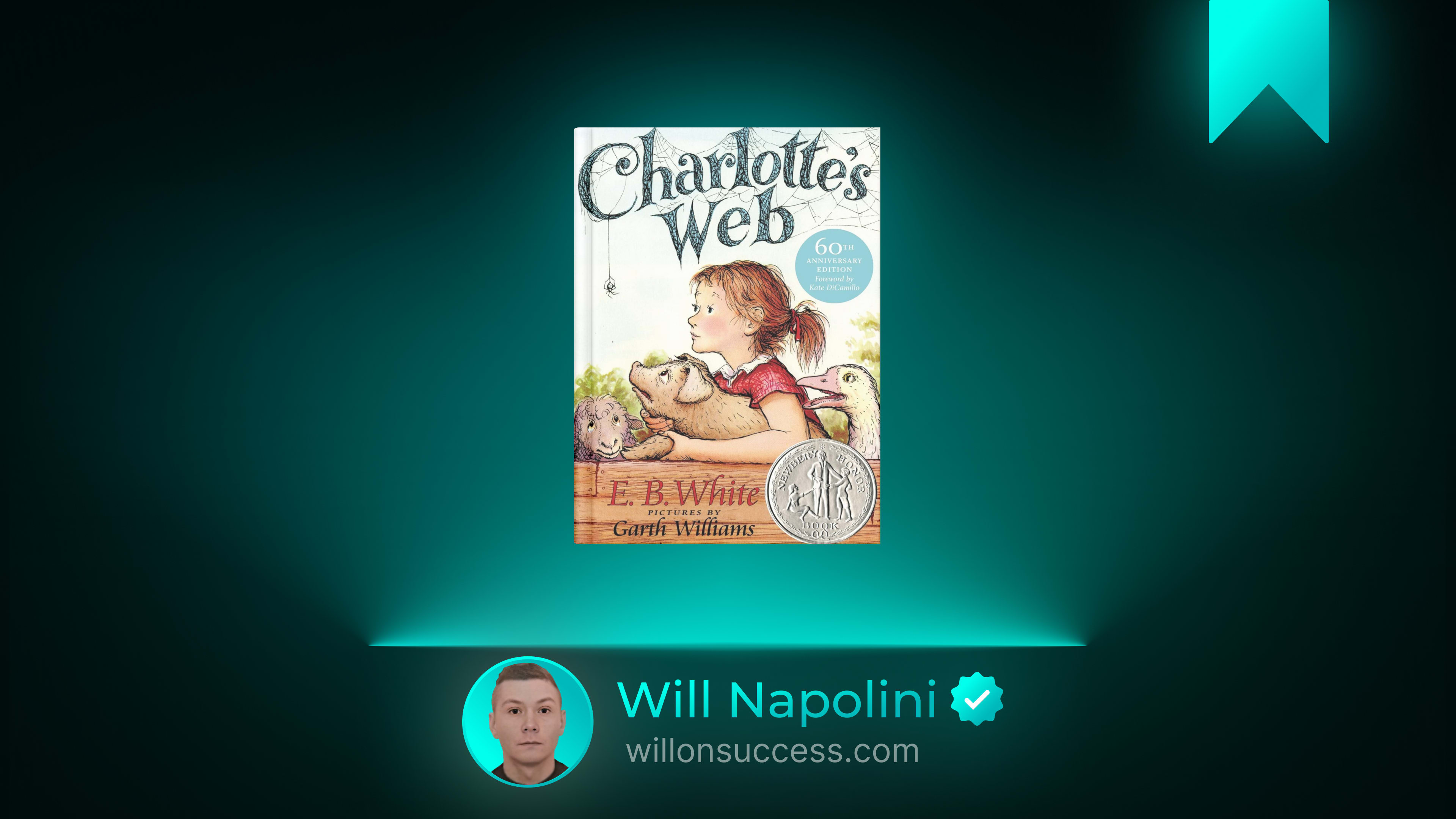
Charlotte’s Web by E.B. White is, on its surface, a story about a pig and a spider in a barn. It is illustrated with gentle ink drawings. It is read to children at bedtime. It is soft-spoken and pastoral and sweet.
And it is also one of the most honest books ever written about what it means to save someone’s life with nothing but patience, loyalty, and the careful weaving of the right words at the right time.
I want to walk you through what this small, quiet book taught me about friendship, about the power of language, about dying well, and about the legacy we leave in the people who loved us. Because if you let it, Charlotte’s Web will not just make you weep. It will change the way you show up for the people you care about.
The Big Idea: To Be Saved, You Must First Be Seen
The novel begins with an act of rescue. A little girl named Fern Arable sees her father raising an axe over the smallest, weakest pig in a litter. The runt. The one who will not thrive. And Fern stops the axe. She takes the pig—Wilbur—into her arms and feeds him from a bottle. She saves him simply because she looked at him and decided he mattered.
But saving a life is not the same as sustaining it. Wilbur survives, but he is moved to the Zuckerman barn, where he is alone, frightened, and terrified. He learns from the other animals that he is being fattened for slaughter. He will become Christmas dinner. He weeps. He panics. He does not know what to do.
And then, from the darkness of the barn doorway, a small grey voice speaks.
Charlotte A. Cavatica is a spider. She lives in the web she has spun across the top of the doorway. She is small, grey, quiet, and patient. And she looks at Wilbur and makes a decision that will cost her everything. She decides he will not die. Not because he is strong. Not because he is useful. But because he is her friend, and that is reason enough.
The central idea of this book is deceptively simple: the most powerful thing one person can do for another is to see them clearly, believe in them fiercely, and then act on that belief with quiet, relentless consistency.
Charlotte does not make a speech. She does not rally the farm. She does not confront Mr. Zuckerman with an argument. She simply goes to work. In the night. In the dark. Thread by thread.
And what she weaves changes everything.
The Words That Reshape a Life
Charlotte’s plan is elegant in its simplicity. She knows that humans are moved by language. She knows that if she can change the words humans use to describe Wilbur, she can change the way they see him. And if they see him differently, they will not kill him.
So she weaves words into her web. The first morning, the Zuckermans look up at the doorway and see two words spun into the silk, perfect and unmistakable:
SOME PIG.
The farm is stunned. The neighbors come. The news spreads. Wilbur, who had been cowering in the straw, suddenly stands a little taller. He tries to look like “some pig.”
Charlotte weaves again. TERRIFIC.
And Wilbur tries to look terrific. He runs in circles. He jumps. He does his best.
Then RADIANT.
And then, at the county fair, where Wilbur’s life still hangs in the balance, Charlotte weaves her final word: HUMBLE.
Here is what I find so profound about this. The words are not descriptions of what Wilbur already is. They are descriptions of what Charlotte believes he can become. She is not reporting reality. She is creating it. She is handing Wilbur an identity, and trusting him to grow into it.
And he does.
Wilbur was a frightened, lonely runt when Charlotte first spoke to him. But word by word, thread by thread, he becomes the pig the web describes. He becomes terrific. He becomes radiant. He becomes humble. Not because he was born that way, but because someone looked at him and wove those words into the fabric of his world, and then trusted him to live up to them.
I have seen this happen in real life. I have seen what happens when one person looks at another and says, with absolute conviction, I see something in you that you cannot yet see in yourself. It does not always work. But when it does, it is the closest thing to magic I know.
The words we speak over the people we love are not decoration. They are architecture. They build the house in which another person’s self-worth will live. Choose them carefully. Weave them with intention.
The Heroism of the Night Shift
One of the things I love most about Charlotte is how completely unglamorous her heroism is.
She does not work in the daylight, when everyone is watching. She works in the night. While the barn sleeps, while the crickets sing, while the moon moves across the sky, Charlotte is up in her web, spinning. Selecting each thread. Placing each letter. Working with a patience and precision that no one will ever witness in the moment.
By morning, the web is finished. The humans look up, marvel, and assume it is a miracle. They do not see the hours of labor. They do not see the small grey spider resting, exhausted, in the corner. They see the product, not the process.
This is how the deepest work of our lives is almost always done. The parent who stays up after the children are asleep, worrying, planning, preparing for tomorrow. The friend who spends an hour choosing exactly the right words for a letter. The teacher who stays late to grade papers and write encouragement in the margins. The partner who quietly handles the thing you never noticed needed handling.
The world celebrates the web in the morning. But the web is built in the dark.
If you are doing work right now that no one sees—if you are building, caring, creating, sustaining in the quiet hours when no one is applauding—I want you to know this: the work matters. The threads are holding. The structure is taking shape, even if the barn is still asleep. You do not need an audience for your labor to be holy.
Templeton, and the Grace of Imperfect Help
There is another character in the barn I want to mention, because he is important. Templeton the rat is selfish, greedy, lazy, and gluttonous. He does not care about Wilbur. He does not care about Charlotte. He cares about scraps of food and finding the best rotting morsels in the garbage heap.
And yet. When Charlotte needs a word for her web, it is Templeton who brings her torn scraps of newspaper from the dump so she can choose the right one. When Charlotte is dying at the fair and needs Wilbur to carry her egg sac home, it is Templeton—grumbling, complaining, demanding food as payment—who climbs up and brings the egg sac down.
Templeton is not noble. He is not selfless. He helps because he is bribed, because he is annoyed, because it is easier than arguing. But he helps.
I think there is a lesson here about the imperfect goodness of people. Not everyone who helps you will do it with Charlotte’s grace and love. Some will help grudgingly. Some will help because it benefits them. Some will help while complaining the entire time.
And that is okay. You do not get to demand that the people in your life love you perfectly before they are allowed to help you. Grace comes in many packages, and sometimes it arrives with sharp teeth and a bad attitude. Receive it. Be grateful for the thread, even if the spider who spun it was grumbling.
The Season That Takes
I need to talk about the ending, because it is the part of the book that breaks you, and it is also the part that teaches you the most.
Charlotte is dying. Spiders have short lives. By the time the county fair arrives, she is old, tired, and fading. She knows it. She tells Wilbur, gently, that she will not be going back to the barn. She has one final act of love to perform. She spins an egg sac—beautiful, waterproof, perfect—and fills it with five hundred and fourteen eggs. Her children. Her legacy.
And then she dies. Alone. At the fairground. While the crowds walk past, buying cotton candy and riding the Ferris wheel. No one notices. No one marks the passing of the small grey spider who saved a pig’s life.
Wilbur is devastated. He carries the egg sac home in his mouth, as carefully as if it were made of glass. He keeps it warm through the winter. He talks to it. He waits.
And in the spring, the eggs hatch. Five hundred and fourteen tiny spiders emerge. And then, one warm morning, they begin to balloon. They send out silk threads on the breeze, and one by one, they float up and away, carried on the wind to barns and fields and doorways all across the countryside.
Wilbur watches them go, and his heart breaks. He thinks he has lost everything Charlotte gave him.
But then he looks up. Three small spiders have stayed. They have settled in the corner of the doorway, right where Charlotte’s web used to be. They tell Wilbur they like it here. They will stay.
Wilbur is never without friends again. The book tells us this plainly. He loves the three spiders who stayed. He loves their children and their children’s children after them.
But then E.B. White writes the sentence that has stayed with me longer than almost any other line in literature. He writes that Wilbur never forgot Charlotte. That though he loved her children and grandchildren, none of them quite took her place. She was in a class by herself.
What It Means to Leave a Web Behind
Here is what Charlotte’s Web teaches about legacy.
Charlotte did not build a monument. She did not write a memoir. She did not accumulate wealth or fame. She wove a web in a barn doorway, saved one small pig, and died in a fairground while strangers walked past eating candy.
And yet. Because of her, Wilbur lived. Because of her, his story was told. Because of her, a barn full of animals learned what loyalty looked like. Because of her, three small spiders stayed in a doorway and became someone’s friend.
Her web dissolved. The morning dew washed it away. The wind tore it. The humans forgot about it within a season. But what the web did—the life it saved, the identity it built, the love it proved—that lasted.
You do not need to build something permanent to matter. You do not need your name on a building or your face on a screen. You need to weave one good web. One honest, patient, loving web, in the doorway of the life you were given. And trust that the threads will hold long enough to matter.
Why This Matters on an Ordinary Tuesday
You may not be saving a pig from slaughter. But you are surrounded by people who are frightened. Who feel unseen. Who are cowering in the straw of their own lives, waiting for the axe.
A colleague who is quietly struggling and afraid to admit it. A child who has decided they are not smart, not worthy, not enough. A friend who has been alone so long they have started to believe they will always be alone. A partner who needs to hear, in plain words, that they are terrific. That they are radiant. That they are humble. That they are some something.
Charlotte’s Web asks you a simple question: What words are you weaving for the people in your barn?
Are you weaving words of criticism, impatience, and indifference? Are you weaving silence, which is its own kind of cruelty? Or are you weaving words that give someone permission to grow into the best version of themselves?
You do not need to be loud. You do not need to be dramatic. You need to be steady. You need to show up in the night, when the barn is quiet, and do the small, unseen work of believing in someone.
Who Should Read This Book
If you are a parent, read it to your children. But also read it to yourself, alone, in the quiet of an evening. Let it remind you of what loyalty looks like when it is not performing for an audience.
If you are someone who feels unseen—who feels like the runt of the litter, waiting for someone to stop the axe—this book is for you. It is proof that the web can still be woven. That the words can still come. That someone, somewhere, might be looking at you right now and deciding that you matter.
If you are grieving—if you have lost a Charlotte in your life, someone whose quiet, steady presence held the world together—this book will not fix your grief. But it will sit beside you in it. It will tell you that it is okay to love the three small spiders who stayed, and also to know that none of them will ever quite take her place. Both things can be true at once.
It is a short book. You can read it in an afternoon. But it will stay in you for years, surfacing in the moments when you need it most.
Your One Small Step
Today, I want you to choose one person in your life. One person who you suspect might be feeling unseen. Feeling small. Feeling like the runt.
And I want you to weave one word for them. One specific, true, honest word. Not “you’re great.” Not “good job.” Something that names exactly what you see in them.
“You were so patient with your daughter this morning. That was beautiful.”
“The way you handled that meeting—you were steady. You were kind. I noticed.”
“You are braver than you think you are.”
Say it. Write it. Leave it on a sticky note. Send it in a text. But say it. Weave it into the air between you. Let them see themselves through your eyes, even just for a moment.
You do not need to save their life. You just need to see them.
Because to be seen—truly seen, by someone who looks at you and decides, without hesitation, that you matter—is the beginning of everything. It is the first thread. And from that first thread, a whole web can be built. Strong enough to hold a life.
The barn is quiet. The moon is up. And the weaving is yours to do.