Charlie and the Chocolate Factory: Why Character is the Only Currency That Survives the Test of Opportunity
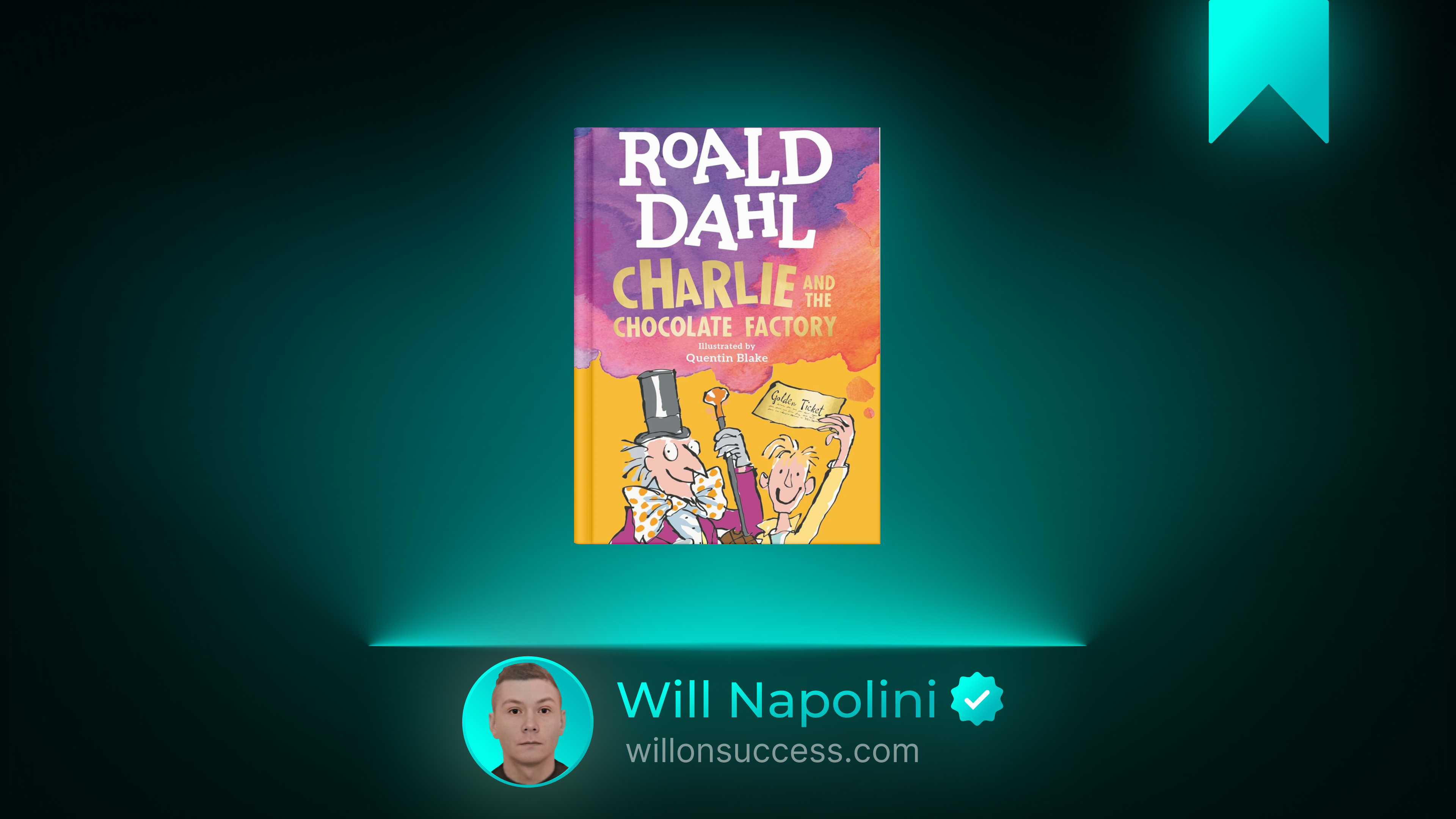
Most of us spend a significant portion of our lives looking for the golden ticket.
We look for the breakthrough. The promotion. The viral moment. The perfect relationship. The financial windfall that will finally lift us out of the daily grind and place us inside the gates of the life we believe we deserve. We convince ourselves that the only thing standing between us and our happiness is a lack of opportunity. If we could just get our hands on the ticket, everything would change.
But if I could sit across the table from you right now, I would ask you to consider a more uncomfortable question: What if the reason you haven’t been handed the keys to the factory is not because the world is unfair, but because you are not yet ready to walk through the doors?
Roald Dahl’s Charlie and the Chocolate Factory is widely remembered as a whimsical, slightly dark children’s story about a magical candy maker and a poor boy who wins a tour. But if you read it again with the eyes of an adult, you will quickly realize it is not a story about candy at all. It is one of the most precise, unsentimental examinations of human character ever written.
It is a story about what happens when people are suddenly handed immense abundance. And its central, unyielding truth is this: Opportunity does not build character. Opportunity reveals it. And then, it amplifies it.
The Big Idea: The Factory is a Crucible, Not a Reward
Willy Wonka is not merely a confectioner; he is an architect of tests. He drops five golden tickets into the world, inviting five children into his factory. But the factory is not a playground. It is a crucible.
Every room the children enter is designed to test a specific facet of their character. And one by one, the children are eliminated. They are not eliminated by Wonka’s cruelty. They are eliminated by their own unchecked appetites, their own entitlement, their own vanity, and their own distractions. The factory simply provides the environment where their hidden flaws become visible, and then it lets those flaws consume them.
Only one child makes it to the end. Charlie Bucket.
Charlie does not win because he is the smartest, the loudest, or the most talented. He wins because he possesses a quiet, unshakeable foundation of character. He knows how to wait. He knows how to savor. He knows how to be grateful for a bowl of thin cabbage soup.
Dahl’s profound insight is that the world is full of chocolate rivers, but only those who have mastered themselves in times of scarcity are fit to manage abundance. If you hand a river of chocolate to a boy who cannot control his appetite, he will fall in and drown. If you hand it to a boy who knows how to take one small, deliberate sip, he will build an empire.
The Architecture of Entitlement
Let us look at the children who fail, because they are not just children. They are archetypes. They are the parts of ourselves that we must outgrow if we want to build a meaningful life.
Consider Veruca Salt. Veruca is the embodiment of entitlement. Her defining phrase is, “I want it now.” When she sees a golden goose, she demands it. When she is told no, she throws a tantrum. She has been taught by her parents that her desires are commands, and that the world exists solely to supply her with whatever she points at.
In personal development, we talk a lot about “manifesting” and “asking the universe for what you want.” But Veruca is a warning about what happens when desire is completely divorced from gratitude and effort. Entitlement is a cage. When you are given everything you demand, you lose the ability to appreciate anything you receive. The thrill of the acquisition lasts only seconds before the boredom sets in, and you must demand something bigger, louder, and more expensive just to feel alive.
Veruca is eventually deemed a “bad nut” by the factory’s sorting machine and thrown down the garbage chute. It is a harsh metaphor, but a true one. A life built entirely on the demand for immediate gratification eventually sorts itself into the trash. The world will tolerate your entitlement for a while, but eventually, the mechanisms of reality will discard you.
The Trap of the Endless Distraction
Then there is Mike Teavee and Violet Beauregarde.
Violet is obsessed with competition and vanity. She holds the world record for chewing the same piece of gum for months. She is so desperate to be “the best” at something—anything—that she chews a piece of experimental, unfinished gum despite Wonka’s explicit warnings. Her need to prove she is special overrides her common sense. She swells into a giant blueberry, a physical manifestation of her own inflated ego.
Mike Teavee is obsessed with screens. In Dahl’s 1964 text, Mike is obsessed with television and violent gangster movies. He is passive, aggressive, and entirely disconnected from the physical world. He shrinks himself by demanding to be sent through the television wires, ending up as a tiny, powerless version of himself.
If Dahl were writing today, Mike would be staring at a smartphone, and Violet would be curating a desperate, competitive personal brand on social media. The mediums change; the human flaws do not.
Both of these children are destroyed by their inability to let go. Violet cannot let go of her need to be the champion. Mike cannot let go of his passive consumption. They are so distracted by the shallow metrics of their own lives that they walk right past the genuine magic happening in the room with them.
When we fill our lives with endless scrolling, endless competing, and endless noise, we shrink our own capacity for deep thought and meaningful connection. We become small.
The Danger of the Unchecked Appetite
Augustus Gloop is the first to fall. He is driven entirely by his physical appetite. When he sees the chocolate river, he does not admire the engineering. He does not ask how it works. He simply drops to his knees and begins to gorge himself, falling in and being sucked up the pipe.
Augustus represents the danger of consuming without creating. He takes and takes, but he has no internal governor. In our own lives, the “chocolate river” might be food, but it might also be information, entertainment, or even work. You can drown in a river of good things if you do not know how to regulate your consumption.
Discipline is not about punishing yourself. Discipline is the practice of building a fence between yourself and the river, so you can enjoy the chocolate without being consumed by it.
The Quiet Power of the Unseen Habit
And then there is Charlie.
Charlie is poor. He lives in a drafty shack with his parents and four bedridden grandparents. They eat watery cabbage soup. They are cold. They are hungry.
But when Charlie receives his one, single bar of Wonka chocolate for his birthday, he does not tear it open and devour it in three seconds like Augustus would have. He unwraps it carefully. He breaks off a tiny piece. He lets it melt on his tongue. He makes it last for weeks.
This is the secret of Charlie’s character. He has mastered the art of savoring.
Because he has practiced restraint in the dark, in the quiet, in the times of scarcity, he is entirely uncorrupted when he is suddenly thrust into the blinding light of the factory. The other children are overwhelmed by the abundance because they have never had to manage their own impulses. Charlie is not overwhelmed, because his internal architecture is already built to handle it.
Character is not forged in the moments of great triumph. It is forged in the quiet, unseen moments of your ordinary Tuesday. It is forged when you choose to eat the smaller portion. When you choose to listen instead of interrupting. When you choose to save the money instead of spending it on a fleeting desire.
What you repeat in private eventually becomes visible in your life. Charlie’s private habit of gratitude and restraint was the exact currency he needed to inherit the factory.
The Oompa-Loompas and the Mirror of Responsibility
There is a brilliant, slightly uncomfortable structural choice Dahl makes in this book. Every time a child is eliminated from the tour, the Oompa-Loompas appear and sing a song. And if you listen closely to the lyrics, the Oompa-Loompas are never actually blaming the children.
They are blaming the parents.
They sing about Mr. and Mrs. Salt spoiling Veruca. They sing about Mr. and Mrs. Gloop feeding Augustus garbage. They sing about the parents who used the television as a babysitter for Mike.
“You can’t wash a pig in a perfume,” they sing. “You can’t wash a pig in a perfume.”
This is where the book transitions from a story about children to a profound lesson for adults. Many of us walk into adulthood carrying the “perfume” of good intentions, but underneath, we are still operating on the flawed programming of our upbringing. We were taught to be anxious, or entitled, or avoidant, or workaholic.
If we want to change our lives, we must take radical responsibility for our own reparenting. You cannot blame your parents for the flaws you are still actively choosing to indulge in at age thirty, forty, or fifty. The Oompa-Loompas are the voice of objective reality, reminding us that while our origins may not be our fault, our current architecture is entirely our responsibility.
You must become the parent to yourself that you needed when you were younger. You must set the boundaries. You must enforce the discipline. You must teach yourself how to savor the chocolate.
Why This Matters When the Ticket Finally Arrives
Here is what I have learned from watching people navigate success: The golden ticket is not the end of the story. It is the beginning of the real test.
When you finally get the promotion, the money, the platform, or the relationship you have been working toward, the factory doors open. And suddenly, you have access to the chocolate river. You have access to power, money, attention, or freedom.
If your character is built on the foundation of Augustus, the abundance will make you sick. If your character is built on Veruca, the abundance will make you tyrannical, and people will eventually stop tolerating you. If your character is built on Mike, the abundance will distract you until you lose touch with reality.
But if your character is built on the foundation of Charlie—if you have spent your years in the “cabbage soup” seasons practicing humility, gratitude, restraint, and hard work—the abundance will not corrupt you. It will empower you. You will be able to walk through the factory, see the magic for what it is, and eventually be trusted to run it.
Abundance does not create character. It reveals it. And the universe is remarkably hesitant to hand the keys of the factory to someone who hasn’t proven they can handle a single square of chocolate.
Practical Application: Building the Architecture of Restraint
How do we build Charlie’s character in a world that constantly rewards Veruca’s demands and Mike’s distractions? We do it through small, deliberate practices of restraint.
1. The Practice of Savoring Choose one thing you consume daily—a cup of coffee, a meal, a piece of music, a conversation—and intentionally slow it down by fifty percent. Do not look at your phone while you drink the coffee. Taste it. Notice the warmth. When you eat, put your fork down between bites. Train your brain to extract deep value from small things, rather than shallow value from massive quantities.
2. The Audit of the River Where in your life are you acting like Augustus? Where are you gorging yourself without thinking? It might be scrolling through social media for three hours a night. It might be eating mindlessly. It might be taking on too many projects at work until you are drowning in obligations. Identify your personal chocolate river, and build a small fence around it. Set a timer. Set a limit. Reclaim your agency.
3. The “Not Yet” Muscle When you feel the urge to buy something you want, to say something you want to say, or to demand a result right now, practice saying “Not yet” to yourself. Delay the gratification by twenty-four hours. You will be amazed at how often the urge passes, and how much power you reclaim by proving to yourself that your impulses do not own you.
Who Should Read This Book
If you are a parent, this book is mandatory reading, not just for your children, but for you. It is a mirror that will force you to examine the ways you might be accidentally engineering your child’s entitlement. Read it to them, but listen to the Oompa-Loompas yourself.
It is also deeply valuable for any adult who feels like they keep getting close to success, only to self-sabotage at the last minute. If you keep getting the interview but not the job, or starting the relationship but ruining it, or getting the money and losing it, this book will help you see the hidden flaws in your own architecture.
A fair warning: Dahl’s writing is a product of its time. It is dark, it is politically incorrect, and it lacks the gentle, therapeutic language of modern parenting books. It is a fable, and fables deal in sharp edges and absolute extremes. Read it for the profound psychological archetypes, not as a literal sociological blueprint.
Your One Small Step
Understanding the mechanics of character is valuable, but understanding without action changes nothing.
So here is what I would ask you to do today.
Find one small thing in your life that brings you joy. It could be a piece of good chocolate, a cup of tea, a beautiful view out your window, or a song you love.
Take ten minutes to do absolutely nothing but experience that one thing. Do not pair it with a podcast. Do not pair it with scrolling. Do not rush to the next task. Just sit with it. Let it be enough.
When you can look at a single, small thing and feel entirely satisfied, you stop being a beggar at the gates of the factory. You become the owner.
The golden ticket gets you through the gates, but it is your character that decides whether you inherit the factory. Start building yours today.