Tiny Habits by BJ Fogg: Why the Smallest Behavior You Can Imagine Changes Everything
You set the alarm for 5:30. You lay out the running clothes the night before. You tell yourself, with genuine conviction, that tomorrow is the day everything changes. And for three days, maybe five, you actually do it. Then a Tuesday arrives that is heavier than the others. The alarm sounds like an accusation. You hit snooze once, twice, and by the time you open your eyes again, the window has closed, and a familiar whisper starts: See? You can’t even keep one promise to yourself.
If that story feels uncomfortably close to home, I want you to hear something before we go any further. You are not broken. You are not weak. You were given a strategy for change that was never going to work, and you blamed yourself when it failed.
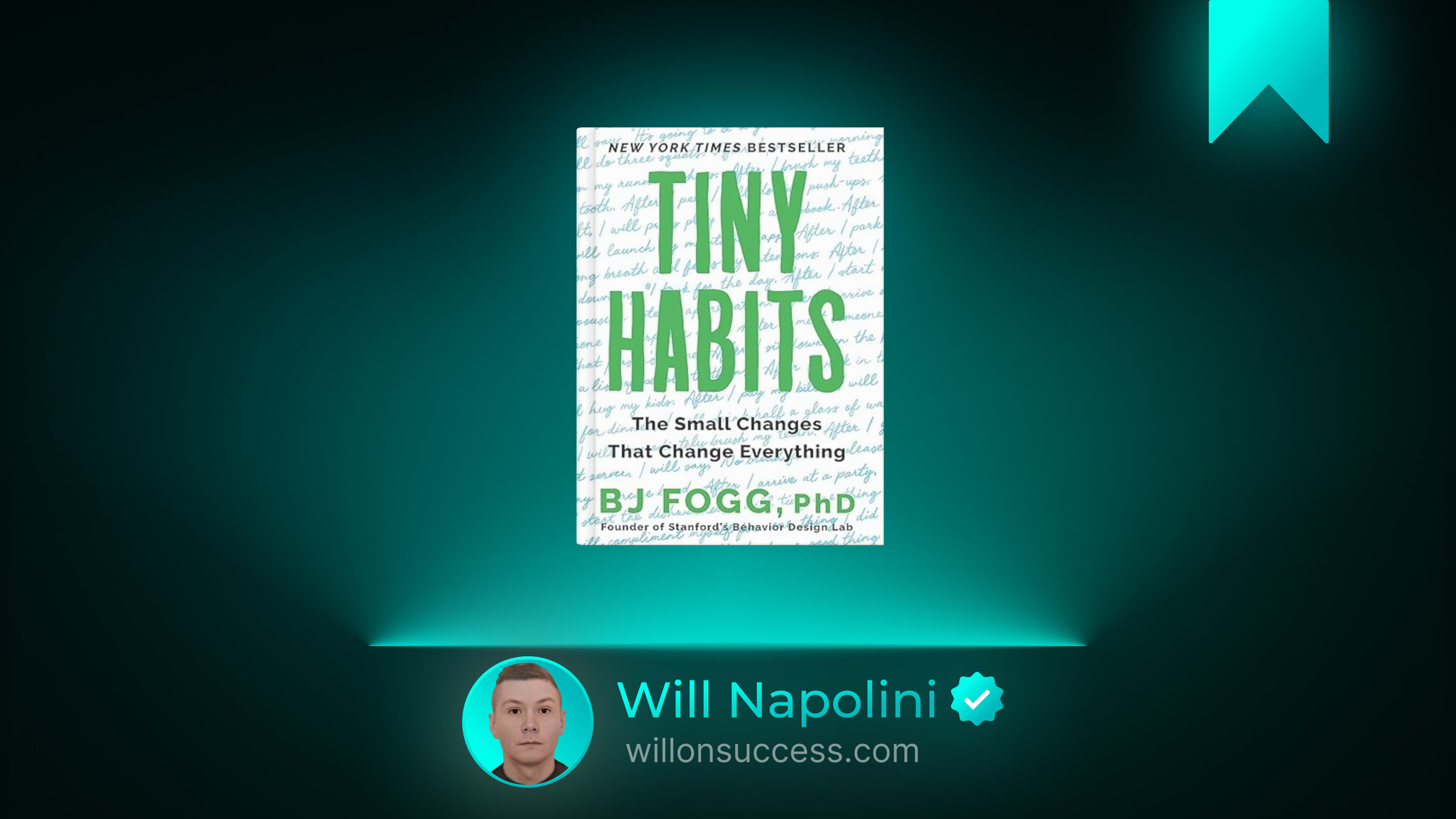
BJ Fogg spent more than twenty years at Stanford studying human behavior, and the conclusion he reached overturns almost everything we have been taught about personal change. His book, Tiny Habits: The Small Changes That Change Everything, makes a claim that sounds almost too gentle to be true: the path to transforming your life does not begin with a dramatic leap. It begins with something so small that you cannot possibly fail at it.
And once you understand why that works, you will never approach self-improvement the same way again.
The Big Idea: Change Is a Design Problem, Not a Character Problem
Here is what I have come to believe after years of watching people struggle, myself included. Most of us treat our own behavior the way someone might treat a stubborn mule. We yell. We pull. We negotiate. We feel guilty when the mule refuses to move. And we conclude that the mule—meaning ourselves—is simply too stubborn, too lazy, too undisciplined.
Fogg’s central argument is that you are not a stubborn mule. You are working with a system you have never been taught to understand. Behavior is not a product of sheer will. It is a product of conditions. Change the conditions, and the behavior follows. Change the conditions back, and the behavior disappears. This is not a judgment on your character. It is mechanics.
His entire method rests on one deceptively simple formula: Behavior happens when Motivation, Ability, and a Prompt converge at the same moment. He calls this the Fogg Behavior Model. A behavior occurs when you want to do it, you can do it, and something reminds you to do it. Miss any one of those three, and the behavior simply will not happen. No amount of self-criticism fixes a missing element.
This reframes everything. You stop asking, “Why can’t I make myself do this?” and start asking, “Which of the three pieces is missing, and how can I adjust it?”
That single shift in question changes the entire conversation you have with yourself every morning.
Motivation Is the Weather, Not the Foundation
If I could sit across the table from you and offer one idea from this book that would save you years of frustration, it would be this: stop building your life on motivation.
Fogg describes motivation as something that rises and falls like weather. There are days you feel electric, ready to overhaul your entire existence. There are days you can barely answer an email. Both days are normal. Neither says anything about your worth or your future.
The mistake most of us make is designing our habits for the motivated version of ourselves. We commit to the forty-five-minute workout, the full journaling session, the complete meal prep, because on the day we made the plan, we felt capable of it. But that version of you is not guaranteed to show up tomorrow. And when she doesn’t, the plan collapses, and you interpret the collapse as a personal failure.
Fogg’s alternative is to design behaviors for the least motivated version of yourself. The version that is tired, distracted, running late. If the behavior is small enough, even that version of you can do it. And here is the quiet miracle: once the behavior exists—even in its smallest form—it can grow. You don’t have to grow it. It grows on its own, like a vine finding a trellis, as long as the root is in the ground.
The Recipe: Anchor, Behavior, Celebration
The Tiny Habits method itself is almost disarmingly simple. Three parts. That’s all.
One. An Anchor Moment. This is something you already do every day without thinking. You pour your coffee. You flush the toilet. You sit down at your desk. You pull into your driveway. The anchor is not something you create. It is something you notice. It already exists in your day, reliable as a heartbeat.
Two. A Tiny Behavior. This is the new habit, shrunk down to its most minimal possible version. Not “floss all my teeth.” Floss one tooth. Not “do a full workout.” Do two push-ups. Not “write for an hour.” Open the document and write one sentence. Not “meditate for twenty minutes.” Take one deliberate breath.
The tiny behavior should take less than thirty seconds. It should feel almost laughably easy. That is the point. You are not trying to accomplish something impressive. You are trying to establish a foothold.
Three. A Celebration. Immediately after doing the tiny behavior, you generate a genuine feeling of success. You might say “Yes!” out loud. You might pump your fist. You might smile and think, “I did it.” This is not performative. Fogg’s research points to emotion as the mechanism that wires a behavior into automaticity. The brain repeats what feels rewarding. Celebration provides that reward instantly, before the habit has had time to produce any external result.
The sequence looks like this: After I pour my morning coffee [anchor], I will do two push-ups [tiny behavior], and then I will say “Nice work” to myself [celebration].
That is the entire architecture. No apps required. No accountability partner. No twenty-one-day challenge. Just a small behavior, attached to something already solid in your day, sealed with a moment of genuine self-encouragement.
Why Celebration Matters More Than You Think
I want to linger on the celebration piece, because I suspect you might be tempted to skip it. It can feel silly. Childish, even. And if you are someone who has spent years criticizing yourself for not doing enough, pausing to say “good job” for flossing one tooth might feel absurd.
But Fogg makes a compelling case that this is precisely where the mechanism lives. The brain does not distinguish well between a small win and a large one when it comes to forming associations. What it registers is the emotional signal. If you complete a behavior and feel nothing—or worse, feel guilty that you didn’t do more—the brain files that behavior under “neutral” or “negative.” It does not get reinforced.
If you complete a behavior and feel a flash of pride, satisfaction, or even playful amusement, the brain files it under “repeat this.” Over days and weeks, the behavior shifts from effortful to automatic. You didn’t white-knuckle your way there. You made the path feel good, and your nervous system walked it again willingly.
I think of it like training a young dog. You would not expect the puppy to understand your long-term vision for obedience. You reward the small sit, the tiny stay, and the behavior grows because the association is positive. You deserve the same patience from yourself.
Making the Hard Things Easier: Adjusting Ability
The second lever in Fogg’s model is Ability, and this is where the book becomes deeply practical. If motivation is unreliable, then your best strategy is to make the desired behavior as easy as possible so that even on a low-motivation day, it requires almost no effort.
Fogg identifies five factors that make a behavior harder or easier: time, money, physical effort, mental effort, and whether it disrupts your current routine. To make a habit stick, you reduce one or more of these factors.
Want to read more but never seem to get to it? Place the book on your pillow in the morning so it is literally the first thing you see at night. You have reduced physical effort and mental effort. You have removed the step of “finding the book” and “deciding to start.”
Want to drink more water? Fill a bottle and set it beside your keyboard before you sit down. The behavior now requires no trip to the kitchen, no decision, no remembering.
This is not laziness. This is design. A river does not flow uphill because it is disciplined. It flows downhill because the terrain allows it. Your job is to shape the terrain of your day so that the behavior you want becomes the path of least resistance.
The Motivation Wave: Use It, Don’t Depend on It
Fogg does not ignore motivation entirely. He acknowledges that it comes in waves. There are moments—a new year, a health scare, a conversation that shifts something inside you—when motivation surges. His advice is practical: when the wave is high, use that energy to make future behavior easier, not to perform a heroic act you cannot sustain.
If you feel fired up on a Saturday morning, don’t commit to running five miles every day. Instead, put your running shoes by the door. Lay out comfortable clothes. Create the environment that makes the tiny version of the behavior effortless on a Wednesday when motivation is nowhere to be found.
You surf the wave to set up the infrastructure. Then the infrastructure carries you through the calm.
Shedding the Shame That Keeps You Stuck
There is one more thread running through this book that I find quietly powerful, and it has nothing to do with productivity. Fogg speaks repeatedly about the role of self-judgment in sabotaging change. He points out that people who feel bad about themselves do not change well. Shame narrows your options. It makes you avoid the very behavior you need because the behavior is now associated with the painful feeling of not being enough.
His approach is almost radical in its gentleness. If you miss a day, you do not spiral into self-recrimination. You simply return to the anchor. The habit is not broken. The vine is still rooted. You missed one morning, and tomorrow the anchor will come again.
I have found this to be one of the most important reframe available to anyone who has ever abandoned a goal and then carried the guilt of that abandonment like a stone in their pocket for months afterward. The guilt does not help. It weighs you down precisely when you need lightness to begin again. You are allowed to start over. You are allowed to start small. You are allowed to celebrate one push-up as though it mattered, because it does.
What This Looks Like on an Ordinary Tuesday
Let me make this concrete, because ideas without a Tuesday-morning version of them tend to evaporate.
Suppose you want to feel more grounded during the workday. Your Tiny Habit might look like this:
After I close my laptop to eat lunch [anchor], I will stand up, place both feet flat on the floor, and take three slow breaths [tiny behavior]. Then I will think, “That was a good pause” [celebration].
Total time: fifteen seconds. No app. No course. No perfect conditions. Just a breath, attached to a moment that already exists, sealed with a small acknowledgment.
Do that every weekday for a month, and something shifts. Not because three breaths are magical. But because you have proven to yourself, repeatedly, in the smallest possible way, that you can make a decision and follow through. And that proof compounds. It changes the story you tell yourself about who you are.
A small decision becomes a direction. A direction repeated quietly, day after ordinary day, becomes the shape of a life.
Who Will Benefit Most from This Book
If you have ever set a goal and abandoned it within a month, this book will speak directly to the frustration you have carried. If you are someone who understands what they should do but cannot make themselves consistently do it, Fogg’s framework gives you a practical answer that does not involve more willpower.
It is especially useful for people rebuilding after a setback—after illness, after burnout, after a period where all structure dissolved. The gentleness of the method makes it possible to begin again without the pressure of returning to some former peak.
I will say honestly: if you are someone who thrives on intensity, who loves the adrenaline of a thirty-day challenge, who is already highly consistent and looking for advanced optimization, this book may feel too slow. It is not designed for the person who already has a robust system. It is designed for the person who has tried systems before and felt betrayed by their own inconsistency.
And even if you are naturally disciplined, the underlying model—motivation, ability, prompt—is genuinely useful for understanding why certain behaviors stick and others quietly fade.
One Small Step You Can Take Before You Close This Page
I am not going to ask you to redesign your entire morning routine tonight. I am not going to ask you to commit to thirty days of anything.
Here is what I would invite you to do, today, right now, in the next two minutes.
Think of one behavior you wish you did consistently. Just one. Then shrink it. Shrink it until it feels almost too easy. Floss one tooth. Write one sentence. Stretch for ten seconds. Put one dish in the dishwasher after dinner.
Now find the anchor. What do you already do, reliably, right before the moment you could insert this tiny behavior? After you turn off the bathroom light. After you pour your coffee. After you shut down your computer for the evening.
Say the recipe out loud, even if you feel a little foolish: After I [anchor], I will [tiny behavior], and I will [celebrate].
Then do it once. Right now, if the anchor is available. And when you do, let yourself feel the small satisfaction of having followed through. That feeling is not trivial. It is the sound of a root taking hold in soil.
You do not need to become a different person by Friday. You need to become someone who keeps one very small promise to themselves, today. And then tomorrow. And then the day after that. The rest—the growth, the confidence, the visible change in your work, your health, your relationships—follows from that first quiet act of showing up for yourself in the smallest possible way.
You have been waiting to feel ready. You have been waiting for the motivation to strike like lightning. But the season does not wait for you to feel ready. It asks only that you place the seed in the ground.
Place the seed. Celebrate the placing. And trust what comes next.