To Kill a Mockingbird: The Quiet Courage of Doing Right When No One Is Watching
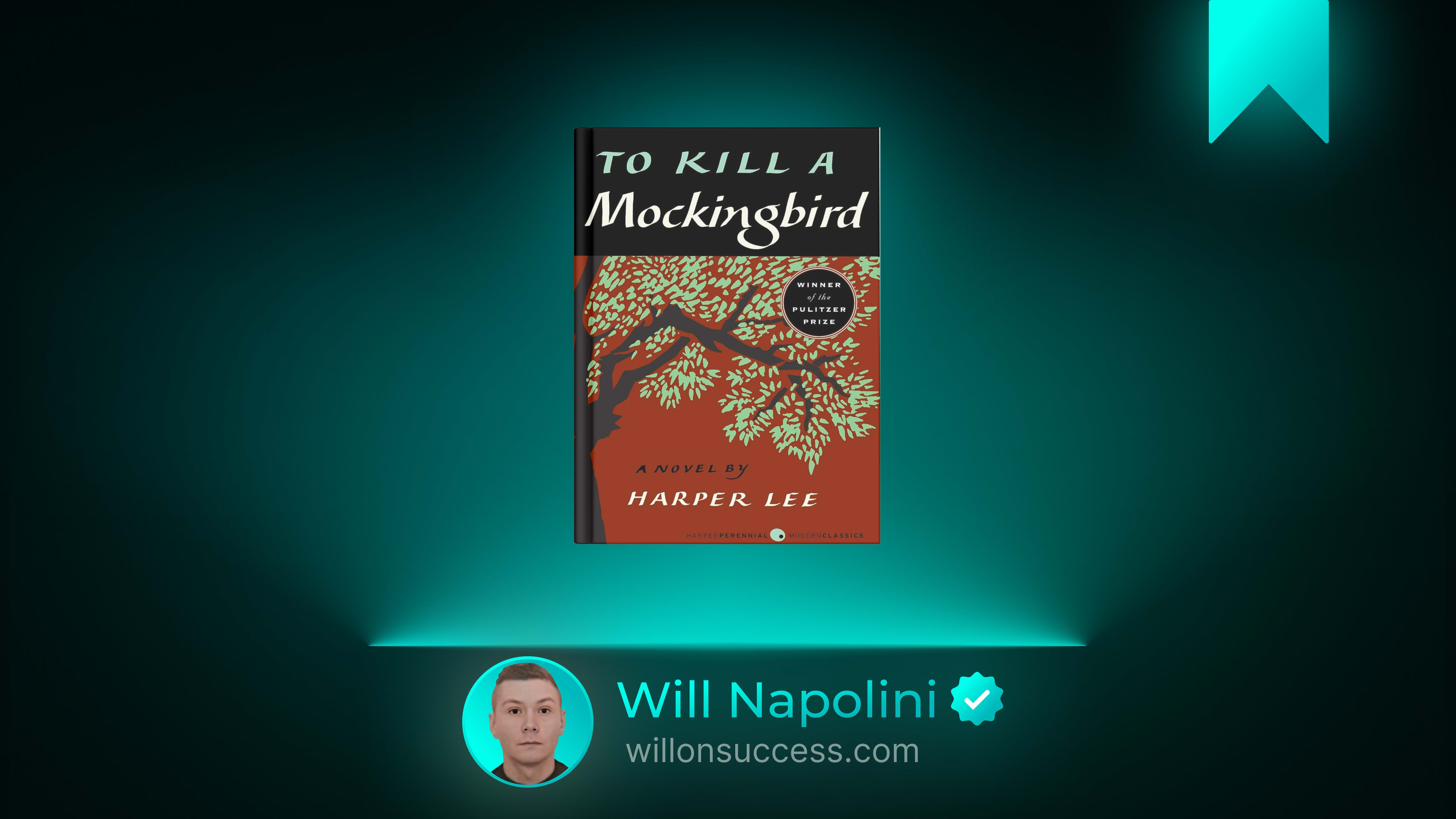
Have you ever known exactly what the right thing was—and still hesitated, because doing it would cost you something you weren’t sure you could afford to lose?
Maybe it was speaking up in a meeting when everyone else stayed silent. Maybe it was defending someone who wasn’t in the room to defend themselves. Maybe it was simply telling the truth when a comfortable lie would have been easier, faster, and more popular.
If that question landed somewhere uncomfortable, good. Stay with it for a moment. Because that discomfort is the exact territory Harper Lee mapped in To Kill a Mockingbird, and the wisdom she placed there is as urgent now as it was when the novel was published in 1960.
This is not a self-help book. It is a story. But some stories teach you more about how to live than any manual ever could, because they let you walk inside a decision before you have to make your own.
Let me walk you through what this novel actually teaches—and how its lessons can reshape the way you show up in your own life.
The Big Idea: Conscience Does Not Take a Vote
At its heart, To Kill a Mockingbird is about one deceptively simple question: What do you do when doing the right thing guarantees you will lose?
The novel is set in the fictional town of Maycomb, Alabama, during the 1930s. The narrator is Scout Finch, a sharp, curious little girl watching her father, Atticus Finch, a lawyer, defend a Black man named Tom Robinson against a false accusation of assault. The evidence clearly points to Tom’s innocence. The truth is not complicated. But Maycomb’s racial prejudice is older than the truth, deeper than the evidence, and louder than any single voice of reason.
Atticus knows he will lose the case before he ever stands up in court. He tells his children this plainly. And he takes the case anyway.
Why?
Because, as he explains to Scout, a person’s conscience is the one thing that does not abide by majority rule. You can lose a vote. You can lose an argument. You can lose a trial. But you cannot lose your own integrity without choosing to hand it over.
That is the spine of this book. Not victory. Not recognition. Not changing the world in a single dramatic stroke. Just the quiet, stubborn decision to align your actions with what you know to be true, even when the world around you has already decided otherwise.
The Story That Holds the Lesson
Before I pull the principles out, let me make sure you can feel the story, because Harper Lee’s genius is that she never lectures. She shows you a town, a family, a summer, and lets the meaning rise on its own.
Scout and her older brother Jem spend their childhood in a world that feels both safe and mysterious. Their fascination centers on Arthur “Boo” Radley, a reclusive neighbor who has not been seen in years. The children build an entire mythology around him—stories, fears, small cruelties disguised as games. To them, Boo is a monster, a legend, a thing to be dared and discussed.
Meanwhile, their father is doing something the town considers almost as strange: defending a Black man with genuine effort and respect. Atticus does not perform his defense for applause. He does not grandstand. He simply does the work—carefully, thoroughly, honestly—because the work is right.
The trial comes. Despite Atticus dismantling the prosecution’s case piece by piece, the all-white jury convicts Tom Robinson. Tom later dies trying to escape prison. The man who accused him, Bob Ewell, humiliated and exposed on the witness stand, directs his rage at Atticus’s children.
And then, in the novel’s most quietly powerful turn, the person the children spent years fearing—Boo Radley—is the one who saves them.
The “monster” was never a monster. He was a person they never bothered to understand.
Harper Lee braids these two threads—the trial and the mystery of Boo Radley—into a single argument: the failure to see another human being clearly is the root of nearly every injustice, large and small.
You Cannot Judge a Life You Have Not Tried to Imagine
Early in the novel, Atticus gives Scout a piece of advice that becomes the moral compass for everything that follows. He tells her, in essence, that you never really understand a person until you consider things from their point of view—until you climb into their skin, as he puts it, and walk around in it.
This is not a sentimental platitude. Atticus says this to a child who has just had a rough day at school, who is frustrated with a teacher, who wants to quit reading because someone told her she’s doing it wrong. The advice is small, domestic, ordinary. And that is exactly the point.
Empathy is not reserved for grand moral crises. It begins in the small frictions of a Tuesday afternoon. The coworker who snapped at you. The friend who canceled plans again. The stranger in traffic who cut you off without signaling.
The instinct is to build a story about them. They are rude. They are selfish. They are the problem. And sometimes people are genuinely wrong, and boundaries matter. But the instinct to build a story before you have any information—that is where misunderstanding takes root. That is where a small town learns to fear a man it has never spoken to.
What I have learned, watching my own reactions over the years, is that the stories I tell myself about other people say far more about my own impatience than about their character. The moment I pause and ask, “What might be true about this person’s life that I cannot see?” the anger usually softens. Not always. But often enough to matter.
Courage Is Not the Absence of Fear—It Is the Decision to Begin Anyway
There is a passage in the novel where Atticus talks to Jem about what real courage looks like. It is not a man with a gun. It is not a dramatic, cinematic stand. It is, he says, knowing you are beaten before you start and beginning anyway, and seeing it through no matter what.
He is talking about Mrs. Dubose, an elderly, unpleasant woman in the neighborhood who is fighting a morphine addiction in her final weeks. She is not heroic by any conventional standard. She is cranky, cruel, and dying. But she chose to face her last days clear-headed rather than comfortable. And Atticus wants his children to see that.
This redefinition of courage changed how I think about my own difficult seasons. I used to believe courage meant charging forward with confidence, feeling strong, knowing the outcome would be good. What I discovered, slowly and often painfully, is that most real courage looks nothing like that.
Most real courage looks like getting out of bed on a morning when everything feels pointless. It looks like sending the email, having the conversation, making the apology, starting the project you have been postponing for two years—not because you feel brave, but because you decided the action mattered more than the feeling.
You do not need to feel ready. You need to begin.
The Mockingbird Principle: Protect What Cannot Protect Itself
The novel’s title comes from a small remark Atticus makes to his children. He tells them they can shoot at tin cans if they want, but they must never shoot a mockingbird, because mockingbirds do not eat gardens or nest in corncribs. They do one thing: they sing. And it would be a sin to harm something whose only purpose is to bring beauty into the world.
Miss Maudie, the neighbor, reinforces this. Mockingbirds are innocent. They cause no harm. Destroying them is destruction for its own sake.
Tom Robinson is a mockingbird. Boo Radley is a mockingbird. Anyone who is vulnerable, who is misunderstood, who cannot defend themselves against the narratives other people build about them—they are mockingbirds.
The principle extends further than the novel’s plot. In your own life, you will encounter moments where someone is being mischaracterized, dismissed, or quietly crushed by a system or a conversation that does not see them. The mockingbird principle asks: Will you be the person who notices? Will you speak, even if your voice shakes? Will you protect the dignity of someone who cannot protect it themselves?
This does not require a courtroom. It might mean correcting a joke at a dinner table. It might mean giving credit to a colleague whose idea was overlooked. It might mean listening—truly listening—to someone whose experience is completely different from yours, without rushing to correct or minimize them.
Small acts. Real consequences. The kind of courage that never makes the news but shapes the culture of every room you enter.
What You Repeat in Private Becomes the Person You Are in Public
One of the most quietly powerful elements of the novel is Atticus as a father. He does not give Scout and Jem long speeches about morality. He lives in front of them. He treats Calpurnia, the family’s housekeeper, with genuine respect. He reads to his children. He answers their questions honestly, even when the honest answer is uncomfortable. He does not perform integrity for the town. He practices it at the kitchen table.
And the children absorb it. Not perfectly. Not without confusion. But they absorb it, because they are watching a life, not listening to a lecture.
This is a principle that applies whether or not you have children. The person you are when no one is watching—how you treat a server, how you handle a small financial decision, whether you keep a promise that no one else remembers you made—that person is the real one. Public character is built from private repetition.
You cannot compartmentalize integrity. You cannot be honest in your career and careless in your relationships and generous in your community and cruel in your private thoughts, and expect the seams never to show. Eventually, the private self walks into the public room.
What you practice in the quiet hours becomes the foundation you stand on when the ground shakes.
Why This Still Matters on an Ordinary Tuesday
You might be thinking, This is a novel about racial injustice in the 1930s American South. What does it have to do with my life?
Fair question. And the honest answer is: everything, if you let it.
Because the mechanics of moral failure are the same in every era and every setting. A community decides who belongs and who does not. A person is reduced to a category instead of being seen as a whole human being. The comfortable majority looks away because looking away is easier than looking closely. And one person, or a small handful of people, must decide whether to speak or stay silent.
This happens in offices. It happens in families. It happens in friendships, in neighborhoods, in online spaces where people are flattened into opinions and avatars. The scale is different. The moral architecture is identical.
You do not need a courtroom to face the question Atticus faced. You need a moment where doing the right thing is inconvenient, unpopular, or costly. And you will have that moment. Probably this week.
The question is not whether you will face it. The question is whether you will have built the inner habit of choosing conscience over comfort before that moment arrives.
How to Actually Use This Book in Your Life
Understanding a novel’s themes is not the same as living them. So let me make this practical.
Practice the “climb into their skin” pause. The next time someone frustrates you—a family member, a colleague, a stranger—stop before you react. Ask yourself one question: “What is one thing about this person’s situation I do not know?” You do not have to solve their life. You just have to interrupt your own assumption. Do this once a day for a week and notice what shifts in your reactions.
Identify one “mockingbird” in your sphere. Is there someone in your workplace, your community, or your family who is being overlooked, misjudged, or quietly struggling? You do not need to launch a crusade. You might simply check in. Ask how they are. Listen without fixing. Acknowledge them. Sometimes the most radical act is to see someone who has been invisible.
Define your own “lost case.” Atticus took a case he knew he would lose because the principle mattered more than the verdict. Is there something in your life you have been avoiding because you are fairly certain it will not work out? The conversation you need to have. The boundary you need to set. The creative project you have been afraid to start. You do not need a guarantee of success. You need a reason that matters more than the outcome. Write it down. Then take the first step, however small.
Audit your private consistency. Pick one area of your life where your private behavior does not match the values you claim publicly. Not to shame yourself. Just to notice. Then choose one small alignment. If you value honesty, tell one small truth you have been avoiding. If you value generosity, give your full attention to one conversation this week without checking your phone. Character is built in these small, unglamorous repetitions.
Who Should Read This Book
If you have never read To Kill a Mockingbird, read it. If you read it in school and remember it as an assignment, read it again as an adult. You will find a different book, because you are a different person.
It will speak most powerfully to anyone navigating questions of fairness, moral courage, parenting, or the tension between conformity and conscience. If you work in law, education, social work, leadership, or any field where you must make decisions that affect people’s dignity, this novel will sharpen your thinking.
It is not a fast thriller. It is not a plot-driven page-turner in the conventional sense. If you want relentless action or neat resolutions, this book may frustrate you. Its power is slower, quieter, and more lasting than that. It works on you the way a long conversation with a wise friend works on you—not by shocking you, but by changing the angle at which you see your own life.
One Small Step Before You Close This Page
Here is what I would ask you to do today. Not tomorrow. Today.
Think of one person in your life you have been misjudging, avoiding, or reducing to a single story. It might be a relative you have written off. A coworker you have decided you cannot stand. A neighbor you have never really spoken to.
Send them one message. Or say one sentence. Or simply decide that the next time you are in the same room, you will ask them a genuine question and listen to the answer without planning your response.
That is it. No grand gesture. No public declaration. Just one small act of choosing to see someone more fully than your assumptions allow.
Harper Lee understood something that no amount of strategy or productivity advice can replace: the quality of your life is shaped, in large part, by the quality of your attention toward other people. Not attention as obligation. Attention as respect. As curiosity. As the willingness to say, “I might be wrong about you, and I am willing to find out.”
You start by seeing one person clearly. Then another. Then the world around you begins to look different, because you are finally looking at it with your eyes open.
The mockingbird is still singing. The question is whether you will take the time to hear it.