The Quiet Strength of Black Beauty: What a 19th-Century Horse Can Teach Us About Resilience and Character
Most personal development books tell you how to climb higher. They hand you strategies to optimize your morning, scale your income, and build a life of constant upward momentum. But what happens when life pulls you downward? What do you do when the circumstances you cannot control strip away your comfort, your status, and your ease?
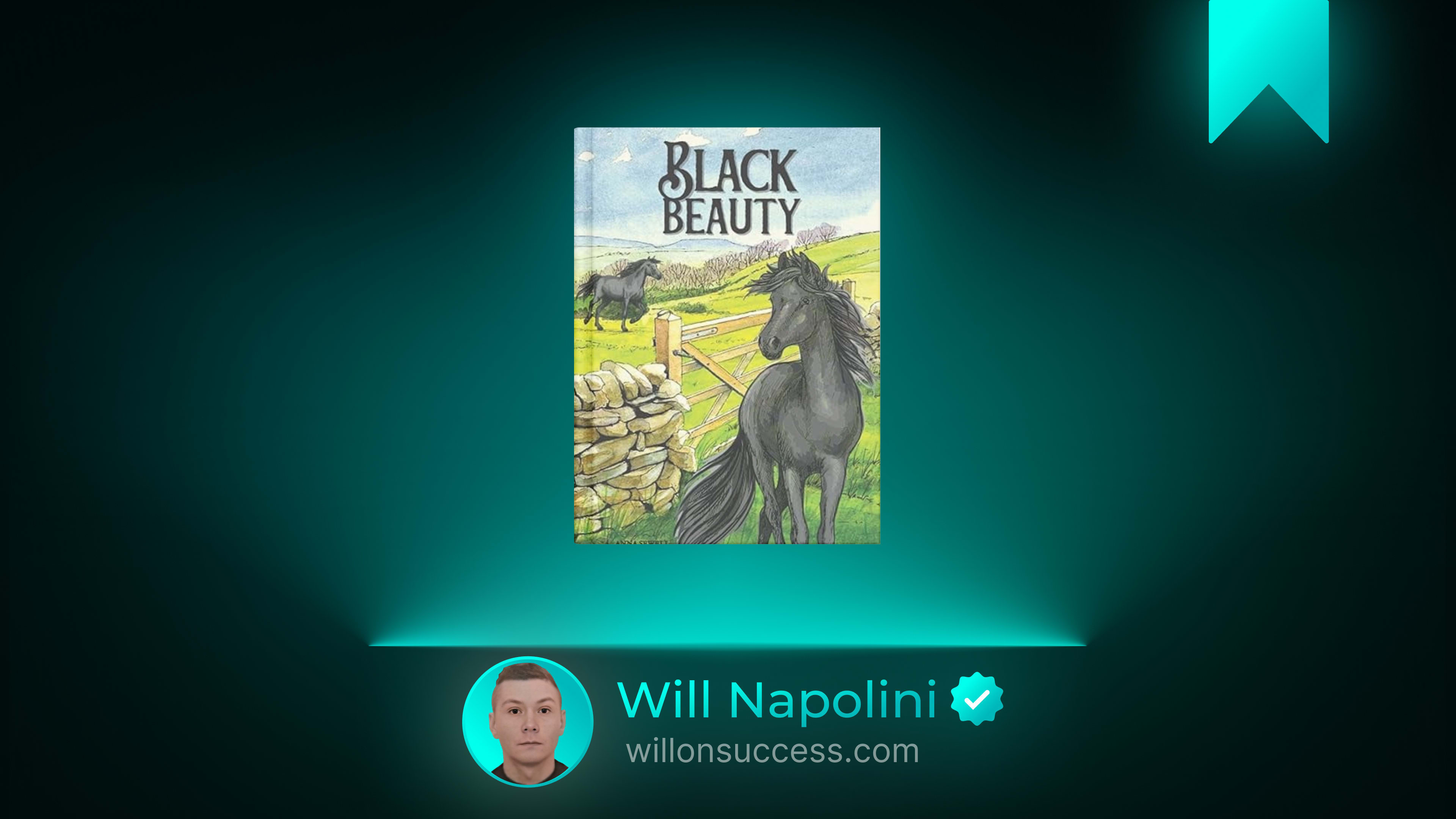
I want to introduce you to a teacher who never wrote a business book, never hosted a leadership seminar, and never spoke a single word of human language. Yet, through the pen of Anna Sewell in her 1877 novel Black Beauty, this teacher offers one of the most profound masterclasses on character, resilience, and empathy ever written.
If I could sit across the table from you right now, especially if you are in a season of life where you feel overworked, underappreciated, or forced to pull a heavier load than you bargained for, I would not hand you a book on productivity. I would hand you this story. Because before you can learn how to succeed, you must learn how to endure without losing your soul.
The Big Idea
On the surface, Black Beauty is a story about a horse. But at its core, it is a mirror held up to human nature. The central thesis of the book is that true character is not forged in the ease of the green meadow, but in the heavy pulling of the cobblestone street.
Sewell wrote the novel to advocate for the humane treatment of animals, but in doing so, she accidentally wrote a timeless guide to human dignity. The book teaches us that our worth is not tied to our current station. It reveals that how we treat those who are entirely dependent on us—or those who cannot speak for themselves—is the ultimate measure of our humanity. And it shows us that while we cannot always control the hands that hold our reins, we always retain the power to choose how we carry ourselves under the harness.
The Story of a Life Unbroken
To understand the power of this book, you have to understand the arc of Beauty’s life.
He begins in a pleasant meadow, raised by a mother who teaches him a foundational lesson before he leaves: to grow up gentle and good, to avoid bad habits, and to always work at a steady, honest pace. He is well-bred, well-treated, and beautiful.
But life does not stay in the meadow. Beauty is sold. Over the years, he passes through the hands of many different masters. Some are gentle and wise. Some are ignorant and careless. Some are actively cruel. He serves as a high-society carriage horse, matching steps with elegant lords and ladies. Later, through a series of misfortunes and injuries, he is reduced to a rented cart horse in London, pulling heavy loads through freezing rain for men who care only about the fare.
Through it all, Beauty does not become bitter. He does not kick, he does not break, and he does not lose his gentle nature. He observes the humans around him without malice. He simply does the work in front of him, relying on the deep, quiet dignity instilled in him during his earliest days.
When you read this story, you realize it is not really about a horse. It is about what happens to us when the world changes our station.
Your Circumstances Do Not Define Your Character
We live in a culture that closely ties our identity to our environment. We are our job titles, our zip codes, and our social standing. When those things are threatened, we feel our very selves are under attack.
But Black Beauty offers a radical alternative: Character before circumstances.
When Beauty is stripped of his comfortable stable and forced to pull a heavy cab in the bitter cold, he does not stop being a noble creature. The harshness of the cab driver does not make Beauty harsh. The ignorance of his owners does not make him ignorant. He adapts to the heavy load. He pulls it as well as he can.
You may be working hard right now and still wondering why nothing is changing. You may feel like you have been sold to a harsh master—a demanding boss, a struggling business, a difficult family situation. You might feel like your current environment is beneath your potential.
Here is what I have learned from watching people navigate deep adversity: You can lose your status, but you never have to surrender your dignity.
The world can change your station, but it cannot repossess your character unless you hand over the keys. If you allow a toxic environment to turn you toxic, the environment has won. But if you can maintain your integrity, do your work well, and treat others with grace even when you are exhausted, you are practicing a quiet, unbreakable strength. You prove that your character belongs to you, no matter who holds the reins.
The Architecture of True Empathy
Anna Sewell wrote this book because she was horrified by the casual cruelty of the Victorian era. But she understood something profound about human psychology: cruelty is rarely born of pure evil. It is usually born of thoughtlessness, vanity, or a lack of awareness.
One of the most powerful concepts in the book is the “bearing rein.” This was a piece of tack used in high society to force a horse to hold its head artificially high. It made the carriage look elegant and the horse look proud. But it caused the horse constant, low-grade suffering, restricted its breathing, and exhausted it much faster. The humans who used it didn’t necessarily hate their horses; they simply cared more about how the carriage looked to the neighbors than how the horse actually felt.
How often do we use bearing reins in our own lives?
In leadership, we sometimes demand unnatural postures from our teams just to make our department look good to the executives above us. In parenting, we sometimes push our children into exhausting schedules just so we can boast about their achievements. And in our own personal growth, we strap bearing reins on ourselves. We force ourselves into rigid, exhausting routines purely for the aesthetic of being highly productive, ignoring the quiet toll it takes on our mental health.
True empathy—the kind that changes lives—requires us to look past the appearance of the carriage and notice the breathing of the horse.
Empathy is not just feeling sorry for someone. It is the willingness to adjust your behavior to lighten their load. It is the leader who says, “I know we need this done, but I see you are running on empty. Let’s adjust the timeline.” It is the parent who looks at an overwhelmed child and says, “We are dropping this activity. Your peace is more important than this trophy.”
The quiet choices you make when no one is watching eventually build the public reality you live in. If you practice thoughtlessness, you build a life of friction. If you practice stewardship, you build a legacy of trust. The people who depend on you—your employees, your children, your aging parents, even your pets—cannot always speak up when the rein is pulled too tight. It is your responsibility to notice.
The Compound Effect of Gentleness
It is easy to think that changing the world requires massive, sweeping actions. But Sewell shows us that the trajectory of a life is altered by small, consistent acts of gentleness.
Throughout the book, Beauty encounters people who seem insignificant in the grand scheme of his life, but who change his reality through tiny interventions. A stable boy who sneaks him extra feed. A groom who takes the time to rub his legs down properly after a hard journey. A cab driver named Jerry Barker who refuses to overwork his horses, and who speaks to them with a calm, steady voice.
Jerry Barker is one of the great unsung heroes of personal development literature. He is poor. He works incredibly hard. But he understands a foundational principle: Consistency before intensity, and kindness before convenience.
Jerry knows that a horse treated with gentleness will work harder, last longer, and remain loyal. He doesn’t use the whip. He uses his voice. He uses patience.
You do not need a surge of willpower to be a good leader, a good partner, or a good friend. You need a daily rhythm that makes compassion the easiest choice. Gentleness is not a weakness; it is a highly effective strategy for long-term endurance. When you are consistently gentle with the people around you, you create an environment where they want to give you their best. When you are consistently gentle with yourself, you prevent the burnout that derails so many ambitious people.
A harsh word takes a second to speak, but it can sour a relationship for a month. A moment of patience takes a deep breath, but it can secure a decade of loyalty. Choose the long game.
Why This Matters on an Ordinary Tuesday
You might be wondering how a nineteenth-century story about a horse applies to your life this week.
Think about the last time you felt misunderstood at work. You put in the effort, but your manager only focused on the one metric you missed. You felt the sharp pull of the bearing rein. The natural human instinct in that moment is to become defensive, to pull back, to become cynical.
But what if you applied the wisdom of the meadow? What if you decided that your work ethic is an expression of who you are, not a reaction to how you are treated? You do the work well, not for the manager who doesn’t see you, but for the standard you hold for yourself.
Think about the people who report to you, or the family members who rely on you. Are you so focused on the destination—the quarterly goal, the clean house, the finished project—that you are ignoring the exhaustion of the ones pulling the load with you?
We often treat ourselves like the harsh cab drivers treated their horses. We drive ourselves into the ground for the sake of a few extra miles, ignoring the signs of fatigue until our knees buckle. We tell ourselves that rest is a reward for finishing, rather than a requirement for continuing.
Black Beauty invites us to stop and loosen the rein. It asks us to recognize that the vessel carrying us through life—whether that is our own body, our team, or our family—requires care, not just commands.
Practical Application: Building a Life of Dignity and Care
Understanding these principles is valuable, but understanding without action changes nothing. If we want to integrate the wisdom of this story into our modern lives, we need concrete practices.
Here are three ways to apply the lessons of Black Beauty starting today.
1. Audit Your Bearing Reins
Take ten minutes with a journal. Identify the bearing reins in your life. These are the small, unnecessary pressures you place on yourself or others purely for the sake of appearances or outdated expectations.
- Are you checking email late at night just to look dedicated, even though it ruins your sleep?
- Are you forcing your team into rigid daily status meetings that drain their energy without providing value?
- Are you maintaining a social obligation that brings you nothing but resentment?
Find one bearing rein and consciously cut it. Give yourself, or someone you lead, permission to breathe easier.
2. Practice Active Stewardship
Look at your sphere of influence. Identify one person who depends on you and cannot easily push back. This might be a junior employee, a young child, an aging parent, or even a pet.
Today, do one thing specifically to lighten their load. Do not do it to get a better result out of them. Do not do it so they will praise you. Do it simply because you have the power to offer relief. Bring them a glass of water, take over a tedious task, or simply offer them your full, unhurried attention for ten minutes.
3. Maintain Dignity in the Cart
If you are currently in a season of hard, unglamorous work, make a quiet pact with yourself. You will do the work well. You will not let the harshness of the environment make you harsh in return. When you feel the urge to complain, to cut corners, or to take your frustration out on a coworker, pause. Remember the meadow. Remember who you are at your core. Let your character be the one thing the world cannot repossess.
Who Should Read This Book
Black Beauty is not a fast-paced thriller, nor is it a tactical manual for entrepreneurs. If you are looking for aggressive strategies to dominate a market, this book will not serve you.
However, this book is essential reading for leaders, managers, and parents. It is a profound resource for anyone who holds power over others and wants to learn how to wield that power with grace.
It is also deeply healing for anyone going through a season of unexpected hardship. If you feel like life has knocked you down a few pegs, if you feel overworked and underappreciated, spending time with Beauty will remind you that your current station is not your final destination. It will remind you that endurance is not defeat.
The prose is simple, clear, and deeply emotional. It bypasses the intellect and speaks directly to the conscience. It is a book that makes you want to be a better human being, not because you are told to, but because you have seen the quiet beauty of a life lived with gentle integrity.
One Small Step
The deepest idea of Black Beauty is that while we cannot control the road we are put on, we can always choose the spirit in which we walk it. We can choose to be the master who loosens the rein, and we can choose to be the creature who maintains its dignity in the storm.
You do not need to overhaul your entire life today. You just need to take one step toward a more compassionate, grounded way of living.
Here is your one small step for today:
Identify one moment today where you feel the urge to rush, to push, or to demand more from yourself or someone else. In that exact moment, pause. Take one deep breath. Loosen the rein. Speak a gentle word, to them or to yourself, and proceed at a steady, humane pace.
A life of quiet strength is not built in a single leap. It is built one loosened rein at a time.