The Architecture of Trust: What Coach K Teaches Us About Leadership Beyond the Game
I used to believe that great leadership was about having the perfect plan. If you could just map out every contingency, assign every role, and anticipate every obstacle, success would simply be a matter of execution. I spent years trying to draw up the perfect “play” for my life, my career, and my teams. But what I discovered, often the hard way, is that a plan only survives until it meets the unpredictable nature of human beings.
What if the secret to enduring success has very little to do with the strategy you design, and everything to do with the environment you cultivate?
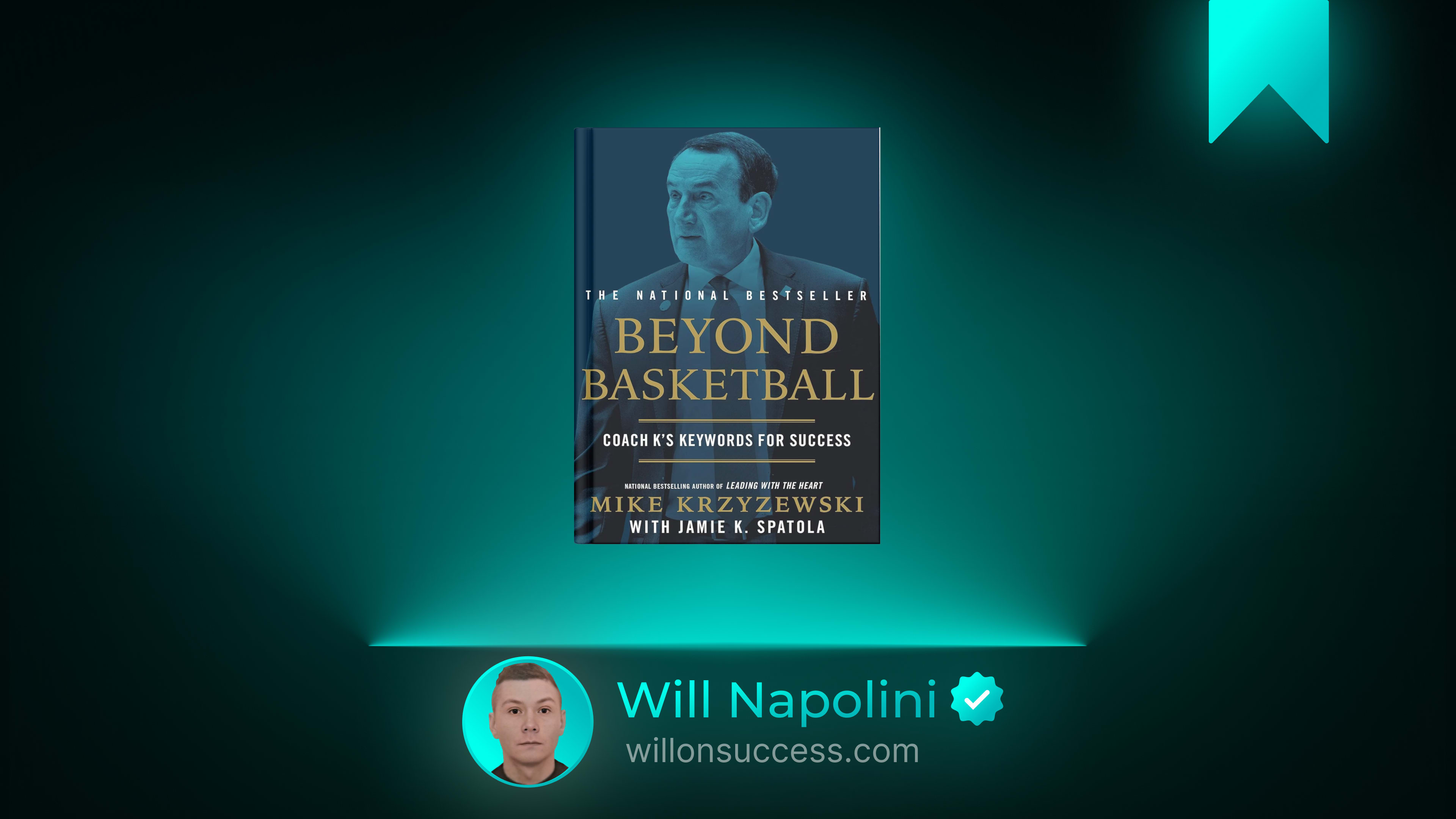
In Beyond Basketball: Coach K’s Keywords for Success, legendary Duke University and USA Basketball head coach Mike Krzyzewski strips away the complexity of leadership. The book is not a dense manual of technical strategies. Instead, it is a collection of short, potent reflections on the human elements of winning.
The central thesis is profound in its simplicity: You cannot lead people if you do not understand them, and you cannot build a winning culture without a foundation of relentless communication, mutual trust, and radical adaptability. Coach K shows us that the principles that build championship teams are the exact same principles that build resilient families, thriving businesses, and a meaningful life.
The Story of the “Next Play”
Consider the concept of the “Next Play.” In basketball, a player might miss a crucial shot, throw a lazy pass, or commit a foolish foul. The crowd groans. The momentum shifts. But Coach K demands that his players immediately clap their hands, yell “Next play!”, and sprint back on defense.
Dwelling on the mistake costs you the current moment. The “Next Play” mentality is not about ignoring failure; it is about refusing to let a past mistake contaminate your future performance. I have seen this exact dynamic destroy careers and relationships. We hold onto a missed opportunity, a harsh word, or a failed project, and we carry its heavy ghost into our next endeavor. Coach K teaches us that resilience is not an innate trait; it is a practiced habit of mental redirection.
Communication Is the Mortar Between the Bricks
You can have the most talented people in the room, but if they cannot communicate, you do not have a team; you have a collection of individuals sharing a space.
Coach K famously identifies communication as the single most important factor in team building. But he isn’t talking about polite emails or weekly status meetings. He is talking about “truthful communication” and looking each other in the eye. This means speaking with conviction, and listening with the intent to understand rather than to reply.
A team without truthful communication is like a house built without mortar. The bricks might be stacked high, and from a distance, the structure might look impressive. But the first time a strong wind blows, it will collapse because there is nothing binding the pieces together. When you replace assumptions with honest, respectful dialogue, you clear the air. You build trust. A team that communicates truthfully can weather any storm because they do not have to waste energy guessing where they stand with one another.
Empathy Is Understanding the Soil Before You Plant
There is a dangerous myth in leadership that empathy makes you soft. The old guard often believed that to drive results, you had to maintain an emotional distance.
Krzyzewski shatters this illusion. Empathy is the process of understanding the soil before you plant the seed. You cannot demand that an oak tree grow in shallow sand, and you cannot demand peak performance from a person whose personal life is currently in drought. He built his career on understanding the unique backgrounds, fears, and motivations of every young man who walked into his locker room. He didn’t treat everyone the same; he treated everyone fairly. Fairness does not mean uniformity. It means giving each person what they specifically need to succeed.
When you lead with empathy, you are not lowering your standards. You are raising your effectiveness. Empathy gives you the data you need to actually help people grow, rather than just demanding that they do.
Standards Are the Craftsmanship, Not the Scaffolding
Rules are created to control behavior. Standards are created to inspire it.
In Beyond Basketball, there is a clear distinction between the two. A rule says, “Do not be late.” A standard says, “We respect each other’s time and commitment.”
Rules are the scaffolding; standards are the craftsmanship. Scaffolding is necessary when you are first building a structure, but eventually, it must come down so the building can stand on its own. If your team only behaves well when the scaffolding of strict rules and your watchful eye is in place, you haven’t built a culture; you’ve built a construction site. When you establish standards, you build a culture where people hold themselves and each other accountable because they refuse to let down the standard they helped create.
The Power of the “Tap”
One of the most beautiful, subtle concepts in the book is the physical act of tapping a teammate on the chest or back after a good play, or even to encourage them after a mistake. It is a micro-interaction that says, “I see you. I am with you. We are in this together.”
In our digital, distracted world, we have lost the art of the tap. We send a thumbs-up emoji instead of looking a colleague in the eye and saying, “I really appreciated how you handled that client.” We assume our families know we love them without offering small, daily physical and verbal affirmations. The tap is a reminder that connection requires intentional, physical, and immediate presence. Small acknowledgments compound over time into an unbreakable bond of trust.
Why It Matters in Your Life
If I could sit across the table from you right now, I would tell you that the basketball court is just a metaphor. The dynamics of human collaboration remain identical whether you are passing a ball, launching a software product, or raising a family.
If you are an entrepreneur, your daily interactions with your co-founders and early employees are your “keywords.” Are you communicating the truth, or just the good news? If you are a manager, are you relying on the rigid rules of your employee handbook, or are you building a standard of excellence? If you are an individual trying to break a bad habit, are you punishing yourself for yesterday’s slip-up, or are you practicing the “Next Play” mentality to win today?
Practical Application
Understanding these principles is only the beginning. Wisdom without action is merely entertainment. Here is how you can bring Coach K’s philosophy into your life this week:
- Audit Your Communication: For the next three days, practice “eye-contact truth.” When you are speaking to someone—your spouse, your barista, your junior analyst—stop multitasking. Look them in the eye. Give them your full, undivided presence. Notice how the quality of your interactions changes.
- Adopt the “Next Play” Trigger: Choose a physical or mental trigger for when you make a mistake. It could be snapping your fingers, taking a deep breath, or literally saying “Next” out loud. When you send a poorly worded email or lose your temper, use the trigger. Acknowledge the error, forgive yourself instantly, and move to the next action.
- Convert a Rule to a Standard: Look at one area of your life where you rely on a strict rule. Maybe it’s “I must work out for exactly one hour every day.” Convert it to a standard: “I honor my physical health by moving my body with intention every day.” Notice how the shift in language changes your motivation and flexibility.
Who Should Read This Book
Beyond Basketball is a masterclass for anyone who finds themselves in a position of influence. If you are a team leader, a manager, a teacher, a coach, or a parent, this book will give you a vocabulary for building trust. It is highly readable, broken into bite-sized chapters that you can digest in five minutes and ponder for five days.
However, if you are looking for a deeply analytical, data-driven business book filled with complex organizational charts and financial models, this is not for you. This book operates on the level of the human heart and the psychology of teamwork. It is for those who understand that at the end of the day, every enterprise is just a group of people trying to do something difficult together.
One Small Step
You do not need to overhaul your entire leadership style or your life today. You just need to start with one small, intentional action.
Tomorrow morning, before you open your email or look at your phone, identify one person on your team or in your family who has been working hard behind the scenes. Send them a brief, specific message—or better yet, tell them in person—exactly what you noticed and why it matters.
Give them the “tap” of acknowledgment.
Because the championship you are trying to win tomorrow is built entirely on the quiet, deliberate connections you choose to make today.