Stop Asking Questions: How to Actually Get to the Truth in Any Conversation
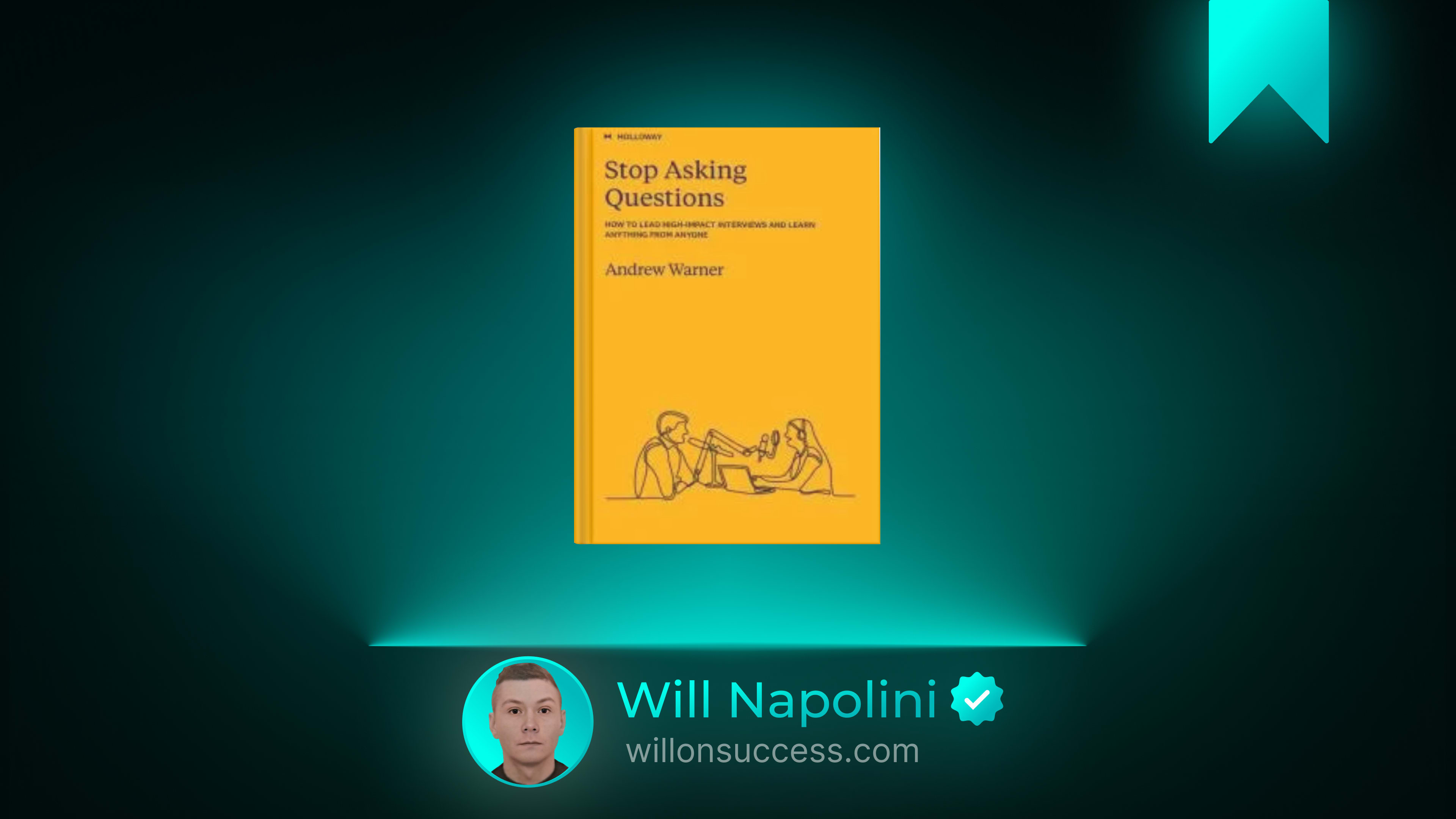
Think about the last time you tried to learn something profound from someone you admired. Maybe it was a mentor, a successful colleague, or a founder you respect. You sat across from them, leaned in, and asked what you thought was the perfect, open-ended question:
“How did you build such a strong company culture?” or “What was your biggest challenge in the early days?”
And they smiled. They gave you a polished, thoughtful, three-minute answer. You nodded. You took notes.
But later, when you reviewed what they said, you realized something uncomfortable. You didn’t actually learn anything you couldn’t have read in their LinkedIn bio. You got the PR version. The safe version. The rehearsed version.
I have spent years watching people try to extract wisdom from others, and I have noticed a quiet tragedy that happens in offices, podcast studios, and coffee shops every single day. We ask brilliant people brilliant questions, and we get hollow answers. Not because the people are lying, and not because our questions are bad. But because a traditional question is often the exact wrong tool for breaking through the walls people build around their real experiences.
Andrew Warner, the founder of the entrepreneur interview platform Mixergy, discovered this after conducting over two thousand interviews. He realized that if you want to get to the raw, unvarnished truth of how someone actually survived a crisis, built a fortune, or navigated a failure, you have to stop relying on questions.
You have to become a guide.
Stop Asking Questions is not literally a command to never use a question mark. It is a provocation. It is an invitation to abandon the passive role of the “interviewer” who simply volleys prompts across a table, and to adopt the active, sometimes uncomfortable, deeply rewarding role of someone who guides another human being into the deep end of their own story.
Here is how that shift works, and why it will change the way you lead, parent, mentor, and connect.
The Big Idea: A Question Hands Them a Blank Canvas. An Anchor Hands Them a Sketch.
When you ask a broad, open-ended question like, “Tell me about your strategy,” you are handing the other person a blank canvas and asking them to paint. You are placing the entire burden of structure, context, and narrative on their shoulders.
And what do people do when handed a blank canvas in a professional setting? They paint what is safe. They paint what makes them look good. They give you the high-level summary because they do not know which specific details you actually care about.
Warner’s central thesis is that to get to the truth, you must do the heavy lifting before the conversation even begins. You must build the scaffolding.
Instead of asking a question, you make a statement based on deep research or careful observation. Warner calls this an Anchor.
An anchor sounds like this: “I was looking at your revenue from 2018 to 2019, and I noticed you completely stopped selling to enterprise clients right when you were gaining momentum. That is a terrifying move to make. Walk me through the Tuesday afternoon you decided to cut off that revenue stream.”
Notice the difference. You are not asking them to figure out what to talk about. You are dropping a heavy, specific, undeniable fact onto the table and asking them to react to it. You have built the frame; now they just have to fill it in.
A question invites a performance. An anchor invites a confession.
The Courage to Confess: Trading Armor for Truth
There is a deeply human reason people do not share their real failures, their real fears, and their real mistakes. It is not always because they are arrogant. Often, it is because they are protecting themselves, and they are waiting for a signal that it is safe to drop the armor.
If you want someone to share the messy, painful, educational reality of their journey, you cannot just ask them to bleed while you sit safely on the other side of the table with a notepad. You have to bleed first.
Warner calls this the Confession.
When you are trying to understand how someone navigated a difficult partnership, do not just ask, “How do you handle conflict with co-founders?” Instead, offer a confession. “I completely lost my temper with my business partner last year over a hiring decision, and it damaged our trust for months. I still don’t fully know how to repair it. When was the last time you felt that kind of fracture in your own partnership, and what did you do?”
What I have learned from watching this dynamic play out is that vulnerability is not a soft skill. It is a tactical mechanism for bypassing the ego. When you lead with your own imperfection, you instantly dismantle the hierarchy of the conversation. You are no longer the examiner and the examinee. You are two flawed humans trying to figure out how to survive the work.
We do not hide our failures because we are ashamed; we hide them because we have not been given permission to share them. Your confession is the permission slip.
The Art of the Gentle Pushback: Friction Creates Clarity
This is the part of the book that makes most people uncomfortable, and it is the part that yields the highest reward.
When someone gives you an answer that sounds like a cliché, or when their stated values do not match their actual behavior, the polite instinct is to nod and move to the next question. We are taught that good communication means avoiding conflict.
Warner argues the opposite. If you care about the truth, you must be willing to introduce friction. He calls this the Pushback.
Imagine a leader tells you, “Our culture is entirely built on radical transparency and work-life balance.” But you know their company has a 40% turnover rate and people are emailing at midnight.
A passive asker moves on. A guide pushes back gently, but firmly. “You say transparency and balance are your core values, and I deeply respect that intention. But I also know your turnover rate is high and the team is working weekends. Help me understand the gap between the culture you want to build and the reality your team is experiencing on the ground.”
This is not an attack. It is an act of deep respect. It tells the other person: I am paying close enough attention to notice the contradictions, and I respect you enough to ask you to explain them.
Friction, when applied with warmth and genuine curiosity, is not a weapon. It is a flint striking steel. The spark of insight only happens when there is resistance. When you politely challenge a rehearsed answer, you force the person to abandon the script and actually think in real time. And the unscripted mind is where the real wisdom lives.
Projections: Bypassing the Defensive Wall
Sometimes, a person is so deeply entrenched in defending their current decisions that they cannot see their own blind spots. If you ask them directly about their current strategy, their ego will immediately fortify the walls.
Warner suggests using Projections to bypass the ego. You move the conversation out of the defensive present and into the hypothetical future or the reflective past.
Instead of asking, “Why are you pricing your product this way?” (which makes them defend their current choice), you project: “If you were forced to start this company over from scratch tomorrow, with everything you know now, what is the very first pricing decision you would change?”
Or, “Imagine it is five years from now and this exact strategy has failed completely. Looking back from that future, what was the hidden flaw we are ignoring today?”
By moving the mind to a different time horizon, you detach the person’s ego from their current choices. You give them the psychological safety to critique their own work without feeling like they are admitting defeat in the present moment.
Why This Matters on an Ordinary Tuesday
You might be thinking, This is great for podcasters and journalists, but I am just a manager, a parent, or a friend. How does this apply to me?
It applies everywhere. Because the core problem Warner is solving is not “how to interview.” The core problem is human defensiveness and the superficiality of modern connection.
Think about a manager doing a quarterly review. If the manager asks, “Are you happy with your workload?” the employee will almost always say, “Yes, it’s fine,” because they do not want to look weak or complain. The manager gets a false positive.
But if the manager uses an anchor and a confession: “I was looking at your hours this month and I noticed you were online at 9 p.m. three times last week. I used to do that when I felt like I was falling behind, and it eventually burned me out. Tell me what is actually piling up on your desk that we need to kill or delegate.”
Suddenly, you are not having a performance review. You are having a real conversation. You are solving a real problem.
Think about a parent talking to a teenager. “How was school?” yields “Fine.” An anchor yields: “I saw your math grade dropped this quarter, and I know that class has been a grind. I struggled with calculus too, and I felt incredibly stupid in front of the whole class. What is the specific part of the material that is tripping you up?”
The mechanics of human connection do not change whether you are extracting business wisdom from a billionaire or trying to understand why your child is quiet at the dinner table. People need scaffolding. They need permission. They need you to do the work of guiding them to the truth.
Who Should Read This Book
If you are a podcaster, a journalist, a sales professional, or a researcher whose literal livelihood depends on getting people to open up, this book is mandatory reading. Warner provides highly specific, tactical frameworks that will immediately improve the depth of your interviews.
If you are a leader, a manager, or a mentor, this book will fundamentally change how you run one-on-one meetings. It will teach you how to stop accepting surface-level updates and start uncovering the actual bottlenecks and fears holding your team back.
It will be less useful if you are looking for a guide to casual networking or small talk. These techniques require preparation, emotional bandwidth, and a willingness to be slightly confrontational. You do not use a pushback when you are chatting with a stranger in an elevator. You use it when you are sitting across from someone whose wisdom you desperately need to understand.
Warner’s writing is practical, anecdotal, and deeply rooted in the thousands of hours he has spent talking to founders. It is not a theoretical book about psychology; it is a playbook forged in the crucible of real, high-stakes conversations.
Practical Application: Building Your Conversational Scaffolding
Understanding the theory is easy. Changing your conversational habits is hard. Here is how you can start shifting from an asker to a guide this week.
1. The Pre-Conversation Audit Before your next important meeting, mentorship call, or deep conversation, spend fifteen minutes doing research. Do not just look at their current title. Look at their timeline. Find one specific, unusual decision they made in the past. Find one metric that looks strange. Write down one Anchor statement based on that research. Walk into the room with your scaffolding already built.
2. The Vulnerability Ledger Identify one area where you are currently struggling, failing, or feeling inadequate. Own it. Write it down. The next time you are trying to learn from someone who has mastered that area, use it as a Confession. Trade your armor for their truth. Watch how quickly the dynamic shifts from an interrogation to a collaboration.
3. The Gentle Friction Rule The next time someone gives you an answer that sounds like a corporate buzzword, a rehearsed platitude, or an obvious contradiction, do not let it slide. Pause. Smile. Say, “That makes sense in theory, but I know the reality on the ground is usually much messier. What happens when that philosophy collides with a client who is screaming at you?” Give them permission to drop the script.
One Small Step
I want you to try one specific shift today. It requires no preparation, only a slight change in how you form your sentences.
Think of one thing you genuinely want to know about someone in your life—a colleague, a friend, a partner. You probably have a standard question queued up in your head: “How did you get so good at X?” or “How are you handling Y?”
Do not ask the question. Turn it into an observation.
Start your sentence with: “I have noticed that you…”
“I have noticed that you always seem to stay calm when the rest of the team is panicking. Walk me through what you are actually doing in your head in those moments.”
“I have noticed that you never check your phone during our dinners, even when things are busy at work. How did you build that boundary?”
Notice what happens. Notice how their eyes change. Notice how they lean in. You have just proven to them that you are actually watching them, that you see them, and that you have done the work of noticing their specific reality.
We spend so much of our lives asking people to explain themselves, handing them the microphone and hoping they will say something profound. But people rarely reveal their profound truths to a microphone. They reveal them to a guide. They reveal them to someone who has walked part of the path, built a bridge, and gently invited them to cross over.
The truth is rarely given to those who simply ask for it. It is unlocked by those who do the hard, humble work of building the door.
Stop asking. Start building. The conversation you have been waiting for is on the other side of the first statement you are brave enough to make.