The Most Liberating Truth About Creativity Is That Nothing Is Original
There is a particular kind of paralysis I have watched settle over people right at the moment they decide to make something. A writer sits down to write the first sentence and freezes, because the sentence in their head sounds too much like someone else’s sentence. A musician picks up a guitar and puts it down, because every chord progression they try echoes a song they love. A designer stares at a blank canvas and closes the laptop, because everything they imagine feels like a lesser copy of something that already exists.
The voice in their head says: If I cannot make something no one has ever seen before, I have no business making anything at all.
I have felt that voice. I suspect you have too. It is the voice of the Originality Myth, and it has quietly destroyed more creative work than any lack of talent ever could.
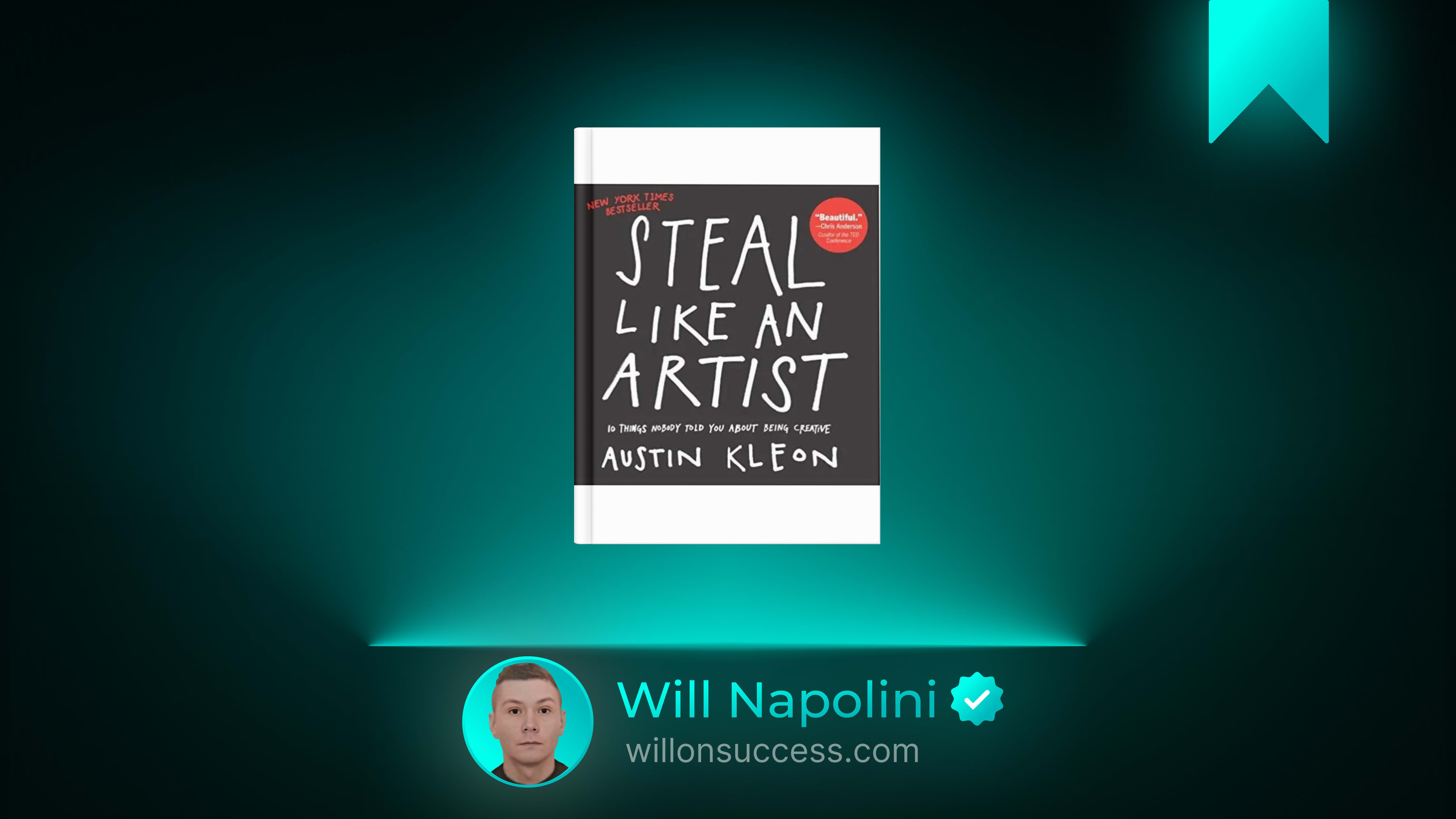
Austin Kleon wrote a small, fierce, hand-drawn book to kill that myth dead. It is called Steal Like an Artist: 10 Things Nobody Told You About Being Creative, and it is barely 150 pages long. You could read it in a single afternoon. But the idea at its center, once you truly let it in, has the power to unlock years of work you have been holding back because you were waiting to be someone you are not yet.
The idea is this: nothing is original. Every creative work is built on what came before. And that is not a failure. That is the entire mechanism by which art and ideas move forward.
Let me show you why that is the most freeing sentence you will read today.
The Big Idea: You Are a River, Not a Fountain
Kleon’s central argument is deceptively simple. We have inherited a romantic, almost religious image of the artist as a lone genius who pulls fully formed ideas out of thin air. A fountain, gushing original water into an empty world. And if you cannot be that fountain — if your ideas feel borrowed, derivative, recycled — then you have nothing to offer.
Kleon looks at that image and says: no. That is not how creativity works. It has never worked that way.
Every artist, writer, musician, inventor, and maker is a river, not a fountain. You are fed by tributaries. Every book you loved, every song that cracked you open, every teacher who changed your thinking, every stranger’s conversation you overheard on a train — those are the streams that flow into you. And what comes out the other side is not a copy of any single source. It is a blend. A remix. A new combination of old ingredients, filtered through the specific, unrepeatable experience of being you.
The goal is not to create from nothing. The goal is to take what moves you, study it deeply, combine it with other things that move you, and let your own perspective transform it into something that could not have existed without you being the one who mixed it.
That is not cheating. That is the process. Every artist you admire did exactly this. They stood on the shoulders of the people who came before them, looked around, and said, What can I build here that no one else could?
The Genealogy of Ideas: Trace the River Back to Its Sources
One of the most practical and genuinely exciting concepts in the book is what Kleon calls tracing your influences back. He does not mean this as an academic exercise. He means it as a creative strategy.
Think about the people whose work makes you stop and say, How did they do that? I want to make something that feels like that. Kleon says: do not just admire them from a distance. Study them. Look at their work closely. And then — and this is the crucial step — find out who they stole from. Trace their influences. Read the books they read. Listen to the music they listened to. Look at the art that shaped their eye.
And then trace those influences back one more generation.
What you are building, Kleon argues, is a family tree of ideas. A genealogy of inspiration. And when you have traced three or four or five generations back, you will find something remarkable: you will have gathered a collection of influences so broad, so varied, and so personally chosen that no one else on earth has assembled the same combination. You have built your own private library of raw material. And from that library, something genuinely new can emerge.
Imagine a cook who studies only one cuisine. Their food will always taste like an imitation. But the cook who studies French technique, Japanese precision, Mexican spice, and their own grandmother’s Sunday cooking — that cook will produce something no single tradition could generate alone. Not because they are more talented. Because their inputs are more varied, more personal, more deeply studied.
You are that cook. Your influences are your ingredients. The more honestly and widely you gather them, the more distinctly yours the final dish will be.
Good Theft and Bad Theft: The Difference Is Everything
Kleon is careful — and I think this matters enormously — to distinguish between two kinds of “stealing.” He is not giving you permission to plagiarize. He is not saying you should copy someone’s work and put your name on it. That is bad theft. That is lazy, dishonest, and ultimately hollow, because it gives you a product without giving you the understanding that produced it.
Good theft is different. Good theft looks like this:
You study. You deconstruct. You ask, Why does this work? What makes this line land? What is the structure underneath this song? You take the principle, not the product. You take the approach, the method, the way of seeing. And then you run it through your own life, your own obsessions, your own limitations, and what comes out sounds like you, even though the seeds came from somewhere else.
A simple way Kleon frames it: bad theft copies one source. Good theft studies many sources. Bad theft takes the surface. Good theft digs for the mechanism. Bad theft says, I want to be this person. Good theft says, I want to understand how this person sees, and then I want to see through my own eyes.
The difference is not legal. It is spiritual. One path keeps you forever in someone else’s shadow. The other path uses their light to find your own direction.
Start Before You Know Who You Are
There is a second idea in this book that I think saves more creative lives than any other, and it addresses the most common excuse I hear from people who want to make things but never do:
I don’t know my voice yet. I don’t know what I want to say. I’ll start when I figure it out.
Kleon’s response is blunt and liberating: you do not figure out who you are and then start making. You start making, and the making reveals who you are.
You do not find your voice by sitting quietly and waiting for it to announce itself. You find it by writing badly, drawing clumsily, playing wrong notes, building crooked things, and noticing — in the middle of the doing — which parts feel true and which parts feel borrowed. Your voice is not a destination. It is a residue. It is what is left over after you have imitated enough people, badly enough, long enough, that the only person left to imitate is yourself.
I have seen this happen over and over. The person who waits until they feel “ready” to begin is the person who never begins. Because readiness is a myth. Confidence does not precede action. Confidence follows action. You take the first clumsy step, and the step tells you where to put the second.
You do not need permission. You do not need a finished identity. You need a pencil, a bad first draft, and the willingness to be a beginner in public.
Use Your Hands: Step Away From the Glow
One of the quieter but more important threads in the book concerns the relationship between your body and your ideas. Kleon advocates strongly for keeping analog tools in your creative process. Notebooks. Pens. Scissors. Glue. Index cards. A whiteboard. A stack of printed images you can physically rearrange on a desk.
This is not nostalgia. It is not anti-technology. It is a recognition that your brain works differently when your hands are involved. When you type, you think in sentences and paragraphs. When you sketch, you think in shapes and relationships. When you physically cut and paste images, you discover connections that would never occur to you while scrolling a screen.
The screen is a tool for finishing. The hands are a tool for finding.
If you have been staring at a blinking cursor for an hour and nothing is coming, the answer is rarely to stare harder. The answer is to stand up. Get a piece of paper. Doodle. Write by hand. Cut something out of a magazine. Build something with your fingers. Let the slowness of analog work give your brain the space it needs to wander toward an idea it could not reach at full speed.
Side Projects Are Not Distractions. They Are Cross-Training.
Kleon pushes back gently against the idea that you must have one single passion, one calling, one narrow lane. He celebrates side projects, hobbies, and what he calls “creative cross-training.”
The novelist who also gardens. The programmer who also paints watercolors. The accountant who also builds birdhouses. These are not distractions from the “real” work. They are the cross-currents that keep the real work alive. They give your mind a different problem to solve, a different rhythm to follow, a different set of constraints to play inside. And the skills, perspectives, and energies they generate flow back into your primary work in ways you cannot predict.
I have learned this in my own life. The periods when I try to focus on only one thing, to the exclusion of everything else, are the periods when that one thing goes stale. The periods when I allow myself to wander, to dabble, to be bad at something new, are the periods when the main work suddenly cracks open with fresh energy.
You are allowed to have more than one interest. You are allowed to be a person with a wide, curious, undisciplined mind. That width is not a weakness. It is the raw material of originality.
Be Boring: The Unsexy Truth About Getting Work Done
Here is a chapter of thought in the book that surprised me the first time I read it, and that I now consider one of its most honest contributions. Kleon has a section essentially titled: Be boring.
His argument is that the most important thing you can do for your creative life is to take care of your basic, unglamorous human needs. Sleep. Eat real food. Pay your bills. Keep a routine. Show up at the same time every day. Do the dishes. Walk the dog. Go to bed at a reasonable hour.
Because the wild, chaotic, romantic image of the artist burning the candle at both ends, living in beautiful disorder, fueled by chaos and insomnia — that image makes for good movies. But it makes for terrible, short careers.
The work requires a container. A routine. A life stable enough that the creative energy has somewhere to land. You protect your mornings. You guard your sleep. You say no to the things that drain you so that you have energy left for the thing that matters.
A small decision becomes a direction, and a direction repeated long enough becomes a life. The boring scaffolding of a well-kept daily routine is not the enemy of creativity. It is the trellis that allows the vine to climb.
Creativity Is Subtraction: Choosing What to Leave Out
The final principle I want to draw from the book is one that applies far beyond art. Kleon argues that creativity is not about adding more. It is about choosing what to leave out.
A blank page with infinite possibilities is not freedom. It is paralysis. What actually generates creative energy is constraint. A deadline. A word limit. A specific medium. A rule that says, You may only use these three colors. You may only write 500 words. You must finish by Friday.
Constraints force decisions. Decisions force clarity. And clarity is where the interesting work lives.
You see this everywhere. The poet who writes in strict meter produces more surprising language than the poet who can write anything. The filmmaker with a tiny budget discovers visual strategies that the filmmaker with a hundred million dollars never needs to invent. Limitation is not the absence of possibility. It is the engine of it.
If you are stuck, the answer is rarely to give yourself more options. The answer is to remove options. Shrink the canvas. Set a timer. Choose a constraint and let it do the choosing for you.
What This Looks Like on an Ordinary Tuesday
Let me bring this down from principle to practice, because I think the distance between understanding “steal like an artist” and actually making something is where most people get lost.
Say it is a Tuesday evening. You have an hour. You have been wanting to write, or draw, or build, or compose something for months, but every time you sit down, the blank page stares back and the voice says, You have nothing original to say.
Here is what you do instead of arguing with that voice:
You open your notebook. You look at the three things you collected this week — a line from a book that struck you, a photograph you saved on your phone, a snippet of conversation you overheard at a coffee shop. You do not try to combine them into a masterpiece. You just play. You write the line from the book in your own words. You sketch the shape of the photograph from memory, badly. You write the conversation as if it were happening between two characters you invent.
You do not aim for quality. You aim for motion. You let your hands move. You let the influences mix. You let yourself be bad.
And at the end of the hour, you will have something. It will be rough. It will be imperfect. It will bear traces of the three things you started with, and it will also bear traces of you, because no one else would have chosen those three things, combined them in that order, filtered them through that particular evening’s mood.
That is the work. That is how it starts. Not with a thunderbolt of genius. With a small, honest act of remixing.
Who Should Read This Book
If you have ever wanted to make something — a book, a song, a painting, a business, a garden, a podcast, a meal that is more than a recipe — and have been stopped by the fear that you are not original enough, not talented enough, not ready enough, this book will feel like someone opening a window in a room you did not realize was sealed shut.
It is short. It is visual. It is warm and funny and deeply encouraging without being saccharine. Kleon draws his own illustrations, includes his own lists and diagrams, and writes in a voice that feels like a friend sliding a notebook across the table and saying, Here. Try this. It’s easier than you think.
It will be less useful if you are looking for a deep, theoretical exploration of creativity, or a structured curriculum with exercises and assessments. This is not a textbook. It is a permission slip. It is a pep talk. It is the book you read in one sitting when you need to remember that you are allowed to make things, and that the making itself is the reward.
One honest note: because the book is brief and broad, it gives you the why and the what of creative courage, but it does not give you the how of any specific craft. It will not teach you to write a novel or compose a symphony. It will teach you to believe you are allowed to try. And sometimes, that is the harder lesson.
One Small Step
I am going to ask you to do one thing before this day ends. It is small. It is concrete. And it is the first brick in the wall.
Think of one person whose creative work you admire. A writer, a musician, a designer, a filmmaker, a chef, a builder. Anyone.
Now, spend fifteen minutes finding out who they admired. Who influenced them? What books did they love? What music did they grow up listening to? Who did they study under? Who did they cite, reference, or thank in their interviews and acknowledgments?
Write down three names. Three people who fed the person who feeds you.
That is your genealogy. That is the beginning of your tributary map. You do not have to study all of them tonight. You do not have to master anything. You just have to notice the river you are already standing in.
And then, tomorrow, make one small thing. A paragraph. A sketch. A chord progression. A recipe with one ingredient swapped. Let it be bad. Let it be borrowed. Let it be yours.
Because here is what I keep coming back to, long after I finished this small, generous book: the world does not need your perfection. It does not need your originality in some pure, untouched, never-before-seen sense. The world needs your perspective. Your specific, unrepeatable way of combining the things you love. Your particular angle on the shared human experience.
No one else has read exactly what you have read. No one else has heard exactly what you have heard. No one else has lived inside your specific Tuesday evenings, your specific griefs, your specific small joys. And that combination — that unrepeatable mix of inputs filtered through your one life — is the only thing you can offer that no one else can.
You do not need to be a fountain. You just need to let the river run through you.
Pick up the pen. The page is not asking you to be new. It is asking you to be honest. And honest, it turns out, is more than original enough.