Become an Idea Machine: Why Your Best Thinking Is a Habit, Not a Gift
Become an Idea Machine: Why Your Best Thinking Is a Habit, Not a Gift
There is a quiet sentence most of us carry somewhere in the back of our minds. It goes something like this: I’m just not a creative person.
Maybe you said it when a colleague brainstormed solutions effortlessly in a meeting while you sat there, drawing small circles in the margin of your notebook. Maybe you thought it while scrolling through someone else’s business launch, their novel, their podcast, their reinvention at fifty-two. Maybe you whispered it to yourself the night you almost wrote the proposal, almost pitched the concept, almost started the thing you had been turning over in your head for months—and then closed the laptop instead.
I want to talk to you about a book that takes that sentence, holds it up to the light, and shows you exactly where it breaks apart.
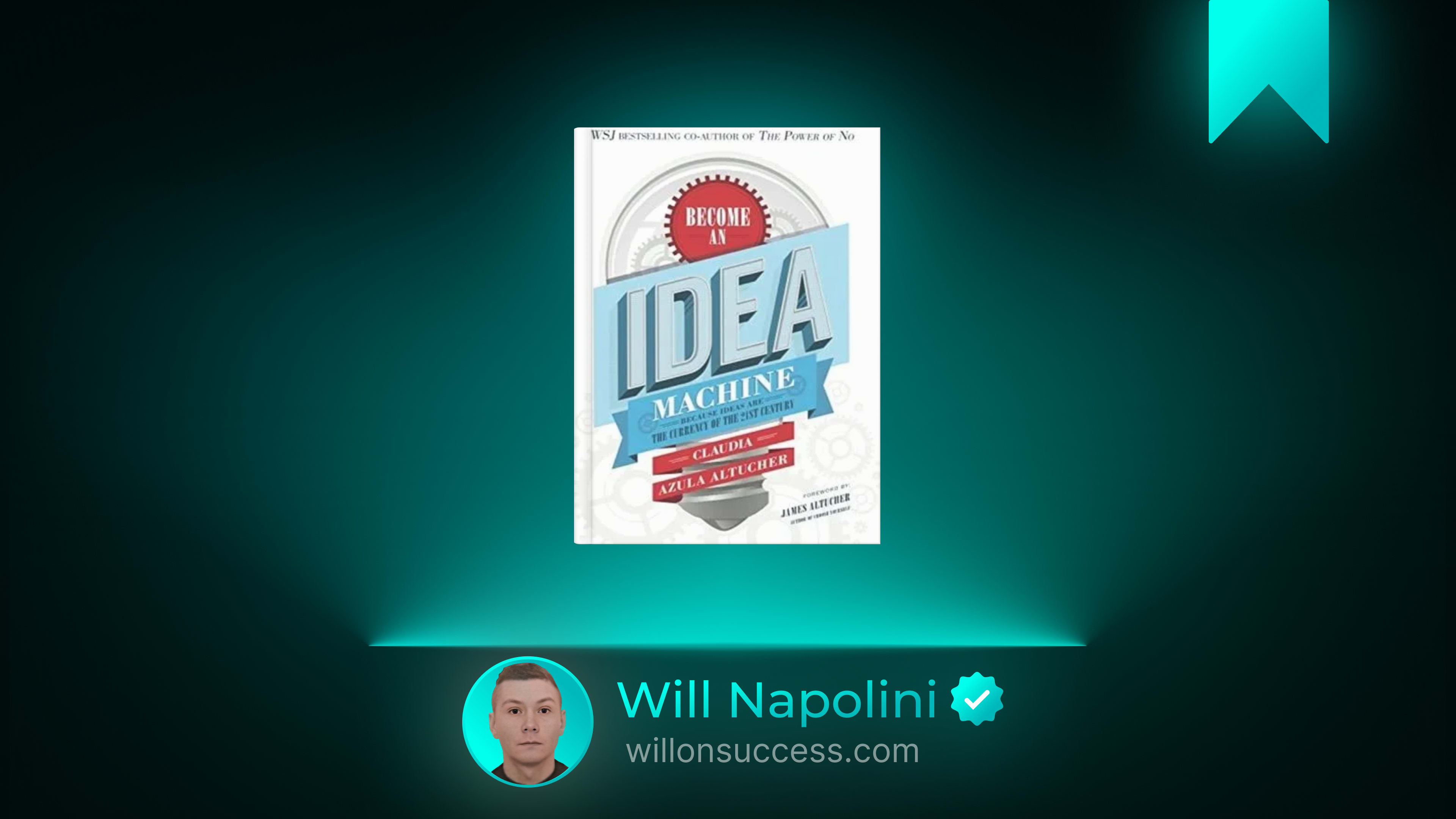
The book is Become an Idea Machine: How to Go from Zero to 100 Ideas Every Day by Claudia Azula Altucher. And its central argument is both simple and, if you let it, genuinely liberating: creativity is not a trait you were born with or without. It is a muscle. And like every muscle you have ever trained, it responds to repetition, weakens with neglect, and surprises you with its capacity once you commit to showing up.
If you have ever felt stuck, stagnant, or convinced that other people simply think in ways you cannot, this book was written for the version of you sitting in that chair right now.
The Big Idea: Ten Ideas a Day Changes the Architecture of Your Mind
Altucher’s core practice is disarmingly simple. Every day, you write down ten ideas. They can be about anything. Business ideas. Book ideas. Ways to improve your neighborhood. Solutions to a problem at work. Gifts for a friend. Ways to make your morning routine less miserable. Ideas for a conversation you have been avoiding.
The topic does not matter. The quality does not matter. What matters is the act of generating them, day after day, without filtering, without judging, without waiting for the ideas to be brilliant before you let them touch the page.
Why ten? Because ten is enough to push past the easy, obvious answers—the first three or four ideas that arrive fully formed—and force your brain into less comfortable, more creative territory. By idea six or seven, you are straining a little. By idea nine, you are reaching into corners of your thinking you rarely visit. That reaching is where the muscle grows.
Altucher frames this not as a productivity hack but as a fundamental shift in how you relate to your own mind. You stop being a passive consumer of other people’s ideas and become an active generator of your own. You stop waiting for inspiration to strike like lightning and start building a small, reliable engine that produces sparks on demand.
The difference between those two orientations is enormous. One leaves you at the mercy of moods and circumstances. The other puts the steering wheel back in your hands.
The Muscle You Forgot You Had
Think about what happens to a muscle you stop using. You do not notice the loss immediately. For weeks, maybe months, everything seems fine. Then one day you try to lift something you used to lift easily, or climb a flight of stairs you used to take two at a time, and your body reminds you—sharply, uncomfortably—that use it or lose it is not a cliché. It is biology.
Altucher applies this logic directly to creative thinking. Most of us stopped exercising our idea muscles somewhere around the time we learned that wrong answers were embarrassing. School rewarded the correct response. Work rewarded the safe one. Somewhere along the way, we internalized the message that an idea was only worth voicing if it was already polished, already validated, already guaranteed to impress.
So we stopped generating. We started editing before we had anything to edit. We became curators of other people’s thinking instead of producers of our own.
The ten-ideas-a-day practice reverses that atrophy. And here is the part I find genuinely encouraging: the recovery is faster than you expect. You do not need six months of preparation. You do not need a retreat or a journaling course or the perfect morning ritual. You need a pen, a blank page, and the willingness to write down ideas that are, frankly, mediocre. Especially mediocre ones. Because the mediocre ones are the warm-up. They clear the path for the ones that surprise you.
You start small. You stay consistent. You let the volume do its quiet work.
Permission to Be Unimpressive
One of the most important things this book does—and it does it without fanfare, almost casually—is give you permission to produce bad ideas.
This sounds trivial. It is not.
I have watched people freeze in front of a blank page not because they had nothing to say, but because they were terrified of saying something unremarkable. The internal critic shows up before the first word is written, arms crossed, eyebrows raised, daring you to produce something less than extraordinary. And so you produce nothing. You protect yourself from the possibility of a bad idea by never risking any idea at all.
Altucher’s practice dismantles that critic through sheer volume. When your only job is to write ten ideas—any ten ideas, about any topic—the critic loses its leverage. You cannot be judged for idea number seven out of ten about how to improve the lunch menu at your office. The stakes dissolve. And in that low-stakes space, something loosens. You begin to play. You begin to combine things that do not obviously belong together. You begin to think the way you thought when you were eight years old and no one had yet taught you that some thoughts were too strange to say out loud.
The practice is not about generating ten brilliant ideas. It is about rebuilding the reflex of generation itself.
The Practice Spills Into Everything
Here is where the book earns its keep beyond the obvious “creativity” shelf. Altucher is not only talking about business ideas or artistic projects. She is talking about a way of engaging with your entire life.
Need a way to reconnect with a friend you have lost touch with? Write ten ideas. Stuck in a recurring argument with your partner and running the same script every time? Write ten ideas for approaching the conversation differently. Feeling like your career has gone flat but you cannot articulate why? Write ten ideas for what a single good Tuesday at work would look like, and see what surfaces.
The practice trains you to move from This is just how things are to What else might be possible here? And that shift, repeated over weeks and months, changes the texture of your daily experience. You stop feeling like a passenger. You start feeling like someone who can look at a locked door and think, What if I tried the window?
A small question becomes a direction, and a direction repeated long enough becomes a way of moving through the world.
Why Consistency Beats Intensity Every Time
You might be tempted to read this summary and think, Great, I will sit down this weekend and write a hundred ideas in one sitting. I would gently encourage you not to.
The power of Altucher’s method is not in the volume of any single session. It is in the daily return. Ten ideas today. Ten ideas tomorrow. Ten ideas on the Thursday when you are tired and the ideas are thin and you would rather do literally anything else. Especially then.
This is the same principle that governs every meaningful change I have seen in my own life and in the lives of people I care about. The dramatic overhaul fades. The daily repetition compounds. You do not build a river by dumping a swimming pool of water into a dry creek bed once. You build it by letting
title: “Become an Idea Machine: Why Your Best Thinking Is a Habit, Not a Gift” description: >- Claudia Azula Altucher’s Become an Idea Machine argues that creativity is a trainable skill, not a rare talent. This summary unpacks the daily practice that turns ordinary thinking into a steady stream of possibilities—and shows you how to start today. date: 2026-08-12 00:00:00 +0800 categories: [book-summaries, personal-development] tags: [ creativity, idea-generation, daily-practice, habit-building, creative-confidence ] image: “IMAGE_URL” alt: “A notebook open on a wooden desk with a pen beside it, pages filled with handwritten lists of ideas” pin: false fallback: —
Become an Idea Machine: Why Your Best Thinking Is a Habit, Not a Gift
There is a quiet sentence most of us carry somewhere in the back of our minds. It goes something like this: I’m just not a creative person.
Maybe you said it when a colleague brainstormed solutions effortlessly in a meeting while you sat there, drawing small circles in the margin of your notebook. Maybe you thought it while scrolling through someone else’s business launch, their novel, their podcast, their reinvention at fifty-two. Maybe you whispered it to yourself the night you almost wrote the proposal, almost pitched the concept, almost started the thing you had been turning over in your head for months—and then closed the laptop instead.
I want to talk to you about a book that takes that sentence, holds it up to the light, and shows you exactly where it breaks apart.
The book is Become an Idea Machine: How to Go from Zero to 100 Ideas Every Day by Claudia Azula Altucher. And its central argument is both simple and, if you let it, genuinely liberating: creativity is not a trait you were born with or without. It is a muscle. And like every muscle you have ever trained, it responds to repetition, weakens with neglect, and surprises you with its capacity once you commit to showing up.
If you have ever felt stuck, stagnant, or convinced that other people simply think in ways you cannot, this book was written for the version of you sitting in that chair right now.
The Big Idea: Ten Ideas a Day Changes the Architecture of Your Mind
Altucher’s core practice is disarmingly simple. Every day, you write down ten ideas. They can be about anything. Business ideas. Book ideas. Ways to improve your neighborhood. Solutions to a problem at work. Gifts for a friend. Ways to make your morning routine less miserable. Ideas for a conversation you have been avoiding.
The topic does not matter. The quality does not matter. What matters is the act of generating them, day after day, without filtering, without judging, without waiting for the ideas to be brilliant before you let them touch the page.
Why ten? Because ten is enough to push past the easy, obvious answers—the first three or four ideas that arrive fully formed—and force your brain into less comfortable, more creative territory. By idea six or seven, you are straining a little. By idea nine, you are reaching into corners of your thinking you rarely visit. That reaching is where the muscle grows.
Altucher frames this not as a productivity hack but as a fundamental shift in how you relate to your own mind. You stop being a passive consumer of other people’s ideas and become an active generator of your own. You stop waiting for inspiration to strike like lightning and start building a small, reliable engine that produces sparks on demand.
The difference between those two orientations is enormous. One leaves you at the mercy of moods and circumstances. The other puts the steering wheel back in your hands.
The Muscle You Forgot You Had
Think about what happens to a muscle you stop using. You do not notice the loss immediately. For weeks, maybe months, everything seems fine. Then one day you try to lift something you used to lift easily, or climb a flight of stairs you used to take two at a time, and your body reminds you—sharply, uncomfortably—that use it or lose it is not a cliché. It is biology.
Altucher applies this logic directly to creative thinking. Most of us stopped exercising our idea muscles somewhere around the time we learned that wrong answers were embarrassing. School rewarded the correct response. Work rewarded the safe one. Somewhere along the way, we internalized the message that an idea was only worth voicing if it was already polished, already validated, already guaranteed to impress.
So we stopped generating. We started editing before we had anything to edit. We became curators of other people’s thinking instead of producers of our own.
The ten-ideas-a-day practice reverses that atrophy. And here is the part I find genuinely encouraging: the recovery is faster than you expect. You do not need six months of preparation. You do not need a retreat or a journaling course or the perfect morning ritual. You need a pen, a blank page, and the willingness to write down ideas that are, frankly, mediocre. Especially mediocre ones. Because the mediocre ones are the warm-up. They clear the path for the ones that surprise you.
You start small. You stay consistent. You let the volume do its quiet work.
Permission to Be Unimpressive
One of the most important things this book does—and it does it without fanfare, almost casually—is give you permission to produce bad ideas.
This sounds trivial. It is not.
I have watched people freeze in front of a blank page not because they had nothing to say, but because they were terrified of saying something unremarkable. The internal critic shows up before the first word is written, arms crossed, eyebrows raised, daring you to produce something less than extraordinary. And so you produce nothing. You protect yourself from the possibility of a bad idea by never risking any idea at all.
Altucher’s practice dismantles that critic through sheer volume. When your only job is to write ten ideas—any ten ideas, about any topic—the critic loses its leverage. You cannot be judged for idea number seven out of ten about how to improve the lunch menu at your office. The stakes dissolve. And in that low-stakes space, something loosens. You begin to play. You begin to combine things that do not obviously belong together. You begin to think the way you thought when you were eight years old and no one had yet taught you that some thoughts were too strange to say out loud.
The practice is not about generating ten brilliant ideas. It is about rebuilding the reflex of generation itself.
The Practice Spills Into Everything
Here is where the book earns its keep beyond the obvious “creativity” shelf. Altucher is not only talking about business ideas or artistic projects. She is talking about a way of engaging with your entire life.
Need a way to reconnect with a friend you have lost touch with? Write ten ideas. Stuck in a recurring argument with your partner and running the same script every time? Write ten ideas for approaching the conversation differently. Feeling like your career has gone flat but you cannot articulate why? Write ten ideas for what a single good Tuesday at work would look like, and see what surfaces.
The practice trains you to move from This is just how things are to What else might be possible here? And that shift, repeated over weeks and months, changes the texture of your daily experience. You stop feeling like a passenger. You start feeling like someone who can look at a locked door and think, What if I tried the window?
A small question becomes a direction, and a direction repeated long enough becomes a way of moving through the world.
Why Consistency Beats Intensity Every Time
You might be tempted to read this summary and think, Great, I will sit down this weekend and write a hundred ideas in one sitting. I would gently encourage you not to.
The power of Altucher’s method is not in the volume of any single session. It is in the daily return. Ten ideas today. Ten ideas tomorrow. Ten ideas on the Thursday when you are tired and the ideas are thin and you would rather do literally anything else. Especially then.
This is the same principle that governs every meaningful change I have seen in my own life and in the lives of people I care about. The dramatic overhaul fades. The daily repetition compounds. You do not build a river by dumping a swimming pool of water into a dry creek bed once. You build it by letting a small stream run, day after day, until it carves its own channel into the earth.
Your idea practice works the same way. Give it ten minutes a day. Same time if you can. Same notebook or the same document. Lower the ceremony. Raise the consistency. And let the weeks do what weeks do when you are faithful to a small thing: they turn it into something you no longer have to force.
What to Do When the Well Feels Empty
Altucher is honest about the fact that some days, the ideas will not come easily. You will write three, stare at the page, and feel the familiar inner voice say, See? You really aren’t creative after all.
When that happens, she suggests prompts. Change the category. Instead of “ten business ideas,” try “ten things I would do if money were irrelevant” or “ten questions I wish someone would ask me” or “ten small improvements to the room I am sitting in right now.” The prompt is a doorway. You do not have to walk through the grand entrance every time. Sometimes the side door gets you into the building just fine.
You can also borrow the structure. Take an existing product, service, or habit and ask, How could this be different? How could this be simpler? Who is this not serving yet? Constraints, paradoxically, free you. A blank page asks too much. A specific question asks just enough.
And if you write ten ideas and nine of them are forgettable, you have still succeeded. You showed up. You flexed the muscle. You kept the channel open. Tomorrow the ideas will come a little more easily, and the day after that, a little more easily still.
Who This Book Is For (and Who Might Skip It)
I will be straightforward with you.
If you are someone who already has a thriving daily creative practice—if you are already generating ideas freely, capturing them, acting on them—this book will feel elementary. You will recognize the principles and nod along, but you will not encounter much that rearranges your thinking. It is a foundational text, and foundations matter most when they are missing.
This book is for the person who wants to start a business but cannot get past the blank page. For the professional who feels like they have stopped contributing anything original at work. For the parent, the student, the retiree who senses there is more thinking inside them than they have been letting themselves access. For anyone who has confused “I don’t feel inspired right now” with “I am not a creative person.”
It is short, practical, and generous with exercises. Altucher fills the book with prompts and challenges that make the practice immediately actionable rather than theoretical. You do not need to read it cover to cover in one sitting. You can read a chapter, try the exercise, and come back.
Where it could be stronger: readers looking for a deep psychological exploration of creative blocks, or a structured system for evaluating and executing ideas once you have generated them, will want to pair this book with other resources. Altucher is strongest on the generation side—the getting-started, the daily practice, the permission to be im