The Permission to Write Badly: How to Silence the Inner Critic and Find the Courage to Create
There is a specific kind of silence that exists only in front of a blank screen. It is not a peaceful silence. It is a heavy, judging silence. You open your laptop, place your fingers on the keyboard, and suddenly every brilliant thought you had yesterday evaporates. The cursor blinks. It feels less like an invitation and more like a ticking clock, counting down the minutes until you prove to yourself that you have nothing meaningful to say.
If I could sit across the table from you right now, I would ask you to close the laptop for a moment. I would tell you that the paralysis you are feeling is not a lack of talent. It is a lack of permission.
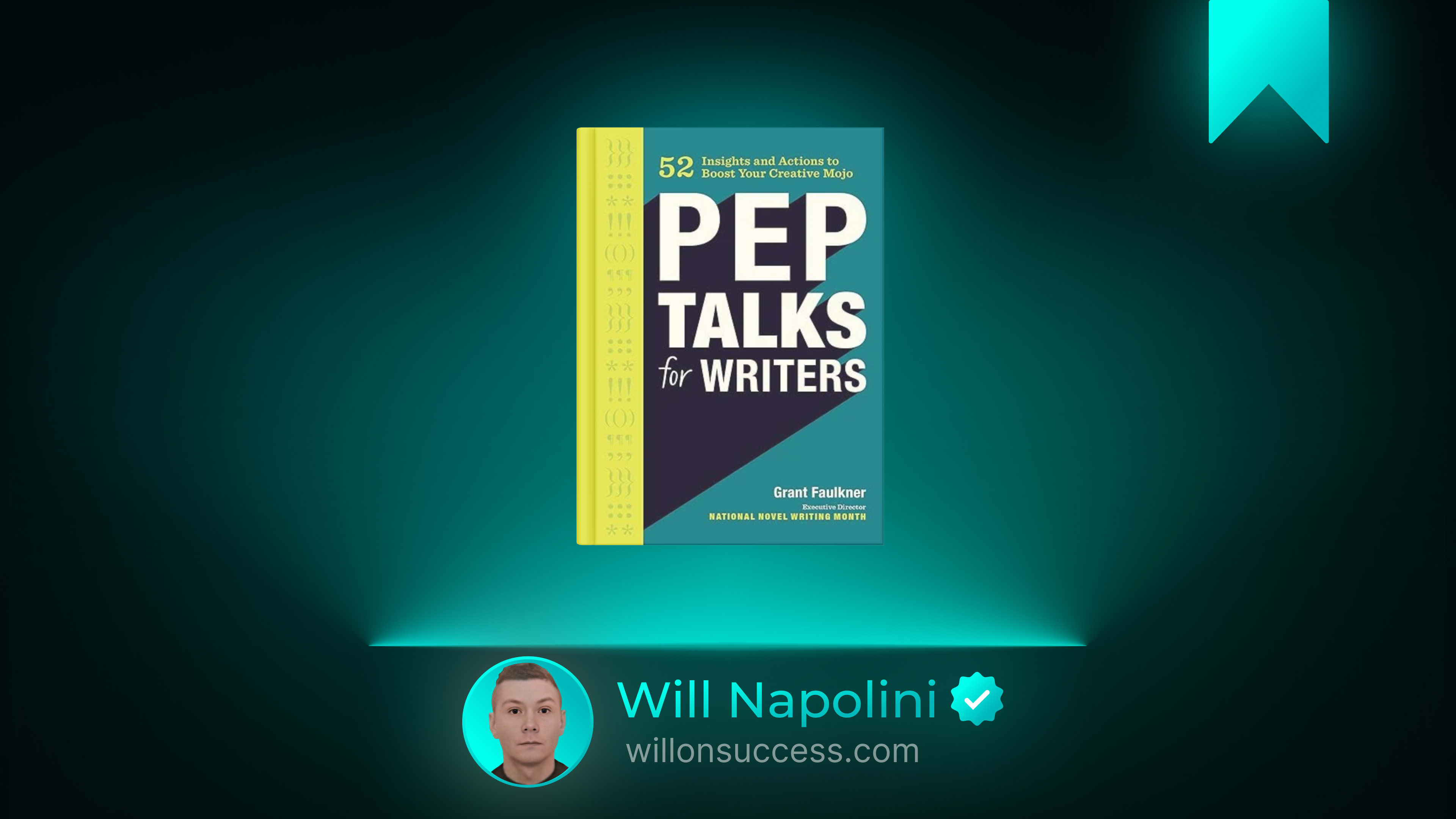
In Pep Talks for Writers, Grant Faulkner, the long-time Executive Director of NaNoWriMo, offers something rare in the crowded space of creative advice. He does not hand you a dense textbook on plot structure, grammar, or character arcs. Instead, he hands you a life jacket.
The central thesis of the book is that the greatest barrier to any creative act is not a shortage of ideas, but an excess of fear. We are terrified of writing badly, so we write nothing. Faulkner’s mission is to dismantle the myth of the effortless genius and replace it with the warm, muddy, imperfect reality of the daily practice. He teaches us that creativity is not a delicate flower that requires perfect conditions; it is a resilient weed that will push through concrete if you just give it a crack to grow in.
The Crucible of the Thirty-Day Draft
To understand Faulkner’s philosophy, you have to understand the environment that shaped it. As the leader of National Novel Writing Month, he oversees a chaotic, high-pressure experiment where hundreds of thousands of people attempt to write a 50,000-word novel in thirty days.
In this environment, there is no time to agonize over the perfect opening line. You either move forward, or you fail. Through this annual crucible, Faulkner observed a universal truth about human nature: the writers who succeed are not the ones with the most brilliant prose on day one. They are the ones who give themselves permission to be terrible.
They understand that a first draft is not a performance for an audience; it is the raw material that will eventually become a story. You cannot build a house without a pile of lumber, no matter how messy that pile looks in the yard. The act of writing is not about being good. It is about being present.
The Blank Page is a Sandbox, Not a Courtroom
When we sit down to write, we often bring an invisible audience with us. We imagine the critics, the editors, the peers who will read our words and judge them. The blank page becomes a courtroom where we are simultaneously the defendant, the prosecutor, and the judge. We sentence our ideas before they even have a chance to speak.
Faulkner invites us to reframe this entirely. The blank page is not a place of judgment; it is a sandbox. It is a space for play, for making messes, for building towers and immediately knocking them down. When a child builds a sandcastle, they do not worry about the architectural integrity or whether it will be published in a magazine. They are simply engaged in the joy of the making.
If you want to write, you must reclaim the spirit of the sandbox. You must lower the stakes. You are not writing a masterpiece; you are just playing with words. When the pressure to be perfect dissolves, the natural, curious voice of the writer can finally emerge.
Your Inner Critic is a Well-Meaning but Overprotective Friend
We often treat our inner critic as an enemy to be destroyed. We battle it, suppress it, and curse it for interrupting our flow. But Faulkner offers a more compassionate and ultimately more effective perspective.
Your inner critic is not a monster. It is a protector. It is the part of your brain that wants to keep you safe from embarrassment, rejection, and failure. It steps in and says, “This isn’t good enough,” because it is terrified that if you share your work, you will be hurt.
The problem is not that the critic exists; the problem is that it is overprotective. It treats the writing of a rough draft like a mortal threat. Instead of trying to silence the critic, you can acknowledge it. You can say, “Thank you for trying to protect me, but we are just drafting right now. No one is going to get hurt.” When you stop fighting the critic, you take away its power to paralyze you.
You Cannot Edit a Blank Page
Perhaps the most liberating mantra in Faulkner’s arsenal is this: you cannot edit a blank page.
Perfectionism is a trap that keeps you staring at the horizon instead of taking the first step. You wait for the perfect sentence, the perfect metaphor, the perfect structure. But in doing so, you produce nothing. A flawed, clunky, messy draft is infinitely more valuable than a pristine, perfect idea that exists only in your head.
The creative process has two distinct modes: the Creator and the Editor. The Creator is wild, intuitive, and generative. The Editor is analytical, critical, and precise. If you try to use the Editor while the Creator is trying to work, you will stifle the life out of the piece. You must give yourself permission to write a “trash draft.” Let it be clunky. Let it be full of holes. You can fix the holes later. You cannot fix a void.
Momentum is the Only Magic
We tend to romanticize inspiration. We wait for the muse to strike, believing that we can only write when we feel a surge of divine energy. But Faulkner’s experience with thousands of writers proves that inspiration is unreliable. Momentum, however, is something you can build.
Momentum is generated by consistency, not intensity. Writing for fifteen minutes every day is far more powerful than writing for five hours once a month. The daily practice keeps the channel open. It keeps the characters and the ideas alive in your subconscious. When you show up, even if you only write a single sentence, you are casting a vote for the person you are becoming.
Over time, these small deposits compound. You do not need a lightning bolt to write a book. You just need to keep the engine running, one small revolution at a time.
The Solitary Writer Needs a Tribe
There is a romantic myth that writers must be lonely figures, isolated in cabins, suffering in silence for their art. Faulkner challenges this notion fiercely. Writing is a solitary act in its execution, but it cannot survive in total isolation.
When you are stuck, when the doubts become too loud, and when you are tempted to quit, you need the echo of other voices. You need to know that someone else has felt exactly what you are feeling. Whether it is a writing group, an online forum, or a single trusted friend, having a community normalizes the struggle. It reminds you that the frustration you feel is not a sign that you are a bad writer; it is a sign that you are a writer. We are meant to create together, even when we are typing alone.
Why This Matters on an Ordinary Tuesday
You might be thinking, “I am not trying to write a novel, so why does this matter to me?”
Because the fear that stops you from writing a novel is the exact same fear that stops you from starting a business, speaking up in a meeting, or learning a new language. The blank page is a metaphor for any new beginning.
We live in a culture that celebrates the final product and hides the messy process. We see the polished launch, the finished book, the successful career, and we assume those people are immune to doubt. They are not. The only difference between the people who build a life they love and the people who remain stuck is the willingness to write the bad first draft of their next chapter.
When you adopt Faulkner’s mindset, you stop waiting for confidence to arrive before you take action. You realize that confidence is not a prerequisite for creativity; it is the byproduct of it. You take the pressure off yourself to be brilliant, and you simply allow yourself to be curious.
How to Reclaim Your Creative Courage Today
Understanding these concepts is valuable, but understanding without action changes nothing. If you want to stop staring at the blinking cursor and start building something real, you must begin applying these principles immediately.
1. Label Your Draft “Trash” Open a new document. At the very top, in bold letters, type the words: “Trash Draft.” This is a psychological trick to disarm your inner critic. When the file is labeled as trash, the stakes are zero. You are not writing a book; you are just filling a trash can with words. Give yourself permission to write the worst possible version of your idea. You will be amazed at how freely your hands move when the pressure to be good is gone.
2. The Fifteen-Minute Sprint Set a timer for fifteen minutes. During this time, you are not allowed to edit, delete, or look up synonyms. You are only allowed to move forward. If you get stuck, write the words “I am stuck” over and over until a new thought arrives. When the timer goes off, stop. You have succeeded. You have built momentum. Repeat this tomorrow.
3. The “What If I Just…” Reframe When you feel overwhelmed by the scale of a project, shrink it down to the smallest possible action. Instead of asking, “How do I write a book?”, ask, “What if I just write one sentence about the character’s shoes?” Instead of asking, “How do I become an artist?”, ask, “What if I just draw one terrible sketch?” Lower the bar until it is so low you cannot fail.
Who Needs to Read This Book
Pep Talks for Writers is a lifeline for the aspiring writer who has a file folder full of half-finished chapters. It is for the perfectionist who is exhausted by their own high standards. It is for anyone who wants to create but is terrified of being judged. It is a warm, gentle, and incredibly practical guide to emotional survival in the creative life.
However, if you are looking for a technical manual on the three-act structure, a deep dive into punctuation, or a masterclass on line editing, this book will not serve you. Faulkner is not interested in the mechanics of the craft; he is interested in the soul of the maker. He wants to get you to the page, not correct your grammar.
Your First Step Toward the Page
You do not need to quit your job, move to a cabin, or wait for a lightning bolt of inspiration. You do not need to be ready.
You only need to be willing to be bad.
Here is what I want you to do today. Open a blank document or grab a piece of paper. Write the worst, most clunky, most uninspired paragraph you can possibly write. Make it terrible on purpose. Do not fix a single comma.
When you are done, look at it and smile. You have broken the silence. You have proven to yourself that you can show up, make a mess, and survive. The blank page is no longer a judge; it is just a mirror waiting for you to show up exactly as you are. Pick up the pen, make a mess, and let the story begin.