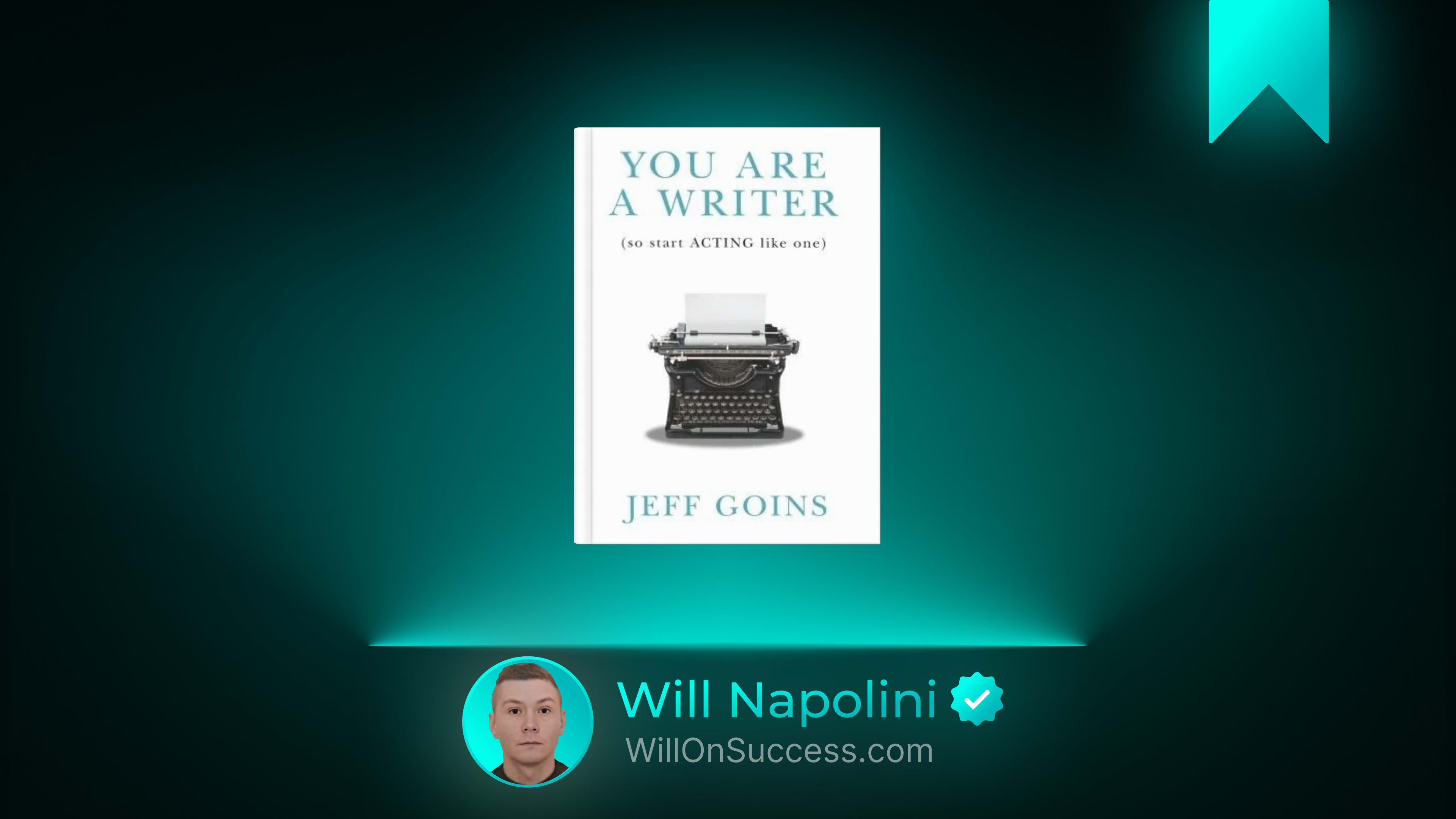
You Are a Writer by Jeff Goins: Stop Waiting for Permission to Begin
You have a notebook somewhere. Maybe two. Maybe a folder on your laptop labeled “Ideas” or “Someday” that you open once every few months, scroll through, feel a small ache of longing, and then close again. You have sentences in your head while you are washing dishes, driving to work, lying awake at two in the morning. You think, I should write this down. I should make this into something.
And then you do not.
Not because you lack talent. Not because you lack time, exactly. But because somewhere between the idea and the blank page, a question rises up and stops you cold: Am I really a writer? And because you cannot answer that question with a confident yes, you close the notebook. You drive on. You fall asleep. And the words stay where they are—unwritten, unformed, yours and no one else’s.
Jeff Goins wrote You Are a Writer (So Start Acting Like One) for that exact moment. For the person standing at the threshold, hand on the doorknob, asking for permission to walk through. His answer, delivered across the whole book, is both simple and unsettling: no one is coming to give you that permission. You give it to yourself. And you give it not by announcing it, not by waiting until you are good, but by sitting down and doing the work.
I have spent years around people who want to write. And I have noticed that the ones who actually write are rarely the most gifted. They are the ones who stopped negotiating with the question of whether they were allowed to. They sat down before they felt ready. They wrote before they felt qualified. They let the work make them writers, rather than waiting to be made writers before they did the work.
That is the whole book, distilled. But let me walk you through it, because the details matter.

The Big Idea: You Do Not Become a Writer by Being Published. You Become a Writer by Writing.
Goins challenges a sequence most of us carry without examining it. We believe the order goes like this: first you become good, then you share your work, then someone validates you, and then you are a writer. Publication is the ceremony. The byline is the diploma. Until that moment, you are pretending.
He reverses the sequence entirely. You become a writer the moment you write. Not when someone reads it. Not when someone pays you. Not when a gatekeeper says yes. The act itself is the identity. Everything after that is distribution.
This sounds almost too simple. But think about how much energy you have spent waiting for external confirmation before granting yourself the title. Think about how many years you have deferred the work because you did not have the degree, the MFA, the agent, the book deal, the blog with ten thousand readers. Think about how many words you did not write because the identity felt premature.
Goins is not saying credentials are meaningless or that craft does not matter. He is saying that if you wait until you feel legitimate to begin, you will never begin. And a writer who never writes is not a writer in waiting. That person is simply someone with a wish.
The identity comes first. The evidence follows.
The Practice Is the Point: Why Showing Up Beats Being Inspired
One of the most grounded ideas in the book is Goins’ insistence on daily practice over the mythology of inspiration.
There is a romantic image of the writer that does a great deal of damage. The image goes like this: a person sits at a desk in a sunlit room, struck by a bolt of creative lightning, and the words pour out effortlessly. If the lightning does not strike, the writer does not write. They are waiting for the muse. They are waiting to feel it.
Goins dismantles this gently but firmly. The writers he admires, the writers who actually build bodies of work over years, do not wait for inspiration. They sit down at the same time. They write whether the words feel alive or dead. They produce pages that are mediocre, clumsy, forgettable. And they do it again the next day. And the next.
The practice is not the preparation for the real work. The practice is the real work.
Think of it like a musician. A pianist does not sit at the bench only on nights when the music moves them. They practice scales. They play pieces badly, slowly, with mistakes. They repeat passages until their fingers remember what their minds have not yet caught up with. The concert is not the point. The concert is the visible tip of thousands of invisible hours at the bench.
Writing works the same way. Your first drafts will be rough. Your voice will sound borrowed for a while. You will write sentences that make you wince. This is not evidence that you are not a writer. This is evidence that you are practicing. And practice, sustained over months and years, is the only honest road from clumsy to competent to genuinely good.
You do not need to write brilliantly. You need to write regularly. Brilliance, if it comes, arrives as a byproduct of showing up so often that your skill has nowhere to hide.
Sharing Your Work Is Not Optional. It Is Part of the Craft.
Here is where Goins pushes the reader past a comfortable stopping point. Many aspiring writers can accept the idea of writing privately. Journaling. Drafting in a document no one will ever see. Keeping the work safe between their own two hands.
Goins argues that this is not enough. Not because you owe the world your words. But because writing for someone—even one person, even a small and imperfect audience—changes the work. It introduces accountability. It forces clarity. It asks you to consider whether your sentences actually land or whether they only make sense inside your own head.
He encourages writers to publish online, to start a blog, to submit to small journals, to read their work aloud to a friend. To let the words leave the private room and enter the world where they can be met with indifference, confusion, criticism, or—occasionally—resonance.
This is terrifying. I will not pretend otherwise. The moment you share something you have made, you become vulnerable to the judgment of others. You discover that the thing which felt profound in your mind at midnight reads as unclear or ordinary in the daylight. That stings.
But Goins frames this exposure not as a verdict on your worth but as a necessary stage of growth. You cannot find your voice in a vacuum. You find it in the friction between what you intended and what the reader received. You find it in the small, repeated act of putting words into the world and learning, sentence by sentence, what works and what does not.
A seed kept in a sealed envelope will never become a tree. It is safe in there. Nothing can harm it. But nothing can feed it either. It needs soil, air, rain, and the risk of being stepped on. Your writing needs the same.
Your Platform Is Built One Honest Conversation at a Time
Goins wrote this book in the early era of blogging and social media, and he spends meaningful time on the idea of building a “platform”—a readership, a community, a group of people who look forward to hearing from you.
But he strips the concept of its corporate, marketing-heavy connotations. Building a platform, in his framing, is not about hacking algorithms or manufacturing virality. It is about showing up consistently with something true to say, and letting the right people find you over time.
He talks about writing for one person. Not a demographic. Not a market segment. One reader. The person you imagine on the other side of the screen, nodding or pausing or feeling slightly less alone because of what you wrote. When you write for one person, your voice becomes warmer, more specific, less performative. You stop trying to impress everyone and start trying to help someone.
And here is the quiet principle underneath: you do not build an audience by chasing one. You build one by being genuinely useful, genuinely honest, and genuinely consistent over a long stretch of time. The audience is not the goal. The audience is the byproduct of doing the work in public, week after week, without guarantee of reward.
This is slow. It is frustratingly slow. You will write for months and feel like you are speaking into an empty room. Goins does not sugarcoat this. But he insists that the slow accumulation of honest work compounds in ways you cannot predict. One reader tells another. A piece you wrote two years ago suddenly surfaces and reaches someone who needed it today. You look up after eighteen months and realize that a small, real community has gathered around your words.
You did not build it through a trick. You built it through repetition. Through showing up on the days no one was watching.
Rejection Is Not a Verdict. It Is a Weather System.
Goins is honest about the pain of rejection. Of submitting work and hearing nothing back. Of hearing no. Of watching less talented writers get opportunities while you are still waiting for a response to an email you sent three months ago.
He does not tell you to develop thick skin, exactly. He tells you something more useful: rejection is not information about your ultimate value. It is information about one editor’s taste on one Tuesday afternoon. It is information about a publication’s current needs, their budget, their theme, their slush pile volume. It is a weather system passing through. It is not the climate of your career.
Every writer who has built a body of work has walked through seasons of no. Goins treats this as a given rather than an anomaly. The question is not whether you will be rejected. The question is whether rejection will be the thing that stops you, or simply the thing that delays you.
You write. You submit. You are told no. You write again. You submit again. You are told yes. Or no. Or nothing at all. And you write again. This is not masochism. This is the rhythm of the work. And the writers who endure are not the ones who avoid rejection. They are the ones who refuse to let rejection make the decision for them.
Finding Your Voice Means Writing Enough Words to Bury the Borrowed Ones
One of the most encouraging ideas in the book concerns voice. Many aspiring writers worry that they sound like someone else. They read writers they admire and feel the echo in their own sentences. They worry they have nothing original to say.
Goins suggests that this is a phase, not a permanent condition. Your early work will sound borrowed. You are learning the instrument. You are trying on shapes and rhythms you absorbed from your reading. This is natural. Every apprentice copies the master before finding their own hand.
But you do not find your voice by thinking about it. You find it by writing enough words that the borrowed patterns begin to thin out, and something underneath them emerges. Something that sounds like your own experience, your own obsessions, your own way of noticing the world.
You write a hundred thousand words that are derivative. And then, somewhere in the next ten thousand, a sentence appears that you could not have written by imitating anyone. It has your fingerprints on it. Your rhythm. Your particular angle of vision.
You do not choose your voice. You uncover it. And you uncover it through volume, not contemplation.
What This Looks Like in a Real Week
Let me bring this down from the level of ideas to the level of a life being lived.
It is Wednesday. You have decided, after reading Goins’ book, that you will write four mornings a week. You do not wait for inspiration. You sit down at six-fifteen, before the house is fully awake, before the phone starts demanding your attention. You set a timer for thirty minutes. You write.
Some mornings the words come easily. Some mornings you stare at the cursor and produce three sentences you will delete by Friday. You write anyway. You do not judge the session by its quality. You judge it by its completion. You showed up. That is the vote that counts.
On Saturday, you take one paragraph you wrote during the week—something small, something true—and you post it. A blog. A social media caption. A short essay submitted to a small online journal. You press publish before your inner editor can talk you out of it. Your hands are slightly unsteady. You do it anyway.
No one comments. Or one person does. Or someone says it resonated. You do not let the response determine whether you write next week. You already decided. The decision was made before the outcome arrived.
You do this for a month. Then three months. Then six. And slowly, almost imperceptibly, the gap between the writer you imagine yourself to be and the writer you actually are begins to close. Not because of a single breakthrough. Because of a hundred small mornings of showing up.
Who Should Read This Book
If you have ever said the words “I want to be a writer” and then spent the next five years not writing, this book is for you. If you have a half-finished novel in a drawer, a journal full of fragments, a blog you abandoned after three posts, Goins will meet you exactly where you are and say, with firm kindness, Begin again. And this time, do not stop.
It is especially useful for writers in the earliest stages—people who need permission more than technique. The book is less concerned with the mechanics of prose than with the psychology of starting. If you already have a daily writing habit and are looking for advanced craft instruction, this may feel too foundational. But if your obstacle is not skill but identity, not technique but courage, this is the right medicine.
It is also honest about the business side of writing in a way that many creative books avoid. Goins does not pretend you can ignore the reality of building a readership or navigating publication. He simply insists that those conversations come after the work exists, not before.
One Small Step
Here is what I want you to do today. Not this weekend. Not after you clear your schedule. Today.
Open a blank document. Set a timer for fifteen minutes. Write about one true thing. A memory. An observation from this morning. A question you cannot stop asking. It does not need to be good. It does not need to be finished. It needs to exist.
When the timer stops, do not delete it. Save it. And tomorrow, do it again.
You do not need a publishing contract to be a writer. You do not need an audience, a degree, or anyone’s blessing. You need a chair, a blank page, and the willingness to be bad for a while in the direction of becoming better.
The title is not granted. It is earned in the quiet, unglamorous act of showing up when no one is watching and putting one honest sentence after another.
You are a writer. Now start acting like one.