100 Ways to Improve Your Writing — A Mentor’s Guide to Finding Your Voice
I remember the first time I read a sentence I’d written and actually felt something. Not pride. Not relief. I felt the quiet electricity of recognition, as if the words had finally caught up with the thought I’d been chasing for three years. I was twenty-four, sitting at a kitchen table with a cold cup of coffee and a legal pad covered in crossed-out lines. And I realized something that changed everything for me: the gap between what you feel and what you put on the page is not a talent problem. It is a craft problem. And craft can be learned.
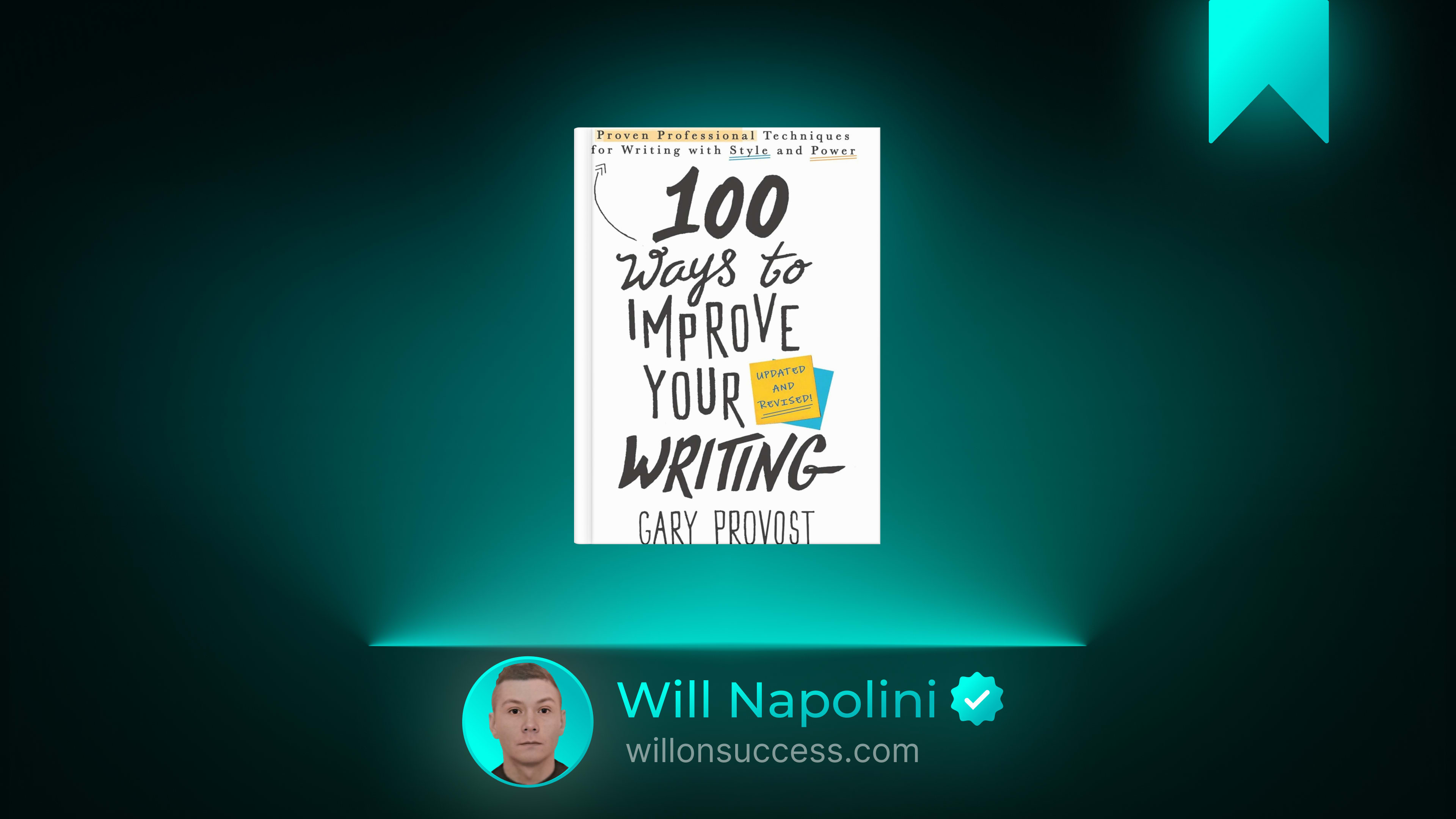
That is the beating heart of Gary Provost’s 100 Ways to Improve Your Writing. Not a single one of his hundred lessons requires you to be born special. Not one demands a degree, a connection, or a stroke of luck. What Provost hands you is a toolbox, and what he says—quietly, firmly, across every page—is this: You already have the wood. Now let me show you how to build.

The Discipline Before the Magic
Here is what I have learned after decades of watching people try to write, try to create, try to become: you do not rise to the level of your ambition; you fall to the level of your practice. Provost understands this in his bones. His very first instruction is not “be creative.” It is not “find your muse.” It is sit down and write. Every day. Whether you feel inspired or whether you feel like a fraud. Whether the words come easy or whether you are dragging them out of yourself like pulling nails from old wood.
He tells you to write for thirty minutes when you have no idea what to say. He tells you to write the bad version first, the clunky version, the version that embarrasses you. Because the first draft is not the performance. The first draft is the plowing. You are turning the soil so that something living can take root later. I have seen people freeze for six months waiting to write the perfect opening paragraph, and I have seen other people write terrible pages for six weeks and then, in week seven, produce something that makes a stranger cry on a train. The difference was not talent. The difference was that one person plowed the field and the other stared at it.
Your first draft is not a verdict on your worth. It is compost. It is the raw material from which every beautiful thing you will ever write gets made.
The Music of the Sentence
Now here is where Provost gets truly magnificent, and here is where I want you to lean in, because this single principle will change the way your words land in another person’s chest.
He teaches you to hear your sentences. Not just read them. Hear them. He shows you that five short words in a row—The dog ran. The cat sat. The boy fell.—create a flatness, a monotone, a kind of rhythmic death on the page. But then you stretch one sentence. You let it breathe and unspool and carry the reader forward on a current of sound and meaning, building and building until the idea arrives not just in the mind but in the body. And then you stop. Short. Like that.
Provost calls this variety, but what it really is, is respect for the reader’s ear. You are not just transferring information. You are composing music with twenty-six letters. A sentence that has rhythm is a sentence that has a heartbeat, and readers follow heartbeats the way travelers follow a lantern in the dark.
He gives you a hundred small ways to do this. Replace the weak verb with a strong one. Don’t write “She walked slowly across the room.” Write “She drifted.” Don’t write “He was very angry.” Write “His jaw tightened and his hands curled into fists at his sides.” One word that does the work replaces four words that merely describe the work. You are not decorating the page. You are building a house, and every unnecessary word is a nail that doesn’t hold anything. Pull it out. The structure gets stronger.
Show Me the Rain
This is the lesson that took me the longest to learn, and the one I most want to press into your hands today: do not tell me it was a sad day. Make me feel the cold glass against my forehead while I watch the neighbor’s wind chime tangle itself in the gray.
Provost spends significant energy on the difference between telling and showing. Telling is summary. Showing is experience. When you write “She was nervous,” you have given the reader a label. When you write “She tore the sugar packet into confetti and swept the grains into a small white pile on the table,” you have given the reader a life. You have let them walk into the room and sit down across from this woman and feel her anxiety in their own fingertips.
This is not a trick. This is generosity. You are trusting your reader enough to let them feel something rather than filing the feeling for them. And I promise you, the reader will reward that trust with attention, with memory, with the kind of loyalty that only comes from being shown something true.
Use your senses. All five. Not just sight. What does the kitchen smell like at 6 a.m. when the bread is still rising? What does the handshake feel like—dry, firm, too long? What is the specific sound of the screen door in August? Provost pushes you toward the concrete, the particular, the irreplaceable detail. Not “a bird sang.” A wren stitched its song into the hedgerow. Specificity is the language of love in writing. It says: I paid attention. This moment mattered enough for me to notice exactly what it looked like.
The Sacred Art of Cutting
I will be honest with you. This part is hard. Provost asks you to take a paragraph you love and cut a third of it. He asks you to find the sentence you are most proud of and ask, ruthlessly, whether it is actually doing anything or just showing off. He asks you to murder your darlings, and he asks you to do it with a steady hand.
But here is the truth I have come to believe after years of revision: cutting is not loss. Cutting is revelation. You are not taking something away from the reader. You are clearing the brush so the reader can finally see the view you climbed the mountain to show them. Every adjective you remove, every “very” and “really” and “in order to” that you strike from the page, makes the remaining words stand taller. They get room to breathe. They get weight.
Provost gives you a specific practice: read your work aloud. Where you stumble, where your tongue trips, where your breath runs out before the sentence does—that is where you cut. That is where the writing is still fighting you. Smooth it. Shorten it. Trust the simpler word. The Anglo-Saxon word. The word a grandmother would use. Help instead of facilitate. Use instead of utilize. Clarity is not the enemy of beauty. Clarity is the foundation on which beauty is built.
Finding the Voice That Is Already Yours
Here is what moves me most about this book, and here is where I want to speak directly to you, because I suspect you have wondered about this: Provost does not ask you to sound like anyone else. He does not hand you a template and say, Write like this and you will succeed. He says something far more radical. He says: Write like you. The you that exists when you stop performing and start telling the truth.
Your voice is not something you manufacture. It is something you uncover. It is already in you, the way the shape of the tree is already in the seed. Your job is not to invent it. Your job is to clear away the imitation, the posturing, the borrowed phrases, the sentences you write because you think they sound “writerly.” Strip those away, and underneath is the way you see the world, the rhythm that is native to your thinking, the particular angle of light you bring to every subject.
You do not need to become a different person to write beautifully. You need to become more fully the person you already are. And that is not a small thing. That is the work of a lifetime, and it is glorious.
The Compound Harvest
Let me leave you with the principle underneath all one hundred lessons. Provost is not teaching you tricks. He is teaching you a practice. And practice, done daily, done with attention, done with the willingness to be bad on Tuesday so you can be better on Thursday, compounds the way snowfall compounds on a mountainside. One flake is nothing. A thousand flakes are a whisper. A million flakes are an avalanche that reshapes the valley.
You will not see the change in a week. Maybe not in a month. But if you write for thirty minutes a day, if you revise one paragraph until it sings, if you read one page of something beautiful before you sleep so the rhythm of good language soaks into you like rain into dry earth—you will look up in eighteen months and you will not recognize the writer staring back at you from the page. I have seen it happen. I have watched it happen in myself, and I have watched it happen in hundreds of people who started exactly where you are standing right now, wondering if they had the right to put words on a page.
You have the right. You have always had the right. The only question was never whether you could write. The question was whether you would give yourself permission to begin, and then begin again tomorrow, and the day after that, until the becoming was done.
Your Next Step
So here is what I want you to do. Not tomorrow. Today. Within the next hour. Take out a notebook, or open a blank document, or grab the back of an envelope. Set a timer for ten minutes. Write one paragraph about a single moment from your life—the smell of your grandmother’s kitchen, the sound of rain on a tin roof, the exact color of the sky the night you made a decision that changed everything. Do not edit. Do not judge. Just show me the moment. Use one strong verb. Use one specific sensory detail. Make me be there.
Ten minutes. That is all. And when you finish, you will have done the thing. You will have plowed the first row. And the soil will be ready.
You are more ready than you know. You have been carrying this book inside you for longer than you realize. Gary Provost just handed you the permission slip.
Now go write the sentence that only you can write. I believe you will surprise yourself. And I will be right here, cheering you on, when you do.