Breaking the Fairy Tale: What Princess Diana’s True Story Teaches Us About Finding Our Own Voice
Most of us spend the first half of our lives trying to get cast in a specific role.
We write a script in our heads. We tell ourselves that if we can just get into the right university, land the prestigious job, marry the right person, or buy the house in the right neighborhood, the curtain will rise and our lives will finally make sense. We believe that if we can just fit perfectly into the mold the world has built for us, we will be safe, and we will be happy.
But what happens when you get the part, the curtain rises, and you realize the play is a tragedy?
What happens when the “perfect life” you sacrificed everything to achieve turns out to be a gilded cage?
If I could sit across the table from you today, I would not talk to you about royalty, palaces, or tiaras. I would talk to you about the agonizing, universal journey of breaking the script. I would talk to you about a young woman who had everything the world told her she should want, and who nearly lost herself trying to maintain the illusion of it all.
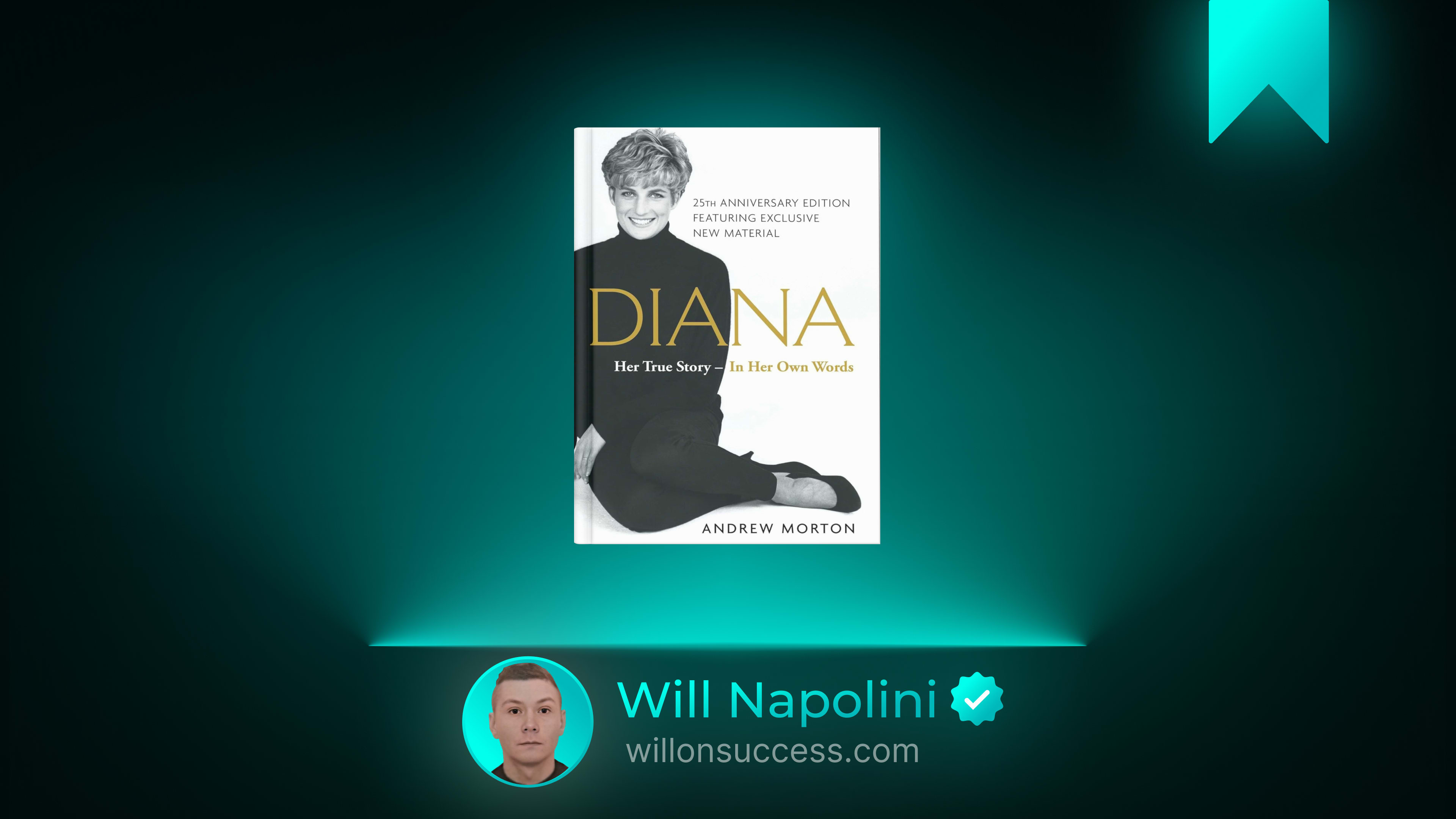
In 1992, journalist Andrew Morton published Diana: Her True Story. At the time, it was a cultural earthquake. It shattered the carefully curated silence of the British Royal Family and revealed the profound isolation, emotional starvation, and private battles of the Princess of Wales.
But if you look past the tabloid headlines and the palace intrigue, you will find something much more valuable. You will find a profound, masterful case study in personal development. You will find a roadmap for what happens when external circumstances demand that you suppress your true self, and the immense courage it takes to finally speak your truth.
The Big Idea: The Illusion of the Golden Cage
The central thesis of Diana’s journey is not about a failed marriage. It is about the danger of outsourcing your identity to an institution, a person, or a societal expectation.
Diana’s life forces us to confront a difficult truth: External validation cannot heal internal emptiness.
You can have the title, the wealth, the public adoration, and the perfect photograph, but if your daily reality requires you to silence your own emotional needs, you will slowly begin to starve. Diana’s story is a testament to the fact that character must eventually confront circumstances. When the environment you are in demands that you be someone you are not, you have only two choices: you can wither away to keep the peace, or you can break the cage to save your life.
The Story of the Unspoken Truth
To understand the power of this book, you have to understand the environment Diana walked into. She was a nineteen-year-old girl who operated on a frequency of deep emotion, warmth, and intuition. She was marrying into an institution—the British Royal Family—that operated on a frequency of duty, stoicism, and emotional distance.
She entered the marriage with an unspoken contract that many of us carry into our own lives: If I am just sweet enough, if I am just compliant enough, if I accommodate your needs and hide my own, eventually you will love me the way I need to be loved.
It did not work. The institution did not change to accommodate her; it expected her to shrink to accommodate it.
Morton’s book details the devastating toll this took. When you cannot speak your pain, your body will often scream it for you. For Diana, this manifested in severe bulimia and self-harm. These were not merely medical conditions; they were the physical manifestations of a woman who felt entirely unheard, unsupported, and profoundly alone in a house full of people. She was trying to control the only thing she felt she had left: her own body.
The turning point—the moment that makes this book a masterclass in personal agency—was not a single dramatic argument. It was a quiet, deliberate decision to reclaim her narrative.
Realizing that the palace would never protect her, and that the press was tearing her apart, Diana decided to speak for herself. Through secret, recorded conversations with a trusted friend (which were later used by Morton to write the book), she began to document her reality. She stopped waiting for permission to be understood.
When she famously noted that “there were three of us in this marriage, so it was a bit crowded,” it was not just a soundbite. It was an act of profound psychological reclamation. She was no longer the passive victim of a fairy tale gone wrong. She was a woman stepping into her power, looking at the reality of her life without flinching, and deciding to take the pen out of the hands of her critics.
The Trap of the Unspoken Contract
One of the most painful lessons I have seen people learn—and one that Diana learned in the echoing hallways of Kensington Palace—is the danger of the unspoken contract.
How many times have you stayed in a job, a relationship, or a social circle because you believed that if you just worked harder, sacrificed more, or smiled through the discomfort, the people in charge would finally recognize your worth?
We do this because we are terrified of conflict. We think that keeping the peace is the same thing as being at peace. But keeping the peace at the expense of your own soul is not a virtue; it is a slow form of self-betrayal.
Diana had to learn that you cannot negotiate genuine connection with people who are committed to misunderstanding you. The Royal Family viewed her emotional needs as a liability to the “firm.” She spent years trying to translate her heart into a language they were incapable of speaking.
Here is what I would tell you: Stop trying to translate your worth to people who are committed to misreading you.
Responsibility means accepting that you cannot control how others treat you, but you are entirely responsible for how long you stay in environments that diminish you. Diana’s growth began the day she stopped asking the institution to change, and started asking herself what she was going to do next.
Empathy as the Ultimate Rebellion
When you are trapped in a golden cage, how do you find your way out? How do you build a sense of self when the world only sees you as a symbol?
Diana found her way out through radical, rule-breaking empathy.
In the late 1980s and early 1990s, the world was terrified of the AIDS epidemic. Patients were shunned, isolated, and treated as untouchables. The royal protocol dictated distance, gloves, and careful, sanitized interactions.
Diana threw the protocol away. She walked into AIDS wards without gloves. She sat on the beds of dying men. She held their hands. She looked them in the eye. Later, she would walk through active minefields in Angola, holding the hands of children who had lost limbs.
This was not just charity. This was a profound mechanism for personal healing.
When you feel empty, invisible, and consumed by your own private pain, the fastest way to find yourself is to step into the pain of someone else. By touching the “untouchables,” Diana was rebelling against the cold, sterile emotional landscape of her own life. She was proving to herself that her warmth, her touch, and her empathy had immense, world-changing power.
She stopped trying to be the perfect royal figurehead and decided to be a human being who connected with other human beings. In doing so, she bypassed the palace entirely and connected directly with the hearts of millions. She found her purpose not in the titles she was given, but in the love she chose to give away.
Why This Matters on an Ordinary Tuesday
You might be reading this and thinking, That is a fascinating biography, but I am not a princess. I do not have paparazzi on my lawn or a royal family to contend with.
But I want you to look closely at your own life.
Where are you performing a role that is slowly draining the life out of you?
Perhaps you are a middle manager in a corporate environment that demands you act like a ruthless machine, when your true strength is your deep empathy for your team. Perhaps you are in a marriage or a family dynamic where you are expected to play the “peacemaker,” swallowing your own grievances so that everyone else can remain comfortable. Perhaps you are curating a perfect life on social media, smiling for the camera, while privately battling the same feelings of isolation and inadequacy that Diana faced.
The pain of inauthenticity is universal. The golden cage does not have to be made of gold; sometimes it is made of a mortgage, a job title, or the fear of disappointing your parents.
What Diana’s story teaches us is that the discomfort of breaking the script is temporary, but the regret of living a lie is permanent. You do not need to call a press conference to reclaim your life. You just need to look in the mirror and decide that your emotional survival is more important than other people’s comfort.
Practical Application: Auditing Your Script
Understanding that you are trapped is valuable, but understanding without action changes nothing. If you feel the walls of a golden cage closing in, you need a system to begin dismantling it.
Here is a practice I want you to try this week. I call it the Script Audit.
Take a piece of paper and draw a line down the middle. On the left side, write the heading: “The Role I Am Playing.” On the right side, write the heading: “The Truth I Am Hiding.”
Under the left side, list the expectations you are currently trying to meet.
- I must always be available to my boss after hours.
- I must never argue with my partner in front of our friends.
- I must pretend I love this career path because I spent four years studying it.
Under the right side, write the physical and emotional toll that role is taking on you.
- I am exhausted and my sleep is ruined.
- I feel lonely and unheard in my own home.
- I dread Monday mornings and feel my creativity dying.
Look at the gap between the two columns. That gap is where your energy is leaking. That gap is where the bulimia, the anxiety, the burnout, and the resentment live.
Choose one small item from the left column. Just one. And decide how you are going to drop the act. You do not have to blow up your life today. But you must stop pretending that the performance is working.
Who Should Read This Book
Diana: Her True Story is a biography, not a self-help manual, but it reads like a psychological thriller about the quest for identity.
It is essential reading for anyone who has ever felt suffocated by family expectations, anyone navigating a high-conflict separation, or anyone who has realized that the “dream” they achieved is actually a nightmare. It is also a vital read for those interested in the intersection of public image and private pain, and how the media shapes our perception of reality.
However, if you are looking for a scandalous, gossipy tell-all that revels in petty revenge, this book may disappoint you. While it is unflinchingly honest about Charles and the royals, its core is deeply sympathetic, focused heavily on Diana’s internal emotional landscape, her struggles with her mental health, and her desperate search for authentic love. It is a book about survival, not just celebrity.
One Small Step to Take Today
You do not need to wait for a crisis to start speaking your truth. You can begin building the muscle of authenticity right now, in the quiet moments of your day.
Here is your assignment for today:
Identify one conversation you have been avoiding because you are afraid of disrupting the “peace.” It might be telling a friend that you cannot afford to go on the expensive trip they are planning. It might be telling your spouse that you felt hurt by a comment they made yesterday. It might be telling your manager that you need to renegotiate your workload.
Have that conversation today.
Do not be aggressive. Do not be cruel. But do not be compliant. Speak your truth calmly, clearly, and without apologizing for your own reality.
The Door Opens
We are raised on fairy tales. We are taught that if we are good, if we are beautiful, and if we follow the rules, the kingdom will embrace us and we will live happily ever after.
But life is not a fairy tale. It is a crucible.
The people who build lives of deep, resonant meaning are not the ones who perfectly maintained the illusion. They are the ones who had the courage to let the illusion shatter. They are the ones who realized that the crown they were chasing was too heavy, and that the only true authority they would ever possess was the authority over their own soul.
You do not need a palace to be powerful. You do not need an audience to be valuable.
Stop waiting for the world to give you permission to be who you already are. Step out of the cage, speak your truth, and let the real work begin.
Because the most beautiful life you will ever live is the one you write for yourself.