The Courage to Run Your Own Race: A Mentor’s Guide to Patricia Nell Warren’s The Front Runner
Picture the exact moment before a runner leaves the starting blocks. The stadium is deafening, but their world has gone entirely quiet. Every muscle is coiled. The mind is stripped of distraction. In that fraction of a second, there is no room for pretense. You are either ready to run the race in front of you, or you are paralyzed by the fear of it.
When was the last time you felt that kind of clarity in your own life?
Most of us do not live in that state of readiness. We live in a state of careful management. We curate our opinions, soften our edges, and stay on paths laid down by others because it feels safer than the vulnerability of choosing our own direction. We convince ourselves that this compromise is the price of stability. But a life built on self-denial is not stable; it is merely suspended.
If you have ever felt the quiet fatigue of maintaining a facade, there is a story that masterfully illustrates what it actually costs to tear down that facade, and what becomes possible when you finally do.
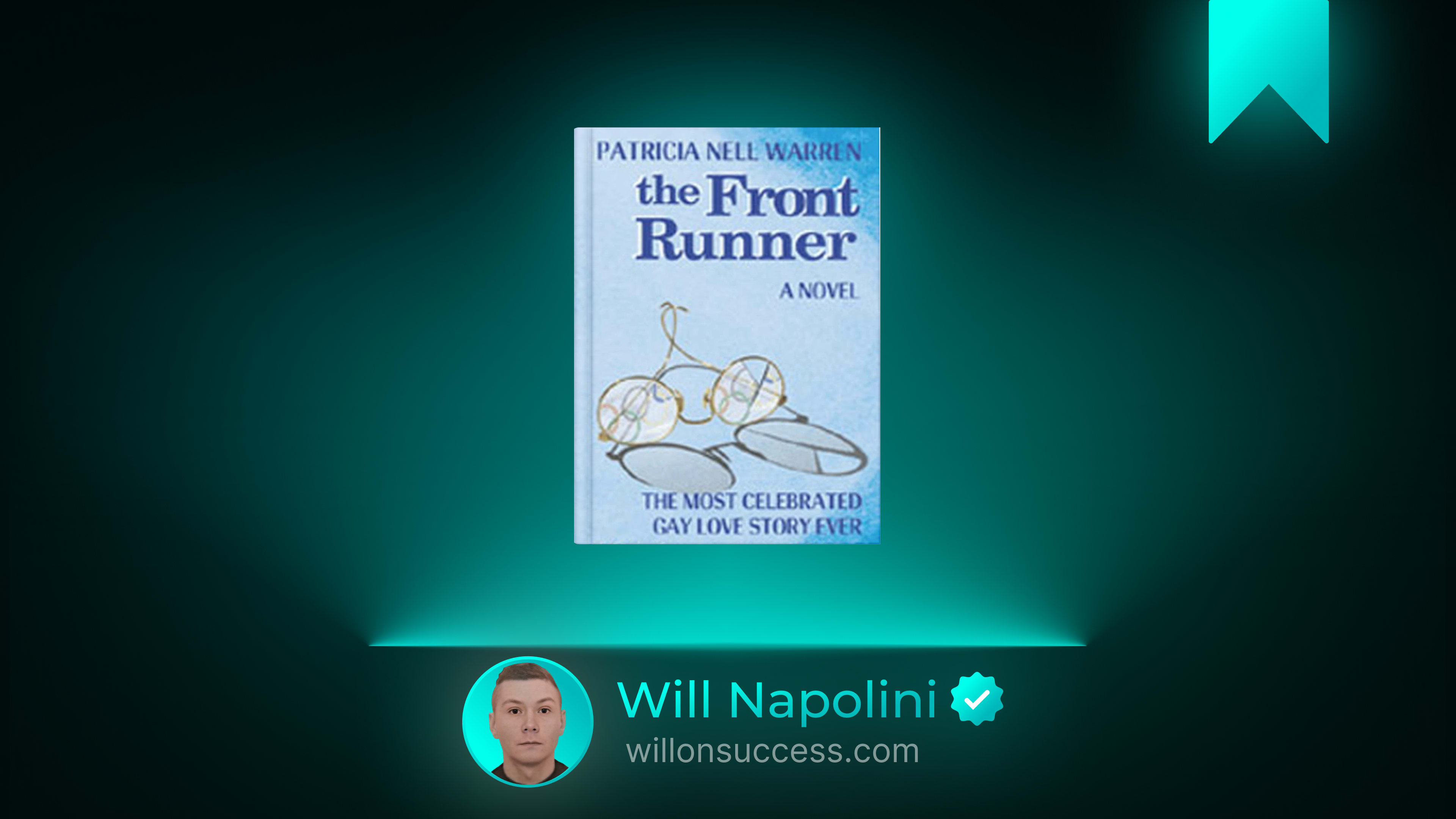
That story is The Front Runner by Patricia Nell Warren.
Published in 1974, it made history as the first contemporary gay-themed novel to appear on The New York Times Best-Seller List. But to view it merely as a historical milestone is to miss its deeper, enduring value. At its core, this book is a masterclass in human development. It is a raw, honest examination of what happens when a person decides to stop running from their own truth and starts building a life on a foundation of authenticity.
Here is what this book can teach you about your own life, your own relationships, and your own potential.
The Big Idea: External Achievement Is Hollow on a Fabricated Foundation
The central thesis of The Front Runner is simple but devastating: you cannot build a genuine, fulfilling life on a foundation of self-denial.
We live in a culture that worships external achievement. We are taught to climb the ladder, win the race, and secure the title. But Patricia Nell Warren asks a more penetrating question: What good is the finish line if you are running someone else’s race?
True growth requires the courage to dismantle the life you built for safety and construct one aligned with your deepest values. It demands that you trade the illusion of control for the messy, beautiful reality of being known. External results mean nothing if the internal architecture is rotten.
The Story: A Collision of Two Worlds
To understand this idea, we must look at the architecture of the story. The novel is told from the perspective of Harlan Brown, a 39-year-old track coach at the small Prescott College. Harlan is a former Marine, a disciplined conservative, and a man who has long since buried his own unfulfilled Olympic running dreams. More importantly, he has buried his true identity, living a carefully constructed, closeted life to maintain his professional standing and social safety.
Then enters Billy Sive. Billy is a brilliant, fiercely authentic, and openly gay young runner with extraordinary potential.
When Harlan takes Billy under his wing, a profound shift occurs. Billy’s raw talent and unapologetic presence force Harlan to confront the walls he has spent a lifetime building. Their relationship evolves from coach and athlete into a deep, romantic partnership. But this is not a fairy tale. It is a grueling test of character. They must navigate intense societal prejudice, professional risk, and their own internal fears.
Harlan is forced to choose between the safety of his fabricated life and the terrifying, authentic purpose he finds in loving Billy and championing his dreams. The novel does not shy away from the tragedy and sacrifice this choice demands, but it ultimately points toward a reimagining of what family and commitment can look like when built on truth.
The Major Principles
The Armor You Build for Survival Eventually Becomes Your Prison
Early in life, we all develop protective personas. For Harlan, it was the rigid, stoic exterior of the Marine and the respected, traditional coach. This mask served a purpose. It protected him from a hostile world and allowed him to carve out a space of professional respect.
But here is the mechanism of the mask: it consumes cognitive and emotional energy. Initially, it feels like armor. Over time, it calcifies. You forget where the mask ends and your actual face begins.
Why does this matter to you? Because you cannot build a genuine life on a fabricated foundation. If you are constantly performing—whether at work, in your relationships, or within your family—you are diverting vital energy away from actual growth. You may be working hard and still wondering why nothing is changing. The answer is often that your effort is being spent maintaining an illusion, rather than cultivating reality.
A small decision becomes a direction, and a direction repeated long enough becomes a life. If your daily direction is concealment, your life will become a prison of your own making.
True Mentorship Is an Act of Surrender, Not Control
One of the most powerful dynamics in the book is the coaching relationship. When Harlan sees Billy’s potential, there is a subtle, dangerous temptation: the urge to mold Billy into the runner Harlan wished he could have been.
This is a trap many leaders, parents, and mentors fall into. We project our unfulfilled ambitions onto the people we guide. We mistake control for guidance.
But true mentorship is an act of surrender, not domination. The goal is not to create a replica of yourself. The goal is to clear the path so the other person can become who they are meant to be.
Harlan’s growth as a mentor is measured by his ability to step back. He learns that his value is not in dictating Billy’s every move, but in providing the stability, wisdom, and resources Billy needs to surpass him.
If you are in a position of influence, ask yourself: Am I nurturing this person’s unique potential, or am I trying to validate my own past choices through them? Growth before achievement means prioritizing the other person’s development over your own ego.
Authenticity Is a Daily Practice of Friction, Not a Single Grand Gesture
We often romanticize authenticity as a single, dramatic moment of truth-telling. The movie-style confession. The slammed door. The grand declaration.
The Front Runner shows us the reality: authenticity is a daily, often exhausting practice. It is not a destination you reach; it is a muscle you build.
For Harlan and Billy, choosing truth is not a one-time event. It is a series of difficult, compounding choices. It is deciding to hold hands in a world that tells them not to. It is facing professional scrutiny and social isolation, and choosing each other anyway.
This is the principle of responsibility before excuses. Circumstances matter. The prejudice they face is real and dangerous. But focusing primarily on what they can control—their commitment to each other and their own integrity—becomes their anchor.
You will face similar, albeit perhaps less dramatic, crossroads. Choosing truth means setting boundaries. It means having the difficult conversation you have been postponing. It means accepting the temporary discomfort of being misunderstood in exchange for the long-term peace of being genuine.
Why It Matters: Your Ordinary Tuesday
You might be thinking, This is a story about a gay track coach in the 1970s. What does this have to do with my ordinary Tuesday?
Everything.
The specific details of the story are unique, but the underlying human mechanics are universal.
Are you staying in a career that drains your soul because it looks impressive on paper? Are you maintaining a relationship out of habit rather than genuine connection? Are you silencing your creative ideas in meetings because you are afraid of being judged?
These are all variations of Harlan’s initial dilemma. They are choices to prioritize safety over truth.
The book challenges you to evaluate the tracks you are running on. Were they laid down by your own values, or were they constructed by the expectations of your parents, your peers, or society at large?
When you apply this principle, something shifts. You stop seeking external validation to fill an internal void. You begin to make decisions based on alignment rather than approval. This does not mean life becomes easy. As the book honestly portrays, doing the right thing often invites friction. But the friction of growth is always preferable to the slow decay of regret.
What you repeat in private eventually becomes visible in your life. If you practice courage in small, unseen moments, you will be ready when the large moments arrive.
Practical Application: Turning Insight into Behavior
Understanding this book is valuable, but understanding without action changes nothing. Here are three concrete ways to apply these principles to your life this week.
1. Conduct a Mask Inventory Take ten minutes with a pen and paper. Write down three areas of your life where you are performing rather than being.
- Where do you say “yes” when you mean “no”?
- What opinion do you hide to keep the peace?
- What dream have you dismissed as “impractical” simply because you are afraid to try? Do not judge yourself for these. Just observe them. Awareness is the first step toward dismantling the cage.
2. The Mentorship Check If you guide, manage, or parent anyone, evaluate your approach this week. Before giving advice or direction, ask yourself: Am I trying to make this person succeed on my terms, or am I helping them discover their own? Practice active listening. Ask more questions than you give commands. Give them the space to make their own decisions, even if their path looks different from yours.
3. Execute a Micro-Truth Authenticity is built through repetition. Choose one small, low-risk action this week to align your external life with your internal values.
- If you have been pretending to enjoy a hobby you dislike, politely decline the next invitation.
- If you have an idea at work you’ve been withholding, voice it in the next meeting, even if your voice shakes.
- If you need to set a boundary with a family member, draft the conversation and deliver it with calm, firm kindness.
You start small. You stay consistent. You let time do its work.
Who Should Read This Book
The Front Runner is not for everyone, and it is important to be honest about that.
You will benefit most from this book if:
- You are navigating a major life transition and feel trapped by the expectations of others.
- You are in a mentorship, leadership, or parenting role and want to understand the deeper, selfless responsibilities of guiding others.
- You are seeking a story that validates the difficult, messy, but ultimately liberating journey toward living authentically.
You may find it less useful if:
- You are looking for a light, escapist romance. This book deals with heavy societal pressures, prejudice, and genuine sacrifice.
- You are unwilling to examine your own complicity in wearing a mask. The book acts as a mirror, and it can be uncomfortable to look into it.
It is a product of its time, and some of the cultural contexts reflect the 1970s. However, the emotional core—the universal longing to be seen, accepted, and free to run one’s own race—remains entirely timeless. It endures as a beacon for anyone who has ever had to fight for the right to be themselves.
One Small Step
We often wait for a grand, cinematic moment to change our lives. We wait for the perfect conditions, the absolute certainty, or the overwhelming surge of motivation.
But life is not changed in the grand gestures. It is changed in the quiet, unglamorous decisions we make when no one is watching.
Identify one small truth you have been avoiding. It could be a feeling you need to acknowledge, a boundary you need to set, or a step you need to take toward a goal you have been hiding.
Do not wait for tomorrow. Do not wait for permission. Speak it, write it, or act on it before the sun sets today.
The track is already beneath your feet. The only question that remains is whether you will run the race that was assigned to you, or the one that was always meant to be yours.
Take the first step. The rest of the path will reveal itself as you move.