Acres of Diamonds — And Why Your Fortune Is Under Your Feet
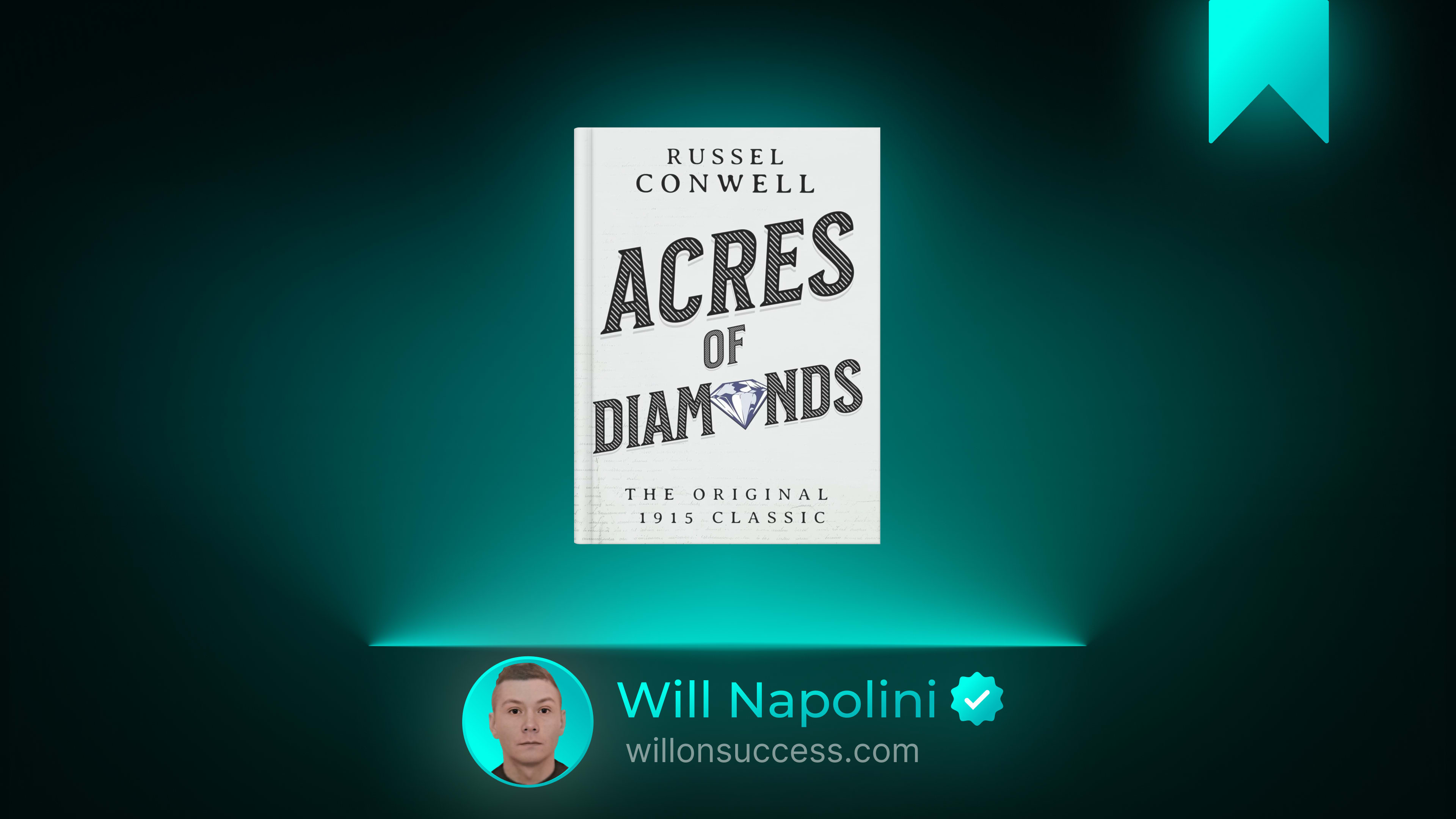
I want to ask you a question that might feel a little uncomfortable, but I promise it will set you free: What if the life you are praying for is already waiting for you, but you are too busy looking for it somewhere else? I know how it feels. I have stood where you are standing. I have looked at my current circumstances—my bank account, my job title, my city—and felt like they were a waiting room for the real life that was going to start once I got to the right place. But here is the truth that changed everything for me, and it is the truth that Russell H. Conwell captures so beautifully in Acres of Diamonds: You are not poor because you are in the wrong place. You are poor because you are not seeing the place you are in.
Let me walk you through this simple, devastatingly powerful story, and then let me tell you why it is the most important lesson you will learn this year.

The Story That Changed Everything
Conwell begins with an ancient Persian tale about Al Hafed, a wealthy farmer who lived near the Indus River. Al Hafed was content until a priest visited him and told him stories of diamonds—how they were formed, how they were used, and how much they were worth. The priest mentioned that if Al Hafed had just one acre of diamonds, he could buy entire provinces.
That night, Al Hafed could not sleep. The seed of discontent had been planted. He sold his farm, left his family in the care of neighbors, and wandered the world searching for diamonds. He traveled to Europe, to Africa, to the Middle East. He spent his money. He lost his health. He grew weary and broken. Finally, destitute and despairing, he threw himself into the sea at Barcelona and drowned.
Meanwhile, back home, the man who bought Al Hafed’s farm was watering his camel in the garden. He noticed a strange gleam in the stream bed. He pulled out a stone. It reflected the light in a way he had never seen. He took it inside. His wife looked at it and said, “Al Hafed has returned! These are diamonds!”
The new owner went out to the garden. He dug. He found more. He sent samples to experts. The entire farm was covered in acres of diamonds. The Golconda diamond mine, one of the most famous in history, was right there. Al Hafed had sold his birthright because he did not recognize the value of what he already possessed. The opportunity you are chasing across the ocean is often hiding in the backyard you are eager to leave.
The Principle I Could Not Unsee
Conwell wrote this speech in the late 19th century, but he might as well have written it for you, today, in 2026. He argues that most people fail not because they lack talent, not because they lack drive, but because they lack perception. They believe that success is a destination you travel to, rather than a resource you develop.
I have mentored thousands of people. I have seen engineers quit stable jobs to start businesses in industries they know nothing about, only to fail because they ignored the problems they saw every day in their current workplace. I have seen writers ignore the stories in their own communities because they think they need to move to Los Angeles to be “real” artists. I have seen entrepreneurs overlook the unmet needs of their neighbors because they are too busy studying the trends in Silicon Valley.
You do not need a new landscape. You need new eyes. The diamonds are not in the distance. They are in the skills you have already built but undervalue. They are in the problems you see every day at work but complain about instead of solving. They are in the network you already have but have not yet served.
The Illusion of “Somewhere Else”
Conwell makes a point that stings a little: “If you want to find diamonds, you must dig in your own backyard.” This is not a metaphor for laziness. It is a metaphor for depth.
When Al Hafed left, he traded depth for breadth. He skimmed the surface of a hundred places but never dug deep in one. Most of us do this with our careers. We jump from job to job, from project to project, from idea to idea, always looking for the “big break.” But diamonds are formed under pressure, over time, in one specific place. Success is not found by scanning the horizon. It is found by drilling down.
Think about your current situation. Your current job. Your current city. Your current relationships. Where are the friction points? Where are the inefficiencies? Where are the things people complain about? Those complaints are not annoyances. They are signposts. They are the glimmer in the stream bed. Every complaint is a request for a solution. Every problem is a business waiting to be born. Every gap in your knowledge is a skill waiting to be monetized.
Why You Must Stop Looking Over the Fence
I know why you want to leave. I know why the grass looks greener on the other side. It is because you can see the whole lawn from here, but you only see the weeds in your own yard. You compare your behind-the-scenes with everyone else’s highlight reel. You see their diamonds, but you do not see the years of digging they did before anyone noticed.
Conwell warns us against this envy. He says, “Do not wait for someone to bring you a map. You are the cartographer.” When you stop looking for permission to succeed from external circumstances, you start taking responsibility for the value you can create right now.
I had a client named Sarah. She was a nurse, exhausted, feeling stuck. She wanted to go back to school for administration, thinking that was the “diamond.” I asked her, “What do you hear patients saying every day that no one is fixing?” She paused. She said, “They are confused about their medications after they leave the hospital. They keep coming back because they don’t understand the instructions.”
That was her diamond. She did not quit her job. She did not move to a new city. She started writing simple, clear guides for her patients. She shared them with her colleagues. Within six months, her hospital adopted her system. Within a year, she was consulted by three other hospitals. She did not need a new career. She needed to dig deeper in the one she had. Your current frustration is the raw material for your future fortune.
The Search for One Equation — and the Search for One Decision
Conwell’s message is simple, but it requires a decision. You must decide to stop wandering. You must decide to stay put, mentally and emotionally, long enough to see what is actually there.
This does not mean you never change jobs. It does not mean you never move. It means you do not move away from something. You move toward something you have identified and cultivated. You do not sell your farm because you are bored. You sell it because you have mined it dry and are ready for a new field. But most of us have not even started digging.
Opportunity is not a lightning strike. It is a excavation. You must be willing to get dirty. You must be willing to look foolish. You must be willing to sift through the dirt of your daily routine to find the one thing that shines.
Why You Should Read It (Even If It’s Old)
Acres of Diamonds is short. You can read it in an afternoon. It is dated in its language, but it is timeless in its truth. Conwell speaks with the authority of a man who saw empires rise and fall, and he noticed that the ones who thrived were not the ones who traveled the furthest, but the ones who saw the clearest.
I press this into your hands because it is the antidote to the anxiety of “missing out.” You are not missing out. You are just not looking down. You are so busy looking at the screens, the feeds, the news, the distant successes of others, that you have forgotten to look at your own two feet. The ground beneath you is fertile. Stop treating it like a waiting room.
Your One Small Step
So here is what I want you to do today. Not tomorrow. Today.
Take out a notebook. Write down three problems you face in your current job, your current community, or your current daily routine. Just three. Do not judge them. Do not try to solve them yet. Just write them down.
Then, ask yourself this question: “If I were paid to solve this, how would I do it?”
Write down the first step. Not the whole plan. Just the first step. Make the call. Send the email. Draft the outline. Research the tool.
You do not need to buy a ticket to Barcelona. You do not need to sell your farm. You need to pick up a shovel. The diamonds are there. They have been there all along.
Start digging.