A Brief History of Time — And What It Taught Me About Yours
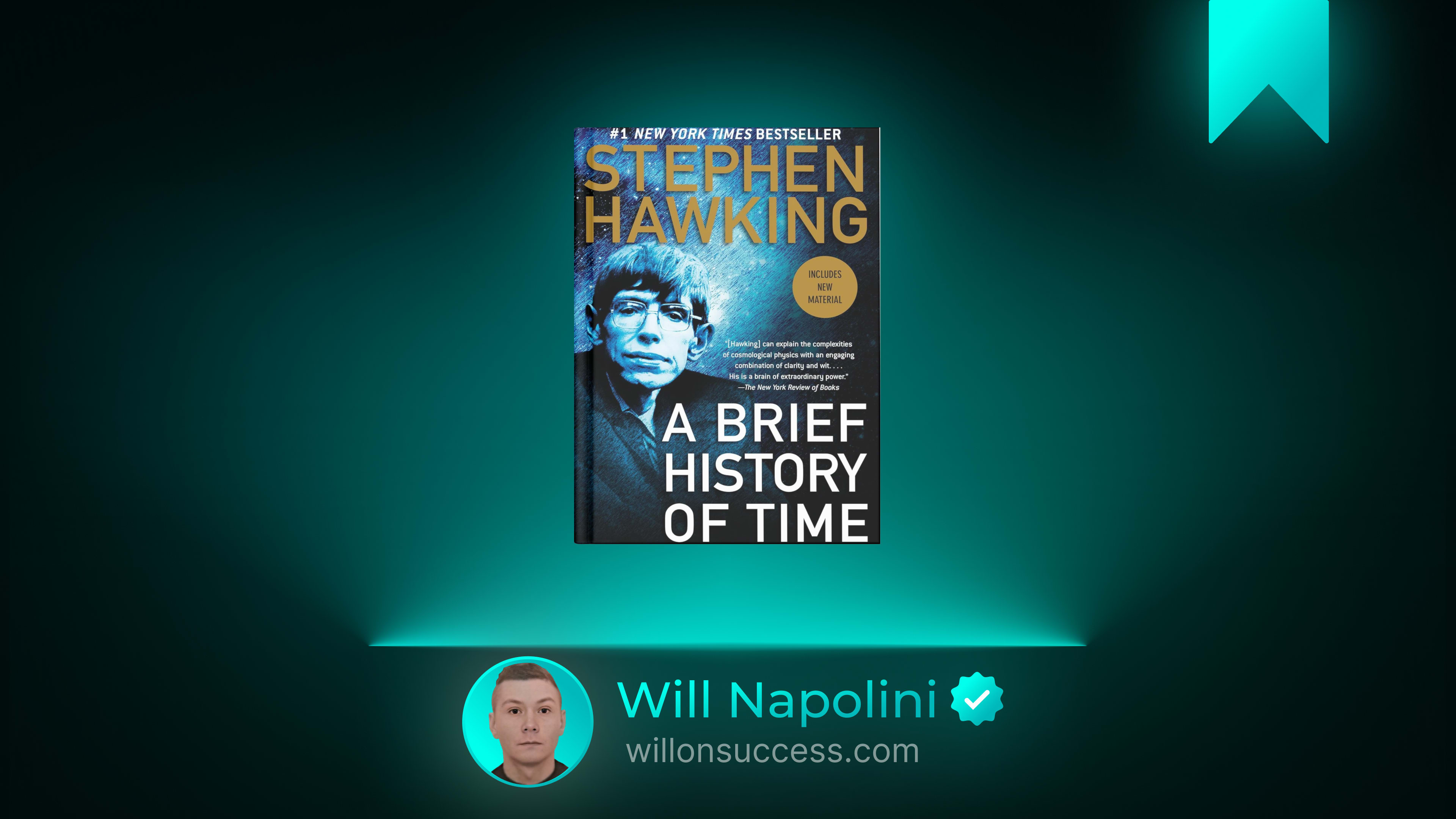
A Brief History of Time — And What It Taught Me About Yours
I was twenty-nine years old, sitting on the floor of a used bookstore in Tucson, when I cracked open a thin paperback with a wheelchair-bound physicist on the cover and a question that stopped my breath: Where did all of this come from, and where is it going? I had no business reading Stephen Hawking. I had barely finished a business degree. I was directionless, a little lost, and honestly a little afraid of my own future. But I read that book in three days, and something shifted in me that I have carried for over twenty years. Not because I understood every equation. I didn’t. But because Hawking handed me a truth I desperately needed: the universe itself is a story of expansion from a single, impossibly small beginning — and so are you.
Let me walk you through what this extraordinary book actually says, and then let me tell you why I believe it will change the way you see your own Tuesday morning.
What Hawking Is Really Asking
The book is, on its surface, a guided tour of cosmology. Hawking takes you from Aristotle’s belief that the Earth sat still at the center of everything, through Newton’s gravity, through Einstein’s relativity, all the way to the bleeding edge of quantum mechanics and the search for a single unified theory of physics. He explains the Big Bang — the idea that roughly 13.8 billion years ago, everything you have ever seen, touched, or loved was compressed into a point smaller than an atom. He explains how space itself has been stretching ever since, carrying galaxies apart like leaves on a river that has no bank.
He walks you through black holes — those regions where gravity is so ferocious that not even light escapes. He shows you how time itself bends near massive objects, how it slows, how it warps. He introduces you to the thermodynamic arrow of time, the reason you remember yesterday but cannot remember tomorrow, the reason an egg shatters but never reassembles itself on the kitchen floor.
And threaded through all of it is one relentless, almost childlike question: Can we find a single set of laws that explains everything? One equation. One elegant sentence that holds the cosmos together.
That is the book. But here is what it did to me, and here is what I hope it does to you.
The Principle I Could Not Unsee
Hawking writes about the expansion of the universe not as an explosion into empty space, but as space itself stretching. There is no center. There is no edge. Every point is moving away from every other point, and the expansion is not slowing down — it is accelerating.
I read that paragraph four times. Then I set the book down and cried a little, because I realized I had been treating my own life like a fixed object in a static sky, waiting for the universe to rearrange itself around me. You are not a planet waiting for a new orbit. You are the expansion itself. Growth is not something that happens to you if conditions are right. Growth is the fundamental nature of a life that refuses to stand still.
Hawking shows you that the cosmos did not need permission to begin. It did not wait for ideal conditions. From a singularity — a point of infinite density and zero volume — everything unfolded. Galaxies. Stars. Carbon. Oxygen. The specific arrangement of atoms that became your hands, your eyes, the particular way you laugh when someone surprises you. You came from a point smaller than a period at the end of a sentence. And you are still expanding.
Black Holes, and the Seasons You Cannot See
The chapters on black holes are where Hawking gets genuinely strange and genuinely beautiful. He explains that a black hole is not simply a hole. It has a boundary — the event horizon — past which nothing returns. And yet, through the work of Jacob Bekenstein and Hawking himself, we learned that black holes are not truly black. They radiate. They emit a faint glow now called Hawking radiation. Even the darkest object in the universe is giving something back.
I think about that when I talk to someone who is in a season they cannot explain. The job loss. The divorce. The diagnosis. The eighteen months of showing up with no visible result. You feel like you have crossed an event horizon. You feel like the light is not coming back. But Hawking proved — mathematically, rigorously, beautifully — that even a black hole radiates. Your darkest season is not an ending. It is a transformation you cannot yet observe from the outside. The energy is not gone. It is changing form. Keep going. The radiation is real, even if no one can see it yet.
The Arrow of Time, and Why You Must Forgive Yourself
One of the most quietly devastating chapters deals with why time moves in one direction. Hawking connects it to entropy — the second law of thermodynamics. Disorder increases. The cup falls. The egg breaks. You cannot unscramble the years.
A lot of people read that and feel grief. I read it and felt freed. Because it means the past is genuinely, structurally, physically closed. Not because someone decided to lock the door, but because the architecture of reality moves forward. You do not owe your future an apology for who you were five years ago. The arrow points ahead. You are allowed to point ahead too. Hawking spent his entire adult life in a body that was failing him, and he pointed his mind at the origin of the universe. If he could refuse to be defined by the direction things were breaking down, you can refuse to be defined by the one chapter you wish you could rewrite. Turn the page. The physics of your life is on your side.
The Search for One Equation — and the Search for One Decision
The final chapters of the book are about the holy grail of physics: a unified theory. General relativity explains the very large. Quantum mechanics explains the very small. But they do not talk to each other. They contradict each other at the seams. Hawking spent decades trying to stitch them together, and he invites you into that search. He does not hand you the answer. He hands you the question, and he treats you as someone capable of holding it.
I have come to believe that every person I have ever mentored is searching for their own unified theory. One coherent story. One principle that makes the chaos of their career, their relationships, their health, their finances, their quiet 2 a.m. thoughts all line up into a single, honest sentence. And here is what I have learned after watching hundreds of people try: you do not find that sentence by thinking harder. You find it by deciding one thing and then living inside that decision long enough for it to explain the rest. Pick your one thing. Protect it. Build outward from it. The unified theory of your life will not arrive as a lightning bolt. It will arrive as a slow, quiet coherence that sneaks up on you around month fourteen, when you look back and realize the scattered pieces have been arranging themselves all along.
Why You Should Read It (Even If Physics Scares You)
I will be honest with you. There are passages in this book where Hawking dives into imaginary time, into Feynman’s sum-over-histories, into the no-boundary proposal, and your eyes will glaze. That is fine. Give yourself permission to skim. Give yourself permission to not understand every line. Hawking himself said he was told that every equation in the book would halve its sales, so he included exactly one: E = mc². He wanted you in the room. He wrote this for the curious, not the credentialed.
And the reason I keep pressing this book into people’s hands is not the physics. It is the posture. Hawking wrote most of this while unable to move, speaking through a synthesizer, dictating the architecture of the cosmos one painstaking word at a time. He could have been bitter. He could have been small. Instead, he looked at the largest questions a human mind can hold and said, I will try. Courage is not the absence of limitation. It is the decision that your mind is bigger than your circumstance. That single posture, repeated over a lifetime, built a book that has sold more than twenty-five million copies and made a generation look up at the night sky with new eyes.
Your One Small Step
So here is what I want you to do tonight. Not this weekend. Tonight. Before you go to sleep, step outside. If you are in a city, find a patch of sky between the buildings. If you are in the country, lie back in the grass. Look up. You are looking at light that left its source four hundred years ago, four thousand years ago, four billion years ago. You are looking at the aftermath of a single, impossibly small beginning that decided — for reasons no equation has fully explained — to become everything.
You are made of that same story. You are made of that same expansion. And whatever you have been postponing, whatever small seed you have been holding in your closed fist because you are afraid the soil will not receive it — plant it. Tomorrow morning. Write the first sentence. Make the first call. Sign up for the class. Send the message. You do not need to see the whole harvest. You need to put one seed in the ground and trust the physics of growth.
The universe has been expanding for 13.8 billion years. It is not tired. It is not finished. And neither are you.
Now go look at the sky. Then come back and begin.