A Guide to the Good Life — And the Quiet Architecture of Your Joy
Ten years ago, I sat in an airport terminal at two in the morning, watching a departure board flash “CANCELLED” in bright red letters, and I felt my entire inner world collapse into anger. I was furious at the airline, furious at the weather, furious at the universe for ruining my schedule. And then an older gentleman sitting next to me closed his paperback, looked at the board, smiled gently, and said, “Well, I guess we get to read for another three hours.” That man had a secret I desperately needed. He wasn’t ignoring reality; he had simply mastered the architecture of his own joy.
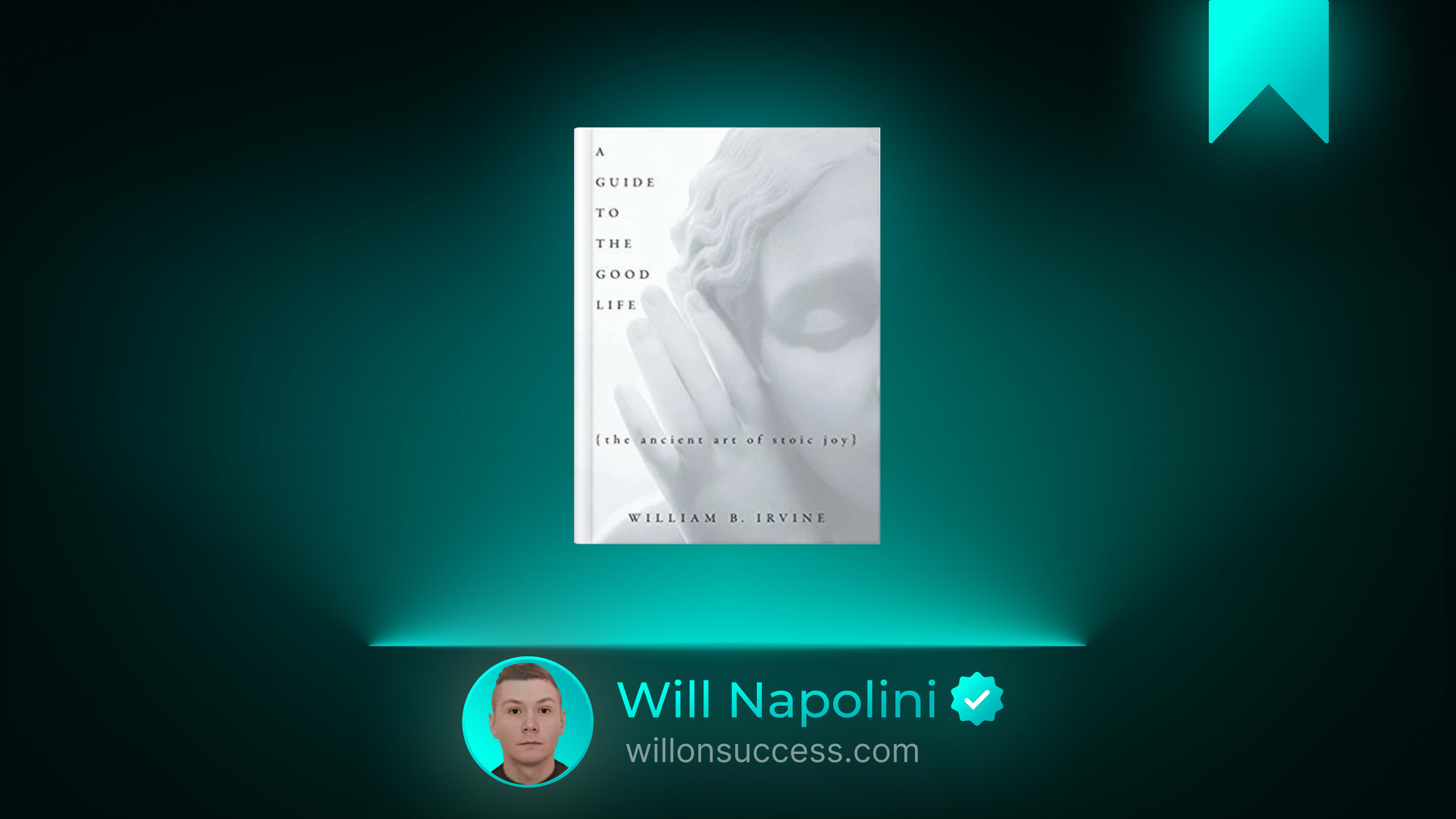
That night sent me on a search that eventually led me to William B. Irvine’s brilliant, life-altering book, A Guide to the Good Life: The Ancient Art of Stoic Joy. When most people hear the word “Stoicism,” they picture a marble statue—cold, emotionless, enduring pain with a stiff upper lip. But Irvine strips away the academic dust and reveals the true, beating heart of this ancient philosophy. Stoicism is not about turning off your heart to avoid the pain; it is about turning on your wisdom to protect your peace. This book is a masterclass in how to stop being a victim of your circumstances and start becoming the author of your inner weather. Let me walk you through the blueprint.

The Ultimate Goal: Tranquility and Joy
Irvine begins by asking a question we rarely pause to answer: What is the grand goal of your life? Most of us chase wealth, status, or achievement, assuming that joy will naturally follow once we arrive. Irvine argues that the Stoics had it right all along: the highest goal of a human life is tranquility—a state of profound inner peace, free from chronic anxiety, anger, and sorrow.
Notice what he is not saying. He is not telling you to avoid ambition. He is not telling you to stop building your business, raising your family, or pursuing your dreams. He is simply reminding you that if the pursuit of those things costs you your tranquility, you have paid too high a price. Joy is not the absence of a storm; it is the anchor you drop in the middle of it. When you make inner peace your primary metric for success, every other decision in your life suddenly becomes clearer. You stop taking jobs that poison your soul. You stop arguing with strangers on the internet. You start protecting your energy like the sacred resource it is.
The Trichotomy of Control: The Soil and the Weather
The most famous principle in Stoicism is the dichotomy of control: some things are up to us, and some things are not. But Irvine offers a brilliant modern update. He introduces the trichotomy of control. He points out that there are things we have complete control over (our thoughts, our actions), things we have zero control over (the weather, the economy, the past), and things we have partial control over (whether we win a tennis match, whether a client signs a contract).
Here is where the magic happens. Irvine tells us that for anything we only partially control, we must radically internalize our goals. If you are an archer, you control your stance, your focus, and the release of the string. You do not control the sudden gust of wind, or whether the target moves. If you tie your happiness to hitting the bullseye, you will be perpetually anxious. If you tie your happiness to shooting the best arrow you possibly can, you are invincible. Your peace of mind is far too expensive to spend on things you cannot change. When you internalize your goals, you stop playing to win the approval of the crowd, and you start playing to master your own character.
Negative Visualization: The Art of Borrowed Gratitude
This is the chapter that usually makes people nervous. Irvine explains the ancient practice of premeditatio malorum—the premeditation of evils. The Stoics believed that we should periodically take a few moments to imagine losing the things we love. Imagine your house burning down. Imagine your car being stolen. Imagine your health failing.
To the untrained mind, this sounds like a recipe for depression. But I promise you, it is actually the secret to a radiant, vibrant life. When you vividly imagine losing your home, and then you open your eyes and see your front door still standing, a profound wave of gratitude washes over you. You don’t need a tragedy to appreciate your life; you just need to practice losing it in your imagination. You do not need a crisis to appreciate your Tuesday morning. By occasionally looking at your life through the lens of loss, you inoculate yourself against taking your blessings for granted. You start hugging your kids a little tighter. You start tasting your coffee. You start realizing that this ordinary day is actually an extraordinary miracle.
Voluntary Discomfort: Winter for the Roots
Irvine also challenges us to practice voluntary discomfort. This means occasionally choosing to do things that are slightly difficult, simply to prove to yourself that you can. Take a cold shower. Fast for a day. Sleep on the floor. Walk home in the rain instead of calling a cab.
Why would anyone do this? Because we live in a world that is obsessed with comfort, and comfort makes us fragile. When you intentionally expose yourself to small hardships, you build the immune system of your soul. You realize that the things you fear are rarely as bad as your imagination makes them out to be. Comfort is a beautiful season, but it is a terrible master. By voluntarily stepping into the cold, you ensure that when the involuntary winters of life arrive—the job loss, the heartbreak, the diagnosis—you do not shatter. Your roots are already deep. You have been training for this.
Fatalism and the Past: Closing the Door
Finally, Irvine addresses how we deal with the past. The Stoics advocated for a kind of psychological fatalism regarding things that have already happened. The past is done. It is closed. It is soil that has already been planted, and you cannot dig it up to change the harvest.
So many of us carry the heavy, exhausting baggage of regret. We replay old mistakes, wishing we had said the right thing, wishing we had taken the other job, wishing we had been a better version of ourselves five years ago. Irvine gently but firmly invites you to drop that baggage. Forgive yourself for what you did not know before you learned it. You cannot rewrite the first chapter, but you hold the pen for every page that follows. The arrow of time only moves forward, and your energy belongs in the present moment, where you still have the power to act, to love, and to build.
The Invitation to a Good Life
I love this book because it does not ask you to become a monk on a mountaintop. It asks you to become a sanctuary in the middle of a crowded city. It teaches you that you were not built to be a leaf blown around by the weather; you were built to be the tree that gives the weather a place to rest. The tools Irvine provides are not academic theories. They are daily, practical, deeply human practices that compound over time, turning a life of quiet frustration into a life of profound, unshakeable joy.
Your One Small Step
So here is what I want you to do today. Not tomorrow. Today. I want you to practice one tiny moment of “negative visualization” combined with immense gratitude.
Tonight, when you tuck your child into bed, or when you say goodbye to your partner, or even when you just turn off your kitchen light before going to sleep, pause for three seconds. Look at the moment. Tell yourself: This could be the last time I ever get to do this. Feel the weight of that thought. Let it break your heart just a little bit. And then, feel the immense, radiant, overwhelming gratitude that floods in behind it.
A single moment of intentional gratitude is worth more than a lifetime of passive complaining. Do it tonight. Feel the shift. And then wake up tomorrow, step into your arena, and play your best arrow.