59 Seconds: The Minute That Changes Everything
I want you to imagine something with me for just a moment. Imagine you are standing at the edge of a vast field in early spring. The soil is dark and cold. Nothing is growing. And somewhere in the back of your mind, a quiet voice whispers, “It would take a whole lifetime to turn this into a harvest.” I have heard that voice. I have felt it in my own chest on the mornings when the distance between where I stood and where I wanted to be felt so enormous that I could barely pull on my shoes. But here is the truth I have learned after decades of walking this road, after watching thousands of ordinary people build extraordinary lives: you do not need a lifetime. You need fifty-nine seconds, repeated with intention, until the seasons turn.
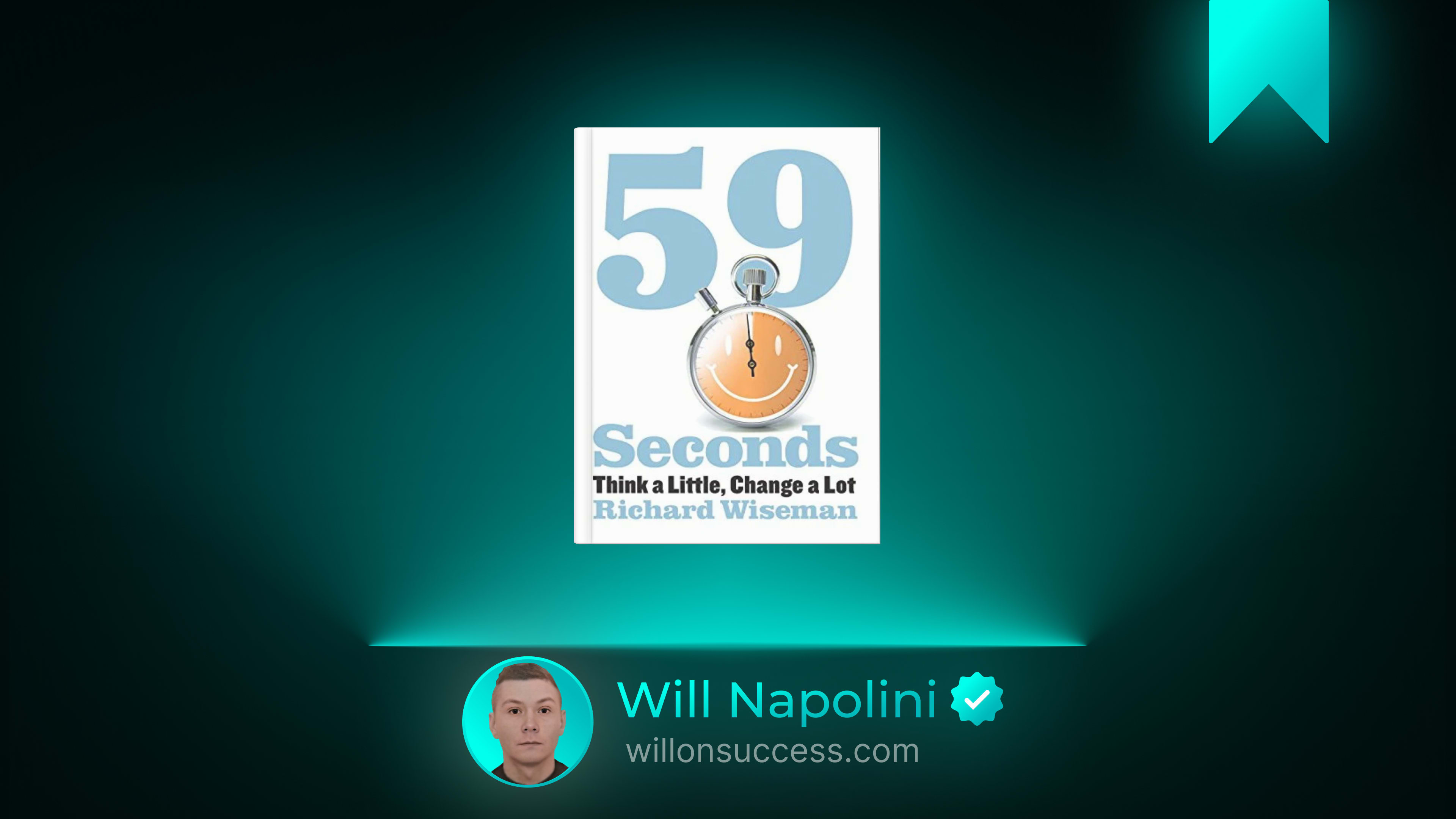
That is the revelation at the heart of Richard Wiseman’s 59 Seconds, and I want you to let it land in you fully before we go any further. Wiseman, a psychologist who spent years sifting through hundreds of studies, discovered something that I believe in my bones: the most powerful shifts in how you think, feel, and act do not require years of therapy, expensive retreats, or some grand dramatic overhaul of your identity. They require less than a minute. Sixty seconds. The time it takes to tie your shoe, to pour your morning coffee, to close your eyes and take one deliberate breath. Transformation is not a mountain you climb; it is a seed you plant, and the planting takes almost no time at all.

The Architecture of Small Moments
Now, let me be honest with you, because you deserve honesty from someone who is asking you to believe. When I first encountered the idea that a single minute of focused thought could reshape my emotional landscape, I was skeptical. I thought, “Surely the weight of my anxiety, my self-doubt, my years of bad habits cannot be moved by something so small.” And I understand if you feel that same resistance right now. The world has told you that change must be painful, expensive, and slow to be real. But Wiseman pulled together the research, study after rigorous study, and the evidence is staggering. The brain is not the rigid, fixed thing we were taught it was. It is more like a garden path. Every thought you think is a footstep. Walk the same thought enough times and you wear a groove. Walk a new thought for just fifty-nine seconds a day, and within weeks, you have carved a new trail through the wilderness of your own mind. You are not stuck. You are simply walking a path you chose before you knew you had the power to choose another.
The book is organized around the areas where you and I feel the most friction in daily life: happiness, motivation, relationships, creativity, decision-making, stress, and how we raise the people we love most. But what struck me, what made me set the book down and stare out my window for a long time, was the underlying principle connecting every chapter. Wiseman is not handing you tricks. He is showing you that your inner world responds to small, deliberate inputs the way a compass responds to a magnet. Nudge the needle one degree, and after a thousand miles, you arrive at an entirely different destination. One degree of correction, applied consistently, will take you to a life you cannot yet imagine.
Gratitude: The Fifty-Nine-Second Harvest
Let me give you the first tool, because I want you to use it tonight. Wiseman’s research confirms what I have seen play out in real lives over and over: spend sixty seconds before you sleep thinking of three things that went well that day, and you rewire your brain’s scanning pattern. Not three enormous things. Not promotions or windfalls. Maybe the barista remembered your name. Maybe the light came through the kitchen window in a way that made you pause. Maybe your child laughed at a terrible joke you told. Write them down. Three lines. Fifty-nine seconds.
Here is why this matters more than it sounds. Your brain is a search engine, and whatever you type into it, it will find. If you type “what went wrong,” it will deliver a thousand results before your head hits the pillow. But if you type “what went right,” even in a whisper, even on the worst Tuesday of the worst month of your life, it will find something. And finding it changes the chemical weather of your sleep, your morning, your next conversation. You cannot control the storm, but you can choose which three drops of rain you carry into the house with you. I started this practice in a season when I was broke, discouraged, and honestly not sure the next chapter of my life would look anything like the one I had planned. Those three lines a night became the first green shoots in frozen soil. They did not fix everything. But they reminded me that the soil was not dead. It was resting. And rest is not the same as the end.
Process Over Fantasy: The Motivation Breakthrough
Now here is where Wiseman’s work gets genuinely exciting, and I want you to lean in. Most of the motivation advice you have ever received tells you to visualize the finish line. Picture the award. Picture the corner office. Picture the body, the bank account, the applause. And Wiseman’s research says, gently but firmly, that this is almost entirely backward. Studies showed that people who spent their mental energy visualizing the steps they would take, the specific actions, the Tuesday-afternoon grind of showing up, were dramatically more likely to actually achieve their goals than those who daydreamed about the trophy.
Think about it this way. A farmer does not stand in the field and hallucinate a ripe pumpkin. The farmer kneels in the dirt, presses the seed in, waters it, pulls the weeds, checks the sky for frost, and does it again the next day. The pumpkin is a byproduct of the process, not the process itself. Dream about the harvest if you must, but fall in love with the planting. When you sit down and spend fifty-nine seconds mapping out the very next physical step you will take toward your goal, not the applause at the end but the phone call you will make at 9:07 tomorrow morning, you move from fantasy into architecture. And architecture is where lives are actually built. I have watched people stall for years because they were in love with a vision but terrified of a to-do list. The moment they shifted their mental camera from the podium to the practice room, everything unlocked. Your breakthrough is not hiding in some distant future. It is hiding in the next small action you have been avoiding.
The “As If” Principle: Borrowing Your Future Self
One of the ideas in this book that I return to again and again, the one I wish someone had whispered to me when I was twenty-four and convinced I had to feel confident before I could act confident, is what Wiseman calls the “As If” principle. The research is clear: if you behave as though you already feel a certain way, the feeling follows the behavior. Smile for sixty seconds, even when you do not feel like smiling, and your brain begins to release the neurochemistry of genuine happiness. Sit up straight, pull your shoulders back, and speak a little slower, and your sense of personal authority rises measurably within moments. You do not have to wait for the feeling to arrive before you begin. You are allowed to borrow courage from the person you are becoming and wear it before it fits.
I remember a season when I had to walk into rooms full of people who seemed taller, louder, and more certain than I was. My instinct was to shrink, to wait until I felt ready. I was never going to feel ready. So I borrowed the posture of the person I wanted to become. I walked in slowly. I made eye contact. I spoke as if what I had to say was worth hearing, even while my hands were shaking under the table. And here is what I learned: the shaking stopped. Not because the fear vanished, but because I stopped waiting for permission to be who I was becoming. You do not owe anyone a performance of readiness. You just have to begin, and let the feeling catch up. Fifty-nine seconds of deliberate posture, of choosing your words with care, of deciding to act as if you are already the person on the other side of this challenge, and the gap between who you are and who you want to be starts to close. Not someday. Today. In the next room you walk into.
Relationships: The Sixty-Second Repair
Wiseman devotes real attention to how we love the people closest to us, and this is where the book touched me most personally, because I have gotten it wrong more times than I can count. The research he presents is beautifully simple. Couples and friends who take even a brief moment to express genuine appreciation for one specific thing, not a vague “thanks for being great” but “thank you for making the coffee this morning when I was running late and it meant I didn’t have to think about one more thing,” build a reservoir of goodwill that sustains them through the hard seasons. Sixty seconds of specific, spoken gratitude. That is the whole intervention.
And on the other side, when conflict flares, when you are standing in the kitchen with your jaw tight and your heart hammering, Wiseman points to research showing that taking even a brief pause, stepping away for less than a minute to lower your physiological arousal before you speak, changes the entire trajectory of the conversation. You are not running away. You are protecting the relationship from the version of you that speaks in wounds instead of words. The strongest thing you can do for someone you love is refuse to let your worst sixty seconds define your best years. I have had to learn that lesson the hard way, more than once, and I am still learning it. But every time I choose the pause, every time I say “give me one minute” instead of letting the sharp sentence fly, I am laying another brick in a foundation I want to stand on for the rest of my life.
Creativity and Decisions: Quiet the Crowd in Your Head
Wiseman also tackles the two areas where I think most of us silently suffer: making decisions and generating new ideas. We sit at our desks or our kitchen tables, paralyzed, turning the same three options over and over until they lose all meaning. His research-backed suggestion is almost laughably simple, and that is exactly why it works. When you are stuck on a decision, stop forcing it. Step away. Take a walk. Let your subconscious do the sorting for fifty-nine seconds, or five minutes, or the length of a shower. The studies show that the brain solves complex problems more effectively when you deliberately disengage conscious effort. You are not being lazy. You are trusting the deeper architecture of your own mind.
And for creativity, Wiseman points to something I have practiced for years without knowing the science behind it: impose a small, arbitrary constraint. Give yourself sixty seconds to come up with ten uses for a paper clip. Force yourself to write one sentence using only words that start with the letter “S.” The constraint is not the enemy of creativity. The river needs the banks. Without limits, the water just spreads into a swamp. But give it edges, give it direction, and it gains force. It carves canyons. Your next great idea is not waiting for unlimited freedom. It is waiting for you to give it one small boundary and say, “Go. You have fifty-nine seconds.”
What I Want You to Carry Forward
Here is what I want you to take from this book and press into your chest like a hand over a heartbeat. You do not need permission to change. You do not need a perfect plan, a perfect season, or a perfect version of yourself waiting at the starting line. You need one minute. One deliberate, focused, chosen minute in which you decide to think a grateful thought, to map a single next step, to smile before you feel like smiling, to say the kind word before the sharp one, to pause before you react. And then you do it again tomorrow. And the day after. And the day after that. And the compound interest of those tiny deposits will build a life that astonishes you.
I have seen it. I have watched people who could not see their own way forward take one fifty-nine-second step and then another and then another, until one morning they looked up and realized they were standing in a field they had planted, watching something green and alive push through the soil. That can be you. I believe, with everything in me, that it will be you, if you decide tonight that you are done waiting for a revolution and ready to plant a seed.
So here is your assignment, and I mean it with all the love and seriousness I can offer. Tonight, before you close your eyes, set a timer on your phone for fifty-nine seconds. When it starts, think of three things that went right today. Write them down. Three lines. Then set the book down, turn off the light, and let yourself feel the quiet, stubborn pride of someone who just kept a small promise to themselves.
You are not too late, you are not too far gone, and you are not too small for the life you are imagining. You just need fifty-nine seconds. And then fifty-nine more. And then the season turns. And then the harvest comes.
Start tonight. I am so proud of you for even reading this far. Now go plant your seed.