The Eagle Has Landed by Jack Higgins: What a War Thriller Teaches Us About Character Under Pressure
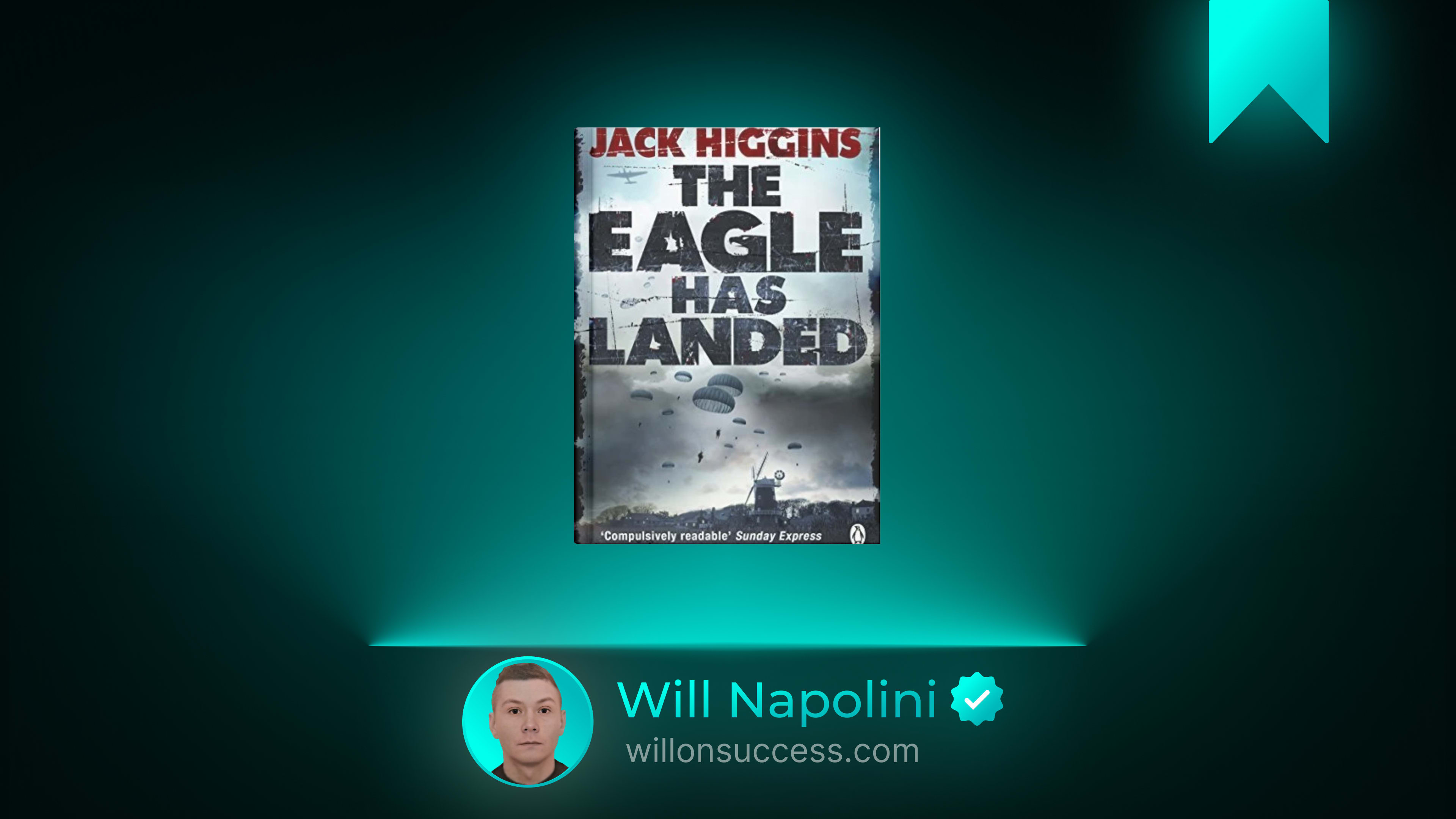
There is a question I have carried with me for a long time, and it arrived not from a philosophy lecture or a self-help seminar, but from a paperback thriller I picked up years ago expecting nothing more than a good story.
The question is this: Who are you when the uniform comes off?
Not the uniform you wear to work. Not the title on your business card or the role your family expects you to play. I mean the deeper uniform—the identity you have stitched together from loyalty, obligation, fear, and habit. Strip that away, put a person under impossible pressure, and what remains?
Jack Higgins asked that question in 1975, and he asked it inside one of the most tightly constructed thrillers ever written. The Eagle Has Landed is, on its surface, a novel about a German plot to kidnap Winston Churchill during the Second World War. But beneath the plotting and the suspense, it is something quieter and more unsettling. It is a study of men and women trying to remain human inside a machine that has no interest in their humanity.
I want to walk you through what this book actually teaches—not just as entertainment, but as a mirror held up to the way you handle duty, conscience, loyalty, and the moments when doing the right thing and doing the expected thing are not the same.
The Big Idea: Character Is Revealed, Not Performed
Higgins built his novel around a deceptively simple premise. In November 1943, German intelligence learns that Churchill will be visiting a quiet Norfolk village called Studley Constable. Hitler, in a moment of theatrical ambition, orders a kidnapping operation. A small team of elite paratroopers, led by Colonel Kurt Steiner, is dropped into England disguised as Polish soldiers. Their mission: infiltrate the village, secure Churchill, and extract him.
What makes the book remarkable is not the mission itself. It is what Higgins does to the people carrying it out.
Steiner is not a zealot. He is a professional soldier who has watched his country descend into something he can no longer recognize, yet he continues to serve because the alternative—open defiance—would destroy his men and his family. He is trapped between conscience and obligation, and every decision he makes carries the weight of that tension.
Here is what I want you to notice: Higgins does not write villains. He writes people. And that is the book’s central argument, whether it announces it or not. Character is not what you declare in comfortable circumstances. Character is what remains when the comfortable circumstances are gone.
You do not get to choose the era you are born into, the organization you serve, or the pressures bearing down on you. But you do choose—often in small, unglamorous moments—whether you will act as a thinking human being or as a function of the system around you.
That is the idea running beneath every page of this novel. And it is the idea I want you to carry into your own life.
The Story: A Village, a Mission, and the Weight of Small Decisions
Let me give you the shape of the story so you can see how the themes work.
Steiner and his men arrive in Studley Constable and must blend in. They need local cooperation. They need silence. And they need time. Into this fragile operation step several figures who complicate everything: Liam Devlin, an Irish operative with his own grievances against the British establishment; Joanna Grey, a woman whose personal history has hardened her into something dangerous; and the villagers themselves, who are not background scenery but living, suspicious, unpredictable people.
What follows is not a clean operation. It is messy. People hesitate. People make choices based on loyalty, fear, love, and pride. The plan, as all plans do when they meet reality, begins to bend.
And here is where Higgins earns his reputation. He does not rush through these human moments to get to the next action sequence. He lingers. He lets you sit with a German soldier sharing a quiet exchange with an English woman. He lets you feel the absurdity of men in disguise trying to be invisible in a place where everyone knows everyone. He lets you see that the “enemy” is a person with a mother, a doubt, a small kindness he cannot quite suppress.
The mission becomes secondary. The people become the point.
Duty Without Blindness: The Steiner Problem
If I could sit across the table from you and ask one question about your life right now, it would be this: Where are you serving something you no longer believe in, simply because stopping feels more dangerous than continuing?
Steiner’s situation is extreme, but the pattern is not. I have seen it in careers that slowly hollow a person out. I have seen it in relationships maintained out of obligation long after the love has gone. I have seen it in organizations where someone stays silent about what they know is wrong because speaking up would cost them security.
Steiner serves a regime he despises. He knows what the regime has done. He has seen it with his own eyes. And yet he leads his men into England because the alternative—refusal—means their deaths and his family’s destruction.
This is not a justification. Higgins does not ask you to excuse Steiner. But he asks you to understand the architecture of trapped loyalty. And understanding it is the first step toward recognizing it in your own life before you are fully locked in.
The principle here is not “follow orders.” The principle is this: examine your commitments before they become your prison. Ask yourself, periodically and honestly, whether the thing you are serving still deserves your service. Whether the loyalty you are giving is earned or merely habitual. Whether you are staying because the work matters or because leaving would require a courage you are not yet ready to summon.
You do not need to burn everything down today. But you do need to look clearly at what you are building your days around. Because a direction repeated long enough becomes a life, and some directions lead somewhere you will not want to arrive.
The Ordinary Person in Extraordinary Circumstances
One of the quiet strengths of this novel is what it does with the villagers of Studley Constable. They are not soldiers. They are not spies. They are people tending gardens, minding children, arguing about small things. And then history walks into their village wearing a disguise, and they must decide who they are.
I think about this often. Most of us will never face a wartime crisis. But every life contains moments where the ordinary is interrupted—by loss, by sudden responsibility, by a decision that cannot be postponed. A diagnosis. A layoff. A betrayal. A moment where someone needs you to be braver than you feel.
What Higgins shows, through the villagers and through the secondary characters, is that courage is not the absence of fear. It is the decision that something else matters more than your fear in this particular moment. And that decision is available to you. It has always been available. You do not need to be extraordinary to act with quiet steadiness. You need only to decide that the person in front of you, or the principle you claim to hold, is worth the discomfort of acting.
A small decision becomes a direction. And in the small village of your daily life, those directions accumulate into the person others see when the pressure finally arrives.
Loyalty Is a Choice You Renew, Not a Chain You Inherit
Liam Devlin, the Irish operative, is one of the most interesting figures in the book. His loyalty is not to Germany. It is not to ideology. It is personal, historical, rooted in wounds that were inflicted on his people long before this war began. He fights alongside Steiner’s men not because he believes in their cause, but because his own cause intersects with theirs for a season.
This matters because it reveals something true about loyalty that we often forget: loyalty is not a permanent state. It is a repeated choice, and it can be directed toward people without requiring agreement with every institution they represent.
Think about your own loyalties. The friend you have kept for twenty years. The team you still support even through losing seasons. The colleague who stood beside you during a difficult project. Those bonds were not forged by contract. They were forged by presence, by showing up, by choosing that person again on the morning it would have been easier not to.
But loyalty also has a limit, and Higgins knows this. Devlin’s loyalty is selective. Steiner’s loyalty to his men does not extend to loyalty toward the regime that sent them. The novel draws a clear line: you can be faithful to the people beside you without being faithful to every structure above you.
In your life, this distinction is everything. You can love your work without loving every policy your company enacts. You can honor your family without repeating every pattern they handed you. You can serve a community while still questioning its assumptions. Loyalty without discernment becomes captivity. Loyalty with discernment becomes integrity.
The Cost of Commitment and the Danger of Certainty
One thing the novel does not flinch away from is cost. The mission carries a price. People pay it. Some pay it with their lives, others with something harder to name—the knowledge that they compromised, or hesitated, or chose safety when courage was the better option.
I will not spoil the specific fates of every character. But I will tell you this: Higgins does not let anyone walk away untouched. And that honesty is what gives the book its weight.
In personal development, we talk a great deal about commitment, about setting goals, about pursuing what matters. And all of that is true. But we talk less often about the fact that commitment costs something. That choosing one path means grieving the others. That standing for a principle will sometimes make you lonely. That doing the right thing on a Tuesday afternoon in November might cost you comfort, approval, or ease.
If you are waiting for a version of growth that costs you nothing, you will be waiting a long time.
The question is not whether the cost is real. The question is whether what you are building is worth what you are paying. And that is a question only you can answer, in the quiet of your own honesty, without an audience.
Why This Book Matters Beyond the Thriller Shelf
You might be wondering why I am drawing personal-development lessons from a 1975 war thriller. Fair question.
Here is my answer: the best stories do not merely entertain. They rehearse you for your own life. When you watch a character navigate impossible pressure, you are quietly expanding your own sense of what is survivable, what is forgivable, what is possible. You are building a library of inner responses before you need them.
The Eagle Has Landed rehearses you for the moment when duty and conscience pull in different directions. For the moment when the plan fails and you must improvise with what is in front of you. For the moment when you discover that the person you were told to distrust is, in fact, someone capable of kindness. For the moment when you must decide whether loyalty means obedience or whether loyalty means telling the truth even when the truth is unwelcome.
These are not abstract problems. They are the Tuesday-afternoon problems of every working life, every family, every friendship. The novel simply strips away the noise so you can see them clearly.
Who Should Read This Book
If you enjoy tightly plotted thrillers with a strong sense of place, this book will satisfy you. The pacing is disciplined. The tension builds through character rather than through constant explosions. The English village feels lived-in, specific, real.
If you are drawn to stories that treat “the other side” with complexity—who refuse to flatten human beings into cardboard villains—this is one of the finest examples of that approach in popular fiction.
If you are looking for a light, consequence-free adventure, this may feel heavier than expected. The characters carry moral weight. The ending does not tie everything into a comfortable bow. You will close the book thinking, not merely satisfied.
And if you are someone currently navigating a situation where loyalty, duty, and personal conscience are pulling you in different directions, this novel will feel less like fiction and more like a conversation you needed to have.
One Small Step: The Quiet Inventory
I am not going to ask you to go out and make a dramatic life change tonight. That is not how character works. Character is built in small, repeated acts of honesty.
Here is what I would invite you to do instead. Tonight, before you sleep, take five minutes and write down answers to three questions:
Where in my life am I continuing something out of obligation that I would not choose if I were starting fresh?
Who do I owe loyalty to, and is that loyalty still freely given, or has it become a habit I no longer examine?
What is one small act of courage I have been postponing because the cost feels too high?
You do not need to solve anything tonight. You do not need to resign from your job or end a relationship or make a grand declaration. You only need to look. Clearly. Without flinching.
Because here is what I have learned, slowly and imperfectly: you cannot change what you will not look at. And the looking itself is the first act of the person you are becoming.
The village is quiet. The mission has not yet begun. But the decision about who you will be when it arrives—that decision is being made now, in the small hours, in the private inventory of your own honesty.
You start small. You stay honest. You let the truth do its slow, necessary work.
And when the moment comes—and it will come—you will not need to decide who you are. You will already know.