Breaking the Hard Ground: What Virgin Soil Upturned Teaches Us About Deep Change
What if the reason you feel so exhausted isn’t that you are working too hard, but that you are trying to build a new life on ground that refuses to let anything new grow?
I have sat across from countless brilliant, driven people who are entirely stuck. They have the right goals. They have the work ethic. They have read the books and downloaded the apps. Yet, year after year, they find themselves fighting the same battles, hitting the same invisible walls, and eventually burning out in quiet despair.
When I look at their lives, I rarely see a lack of effort. What I usually see is a profound misunderstanding of how change actually happens. They are scattering new seeds on top of old, compacted earth, and wondering why the harvest never comes.
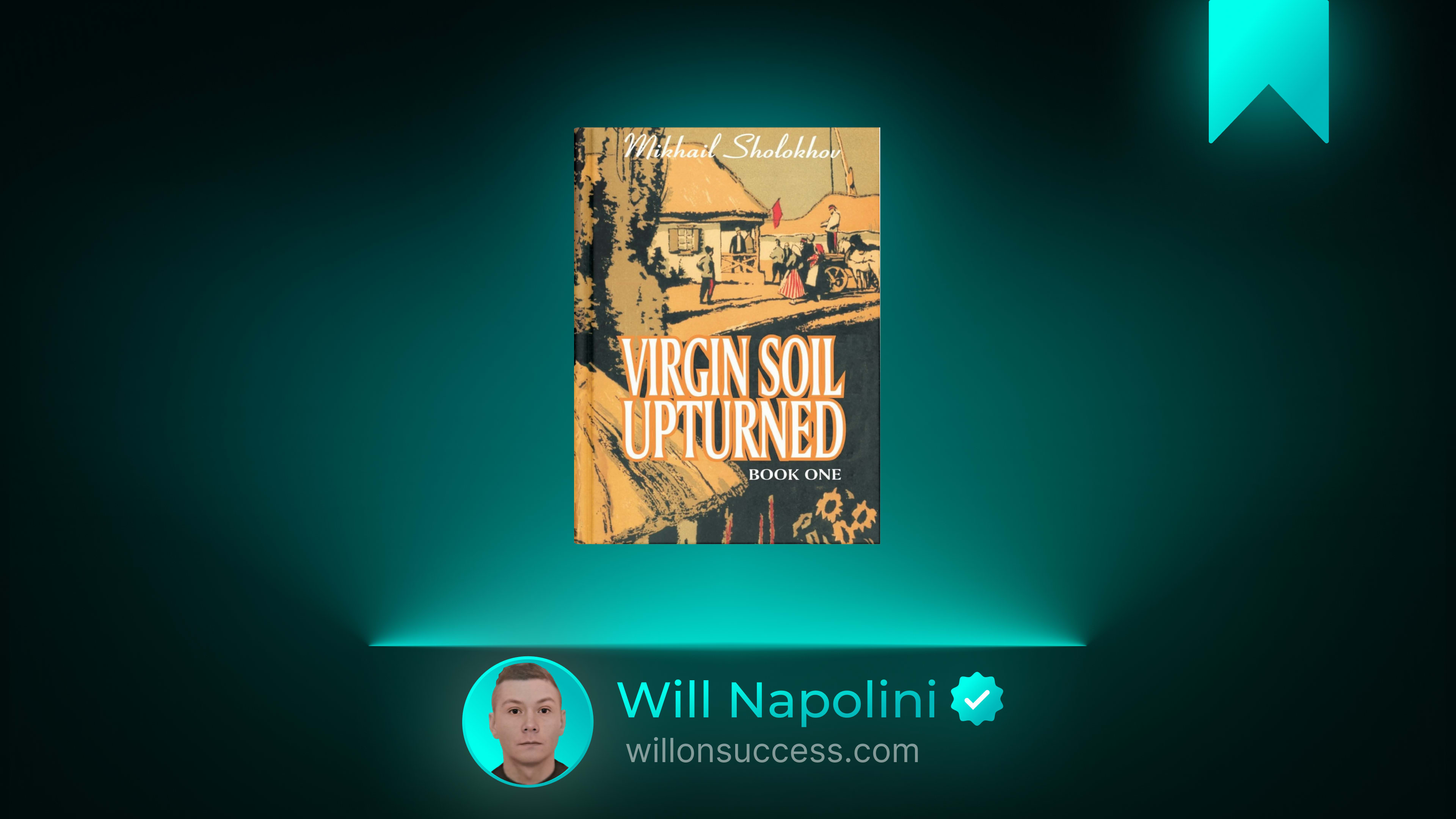
If we want to understand the deep mechanics of human transformation, we have to look past the modern shelves of quick-fix self-help. We have to look at the soil. And to do that, I want to take you inside a massive, sweeping novel that you might never expect to find on a personal development reading list: Virgin Soil Upturned by the Nobel laureate Mikhail Sholokhov.
On the surface, this is a towering work of twentieth-century historical fiction. Published in two volumes between 1932 and 1960, it chronicles the brutal, turbulent collectivization of agriculture in the Don Cossack region of Russia during the 1930s. It is a story of state mandates, political upheaval, and the tragic collision between grand ideologies and rural traditions.
But if you read it closely, looking past the heavy historical context, you will find a masterclass in the psychology of change. Sholokhov captured something universal about the human condition. He documented the agonizing friction that occurs when the future demands that we surrender the past.
The central thesis of this epic, when translated from the steppes of Russia to the reality of your daily life, is this: True transformation is never a matter of simply adding new habits to an old identity. Lasting change requires the violent, uncomfortable, and deeply messy work of upturning your “virgin soil.” You must break up the deep, hardened layers of who you have always been before anything new can actually survive.
The Blueprint Meets the Earth
To understand this, we have to look at the village of Gremyachiy Log, where the novel takes place.
The story follows Semyon Davydov, a pragmatic, skilled worker from a city factory who is sent to the village with a strict mandate: organize the fiercely independent Cossack peasants into a collective farm. Davydov arrives with a blueprint, a timeline, and absolute certainty about how the future should look.
But when he steps off the cart, he hits a wall of human nature.
The villagers are being asked to give up their private land, their livestock, and the individual rhythms of life they have known for generations. They are terrified. They are resentful. They hide their grain in the woods. They sabotage the machinery. They fiercely protect the old way of doing things, even when the old way is failing them.
Davydov does not work alone. He is partnered with Makar Nagulnov, a local leader whose desperate, intense zeal for the new system is matched only by his ruthlessness. Nagulnov believes that if people will not change willingly, they must be forced. He relies on pressure, aggression, and sheer willpower to bend the village to the new reality.
What unfolds is a brilliant, tragic study of the friction of change. We watch as blueprints meet reality, as force meets resistance, and as the deep, unyielding soil of human habit is finally, painfully, turned over. From this struggle, we can extract timeless principles for navigating the massive transitions in our own lives.
You Must Break the Hardpan Before You Can Plant
In agriculture, there is a concept known as the “hardpan” or “plow pan.” This is a dense, compacted layer of soil that forms just beneath the surface, usually caused by years of the same plow running at the exact same depth.
If you plant a seed in a field with a hardpan, it might sprout. It might even look green for a few weeks. But when the roots reach that compacted layer, they cannot push through. They hit a wall. The plant becomes stunted, vulnerable to drought, and eventually dies, because it cannot reach the deep water and nutrients below.
In Virgin Soil Upturned, the Cossacks represent this hardpan. Their identity is entirely tied to their private plots of land. To join the collective means the death of their old self. The soil of their lives is compacted by generations of tradition, suspicion, and survival instincts.
I have seen this exact dynamic play out in modern life more times than I can count. You may be working incredibly hard and still wondering why nothing is changing. You buy the planner, you set the aggressive financial goal, you commit to the new relationship. But you are trying to build a new life on top of your old identity.
You cannot become a healthy, vibrant person while holding onto the deep-seated, compacted belief that you only have value when you are exhausted. You cannot build a thriving, abundant business while clinging to the hidden, hardpan comfort of playing small.
The soil of your life is compacted by years of old coping mechanisms, past failures, and inherited beliefs. When you try to plant a new habit on top of that hard ground, the habit dies. It has nowhere to send its roots. Change is not additive; it is disruptive. Before you can plant the new, you must identify and break up the old, hardened layers beneath the surface. You have to dig deeper than you have ever dug before.
Force Creates Resistance; Alignment Creates Momentum
One of the most striking and tragic contrasts in Sholokhov’s novel is between Davydov and Nagulnov.
Nagulnov operates like a blunt instrument. He is driven by raw emotion and ideological purity. When the villagers resist, he yells. He threatens. He tries to force the harvest through sheer intensity. But his force only creates deeper resistance. The villagers dig in their heels. They hide their assets. They sabotage the work. Nagulnov’s intensity ultimately breaks his health, his relationships, and his spirit.
Davydov, the factory worker, is different. He is not devoid of passion, but he is grounded in systems. He understands that you cannot bully a seed into growing. When he faces resistance, he does not just yell; he investigates. He learns the mechanics of the farm. He figures out how to fix the tractors. He listens to the peasants’ grievances, even the irrational ones. He builds trust through competence and consistency.
We all have a Nagulnov inside our heads.
When we decide to change our lives, our first instinct is often to use brute force. We rely on sheer willpower. We wake up at 4:00 AM, we starve ourselves, we work eighty-hour weeks, and we aggressively bully ourselves into submission. We treat our own minds like a rebellious village that needs to be conquered.
But what I have learned through years of trial and error is that force always creates internal resistance. When you use sheer discipline to change, you trigger your own psychological rebellion. You will eventually sabotage your own efforts because the brain does not like being held hostage, even by its owner.
We often mistake the exhaustion of fighting ourselves for the fatigue of actual progress.
Davydov wins because he understands alignment and systems. He knows that sustainable change requires making the right action easier, not just demanding more effort. If you want to change your life, stop trying to be Nagulnov. Stop relying on dramatic bursts of agonizing willpower. Become Davydov. Look at the mechanics of your day. Build systems that support your goals. Persuade your mind through small, consistent wins rather than trying to conquer it through force.
The Grief of Letting Go Is the Price of Admission
There is a heartbreaking scene in the novel involving a poor peasant named Maidannikov. Maidannikov is not a wealthy, stubborn holdout. He is a good man who genuinely wants to join the collective farm because he knows it is the only way his family will survive the winter. He signs his name to the ledger. He commits to the change.
But when the moment comes to lead his only cow—the last remnant of his private property, his sole safety net—into the communal barn, he breaks down. He weeps. He hesitates. The grief of surrendering his last piece of independence nearly paralyzes him.
Sholokhov does not judge him for this. He paints it with profound empathy.
When we decide to upturn our soil, we focus entirely on the harvest we are going to get. We focus on the new career, the new body, the new marriage, the new peace of mind. But we rarely prepare ourselves for the grief of what we have to leave behind.
Even when our old lives are making us miserable, they are familiar. They are safe. We know how to navigate the dysfunction. We know how to survive the stress. When you finally decide to change, you are not just gaining a future; you are losing a past. You are mourning the death of the person you used to be.
I have watched highly successful people self-sabotage right on the edge of their biggest breakthroughs. They blow up a great relationship. They procrastinate on a massive launch. They pick a fight with a mentor. Why? Because the unknown is terrifying, and the old, familiar dysfunction feels like home. They are standing outside the communal barn, weeping over their cow.
If you are in the middle of a massive transition and you feel a sudden, inexplicable wave of sadness, hesitation, or urge to self-sabotage, do not panic. Do not tell yourself you are weak. Recognize it for what it is: the grief of letting go. Acknowledge the price of admission. Give yourself permission to miss the comfort of the familiar, and then gently lead the cow into the barn anyway.
Small Consistencies Outweigh Dramatic Upheavals
The collectivization of the village is not achieved through a single, glorious speech. It is achieved through the grinding, unglamorous, daily reality of running a farm.
It is about fixing a broken axle in the freezing rain. It is about negotiating the distribution of seed grain. It is about the quiet, persistent work of showing up day after day, proving that the new system can actually sustain life.
We live in a culture that worships the dramatic upheaval. We love the montage in the movie where the hero transforms their life in three minutes of high-energy music. We want the overnight success, the sudden epiphany, the massive leap.
But real life is not a montage. Real life is a Tuesday morning in November when it is cold, you are tired, and the work is boring.
A small decision becomes a direction, and a direction repeated long enough becomes a life. The Cossacks did not learn to trust the collective farm because of a mandate; they learned to trust it because, season after season, the tractors were maintained, the grain was accounted for, and the work was shared.
If you want to build something that lasts, you must fall in love with the mundane. You must respect the power of small consistencies. You do not need a massive burst of motivation to change your life. You need a quiet, unbreakable commitment to showing up and doing the unglamorous work, day after day, until the new soil yields its crop.
Why This Matters in Your Life Today
You might be thinking, This is a fascinating historical analysis, but how does this apply to me right now?
Let us translate this from the steppes of Russia to your ordinary life.
In your career: You cannot build a new, fulfilling career on the hardpan belief that you must please everyone to be valued. If you try to launch a business while holding onto the need for universal approval, your business will hit the hardpan and die. You must plow up the need for approval first.
In your leadership: If you are leading a team through a merger, a restructuring, or a cultural shift, you cannot just mandate the change and act like Nagulnov. Your team will hide their grain. They will quietly sabotage the new software. You must act like Davydov. You must listen to their fears, understand their mechanics, and patiently break up the hardpan of the old company culture before you can plant the new vision.
In your relationships: You cannot build a healthy, secure partnership on the compacted soil of your past traumas and unhealed defenses. You cannot just “add” better communication skills to a foundation of deep-seated mistrust. You have to do the deep, painful work of turning over that soil, often with the help of a professional, before real intimacy can take root.
Understanding this shifts your entire perspective on why you are stuck. It removes the shame. You are not failing because you lack discipline. You are failing because you are trying to farm on concrete.
Practical Application: Turning the Soil
Understanding is valuable, but understanding without action changes nothing. If we are going to upturn the soil, we need to get our hands dirty. Here is how you apply the wisdom of Gremyachiy Log to your life this week.
1. Conduct a Hardpan Audit Take a piece of paper and draw a line down the middle. On the left side, write down a goal you have been trying to achieve but keep failing at (e.g., “Start my own consulting business,” “Get into shape,” “Stop yelling at my kids”). On the right side, write down the deep, unexamined belief or coping mechanism that might be acting as your hardpan (e.g., “If I fail, I am worthless,” “I don’t deserve to take up space,” “I only know how to connect through anger”). You cannot fix what you cannot see. Identify the hard layer.
2. The Willpower Fast Identify one area of your life where you have been acting like Nagulnov—where you have been relying on brute force, extreme diets, or aggressive self-talk to force a change. Stop. For the next seven days, you are not allowed to use force in that area. Instead, act like Davydov. Ask yourself: How can I make the right action just 10% easier? How can I build a system that doesn’t require me to be a hero every single day?
3. Acknowledge the Grief If you are currently in a season of massive transition, write a letter to the person you are leaving behind. Thank your old coping mechanisms for keeping you safe when you were younger. Thank your old career for paying the bills. Acknowledge what you are losing. Grief that is acknowledged loses its power to sabotage you.
Who Should Read This Book
I believe in being honest about what a book can and cannot do for you. Virgin Soil Upturned is not a light, breezy weekend read. It is a dense, sprawling, historically specific Soviet epic. It requires patience, and it requires the reader to look past the heavy political ideology of the era to find the human truth underneath.
If you are looking for a quick, five-step framework to optimize your morning routine, this book will frustrate you.
But if you are a leader navigating a massive organizational shift, if you are in the middle of a profound life transition, or if you are a student of human nature who wants to understand the deep, agonizing psychology of resistance and change, this book is a goldmine. It will teach you more about the friction of human transformation than a dozen modern business books combined.
It is worth reading because it refuses to lie to you about how hard change actually is. It respects the difficulty of the work.
One Small Step
We spend so much of our lives protecting the ground beneath our feet, terrified that if we break it open, we will be left with nothing but dirt. But the earth must be broken to be fertile. The old must be upturned to make way for the new.
You do not need to plow the entire field today. You do not need to have the whole five-year plan figured out. You just need to take one small, deliberate action that breaks the hardpan of your current routine.
So here is what I want you to do before you go to sleep tonight.
Choose one small, outdated habit or belief that you know is keeping you stuck. Just one. And tomorrow morning, before you check your phone, before you open your email, before you let the world rush in, do the exact opposite of what that old habit demands. If your hardpan is the belief that you must answer to everyone else first, spend the first twenty minutes of your day entirely for yourself. If your hardpan is the fear of starting, write one single paragraph of the project you have been avoiding.
Turn over one small patch of soil.
Because what you repeat in private eventually becomes visible in your life, and the harvest you are waiting for is already hiding in the ground you are finally brave enough to break.