Valley of the Dolls: What a 1966 Novel Still Teaches Us About the Price of Living for Applause
Have you ever achieved something you wanted—badly, for years—and felt almost nothing the morning after?
Maybe it was a promotion, a degree, a relationship, a number on a scale. You got it. You held it in your hands. And somewhere beneath the relief, a quiet voice asked: Is this all? Am I still the same person who felt empty before?
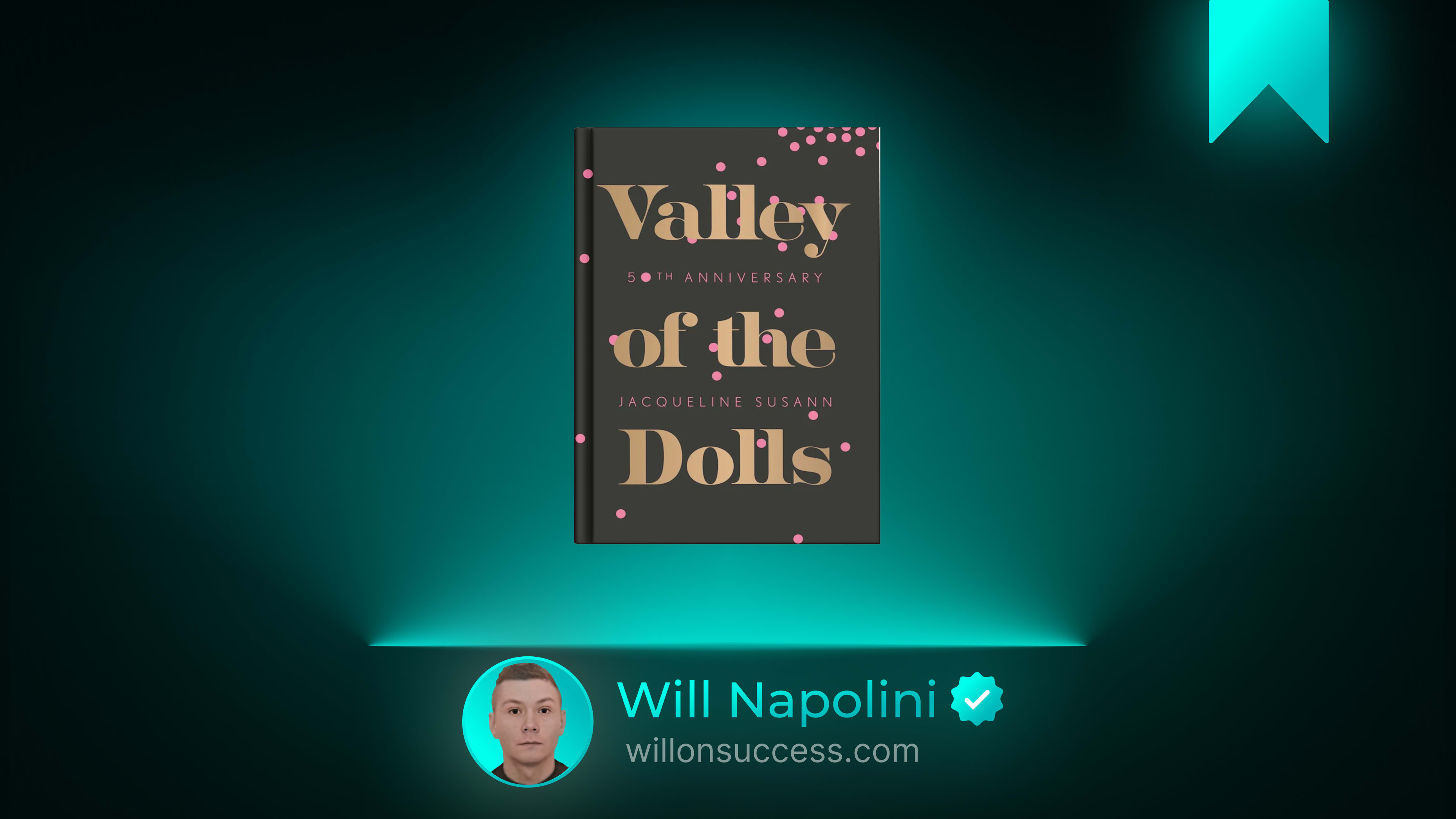
I ask because a novel published in 1966, one that sold more than thirty million copies and was dismissed by critics as pulp, understood that question better than most philosophy books. Jacqueline Susann wrote Valley of the Dolls not as entertainment alone, but as a warning dressed in sequins. And if you have ever confused being admired with being whole, this book will find you exactly where you are.
The Big Idea: You Cannot Fill an Inner Void with Outer Noise
The word “dolls” in the title refers to pills—barbiturates, amphetamines, the little chemical helpers that keep a person performing when the soul has long since left the building. But the pills are only the symptom. The disease Susann diagnoses is older and more universal: three women who do not know who they are without an audience, and who will destroy themselves trying to keep that audience clapping.
The central thesis is not subtle, and it does not need to be. When your sense of worth depends entirely on what other people see, you become a tenant in your own life. And tenants can be evicted.
Three Women, Three Versions of the Same Wound
The novel follows Anne Welles, Neely O’Hara, and Jennifer North from the mid-1940s through the 1960s, primarily in New York and Hollywood. Each woman carries a different gift and a different hunger, but the hunger is the same underneath.
Anne arrives in New York as the careful, principled girl from a small town. She wants love, stability, meaning. But she falls into a relationship with a married man, and compromise by small compromise, she finds herself living a life she once would have pitied. She does not lose herself in one dramatic moment. She loses herself one quiet Tuesday at a time, each concession so small it barely registers until the woman in the mirror is a stranger.
Neely is raw talent—singing, dancing, electric presence. She rises fast. And the rise is intoxicating until the machinery of fame demands she keep performing whether she is well, rested, or willing. The pills begin as helpers. They become the architecture of her days. What starts as a tool for endurance becomes the only way she can feel anything at all.
Jennifer is beautiful, and the world will not let her be anything else. She is valued for her face and body, dismissed when she tries to speak, and slowly she begins to believe the dismissal. She marries, divorces, remarries, searching for a man who will see her as a person rather than an image. No one does, because she has stopped seeing herself that way first.
Three different stories. One shared wound: I do not know who I am unless someone is looking.
The Erosion Principle: Character Is Lost in Increments
Here is what I have learned from watching people—myself included—drift away from their own values. It almost never happens in a single dramatic betrayal. It happens the way a riverbank erodes. One small current. One more small current. You look up after five years and the ground beneath you is gone, and you cannot remember the day it started.
Anne does not decide to become the other woman. She decides to have one more conversation. One more dinner. One more night of telling herself it is complicated. Each step is defensible in isolation. Together, they build a life she never chose.
You can see this pattern everywhere once you recognize it. The person who takes one small ethical shortcut at work, then another, then another, until the shortcuts are the job. The person who says yes to one obligation they resent, then ten, then a hundred, until their calendar belongs to everyone except them. The person who numbs one hard evening with a drink, then another, until the evening without the drink feels impossible.
Susann understood that no one sets out to destroy themselves. They set out to cope. They set out to be loved. They set out to be enough. And the destruction arrives sideways, wearing the mask of a reasonable next step.
If I could sit across the table from you, I would say this gently: the small compromise you are rationalizing tonight is not small. It is a direction. And a direction repeated long enough becomes a life.
The Audience Trap: Why Applause Is a Poor Foundation
Neely’s story is the one that haunts me most. She is genuinely gifted. She is not a fraud. And yet the machinery around her—the agents, the studios, the fans, the critics—reduces her to a product. Her value is measured in ticket sales, reviews, column inches. And because she has no internal anchor, she lets their measurement become her own.
When you build your identity on performance—on being the best employee, the most attractive partner, the most accomplished parent, the most admired friend—you hand the blueprint of your self-worth to people who have their own agendas. They will applaud today and forget you tomorrow. The market shifts. Trends change. Younger faces arrive. And if your answer to “Who am I?” is “I am what they say I am,” then their silence becomes your annihilation.
This is not a book about Hollywood. It is a book about any environment that rewards you for being useful, attractive, or entertaining rather than for being real. Corporate culture does it. Social media does it. Family systems do it. Anywhere you must perform to earn love, the dolls are waiting.
The dolls are not always pills. Sometimes the doll is the next achievement. The next compliment. The next relationship that promises to finally make you feel chosen. The next purchase that promises to finally make you feel complete.
The doll is anything you swallow to avoid sitting in the quiet room where you would have to meet yourself.
What Jennifer’s Story Teaches About Being Seen
Jennifer’s tragedy is not that she is beautiful. It is that she is only beautiful to everyone around her, and eventually to herself. She wants to act, to think, to be taken seriously. But the world keeps handing her mirrors instead of scripts. And after enough years of being reflected back as an object, she stops fighting the reflection.
I have seen this happen in quieter ways. The person at work who is praised for being agreeable until they forget they are allowed to disagree. The partner who is loved for being low-maintenance until they stop having needs. The child who learns that their role is to make everyone comfortable, and who carries that role into every room for forty years.
You do not have to be famous to be reduced to a function. You only have to be in a space that rewards your usefulness more than your truth, and you only have to stay there long enough to confuse the two.
The question Jennifer never quite asks herself—the question the novel asks for her—is this: If no one were watching, if no one needed me to be this, what would I choose?
That question is not selfish. It is the first honest question. And until you ask it, every choice you make is a reaction to someone else’s expectation rather than an expression of your own life.
The Difference Between Ambition and Hunger
Susann does not condemn ambition. Anne wants a career. Neely wants to perform. Jennifer wants to be more than a face. Wanting things is not the disease. The disease is needing the want to be met in order to feel like a person.
There is a difference between pursuing a goal because it genuinely excites you and pursuing a goal because you believe achieving it will repair something broken inside you. The first kind of ambition can sustain you through difficulty because the work itself is meaningful. The second kind collapses the moment the achievement fails to deliver the healing you secretly assigned to it.
And it always fails to deliver. The promotion does not fix the childhood wound. The relationship does not silence the inner critic. The applause does not answer the question of whether you matter when the lights go off.
Growth before achievement. That is the order that holds. You do not become whole by getting the thing. You become capable of sustaining the thing by doing the slow, unglamorous work of building a self that exists independently of outcomes.
What This Looks Like on an Ordinary Tuesday
Let me bring this down from the dramatic and make it practical, because I do not believe wisdom is useful if it only lives in the realm of grand stories.
You do not need to be in show business to be living in your own Valley of the Dolls. You only need to be performing a version of yourself for approval while the real you waits, unattended, in the back of the room.
Here is what recognition looks like in daily life:
You say yes to a project you do not want because you are afraid of being seen as difficult. You post something online and check it eleven times for validation. You stay in a role, a relationship, a city, because leaving would mean admitting the last few years were built on someone else’s script. You reach for a distraction—food, scrolling, shopping, a drink—the moment a hard feeling surfaces, because sitting with the feeling would require you to ask what you actually need.
None of this makes you broken. It makes you human. But it does mean you are borrowing your sense of self from the outside, and borrowed things can be called back.
A Practical Starting Point
If this book’s warning lands somewhere true for you, I would not suggest a dramatic overhaul. I would suggest one honest conversation with yourself, done in writing, because writing slows the mind down and makes evasion harder.
Take ten minutes tonight. Close the door. Put your phone in another room. And answer three questions:
What am I doing right now primarily because I want someone to approve of me?
What would I choose if I knew no one would ever find out, praise me, or judge me?
What small thing have I been avoiding because facing it means admitting I have been living on someone else’s terms?
You do not have to act on the answers tonight. You do not have to quit your job or end your relationship or delete your social media. You only have to look honestly at the gap between the life you are performing and the life you would choose if the audience left the theater.
That looking is the first step out of the valley. Not the last. The first.
Who Should Read This Book
Valley of the Dolls is not a comfortable read. It is melodramatic, sometimes heavy-handed, and Susann’s prose favors sensation over subtlety. If you are looking for literary elegance, this is not your book. If you are sensitive to depictions of addiction, depression, and suicide, approach with care.
But if you have ever felt hollow inside a success, if you have ever performed a version of yourself until you forgot which version was real, if you have ever used achievement or approval as anesthesia—this novel will read you like a letter you wrote to yourself and forgot to send.
It is most useful for people in their twenties and thirties who are building a life and career and have not yet examined the foundation. It is also useful for anyone in their forties, fifties, or beyond who suspects they built on someone else’s blueprint and wants to know whether it is too late to renovate.
It is not. It is never too late to ask the honest question. But the longer you wait, the more expensive the renovation becomes.
One Small Step
Here is what I would ask you to do today. Not tomorrow. Today.
Identify one thing you are doing this week primarily for external approval—a meeting you dread but attend for optics, a post you craft for likes, a commitment you made to seem generous. You do not have to cancel it. You do not have to make a scene.
You only have to name it honestly to yourself. Say the sentence: I am doing this because I am afraid of what they will think if I stop.
That sentence is uncomfortable. Good. Discomfort means you have touched something real. And once you can name the performance, you have already stepped one foot outside it.
You start by seeing the script. You continue by questioning it. You let time teach you who you are underneath.
The valley is not a place you fall into all at once. It is a place you walk into one small, reasonable step at a time. And the way out follows the same rule in reverse. One small honest step. Then another. Then another, until you look up and realize the applause no longer matters because you are no longer performing for it.
You are simply living. And that, more than any spotlight, is what you were actually looking for all along.