What 109 Years of Living Can Teach You About Building a Life That Endures
There is a question most of us never sit with long enough, because the honest answer is uncomfortable. It is this: If you stripped away every plan, every five-year projection, every image you have curated for the world—what would remain of you that could survive a Tuesday that goes completely wrong?
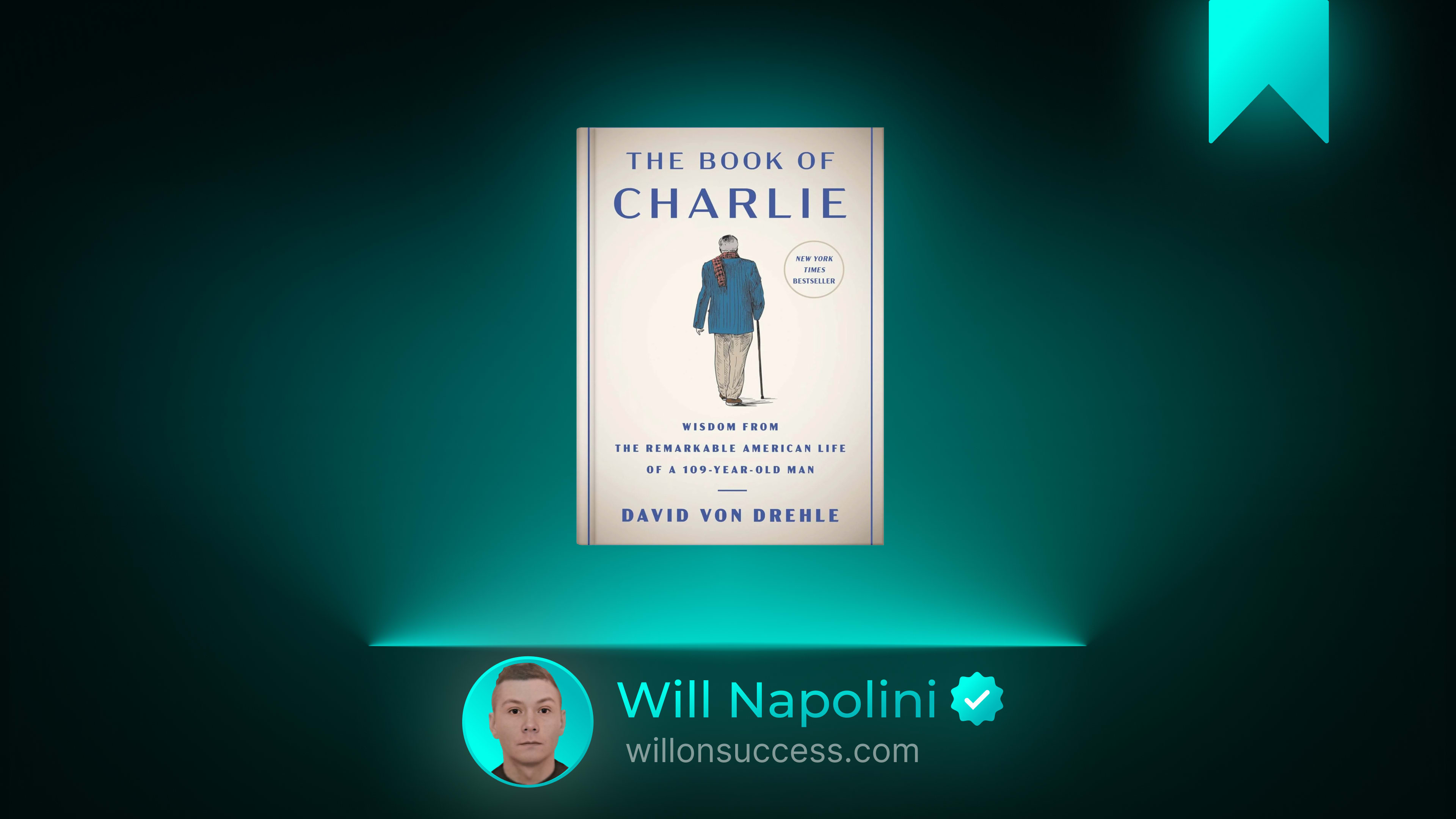
I ask because I have found that the lives worth studying are rarely the ones that went according to plan. They are the ones where the plan shattered, and the person had to discover who they were in the wreckage. And few lives illustrate that better than the one David Von Drehle spent years piecing together in The Book of Charlie.
The book is not a self-help manual. It is not a listicle dressed in narrative clothing. It is the true story of Charlie White, a man born in 1909 who lived to be 109 years old, and the journalist neighbor who came to know him in Washington, D.C. What Von Drehle discovered in Charlie’s long, layered, often heartbreaking life was not a formula for success. It was something quieter and more durable. It was a way of meeting the world—its losses, its surprises, its slow grinding changes—that kept a man not merely alive but genuinely engaged for over a century.
If you have ever felt that life keeps handing you chapters you did not write, this book is for you.
The Big Idea: Wisdom Is Forged in the Living, Not the Avoiding
The central insight Von Drehle draws from Charlie White’s life is deceptively simple, and I think that is precisely why it is easy to overlook.
A good life is not built by avoiding hardship. It is built by developing the capacity to walk through hardship without losing your curiosity, your compassion, or your willingness to keep showing up.
Charlie did not glide through the twentieth century. He was born into a world of horse-drawn carts and died in a world of smartphones. Between those two points, he lost his father young. He grew up through poverty and depression. He served in a world war. He watched the country he loved wrestle with segregation, violence, and slow moral progress. He buried people he loved. He faced the particular loneliness of outliving your era.
And yet.
He did not calcify. He did not retreat into bitterness or nostalgia. He kept asking questions. He kept forming friendships with people decades younger than himself. He kept finding reasons to be interested in tomorrow.
Von Drehle’s argument, woven through the narrative rather than announced in bold type, is that Charlie’s longevity was not merely biological. It was a byproduct of a posture toward life: open, adaptive, grounded, and unafraid of change. The body lasted 109 years. But the life inside that body lasted because Charlie refused to let any single tragedy, era, or disappointment become the final word.
That is the idea I want you to carry forward. Not that you must live to 109. But that the quality of your years is determined less by what happens to you and more by how you metabolize what happens.
The Neighbor Who Became a Teacher
Von Drehle did not set out to write a book about a 109-year-old man. He was a journalist living in Washington, D.C., busy with deadlines and the ordinary scramble of middle-aged life. Charlie White was his elderly neighbor. Their friendship grew the way real friendships do—slowly, through small conversations, shared meals, and the quiet accumulation of trust.
When Charlie died, Von Drehle realized he had been sitting beside a living archive. Charlie had witnessed and participated in nearly the entire American century. More than that, he had processed it. He had turned experience into understanding.
What struck me about the way Von Drehle tells this story is the absence of hero worship. Charlie is not presented as a saint or a sage on a mountaintop. He is a man who made mistakes, who carried regrets, who sometimes did not know what to do next. His wisdom was not the polished kind you find in greeting cards. It was the weathered kind—the kind that comes from falling down, getting up, falling again, and eventually learning that the ground is not your enemy. It is just where you happen to be right now.
Von Drehle weaves Charlie’s personal chronicle through the larger sweep of American history: two world wars, the Depression, the civil rights movement, the digital revolution. The effect is not a history lesson. It is a demonstration. You watch one human being adapt, decade after decade, to a world that never stops changing. And you begin to see that adaptability is not a personality trait you either have or lack. It is a practice. A daily decision to remain porous to the world rather than sealed against it.
The Principles That Held a Century Together
Charlie White’s life was not governed by a single philosophy. But certain patterns emerge so clearly from Von Drehle’s telling that they function almost like load-bearing walls. Remove them, and the structure of a long, meaningful life begins to lean.
Loss Does Not Get the Final Vote
Charlie lost his father when he was young. The specifics of that early grief shaped him, but they did not imprison him. Throughout his life, loss arrived in various forms—the deaths of friends, the end of eras, the slow fading of a world he recognized. What distinguished Charlie was not that he grieved less than others. It was that he grieved and kept walking.
Here is what I would tell you if you are carrying a loss right now, whether it is fresh or years old: grief is not a sign that you are broken. It is evidence that you loved something real. The question is not whether you will lose things. You will. The question is whether you will let loss become your entire identity, or whether you will let it become one chapter in a longer story you are still writing.
Charlie’s life suggests that the human heart is more elastic than we give it credit for. It can hold sorrow and curiosity at the same time. It can mourn what is gone and still lean toward what is next.
Curiosity Is the Antidote to Stagnation
One of the most striking things about Charlie, as Von Drehle portrays him, is that he never stopped being interested. In his nineties and beyond, he still wanted to know what was happening in the world. He still asked questions. He still found people fascinating.
This matters more than it sounds. Most of us, long before we reach old age, begin to close. We decide we already know how the world works. We retreat into routines that confirm what we already believe. We stop asking questions because asking questions requires admitting we do not yet know the answer.
Curiosity, in Charlie’s life, functioned like oxygen. It kept the mind supple. It kept relationships fresh. It made every decade feel like new territory rather than a repetition of the last one.
You do not need to travel the world to practice this. You can start tomorrow morning by asking one genuine question of someone you usually overlook. You can pick up a subject you dismissed years ago and give it thirty minutes of honest attention. You can walk a different route to work and actually look at what is there.
Small curiosities, repeated over years, become a life that feels wide rather than narrow.
Adaptability Is a Skill You Build, Not a Gift You Receive
Charlie lived through more technological, social, and political upheaval than most of us can fully imagine. The world he was born into bore almost no resemblance to the world he left. And yet he did not spend his final decades railing against change or pretending the old ways were the only true ways.
He adapted. Not passively. Not by abandoning his values. But by distinguishing between what was essential and what was merely familiar. He held his principles. He released his preferences.
I think this is where many of us get stuck. We confuse comfort with correctness. We mistake the way things have always been done for the way things must be done. And when the world shifts—as it always does—we feel personally attacked, as though change is happening to us rather than around us.
Charlie’s example suggests a different posture. You can honor where you came from without chaining yourself to it. You can grieve what is passing while still making room for what is arriving. That is not weakness. That is the deepest form of strength I know.
Ordinary Days Are Where a Life Is Actually Built
Von Drehle’s book spans more than a century, but its emotional weight does not rest on the dramatic moments. It rests on the accumulation of regular days. The mornings Charlie got up and did what needed doing. The conversations that had no agenda. The small kindnesses offered without fanfare.
We tend to imagine that a meaningful life is built from peak experiences—the promotions, the weddings, the breakthroughs. And those moments matter. But they are rare. Most of your life will be spent in the unremarkable middle. Tuesday afternoons. Grocery runs. Emails that could have been shorter. The quiet hours before anyone else is awake.
Charlie’s 109 years teach you that those hours are not filler. They are the substance. The way you treat a stranger at a gas station. The patience you extend to a colleague who is struggling. The decision to cook a meal instead of scrolling through your phone. These small acts, repeated across decades, become the texture of who you are.
A life is not a highlight reel. It is a mosaic, and most of the tiles are plain.
Connection Across Difference Keeps You Human
Charlie’s friendship with Von Drehle—a man decades younger, from a different background, living a very different life—was not an anomaly. It was a pattern. Charlie formed bonds across generational and social lines because he treated people as individuals rather than categories.
In a time when so much of public life rewards tribal thinking, there is something quietly radical about simply being curious about someone whose life looks nothing like yours. Not to debate them. Not to convert them. Just to understand what the world looks like from where they stand.
Charlie’s long life was enriched not because he surrounded himself with people who agreed with him, but because he remained open to the full range of human experience. That openness kept him from becoming a caricature of himself. It kept him growing when growing was no longer expected of him.
Why This Matters on an Ordinary Wednesday
You might be thinking, This is a beautiful story, but I am not 109. I am thirty-four, or fifty-two, or twenty-six, and I am trying to figure out my career, my marriage, my finances, my health. Fair enough.
But the principles Charlie’s life demonstrates do not require a century to practice. They require a Tuesday.
Maybe you lost a job six months ago and you are still letting that loss define your sense of worth. Charlie’s story asks: Can you grieve this and still walk forward? Can you honor what you lost without letting it become your entire address?
Maybe you have been doing the same work for eight years and the curiosity has drained out of it. You go through the motions. You have stopped asking questions. Charlie’s example whispers: Interest is a decision, not a feeling. Choose one small thing about your work today that you do not fully understand, and look into it.
Maybe you are watching the world change in ways that make you anxious—technology, politics, culture—and your instinct is to dig in, to resist, to declare that things were better before. Charlie lived through more change than any of us will face, and his response was not resistance. It was engagement. You can hold your values and still lean into what is new.
Maybe you are lonely in a way that is hard to explain. You are surrounded by people but not truly known by any of them. Charlie’s friendships remind you that connection is not about proximity. It is about willingness. The willingness to ask. To listen. To show up without an agenda.
These are not abstract ideas. They are the architecture of a Tuesday.
What to Do With This
Understanding is valuable. But understanding without action is just a pleasant feeling that fades by Thursday.
So here is where I want to bring this down to the ground.
One small experiment for this week: Choose one conversation where you would normally perform—where you would talk, defend, explain, or fill the silence—and instead, ask three genuine questions. Listen to the answers without planning your response. Notice what you learn about the other person. Notice what you learn about your own hunger to be heard.
One daily practice to consider: Each evening, before you sleep, identify one small thing that surprised you that day. Not something dramatic. Just one moment where reality differed slightly from your expectation. This is the seed of curiosity. Water it daily and it grows into a posture.
One question to sit with: What am I holding onto that belonged to a previous chapter of my life? Not your values. Not your people. But a preference, a routine, a grudge, a self-image that no longer fits who you are becoming. Charlie adapted because he knew the difference between what was essential and what was merely comfortable. You can do the same.
One behavior to stop: Stop waiting for the dramatic turning point to begin living with intention. The turning point is not coming. The turning point is this afternoon. It is the next email, the next conversation, the next meal. Begin there.
Who Should Read This Book
If you are navigating a season of loss or transition and need to be reminded that a life can be shattered and still rebuilt, this book will steady you. If you are younger and tend to think that wisdom belongs only to the old, Charlie will change your mind. If you love narrative nonfiction that moves through American history without feeling like a textbook, Von Drehle’s storytelling will carry you.
The book is especially powerful for anyone who feels stuck—who senses that they are repeating the same year over and over and cannot figure out how to break the pattern. Charlie’s century of adaptation is a living argument that reinvention does not have an expiration date.
That said, if you are looking for a structured, step-by-step personal-development system with worksheets and frameworks, this is not that book. It teaches through story, through presence, through the slow accumulation of a life well met. You have to be willing to receive wisdom in narrative form rather than bullet points. For some readers, that will feel slow. For others, it will feel like finally being spoken to as a whole person rather than a problem to be optimized.
One Small Step, Before You Close This Page
Here is what I want you to do today. Not tomorrow. Today.
Think of one person in your life who is older than you—perhaps much older. A grandparent. A neighbor. A former teacher. A colleague who has been at your company longer than you have been alive. Reach out to them. Not with a grand gesture. Just a message. A phone call. A knock on the door if they live close enough.
Ask them one question about their life that you have never thought to ask. What was the hardest year, and how did you get through it? What surprised you about getting older? What do you wish you had done differently when you were my age?
Then listen. Do not plan your response. Do not steer the conversation. Just listen.
Charlie White’s wisdom reached the next generation because someone was willing to sit down, be quiet, and pay attention. You can be that someone. You can be the person who receives what another life has to offer, and in doing so, you begin to build the kind of rootedness, perspective, and patience that no amount of scrolling or self-optimization can replicate.
A century of living taught Charlie White that the most important thing a person can do is remain open—open to loss, open to change, open to the next person who walks into the room.
You do not need 109 years to begin. You need one conversation, one honest question, one decision to stay curious when it would be easier to close down.
The door is not locked. You simply have to walk toward it.