The Art of Practice by Peter Hollins: Why Logging Hours Won't Make You Master
There is a quiet tragedy in how most of us try to get better at the things we care about. We put in the hours. We sweat. We show up day after day, believing that the sheer volume of our effort will eventually tip the scales in our favor. And yet, months or even years later, we find ourselves stuck at the exact same level of mediocrity.
You may be working incredibly hard right now, yet looking around and wondering why nothing in your life seems to be changing. You are not alone in this. I have seen countless driven, intelligent people fall into this exact trap. They confuse the passage of time with the accumulation of skill.
If I could sit across the table from you right now, I would tell you that the problem is rarely a lack of dedication. The problem is your definition of practice.
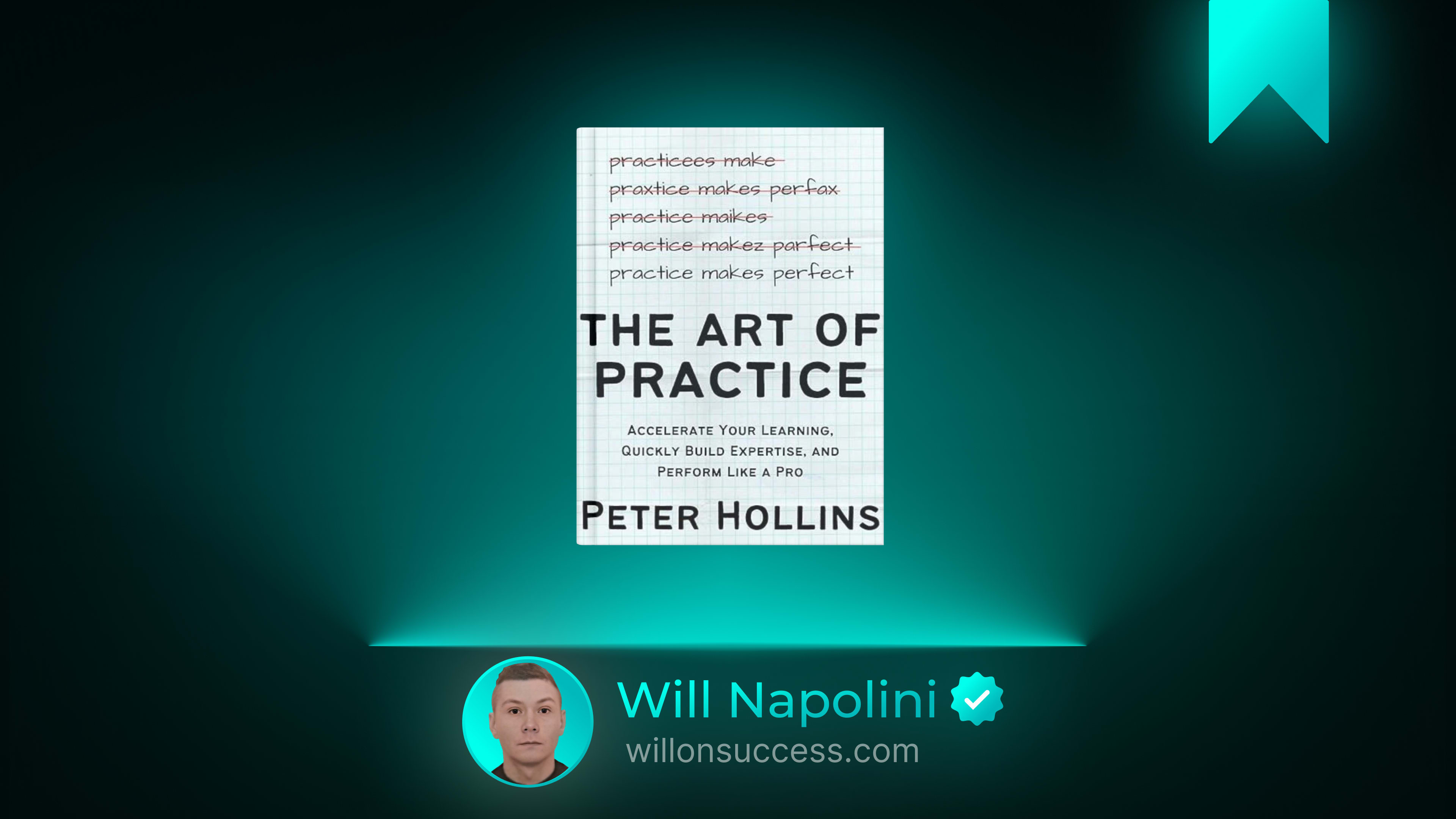
In his book The Art of Practice, Peter Hollins dismantles the myth that simply doing something over and over again makes you better at it. He draws on the cognitive science of learning to reveal a much more demanding, but infinitely more rewarding, reality. True practice is not a passive accumulation of hours. It is a highly specific, cognitively intense process of targeting your weaknesses, seeking immediate feedback, and pushing just beyond the edge of your current abilities.
Mastery is not the absence of struggle. It is the result of struggling with purpose.
The Illusion of the Commuter
To understand why we get stuck, consider a simple, everyday example.
Imagine a person who has driven the same route to work every day for fifteen years. They know every pothole, every traffic light, and every shortcut. Now, imagine a driving instructor who has only been teaching for one year.
If you asked the commuter to perform a precision parallel park on a steep, icy hill while explaining the exact mechanical function of the clutch, they would likely fail. The driving instructor, however, would do it flawlessly.
Why? Because the commuter has not been practicing driving for fifteen years. They learned how to drive in the first six months, and for the next fourteen and a half years, they have merely been commuting. They are on autopilot. Their brain has automated the task to save energy.
This is what Hollins calls “naive practice.” It is the assumption that repetition equals improvement. But when you operate on autopilot, you are no longer learning. You are just maintaining.
If you want to change your life, you have to step out of the commuter’s seat and into the instructor’s. You have to learn the art of deliberate practice.
Designing the Crucible: The Mechanics of Deliberate Practice
Hollins builds his framework on a foundational truth: your brain only rewires itself when it encounters friction.
When a task becomes easy, your brain stops building new neural pathways. It has already solved the problem, so it shifts into energy-conservation mode. To force your brain to adapt, you must introduce deliberate, targeted discomfort.
This requires three non-negotiable elements:
1. Intense, Unbroken Focus You cannot improve while distracted. Deliberate practice demands your complete cognitive presence. It is not about how many hours you log; it is about the density of your attention. Twenty minutes of deep, unbroken focus will outperform three hours of half-hearted, distracted repetition every single time.
2. Micro-Targeting Amateurs practice the whole thing. Professionals isolate the broken piece. If you are learning a new language and keep stumbling over a specific verb tense, you do not read the whole chapter again. You isolate that verb tense. You write it out. You say it aloud. You drill it until it loses its power over you. You must identify the exact micro-skill that is holding you back and attack it directly.
3. Immediate Feedback You cannot correct a course if you do not know you are drifting. Practice without feedback is just guessing. You need a mechanism that tells you, in real-time, whether you are doing it right or wrong. This could be a coach, a software program that grades your code, a recording of your own voice, or a strict set of metrics. Without feedback, you are just reinforcing your own mistakes.
Spacing, Interleaving, and the Architecture of Memory
Understanding how to practice in the moment is only half the battle. You also need to understand how your brain stores what you have practiced.
Hollins highlights a fascinating quirk in human cognition: the way we feel about our learning is often the exact opposite of what is actually happening in our brains.
When we cram for an exam or practice a skill for six hours straight, we feel a sense of immediate fluency. We feel confident. But this is the “illusion of competence.” Because the information is currently in our short-term working memory, we trick ourselves into believing it is permanently stored. By the next day, it is gone.
To build lasting skill, Hollins advocates for two counterintuitive strategies:
Spaced Repetition Instead of practicing for five hours on Monday, practice for one hour a day for five days. The slight forgetting that happens between sessions forces your brain to work harder to retrieve the information. That retrieval effort is what cements the memory. You are not just learning the material; you are training your brain to access it under pressure.
Interleaving When we learn, we naturally want to block our practice. We want to master topic A, then move to topic B, then topic C. Hollins explains that mixing these topics together—interleaving them—creates a much stronger foundation. By constantly shifting contexts, your brain is forced to continually reload different motor programs and cognitive rules. It feels messier. It feels harder. But it creates a flexible, robust skill set that holds up in the real world.
Think of your mind like a river. A river does not carve a canyon by flowing smoothly over flat, unbroken rock. It carves the canyon by finding the cracks, applying relentless pressure, and shifting its course to exploit every weakness in the stone. Your practice must be like that river.
Embracing the Friction: The Emotional Reality of Getting Better
Here is the part of the book that I find most vital, yet it is the part most people ignore. We spend so much time talking about the mechanics of learning that we forget the emotional toll it takes.
Deliberate practice is exhausting. It is frustrating. It is deeply uncomfortable.
When you are truly practicing, you are operating at the very edge of your ability. You are failing frequently. You are acutely aware of your own inadequacies. Because of this, many people mistake the feeling of frustration for a sign that they are not cut out for the task. They feel the friction and assume they are doing something wrong.
I have learned that frustration is not a sign of failure. It is the physical sensation of your brain rewiring itself.
When you sit down to practice and feel that familiar wave of irritation, that desire to check your phone, that urge to quit, you must reframe that feeling. That friction is the work. If your practice session feels easy, smooth, and enjoyable, you are likely just performing what you already know. You are commuting, not practicing.
Character is built in that space of discomfort. The ability to sit with the frustration of not being good at something yet, and to keep pushing forward anyway, is the true separator between those who achieve mastery and those who merely dabble.
Why This Changes Everything in Your Daily Life
You might be thinking that this level of intense practice is only for concert pianists, elite athletes, or chess grandmasters. But the principles in The Art of Practice apply to every domain of a modern life.
In Your Career: If you want to move up, you cannot just do your current job for ten years and expect a promotion. You must identify the micro-skills required for the next level—perhaps public speaking, data analysis, or conflict resolution—and practice them deliberately outside of your normal duties.
In Your Relationships: We often assume that being a good partner or parent is just a matter of time spent together. But if you are repeating the same arguments year after year, you are just commuting. Deliberate practice in relationships means isolating the specific behavior you want to change—like learning to pause for three seconds before responding when you feel defensive—and drilling that specific pause until it becomes your new default.
In Your Personal Growth: If you are trying to build a new habit, like reading more or exercising, naive practice looks like buying a book and leaving it on the nightstand. Deliberate practice looks like designing your environment to remove friction, tracking your exact metrics, and adjusting your system when you fail.
When you apply these principles, you stop being a passive participant in your own development. You become the architect of your own capability.
How to Actually Apply This Tomorrow
Understanding the theory is not enough. Action before intention. Here is how you can translate Hollins’ concepts into your life starting today.
1. Deconstruct the Skill Take the one thing you most want to improve. Break it down into its smallest possible components. If you want to be a better writer, do not just “practice writing.” Isolate the specific micro-skill: writing stronger opening sentences, or using more active verbs, or structuring a logical argument.
2. Set a Friction Timer Commit to practicing that micro-skill for just 20 minutes. During this time, eliminate all distractions. Put your phone in another room. Close your browser tabs. Tell yourself that for these 20 minutes, your only job is to engage with the friction.
3. Build a Feedback Loop Decide right now how you will measure your performance. If you are practicing a physical skill, record yourself on video. If you are practicing a cognitive skill, use a quiz, a checklist, or ask a knowledgeable peer to review your work. You must know if you are doing it right.
4. Schedule the Spacing Do not try to do this for three hours on Saturday. Schedule four 20-minute sessions spread across the week. Let your brain do the quiet work of consolidation in the background.
Who Should Read This Book
The Art of Practice is an essential read for anyone who feels stuck in their learning journey. If you are a student, a professional looking to upskill, an artist, or a lifelong learner who is frustrated by a lack of progress, this book will fundamentally change how you approach your goals. It is highly practical, deeply grounded in cognitive science, and refreshingly honest about how hard real learning actually is.
However, if you are looking for a “life hack” that will allow you to master a complex skill in a weekend without breaking a sweat, this book will disappoint you. Hollins does not offer shortcuts. He offers a better, more reliable road. It is a road that requires effort, but it is a road that actually leads somewhere.
One Small Step
The canyon is carved one drop at a time. You do not need to overhaul your entire life today. You just need to change how you practice.
Right now, identify one micro-skill you want to improve. Write it down. Break it into a task so small that it feels almost trivial. Set a timer for fifteen minutes. Put your phone out of reach, and practice that single micro-skill with total, unbroken focus.
When the timer goes off, stop. Notice how you feel. Notice the friction.
You do not need more motivation. You need a system that makes the right action easier, and the courage to embrace the discomfort of getting better. Start small. Stay consistent. Let the friction do its work.